

Gemini, Google’s artificial intelligence (AI) assistant, can now phone businesses for its users in the U.S. On Friday, November 20, 2026, Google Research explained on its blog how the calls work. They come from Google Duplex, the AI Google introduced in 2018 to make phone calls in a natural-sounding voice. Duplex now works inside Tasks, a mode of the Gemini app that carries out chores.
Google began rolling Tasks out for free on November 17 in six countries: the U.S., Japan, South Korea, Canada, Australia and India. Calling works only in the U.S. for now. Tasks is not offered in the European Economic Area (EEA), Switzerland or the U.K., even with a paid subscription. The EEA includes every European Union country.
Google says every call opens by announcing that an automated system from Google is calling. Businesses can turn the calls off in the settings of their Google Business Profile, the listing that shows a business in Google Search and Maps. Google also reuses what it learns on these calls in Google Maps.
The news lands the same week as another expansion of Google’s AI agents, which act on a user’s behalf. Since November 19, Gemini can also click and type in Mac apps for paying subscribers in the U.S.
The launch: a dealership appointment in under five minutes
Josh Woodward, the Google vice president in charge of the Gemini app, introduced the calls on November 17 on The Keyword, Google’s official blog. Google said Tasks was rolling out free “for hundreds of millions of people” in six countries. It runs on Gemini 4 Hydrogen, the AI model Google also put behind AI Mode in Google Search on November 12. Some advanced features roll out in the U.S. first, and according to Android Central, calling businesses is one of them.
According to the Gemini help center, Google had been testing the mode with its subscribers since May under the name Spark. It was then renamed Task, the name of the toggle that turns it on in the app.
In Woodward’s example, the check-engine light came on in his minivan. He asked Gemini to call the two nearest dealerships for an appointment early on a Friday morning. Gemini found them on Google Maps, called both at once and booked a slot at the one that takes appointments instead of walk-ins only. It picked a time when his Google Calendar was free and added the appointment “in less than five minutes,” he wrote.
“On the dealership’s end, Gemini disclosed right away that it’s an AI,” Woodward wrote. He added that businesses can opt out whenever they want, and that Gemini won’t share his payment or private account details unless he says so. A footnote to the post says calling through Gemini is not currently available in five states: Indiana, Louisiana, Minnesota, Montana and Nebraska.
A technology Google first showed in 2018
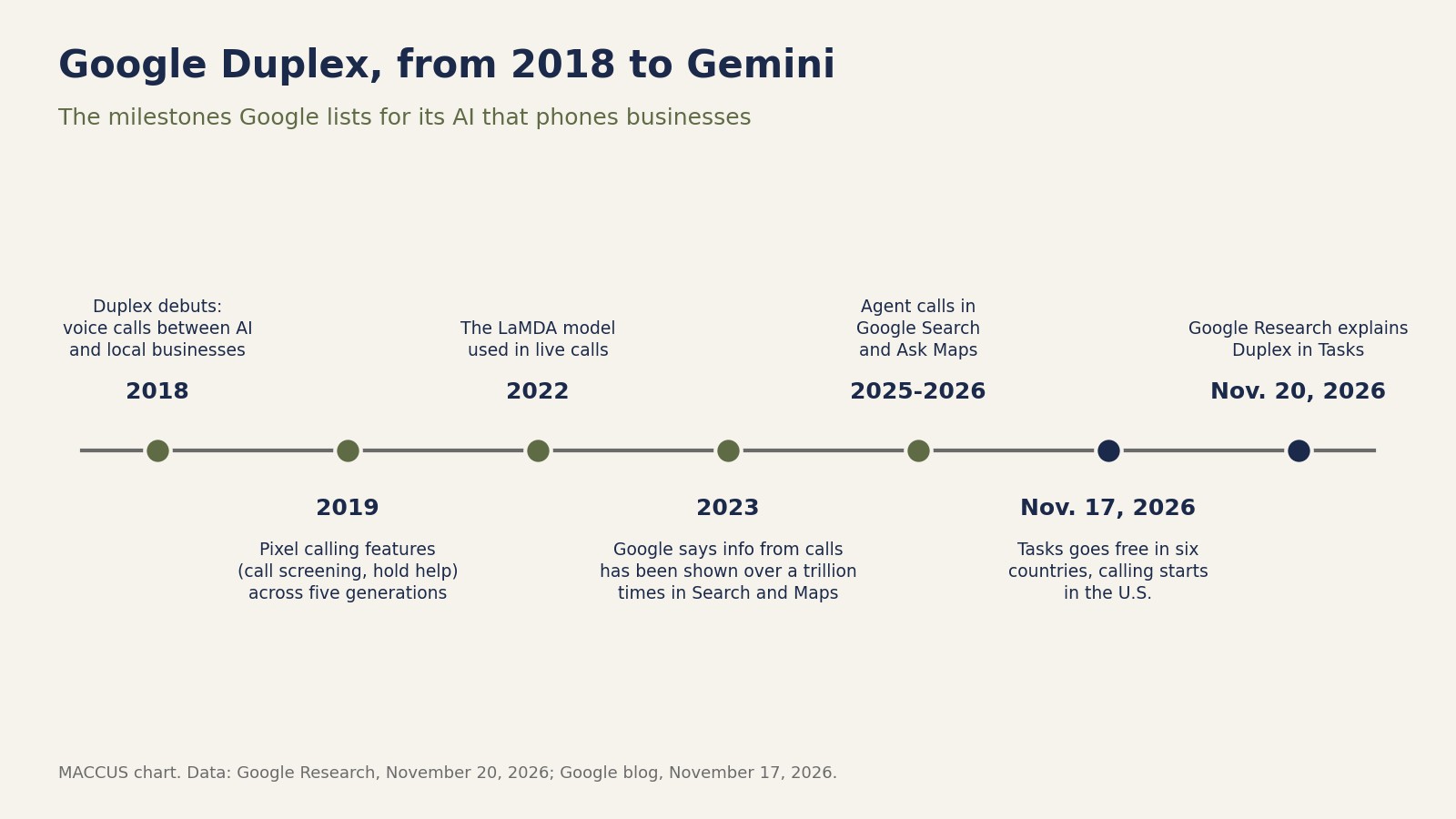
Since 2018, Duplex has had other jobs. During the COVID-19 pandemic, when business hours kept changing, it checked business details automatically to keep listings accurate. Its models have also run on Google’s Pixel phones since 2019, for example to screen unknown callers.
In 2025 and 2026, AI agent calls came to Google Search and to the Ask Maps feature in Google Maps. They check quotes, product availability and open appointment slots, from pet grooming to auto repair.
The Google Research post is signed by Yossi Matias, head of Google Research; Yaniv Leviathan, a Google Fellow there; and Janet Zhou, a group product manager at Google Maps. It describes three technical generations of Duplex.
Google started work on the first generation before large language models, the technology behind chatbots such as Gemini. That was even before the transformer was invented, the design those models are built on today. Early Duplex was limited to narrow domains. It used recurrent neural networks, an older kind of AI model, trained on anonymized phone conversations specific to each type of task.
In 2022, the second generation put LaMDA, one of Google’s early large language models, into live calls. Because those models were less predictable and sometimes slower than today’s, Google paired them with fixed rules and “strict policy guardrails.”
The third generation takes a request written in plain language. Gemini handles understanding, planning and conversation. For example, it can fit a car service around calendar conflicts and adjust when a receptionist suggests another time.
The hard parts of a live phone call
A pause half a second too long sounds like a dropped call, and a reply that comes too soon makes the two voices overlap. Calls also run over compressed phone lines, against kitchen clatter, espresso machines or street noise.
Among the hurdles, Google lists replying in under a second in noisy settings. It says it tuned the system to reply at a natural conversational pace, with dedicated models for background noise and pauses. It publishes no measured response time.
Duplex also draws on past calls. Before dialing, it estimates whether a request is likely to work, for example with a business that does not take reservations for large groups on weekends. During the call, that history helps it read a polite, indirect refusal.
A voice that says it is automated
According to Google, every call opens by stating that it is an AI agent, “specifically, an automated system calling from Google.” The business has nothing to install or set up. Whoever answers treats the call like one from any customer.
Google’s help page for Business Profile describes the automated calls Google places for customers, without naming Gemini. “These calls are monitored and recorded for quality assurance,” the page says. Its examples are requests made through Search or Maps: booking appointments, checking restaurant wait times, or confirming the price and availability of a product or service. That feature is free for businesses and customers alike.
Google says it limits repeat calls for the same information and avoids calling late at night or early in the morning. The page also warns that Google will never ask for payment, credit card details or account passwords.
How a business can opt out
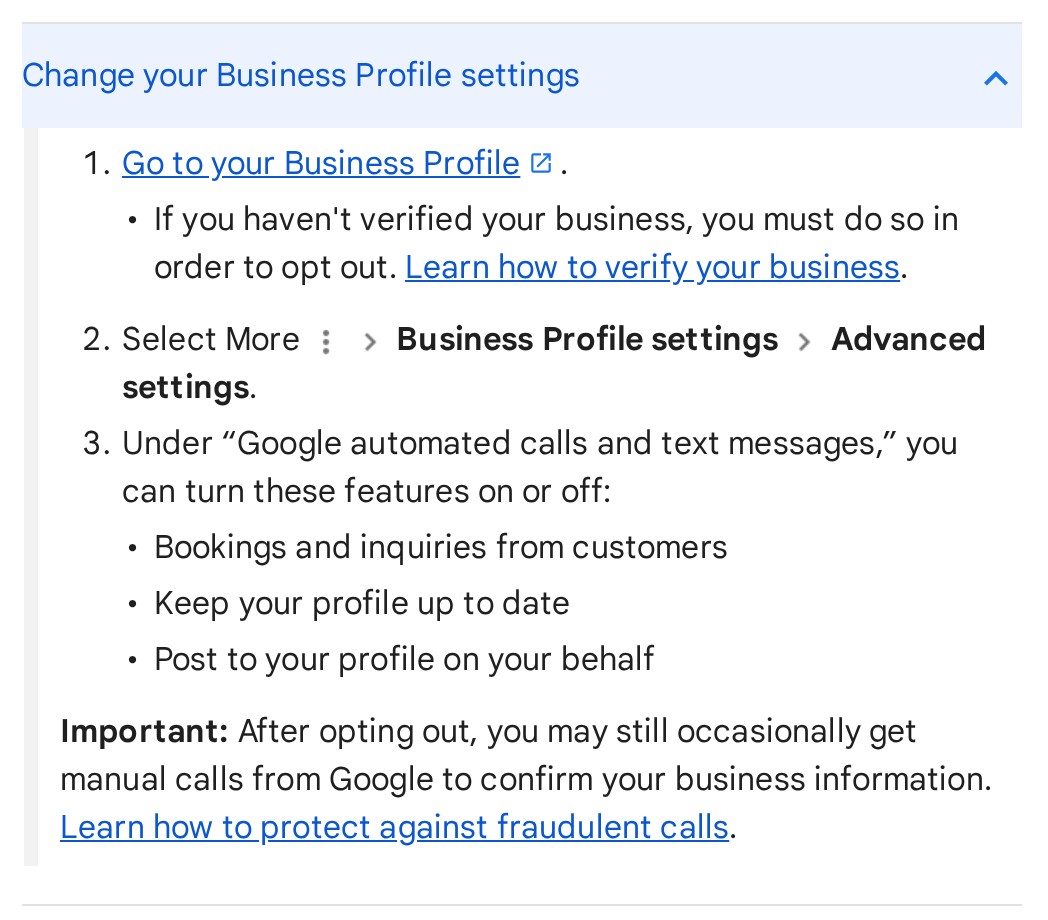
The calls are on by default. To stop them, a business can say so during a call, with a line such as “Please stop calling my business,” according to the help page. It can also turn them off in its profile settings, as long as the profile is verified.
The path Google gives is More, then Business Profile settings, then Advanced settings. Under “Google automated calls and text messages,” three switches appear: “Bookings and inquiries from customers,” “Keep your profile up to date” and “Post to your profile on your behalf.” Google warns that after opting out, a business may still occasionally get manual calls from Google to confirm its information.
The answers end up in Google Maps
Google Maps can show details Duplex gathers, such as happy hour specials, patio seating, pet-friendliness, a parking tip or a weekly trivia night. “Details gathered on one call can answer many later questions, so a business isn’t asked the same thing over and over,” the Google Research post says.
The post repeats a figure Google shared in 2023: business information from Duplex calls had been shown in Search and Maps over one trillion times. That figure counts displays of information. Google gives no count of the calls behind it.
The help page adds that Google can post updates to a profile based on these exchanges. The business gets an email each time and can remove the post.
What Google leaves out
Google does not publish how many calls Gemini has placed, how many succeed, or how many finish without a human stepping in. It does not say how many calls a free user can make. The Gemini help page only says that tasks count against usage limits that rise with paid plans, and that up to 15 tasks can run at once. Google gives no timeline for Europe.
The AI disclosure at the start of each call, the opt-out and the promises about payment details are Google’s own descriptions. The post cites no independent measurement. Woodward concedes that tasks can still fail: “While we’ve tested tasks extensively to minimize mistakes, we haven’t eliminated all of them.”
What it means
The change is mostly one of access. Until now, Duplex called businesses within limits Google set, from Search or Maps. In Tasks, a Gemini user in the U.S. can hand it a request written in plain language, in a free app.
Google presents the voice as a tool the agent uses when a business offers no online booking form and no application programming interface (API) to reach it. An API lets software connect to a company’s systems directly. For U.S. businesses, the phone number on a Google Business Profile becomes a way in for agents acting on behalf of customers. The same logic applies on the web: on November 17, Google published a guide asking sites to let its AI agents past their bot filters.
Receiving these calls takes no action, while stopping them takes a request on the phone or a verified profile. Google, for its part, gets fresh details for Maps.
In France, Belgium, Switzerland and Luxembourg, Tasks is not available, even with a subscription. In Canada, the mode is free, but calling works only in the U.S. Google’s help page on automated calls says they are available “only in select regions and languages.” The only country it names is the U.S.
Four things are worth watching: a date for Tasks in the EEA, a first public figure on call volume or success rates, calling beyond the U.S., and the share of businesses that switch the calls off once they start receiving them.
Sources
- How Google Duplex evolved to also call businesses for you in Gemini, Google Research, November 20, 2026
- Put Gemini to work for you, Google, The Keyword, November 17, 2026
- About automated calls and texts from Google to your business, Google Business Profile Help, accessed November 22, 2026
- Manage your tasks & workflows in Gemini Apps, Gemini Apps Help, accessed November 22, 2026
- Google just made its best Gemini agent free: here’s where you can get it, Android Central, November 18, 2026