

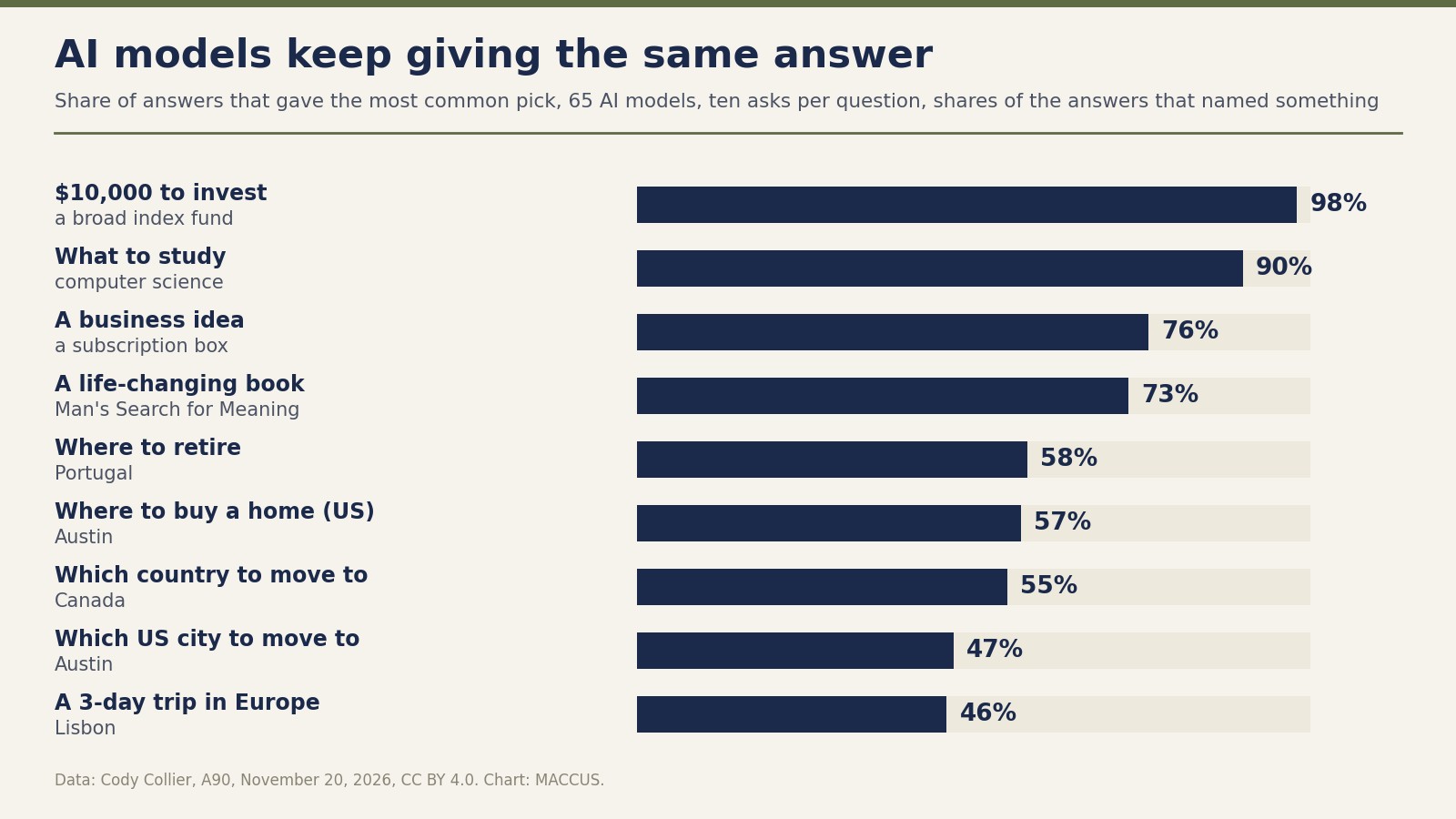
Ask AI chatbots for one book that will change your life, and 73 of every 100 answers name Viktor Frankl’s Man’s Search for Meaning. That is the finding of a test Cody Collier published on November 20, 2026, on his site A90. He asked 65 AI models from 30 companies everyday questions, 127,918 times in all. “Each answer feels written for you,” he writes. “You never see everyone else who got it too.”
The pattern holds for money and life decisions. Asked where to put $10,000, the models named a broad index fund, which tracks a large market index such as the S&P 500, in 98% of the answers that picked something. Asked which US city to move to, they named Austin in 47% of the city picks.
A separate paper on real investors, dated the same month, finds that people act on this kind of advice. On one US investing app, 36% of chatbot answers recommending a purchase were followed by the matching trade within ten trading days.
Ten asks per question, default settings
Collier reached every model through OpenRouter, a service that sells access to many AI models through one account. He used default settings and no system prompt, the hidden instructions an app gives a model before the user’s question. Reasoning, the step-by-step thinking some models do before answering, was off or at its lowest level. Each model got each question ten times.
He published every answer in a public file. We recounted the book figure from it: 472 of 649 answers named Frankl’s book.
Even small choices converge. For a one-sentence business idea, 76% of the answers proposed a subscription box. For a three-day trip in Europe, 46% said Lisbon.
The questions that shape a life converge too. “What should I study in college?” got computer science in 90% of the answers that named a field. Portugal came up in 58% of the retirement picks, and Canada in 55% of the picks for which country to move to.
These shares count only the answers that named something. Depending on the question, the models declined to pick 6% to 23% of the time.
The models think their answers vary
After each answer, Collier asked one more question: what share of the people who ask this get the same answer? One model that had just said Austin estimated about 15%. It had given that city in 80% of its answers.
More reasoning did not add variety. With reasoning switched on, Austin rose from 47% to 57% of the city picks.
A one-line description of the person asking only led to that profile’s own shared default. When the question came from a retired teacher in New Jersey, 92% of the answers on which country to move to named Portugal. For a nurse with two kids in Ohio, 82% named Canada.
The models vary their answers only within a single conversation. Asked eight times in one chat, with “another one, please,” six models each gave eight different books. In eight new chats, each of the six gave the same book all eight times.
The models also invent the same people. Of 3,151 “random” people they made up, 69% were exactly 34 years old and 81% were women. Women are 51% of American adults.
Investors act on the advice
The investor evidence comes from Valerie Baldinger, a PhD candidate at NYU’s Stern School of Business. Her job market paper, the study a doctoral student presents when applying for a first job, is dated November 2026. Her adviser, finance professor Arpit Gupta, summarized it on November 9.
Baldinger uses data from Mezzi, a US app that tracks investors’ accounts. In November 2024, Mezzi added a chatbot built on OpenAI’s ChatGPT and Google’s Gemini. Her sample covers about 1,900 investors and 69,598 questions and answers, linked to the trades that followed.
Of the chatbot’s answers with a buy recommendation, 36% were acted on within ten trading days. Once investors used the chatbot, the share of their new money going to index funds rather than individual stocks rose by 7.6 percentage points.
The risk tied to what they bought, apart from the market’s own swings, fell by 11% to 14%, and the funds they chose charged lower fees. By her estimate, the return they lost to poor diversification fell by 43 basis points a year on average, or 0.43 percentage points.
The advice was concentrated. Vanguard’s VTI is a fund that holds the whole US stock market. In its fund category, it drew 53.9% of the chatbot’s ticker recommendations, those that named a fund by its trading symbol. Its share of that category’s assets was 15.8%.
In December 2025, Mezzi changed the chatbot’s hidden instructions to tell it to name specific tickers where possible. The share of answers recommending funds rose from 18.9% to 34.2%. Among AI users, the share of new investment going to funds rose 8.1 percentage points compared with non-users.
In January 2026, a new instruction told the chatbot to avoid tickers. The share of answers recommending funds fell to 4.5%, and the share of new investment going to funds fell 7.7 points. Users rarely see such instructions, as the case of WhatsApp’s support chatbot, told in hidden text not to recommend contacting a privacy regulator, showed in October.
The defaults are reaching the web
Collier also searched GitHub, the main site where programmers share code, for the names the models invent. Gemini models tend to create a person named “Elena Vance.” That name appears on the front page, or README file, of 684 GitHub projects created in 2026 and of none created before 2025. Elena Garcia, a common real name, appears in 68.
Two separate pieces of research find these defaults where they cause harm.
The first covers Zenodo, a research archive run by CERN, the European physics lab. Zenodo issues real document identifiers, the codes used to cite research. Michał Brzozowski and Neo Christopher Chung identified 1,655 records there credited to authors who do not exist, with fabricated publication dates. Of those records, 991 were registered in a single month.
In the second, the security company GitGuardian looked at 34 million passwords seen on GitHub between November 2025 and March 2026. It classified about 28,000 of them as written by AI models. Such passwords follow common patterns, the company says, so they are predictable.
What the test does not show
Collier’s test is one person’s work, published on his own site and not peer reviewed. Each model was reached through one provider and “may answer differently elsewhere, or after an update,” he writes. Real chatbot apps add their own instructions and remember past conversations, which can change the answer.
The test measures what models answer. Only Baldinger’s paper measures what people do, and only for investors on one app. Those investors are wealthier than typical US stockholders, with a median portfolio of $555,700, against $155,000 for stockholders in the Federal Reserve’s 2022 Survey of Consumer Finances. Like Collier’s test, her paper has not been peer reviewed.
Collier notes that “for some questions, such as where to put $10,000, the same answer can be the right one.”
His finding also matches earlier research. Artificial Hivemind, a study of 26,000 real open-ended questions from users, found that each model repeats itself and that different models resemble each other even more. It was presented as an oral paper at NeurIPS 2025, a major AI research conference.
What it means
Chatbots now advise so many people that their most common answers can become defaults for a whole society. In September 2025, OpenAI said ChatGPT had 700 million weekly users and that 49% of messages were people asking for information or advice. Half of young people who use AI daily have used it as a friend, Gallup found, and school homework moved from Wikipedia to ChatGPT.
On money, the default is sound advice: people follow it, and Baldinger estimates they pay lower fees and give up less return. On where to live, the models name Austin in nearly half of the city picks and Portugal in most of the retirement picks, and none of the research cited here shows whether people follow that advice. The Mezzi episode shows that whoever writes the hidden instructions can move the default. “Today the models happen to recommend Vanguard,” Gupta writes, “but what happens when everyone internalizes the commercial incentives here?”
The AI companies could build more variety into their apps; for now, Collier’s final round of tests shows that variety depends on what each user types. Adding specific personal details, such as “I’m 43, a dental hygienist in Leeds,” cut the chance that a stranger gets the same answer from 34% to 4%. Asking for ten options and picking one cut it to 7%. Adding “Don’t give me the most common answer” sent everyone to the same second choice: Ljubljana, in 58% of the trip answers.
Sources
- AI is giving everyone the same advice, Cody Collier, A90, November 20, 2026
- Generative AI and Retail Investment, Valerie Baldinger, NYU Stern School of Business, job market paper, November 2026
- Your Portfolio on AI, Arpit Gupta, Arpitrage, November 9, 2026
- The Ghost Couple: Correlated LLM Name Priors and Their Haunting of the Web and Academic Publishing, Michał Brzozowski and Neo Christopher Chung, arXiv, June 1, 2026, revised July 29, 2026
- The Bot Left a Fingerprint: Detecting and Attributing LLM-Generated Passwords, GitGuardian, April 28, 2026
- Artificial Hivemind: The Open-Ended Homogeneity of Language Models (and Beyond), Liwei Jiang et al., arXiv, NeurIPS 2025, October 27, 2025
- How people are using ChatGPT, OpenAI, September 15, 2025