The Chinese AI company MiniMax says an unreleased AI model recovered 94 secret keys in a public code-breaking challenge. Nobody had published a solution for 55 of them. The company posted the results on November 20, 2026, and says the model beat earlier records in that challenge, two of them set in August and September.
The model, MiniMax’s Internal Model (MIM), ran as an autonomous agent system, according to the company. It also attacked old competition entries and peer-reviewed designs.
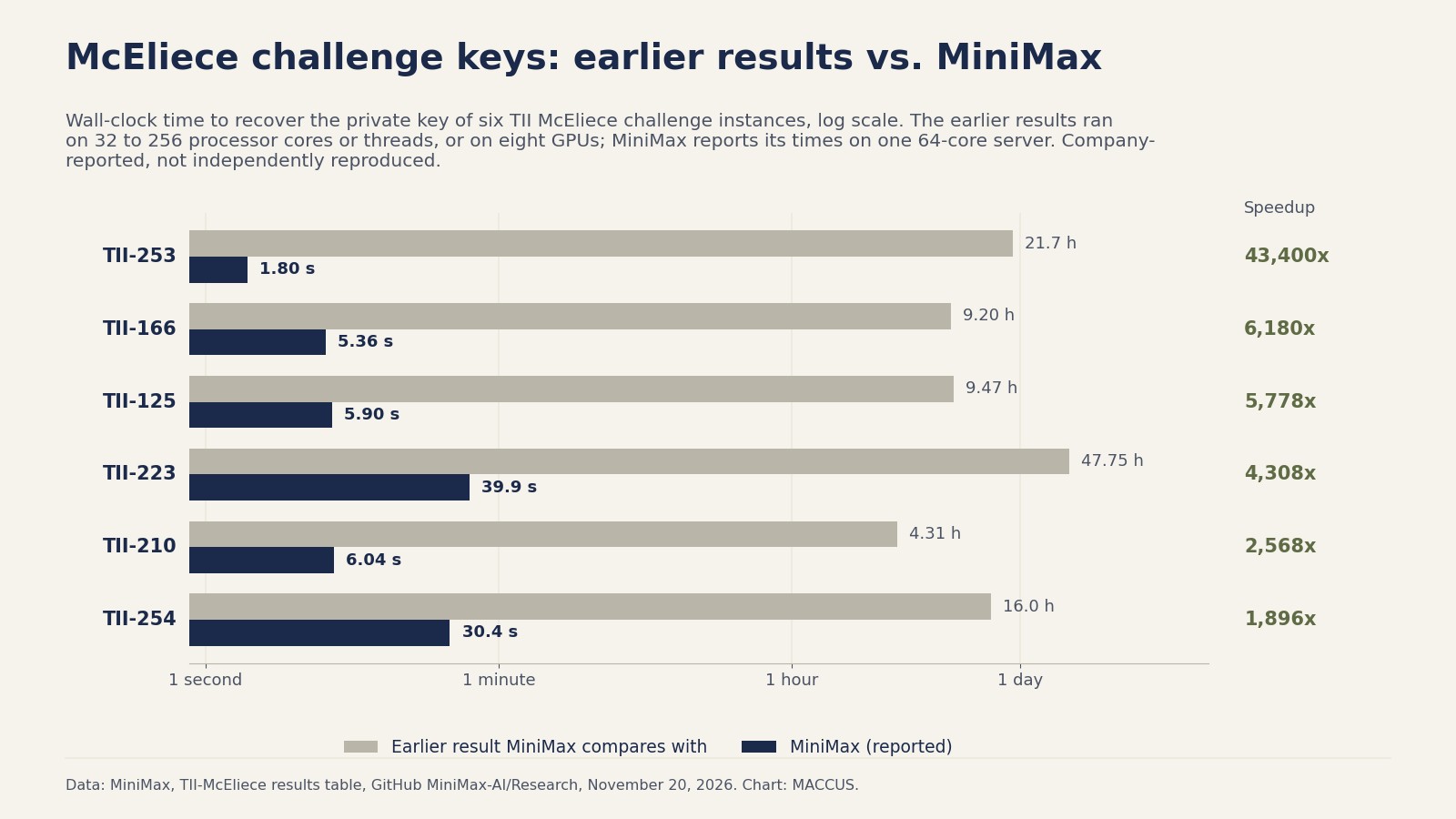
The figures are MiniMax’s own, and we found no outside team that has rerun them yet. A researcher at the AI company Anthropic first recovered one of the keys in August, in a run MiniMax’s paper puts at 21.7 hours. MiniMax’s code took 1.80 seconds, a 43,400-fold cut in wall-clock time, according to the company’s GitHub repository.
From a July benchmark to September records
The release ends four fast months for AI in cryptanalysis, the work of finding ways to break encryption. The field makes a clean test for AI because the result is easy to check. MiniMax’s post says: “The script either recovers the target secret or it does not, leaving zero room for hallucination.”
On July 20, eight researchers, including Nicholas Carlini and Florian Tramèr, posted CryptanalysisBench, a benchmark of 191 code-breaking tasks. Most come from four competitions run by NIST, the US standards agency. The five frontier, or leading-edge, AI models tested broke 65% to 86% of the schemes with known attacks.
They also broke 6 to 12 full-strength schemes that had no known practical attack. The authors called this “an early snapshot of a fast-moving frontier that may soon match, and in places exceed, the published state of the art.”
On July 28, Anthropic reported that its Claude Mythos Preview model, working with one researcher, had improved the best-known attack on HAWK. HAWK was a digital signature scheme, a way to prove who signed a message. It was in the third round of NIST’s search for signatures that resist quantum computers.
The work took about 60 hours and about $100,000 in model usage fees. For the smallest version, HAWK-256, the expected cost of recovering a key fell from 2⁶⁴ operations to 2³⁸. Each step down in the exponent halves the work.
The paper behind it, by Zygimantas Straznickas and Stephen A. Weis of Anthropic, describes how to recover a HAWK-256 key “end-to-end in a few hours on a single server”. On July 29, HAWK’s designers withdrew it from the NIST process. “Hawk is insecure and should not be used,” their site now says.
Records then fell in a public code-breaking contest, the McEliece challenges of the Technology Innovation Institute (TII). On August 19, Anthropic’s Weis recovered the key of instance 253, “a toy-sized code that had not been solved”. On September 8, Markku-Juhani Saarinen of Tampere University solved instance 254, according to his results repository.
AI is also finding more flaws in ordinary software. On November 4, OpenAI said an unreleased model had found 948 flaws in the Linux kernel, the core of the Linux operating system. AI-driven hunting has helped push the number of software flaws published in 2026 past 100,000.
The McEliece challenge: 55 first solutions
McEliece is an encryption system from 1978, built on error-correcting codes, the math devices use to fix garbled data. Its modern version, Classic McEliece, was a finalist in NIST’s post-quantum process, the search for encryption that resists quantum computers.
TII’s challenges use the same kind of code at smaller sizes. Each challenge, or instance, is a public key, the openly shared half of a key pair. Solving it means recovering the matching private key, the secret half.
The key-recovery track has 206 instances. The 36 easiest were solved during the initial competition. Of the 170 harder ones, 41 had been solved across eight public papers and code repositories, MiniMax’s paper says.
MiniMax says its method recovered 94 keys: 55 first solutions and 39 faster re-solves of known ones, “with all 94 keys verified by TII’s official SageMath checker.” If that holds, 96 of the 170 harder instances now have a published solution.
The most expensive run, on instance 250, took 9.2 hours on a computer cluster and used 66,722 core-hours (a core-hour is one processor core running for one hour).
The speedups compare a single 64-core MiniMax server with earlier records. For instance 253, Weis needed 21.7 hours on 32 processor threads, or parallel work streams. MiniMax reports 1.80 seconds.
MiniMax’s paper puts the gain at 28,000 times against a faster earlier run on that instance: 14 hours on one GPU, a graphics chip, by researcher Kirill Vedenev.
Two records from a paper at the CRYPTO 2026 conference, 9.20 and 9.47 hours on 72 cores, fell to 5.36 and 5.90 seconds, MiniMax reports. Saarinen’s instance 254, a 16-hour job on up to eight GPUs, took 30.4 seconds on ordinary processors, by MiniMax’s count.
These results do not apply to the full-size system. MiniMax’s paper says Classic McEliece at its standard sizes lies “far outside the feasible regime of this attack”. Weis, writing about his improved attack on the full scheme, put it more bluntly: “None of this is close to practical.”
MiniMax runs an improved HAWK attack on one core
MiniMax’s HAWK result builds on Anthropic’s attack, which it credits. According to MiniMax’s HAWK notes, Anthropic’s demonstration recovered a HAWK-256 key in 3 hours 42 minutes on a 96-core server. MiniMax says its version recovers an equivalent key in 30.9 minutes on one core, about 690 times less computing in total.
MiniMax also says it lowered the security estimates of all three HAWK sizes by 9.3 to 23.7 bits. Each bit removed halves the estimated work. HAWK was already withdrawn in July, so the result changes no deployment plan.
Attacks on older designs and a contest winner
The rest of the release targets designs that had no known practical attack. Two are hash functions submitted to the SHA-3 competition. A hash function turns any input into a short fingerprint.
MiniMax says MIM found the first practical collisions, two inputs with the same output, for Waterfall-256. For Blender-256, it reports collisions on the complete, full-round design. Each took seconds or less on one core.
On LOCKER, a post-quantum candidate, the company says the model shrank the attack’s matrix from 42 petabytes to 58 megabytes and recovered the shared secret in 2 seconds.
MiniMax also reports more than a dozen unreported bugs in reference code, the code published with a scheme. In the DRS signature scheme, a typo, “&” where “&&” belonged, let the model forge signatures from the public key alone.
Three targets came from peer review. COLM, a winner of the CAESAR competition for authenticated encryption, was “selected after five years of public review”. MiniMax says it forged a valid ciphertext, an encrypted message COLM accepts as genuine, with two encryption queries.
The company says it recovered the full secret key of SBC-VOLE, a signature scheme presented at the ASIACRYPT 2025 conference, from one known signature in 0.06 seconds. ARADI is a cipher the US National Security Agency published in 2024. Ciphers scramble data in repeated rounds, and MiniMax says it pushed practical key recovery from 5 rounds to 8.
The limits of the evidence
Every result is self-reported. MiniMax’s repository says the manuscripts “may still contain minor bugs or typos and are not yet intended as polished academic papers.” The McEliece paper says its results were “initially developed through an autonomous agent system,” and that the team “validated the key technical claims.”
The China tech outlet Pandaily wrote on November 21 that “these are the issuer’s findings.” It added that the counts are not evidence of keys taken from 94 live services. It did not rerun the attacks and noted that the speed comparisons depend on the hardware and reference methods chosen.
MiniMax says the work “does not affect deployed cryptographic standards.” Its targets are retired candidates, academic designs and challenge keys far smaller than those of real systems.
The model itself stays private, unlike public MiniMax models such as M3.1 Flash, launched in October. The company says it will give access to qualified researchers and developers who apply.
What it means
Records in cryptanalysis can now fall within a few months, and each published result gives the next lab a target to beat. MiniMax says it beat the McEliece records of August and September by November 20, with new times counted in seconds. Earlier this month, Google DeepMind agents reran a 1024-bit RSA attack in under four days, against about five months for the team that first ran it. RSA is a widely used encryption system.
“The bottleneck shifts from discovering attacks to verifying and assessing them,” MiniMax writes. A script can check a recovered challenge key. Judging whether a new method weakens a real scheme still takes human cryptographers.
Outside researchers can rerun the published code and test the 55 first solutions with TII’s verifier. MiniMax says it told the schemes’ authors in advance; we found no published response from them yet. Saarinen’s repository lists instance 255, the highest-numbered of the original challenges, as still unsolved. MiniMax’s results stop at instance 254.
Sources
- Practical cryptanalysis with MiniMax’s latest Internal Model, MiniMax, November 20, 2026
- Primal-Shortened ISD Key Recovery on Binary Goppa Codes, MiniMax (GitHub), November 20, 2026
- CryptanalysisBench: Can LLMs do Cryptanalysis?, arXiv (Fluri, Shafran, Carlini et al.), July 20, 2026
- Discovering cryptographic weaknesses with Claude, Anthropic, July 28, 2026
- HAWK-n Key Recovery Reduces to SVP in Dimension n/2 + 1, IACR ePrint (Straznickas and Weis), August 6, 2026
- Hawk: a signature scheme inspired by the Lattice Isomorphism Problem, Hawk team, July 29, 2026
- Improving GIJS Key Recovery for Classic McEliece, IACR ePrint (Weis), September 11, 2026
- MiniMax Reports Cryptanalysis Results From an Unreleased Internal Model, Pandaily, November 21, 2026