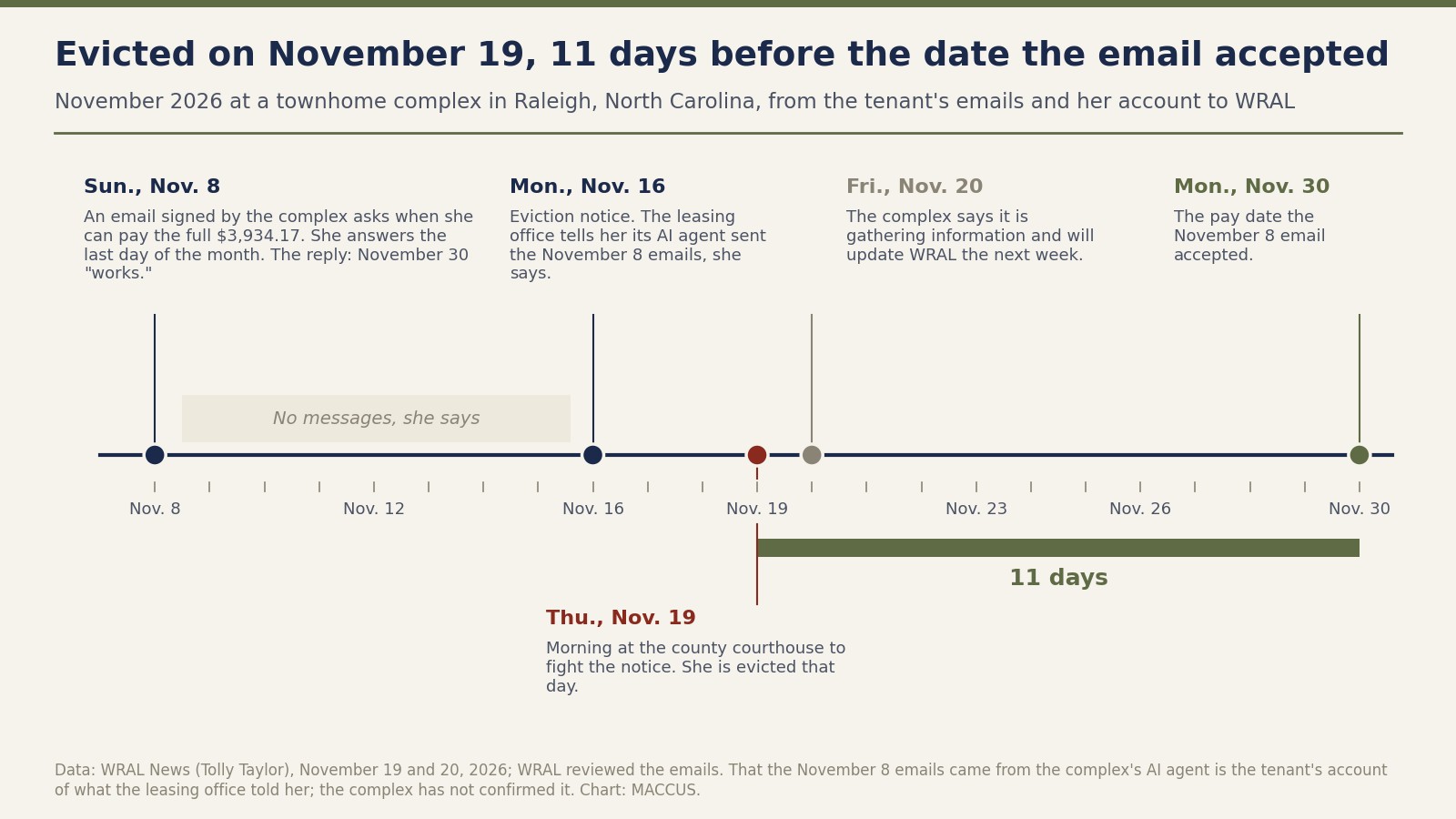
A tenant at an apartment complex in Raleigh, North Carolina, was evicted on Thursday, November 19, 2026. That was 11 days before November 30, the date an email signed by her landlord had accepted for her to pay $3,934.17 in back rent. She says the complex’s leasing office told her the email came from its AI agent, Olivia, and that Olivia had given her the extra time by mistake. The landlord, Colony Townhome Apartments, has not confirmed or denied her account. Its spokesperson told WRAL, the Raleigh TV station that first reported the case, that the complex is “gathering all information related to this matter.”
WRAL reviewed the emails, which the tenant provided. On Sunday, November 8, an email signed “Colony Townhome Apartments” asked her: “What date works for you to pay the full $3,934.17?” She answered that she would like to pay on the last day of the month. The reply came the same day: “Paying on November 30, the last day of the month, works.”
One of the emails also mentioned damage in her home. “I also know you’re dealing with the hole in the downstairs bathroom ceiling,” it said. “I’m sorry you’re dealing with that.”
Earlier in November, the leasing office had taken almost two weeks to fix a severe leak in her bathroom ceiling, she told WRAL. “I thought it was someone from the office because all my information was in there and it mentioned my bathroom,” she said.
Three days from notice to eviction
She says she heard nothing more from the complex until Monday, November 16, when an eviction notice arrived. She called the leasing office. According to her account to WRAL, a leasing agent, one of the office staff, told her that Olivia had sent both November 8 emails. The leasing agent said Olivia had given her the November 30 date by mistake, and that she would be evicted on Thursday.
On Thursday morning, November 19, she went to the Wake County courthouse, the county court for Raleigh, to try to reverse the notice. She was evicted that day, WRAL reported in a follow-up on November 20, and she was staying at a hotel through the weekend. “If you told me till the 30th, I’ll get out by the 30th,” she said in WRAL’s first report. “But give me that. You at least honor that.”
Emails with no AI label
The complex told residents about Olivia in a December 2025 email, WRAL reported. That email had section headings such as “Who is Olivia?” and “Why we’re excited.” It said the AI agent could answer rent and maintenance questions around the clock. In the months that followed, emails from Olivia to residents were clearly marked as coming from it.
The two November 8 emails were not marked that way. They ended with “Best regards, Colony Townhome Apartments” and did not say they had been written by AI. Her landlord blamed the confusion on an AI-powered property management service, she says.
WRAL has not named the company behind Olivia or the owners of the complex. Tech Times UK, a British technology news site, noted on November 21 that the complex had not said publicly whether the agent was allowed to approve later payment dates.
On Friday, November 20, Alfred Leach, a spokesperson for the complex, told WRAL that its owners were looking into the eviction. “Colony Townhome Apartments is gathering all information related to this matter and will be providing an update to WRAL next week,” he said. As of November 22, WRAL had published no update.
A state senator revives his bot bill
The day after WRAL’s first report, a North Carolina state senator spoke out about the case. Sen. Jim Burgin, a Republican from Harnett County, said the November 8 email should have told the tenant it was written by Olivia.
“It’s ridiculous,” he told WRAL. “I think notification is one thing, and I think liability is another.” He added: “Before someone evicted that lady, they should have reviewed their documents.”
Burgin has introduced his “Bot Bill” in each of the past three years. It would require that people be told when they are dealing with an AI. The bill has not advanced in the state legislature, and he plans to try again in the next session.
What the emails do not settle
The AI part of the story rests on the tenant’s account of what a leasing agent told her. The complex has not confirmed that Olivia wrote the November 8 emails, and WRAL’s follow-up calls them “the purported emails.” None of the email lines WRAL quotes says it was written by AI.
The debt itself is not in dispute. “It’s my fault,” the tenant told WRAL about her overdue rent. “I’m taking full responsibility for that. But someone in that office has to take responsibility.”
The email lines WRAL quotes also say nothing about the eviction case, and WRAL has not reported when the landlord filed it. No report so far cites a court record. Tech Times UK wrote that it “remains unclear” whether the emails created an enforceable agreement. The site also called it unclear whether eviction proceedings had already begun when the reply accepted November 30.
AI agents in rental offices, and the rules so far
AI tools like Olivia are spreading through US rental offices. EliseAI, a company that sells AI agents to landlords, published a survey of 350 decision-makers at US apartment companies on July 29, 2026. In it, 58% of apartment operators said they already used AI in leasing.
North Carolina has no rule that such an agent must say it is an AI. The European Union has had such a rule since August 2, 2026, under its AI law, the AI Act. It requires AI systems that talk directly with people to be built so that people know they are dealing with an AI, unless that is obvious.
Some companies, among them banks, are writing their own rules for AI agents. Citi, a US bank, has one for AI agents that customers pick themselves. A Citi spokesperson told TechCrunch, a tech news site, that customers who give outside AI agents access to their accounts “are responsible for activities conducted through those agents.” TechCrunch published the story on November 18.
What it means
Our reading is that over the next five to ten years, small cases like this one will decide who answers for what an AI agent agrees to. So will the contract terms companies write after them. Automated systems already make decisions about ordinary people and act on their behalf: a school AI mistook a bag of chips for a gun, and OpenAI’s agents now pay online for their users. Courts elsewhere have begun ruling on who carries the blame when AI use goes wrong. In Beijing, a worker fired for using AI tools her managers had recommended won her job back in a case made public in October.
One reading holds that the debt caused the eviction: the tenant owed $3,934.17 in back rent and says herself that it was her fault. On this view, one reply in an email thread is far from a signed repayment plan. Any deal for a tenant facing eviction, this side argues, has to come from a person and be in writing. No published record shows whether the emails created an enforceable agreement, or whether the eviction case had begun before they were sent. This side still has to account for the reply itself, which carried the landlord’s name, used details from her file and accepted the date she proposed.
The other reading holds that a company is responsible for what an unlabeled AI says in its name. The emails were signed by the complex, and one mentioned her bathroom ceiling. They lacked the label Olivia’s messages usually carried. A Canadian tribunal applied a broader version of that view in 2024, CBC News reported. British Columbia’s Civil Resolution Tribunal held Air Canada responsible for its chatbot’s wrong answer on bereavement fares, the discounts for travel after a death in the family. It ordered the airline to pay about 812 Canadian dollars in compensation. “It should be obvious to Air Canada that it is responsible for all the information on its website,” tribunal member Christopher Rivers wrote. That decision rested on negligent misrepresentation, the legal term for a careless false statement, and did not enforce the chatbot’s answer as a contract. It binds no court in North Carolina. The next things to watch are the update Colony Townhome Apartments promised WRAL, any court record of the eviction and whether Burgin’s bill advances in the next session.
Sources
- Raleigh woman says company’s AI agent confused her over rent. Now she’s evicted., WRAL News, November 19, 2026
- ‘It’s ridiculous’: Raleigh eviction after AI bot’s promise reinvigorates push for protections, WRAL News, November 20, 2026
- Woman Evicted After Landlord’s AI Assistant Allegedly Said She Could Delay $3,934 Rent Payment, Tech Times UK, November 21, 2026
- EliseAI Unveils New State of AI in Multifamily Report; 85% See Reduced Operating Expenses, EliseAI via GlobeNewswire, July 29, 2026
- Regulation (EU) 2024/1689 laying down harmonised rules on artificial intelligence (Artificial Intelligence Act), Official Journal of the European Union, July 12, 2024
- More banks say customers using AI agents are on their own, even if they get hacked, TechCrunch, November 18, 2026
- Air Canada found liable for chatbot’s bad advice on plane tickets, CBC News, February 15, 2024