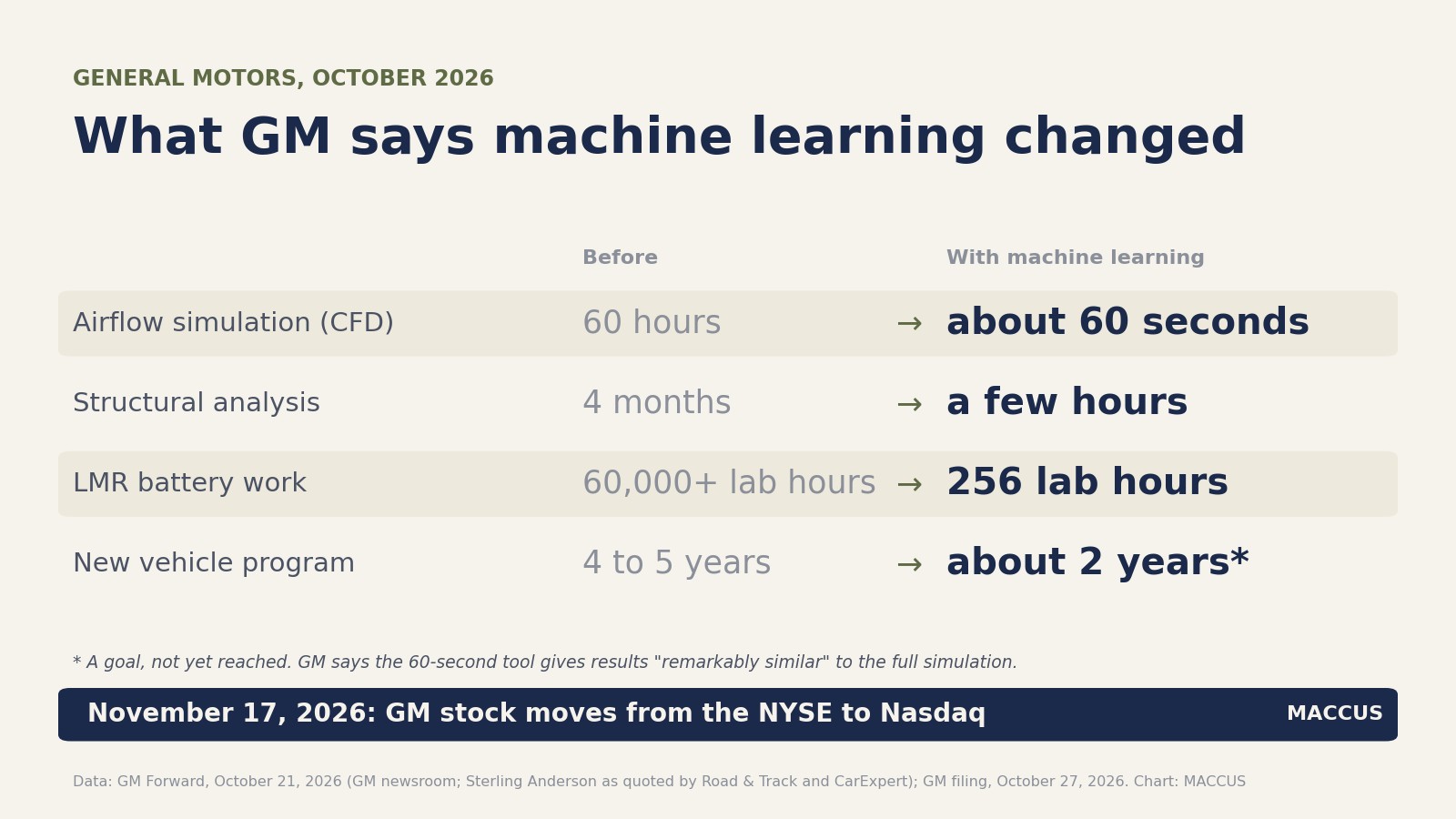

General Motors says one of the slowest steps in car engineering, a computer simulation of air flowing around a vehicle that can run for 60 hours, now has a machine learning stand-in that answers in about 60 seconds. Chief product officer Sterling Anderson gave the figures at GM Forward in New York on October 21, 2026, where GM set a goal of cutting the traditional four-to-five-year development cycle in half. Six days later, on October 27, GM said it will move its stock listing from the New York Stock Exchange to Nasdaq on November 17.
GM’s filing ties the move to its “technology-driven strategy” and does not mention AI. CNBC described the switch as part of the automaker’s effort to “position itself more as a technology-focused company,” a week after an event where GM executives laid out their plans for AI and self-driving cars.
One iteration a day, then one a minute
Anderson walked through the airflow example, as quoted by Road & Track. Designers and engineers have long relied on wind tunnels and on computational fluid dynamics, or CFD, which he called “a virtualized way of assessing how the air effectively flows in and around the vehicle.” Both take time, he said: “Wind tunnels take weeks to schedule. CFD models can take upwards of sixty hours to run. You get effectively one iteration per day.”
GM built a proprietary tool that skips the heavy number crunching. It uses machine learning models trained on GM’s own data “to get results that are remarkably similar to CFD, in about 60 seconds,” Anderson said. “You can imagine what that does for the iteration speed.”
Anderson credits GM’s data for the speed. “Decades of data and experience. Smaller players can build models, but can’t match GM’s data,” he said, according to The Drive. “In the age of AI, data is currency,” he said, as reported by CNBC.
Airflow matters even more on electric cars, where drag eats into range. GM said its coming EVs are expected to be 25% more aerodynamic and 15% lighter, CNBC reported.
From four months to a few hours
By Anderson’s account, the same approach runs through other parts of the job. Structural analysis that sets front-end stiffness and durability used to take four months, Road & Track reported, and the new process takes a few hours.
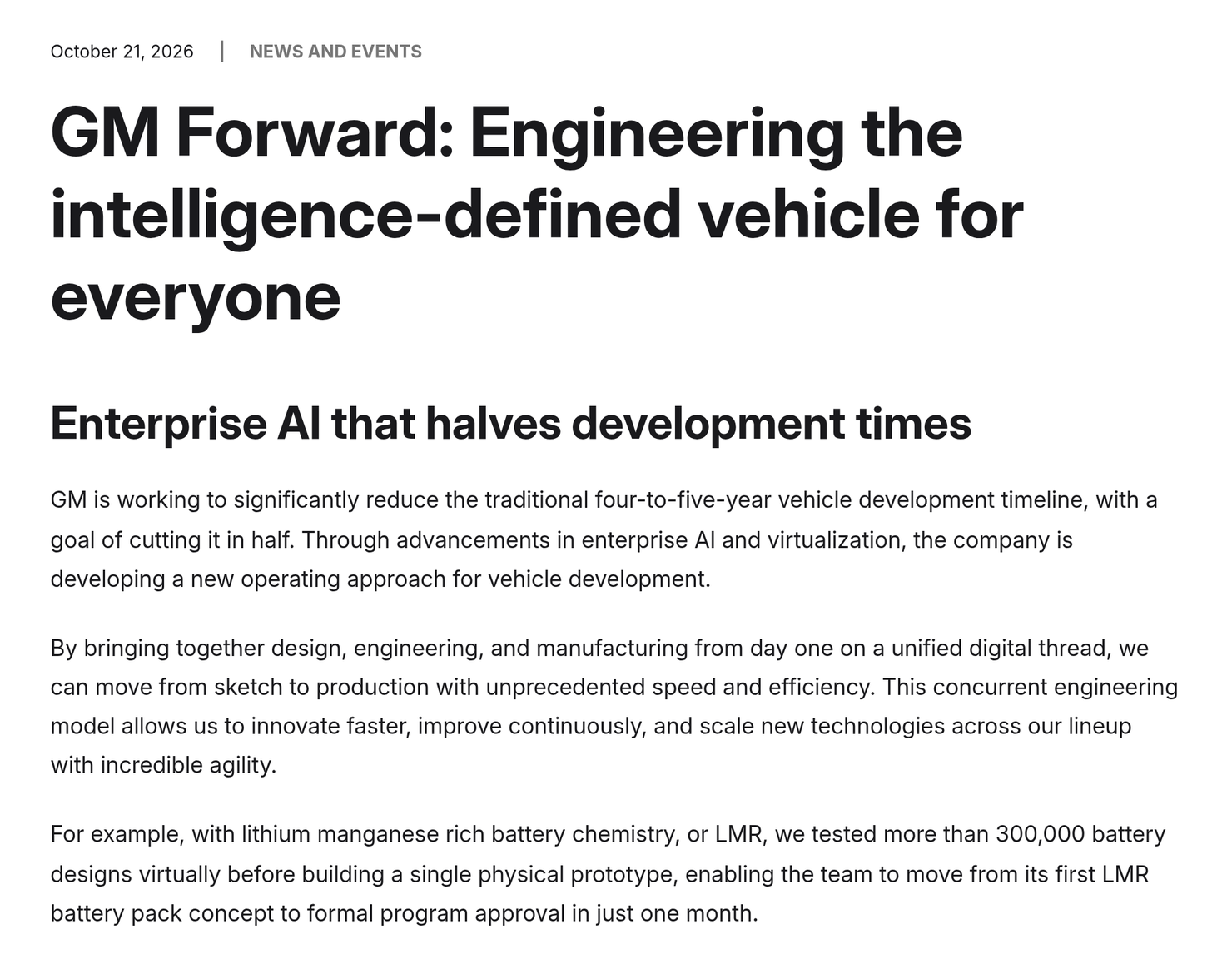
The battery work is the example GM put in writing. GM’s own release says its team tested more than 300,000 designs for its lithium manganese-rich (LMR) battery chemistry virtually before building a single physical prototype, then went from the first pack concept to formal program approval in one month. Anderson put the lab time in figures: work that would normally take more than 60,000 lab hours took 256, using molecular-level modeling and machine learning.
Road & Track added that the new 6.6-liter V-8 in the 2027 Chevrolet Silverado was “reportedly developed in a third of the time” a typical engine needs, at 80% of the usual prototyping cost. Jason Fischer, GM’s executive director of virtual integration, said GM can now compress around 100 days of test data into a single day, according to CarExpert.
Fischer’s example came from the track: the Corvette ZR1 hit 231 mph in top-speed testing, while GM’s virtual model said it should reach about 233. “That very same day that we had a test, we wrote back to our virtual engineering team and our powertrain team, and we respun our calibration,” he said, as quoted by Road & Track. The next day the car hit 233 mph.
A two-year car, as a goal
Put together, GM says, these tools let design, engineering and manufacturing work at the same time instead of handing work down a line. “This sequential process, and iterations between it, on average took the industry four to five years,” Anderson said, according to CarExpert. Fischer went further: “This operating system will allow us to develop vehicles in two years.”
CNBC noted that GM “did not detail a timeline for reaching that goal,” and Road & Track wrote that GM did not explicitly link the new process to any specific upcoming model. The Drive reported that a GM spokesperson said the faster cycle is expected to start in 2028, which by The Drive’s own estimate puts the first cars from it on the road around 2030.
GM’s self-driving plans follow a similar calendar: its release puts autonomous highway driving on the Cadillac Escalade IQ in 2028. Alphabet’s Waymo already reports 95% fewer serious crashes than human drivers for its driverless fleet, based on its own data.
Anderson told CNBC the faster development would also help GM compete with Chinese automakers abroad. Consulting firm AlixPartners believes Chinese automakers bring vehicles to market twice as fast as traditional ones, with 40% to 50% less investment and a 30% cost advantage, CNBC reported. Inside China, buyers purchased 49% fewer gasoline-only cars in September than a year earlier. In the European Union, electric car sales jumped 73% the same month.
A Nasdaq listing from November 17
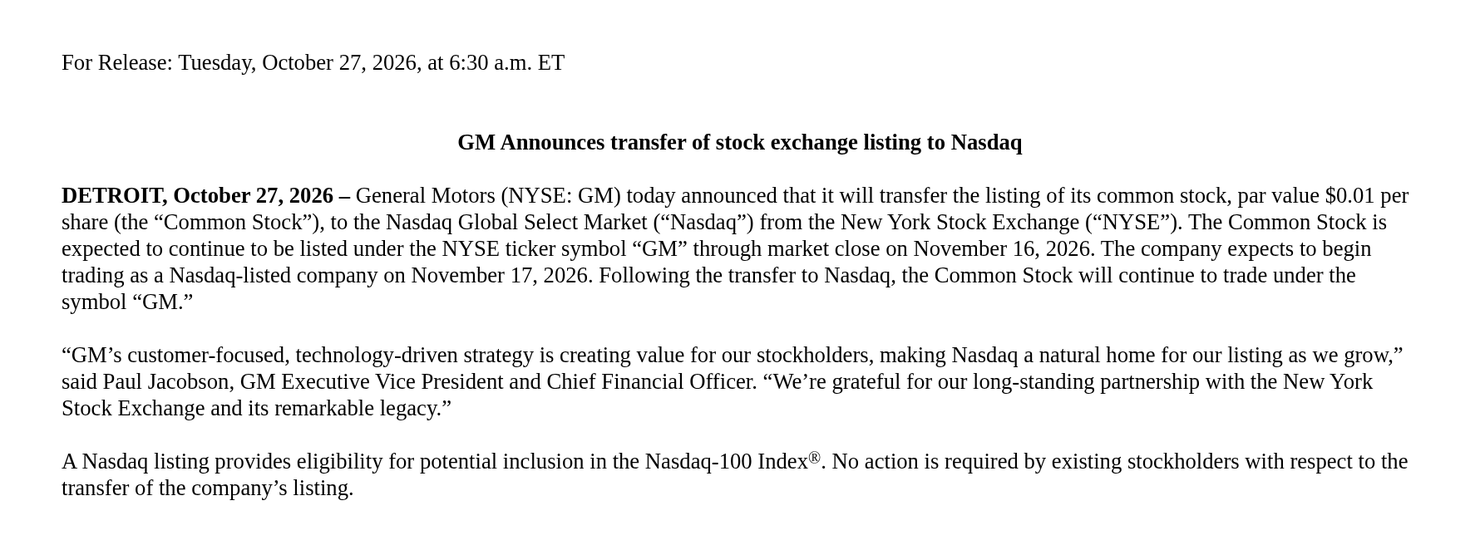
According to GM’s 8-K filing of October 27, the company expects its shares to trade on the NYSE through the close on November 16 and on the Nasdaq Global Select Market from November 17, under the same “GM” ticker. “GM’s customer-focused, technology-driven strategy is creating value for our stockholders, making Nasdaq a natural home for our listing as we grow,” said chief financial officer Paul Jacobson. The move makes GM eligible for inclusion in the Nasdaq-100 index, though inclusion is a separate decision.
GM first listed on the NYSE in 1911 and relisted there in 2010 after its government-backed bankruptcy, CNBC reported. Walmart, DoorDash and Palantir have made the same switch in recent years, and Hilton announced its own move the week before. GM stock closed at $80.54 on October 27, up 5%.
Claims without a benchmark
The 60-second tool approximates a full simulation. Anderson’s own words are “remarkably similar,” and neither GM’s release nor the coverage gives an accuracy figure, a paper or a comparison that outsiders can check. The speed numbers come from Anderson’s remarks at the event, as reported by the press. GM’s written release carries the halving goal, the 300,000 battery designs and the one-month approval; the 60-hour, four-month and 60,000-hour figures are absent from it.
Physical testing still decides, as the Corvette story shows: the virtual model flagged the gap, and a run on the track confirmed the fix. Part of the coverage came from a press trip, and CarExpert disclosed that it traveled to GM Forward as GM’s guest. The Drive reported that CEO Mary Barra dodged a question on whether the savings would reach buyers, and it cited AutoPacific analyst Paul Waatti’s view that at GM the devil has historically been in the execution.
What it means
Much of a car program’s time goes into its engineering loops: draw, simulate, build, test, repeat. In the 60 hours one full airflow simulation can take, a one-minute tool could return about 3,600 approximate answers, and a battery program approved one month after its first pack concept leaves more of the schedule for everything else. GM is betting that the edge goes to whoever owns the deepest archive of engineering data to train on, and Anderson pointed to GM’s more than 100 years in the industry as that advantage.
Halving the cycle would put GM at about the speed AlixPartners already attributes to Chinese automakers. The Nasdaq listing is the investor-facing half of the same pitch: CNBC reads it as an effort by GM to be seen as a technology company.
The first test is a production model that GM says was developed on the two-year cycle, which a GM spokesperson said should start in 2028. The second is whether GM publishes accuracy data for the fast airflow tool. The third is how GM stock trades on Nasdaq after November 17, and whether it joins the Nasdaq-100.
Sources
- GM Forward: Engineering the intelligence-defined vehicle for everyone, General Motors newsroom, October 21, 2026
- GM Announces transfer of stock exchange listing to Nasdaq, General Motors, Form 8-K Exhibit 99.1, SEC EDGAR, October 27, 2026
- Here’s How General Motors Plans to Speed Up Vehicle Development Cycles Using AI, Emmet White, Road & Track, October 21, 2026
- GM Just Laid Out Its Entire Future. It Runs on AI, Eyes-Off Driving, and One Central Computer, Joel Feder, The Drive, October 21, 2026
- GM says AI is halving the time it takes to develop a new car, Paul Maric, CarExpert, October 22, 2026
- GM aims to develop vehicles in as little as two years with AI, software push, Michael Wayland, CNBC, October 21, 2026
- GM will switch to Nasdaq from the NYSE on Nov. 17, Michael Wayland, CNBC, October 27, 2026
Header image: chart by MACCUS from GM Forward figures (GM newsroom; Sterling Anderson as quoted by Road & Track and CarExpert, October 21, 2026) and GM’s Form 8-K exhibit of October 27, 2026