

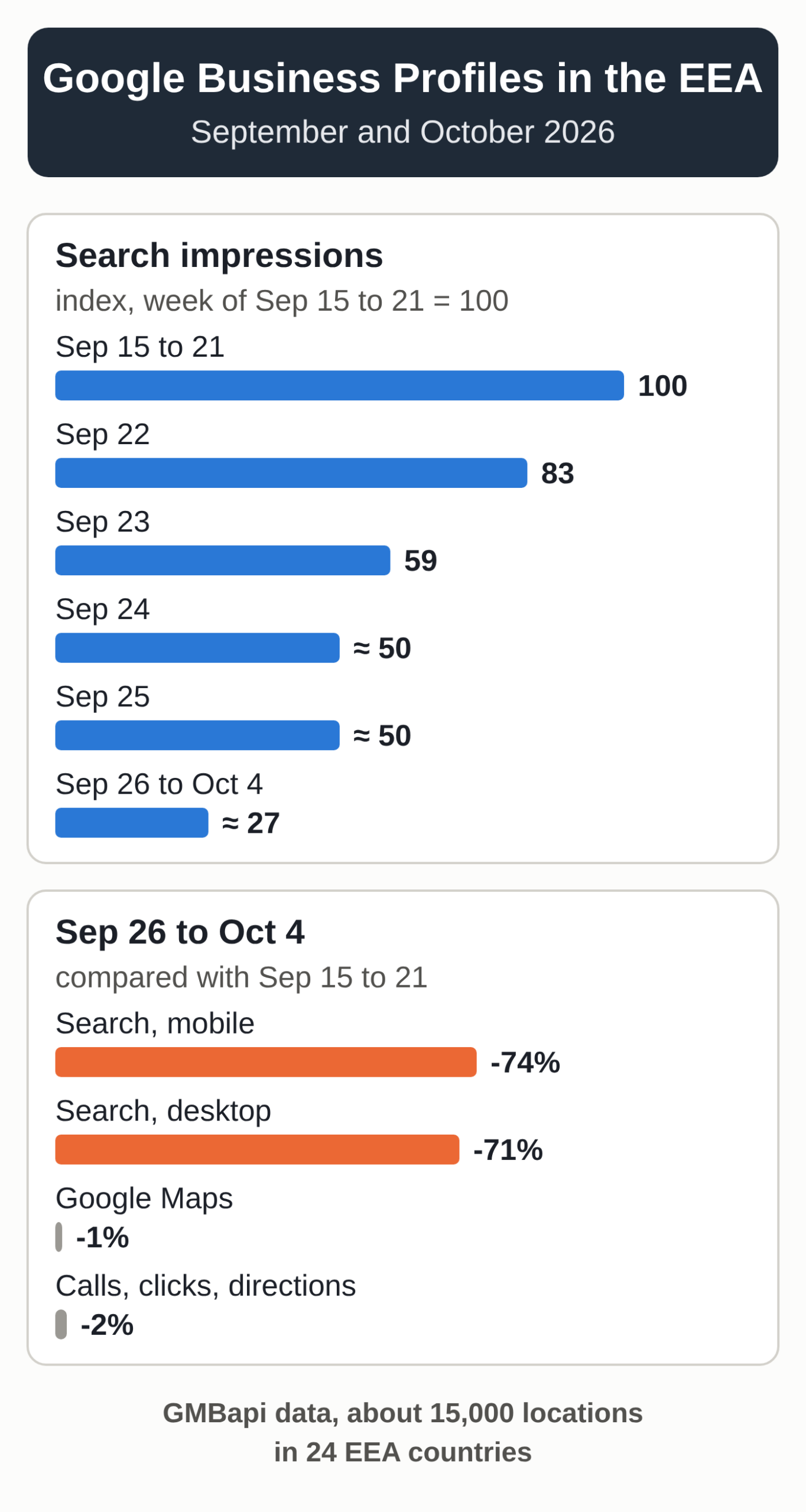
About 15,000 Google Business Profiles in 24 countries of the European Economic Area (EEA) lost more than 70% of their Google Search impressions in late September. GMBapi, a Dutch company that makes a Business Profile management tool, published the study on October 13, 2026. Measured against the week of September 15 to 21, Search impressions from September 26 to October 4 were down 74% on mobile and 71% on desktop.
Calls, website clicks and direction requests combined fell just 2% over the same period. The 10,400 locations GMBapi tracks in the U.S., the U.K. and Switzerland show no break. In France (1,044 locations), the year-over-year change in Search impressions per location went from +15% to -66%, and in Belgium (709) from +22% to -70%. GMBapi’s read is that the main change is in how Google counts, and that most businesses did not lose any real visibility.
A four-day drop across the 24 countries studied
The decline came in steps. With the week of September 15 to 21 indexed at 100, impressions fell to 83 on September 22, to 59 on September 23, to about 50 on September 24 and 25, and to about 27 from September 26 on. They stayed at that level through October 4, the last day in the published data.
Seasonality doesn’t explain it. Over the same dates in 2025, impressions rose 4.5% on mobile and fell 3.6% on desktop. Year over year, mobile impressions went from +6% in the week before the drop to -73% after it, and desktop went from flat to -69%.
All nine markets GMBapi breaks out (France, Belgium, the Netherlands, Germany, Italy, Spain, Austria, Sweden and Poland) fell on the same days, September 22 to 26. After the drop, their year-over-year change ranges from -66% to -73%.
The profiles in the sample lost about 685,000 Search impressions a day, with no shift to Maps, where impressions slipped just 1%.
Customer actions barely moved
For a local business, the number that matters is how many customers get in touch, and that hardly changed. With contacts flat and impressions falling, actions per 1,000 impressions rose from 73 to 100.
Two numbers still call for caution. Website clicks fell 3% from the prior week, compared with a 10% gain over the same period in 2025. Calls also declined, but they declined in the U.S. and the U.K. as well, so GMBapi doesn’t treat the dip as specific to the EEA.
The results page Google built for the DMA
The timing lines up with Google’s compliance work under the EU’s Digital Markets Act (DMA). On July 23, 2026, the European Commission fined Google €460 million for favoring its own services in Google Search, including shopping, hotel search, transportation and sports results. Google had 60 days to comply.
On September 8, Google rolled out a new results layout in the EEA on searches for hotels, flights, long-distance trains and buses, and products. According to The Next Web, Nick Fox, Google’s senior vice president for knowledge and information, said the changes degrade the experience for Europeans by boosting online intermediaries at the expense of local businesses.
On September 18, Google’s Search Central documentation changelog announced that the layout’s two units now support local business queries. The first, the “aggregator unit,” shows results from approved directories, comparison sites and booking platforms. The top-ranked aggregator is expanded by default, and clicks go to its website. The second, the “supplier unit”, shows the businesses themselves, such as an independent hotel or a plumber. Google says, “The supplier unit only appears if the aggregator unit appears.”
Google’s documentation also tells businesses: “You don’t need to provide additional data beyond what’s accessible through web crawling to appear in this feature.” On a page for partner platforms (directories, booking, delivery), Google says the aggregator unit replaces existing units in local results but doesn’t name them.
The aggregator unit doesn’t explain everything
All 36 categories with at least 50 profiles in GMBapi’s data declined, by 45% to 84%, with a median of 73%. Insurance agencies lost 64% of their impressions, day care centers 70%, auto repair shops 74% and cell phone stores 84%. Yet GMBapi found no aggregator unit on searches for insurance, day care or hair salons.
Hotels took two hits. Their impressions started falling right after September 8 and were down about 70% by September 16, then dropped again on September 23 along with the other categories. The sample includes only 56 hotels, so GMBapi calls the hotel pattern a strong hint rather than proof.
When it checked local searches in the Netherlands on October 12 and 13, GMBapi found the results now sit in a block with a provider header, even when Google is the only provider. Its hypothesis is that views of that block may no longer count as Business Profile Search impressions, or count only when the searcher opens the Google section.
Google’s API support team suggested to GMBapi that impressions may now be attributed differently between Google Search and Maps. GMBapi says its data partly contradicts that, since Maps stayed flat. Support could not yet confirm what changed or whether historical data would be corrected.
In late June 2025, many profiles had already lost Search impressions while engagement held steady. Search Engine Roundtable suspected a reporting bug at the time, with no official confirmation from Google.
For restaurants, more is at stake than reporting. On October 12, a pizzeria search in ‘s-Hertogenbosch, in the Netherlands, showed the section from delivery platform Just Eat expanded by default. It listed one restaurant as open 24 hours, while the restaurant’s own Business Profile showed it closed until 5 p.m. Wednesday. The next day, Google’s section came first, so the provider order isn’t fixed.
What should you do with your reports and profiles?
- Mark September 22 to 26 in your dashboards and client reports (and September 8 for hotels), so nobody mistakes the drop for lost rankings or a broken profile.
- Judge your profile on actions (calls, website clicks, directions) and on actions per 1,000 impressions. To check your local rankings, keep using a rank tracker, but read our warning about rank-tracking tools first: some have been receiving distorted results pages since mid-September.
- For locations in the EEA, stop comparing Search impressions year over year. Use the weeks before September 22 as your baseline, and only compare Maps impressions within 2026.
- If you have locations outside the EEA (in Switzerland or the U.K., for example), use them as a control group to separate EEA-specific changes from global ones.
- Keep your hours, menus, photos and contact details on booking, delivery and directory platforms in line with your Business Profile, which should stay the source of truth. When a platform opens first, your customers see its data. Our complete guide to local SEO explains how to clean up your NAP (name, address, phone) citations.
- Don’t rush to rewrite your profile to make up for a drop that GMBapi mostly attributes to how Google counts. If you do edit it, follow the new rules on promotional text in listings, live since mid-September.
Open questions
As of October 15, we have found no public explanation from Google of what changed between September 22 and 26, and no announcement that past data will be corrected. The split between a display change and a counting change is still GMBapi’s hypothesis.
The figures come from a single vendor that sells a Business Profile dashboard. Its sample is limited to locations its customers track, and its data ends on October 4. Another vendor, Partoo, painted a different picture. On October 1, it wrote that local business searches did not appear to be affected by the new layout at that stage, though it noted early signs in restaurant and supermarket searches.
Three things are worth watching: an explanation or a data correction from Google, the Commission’s view on whether the new layout complies, and the arrival of an aggregator unit on searches in your own industry. For that last one, run your customers’ searches yourself, from the EEA country you serve, and note what shows up first.
To see what these changes actually mean for your business’s visibility, beyond impressions, request our free SEO audit.