

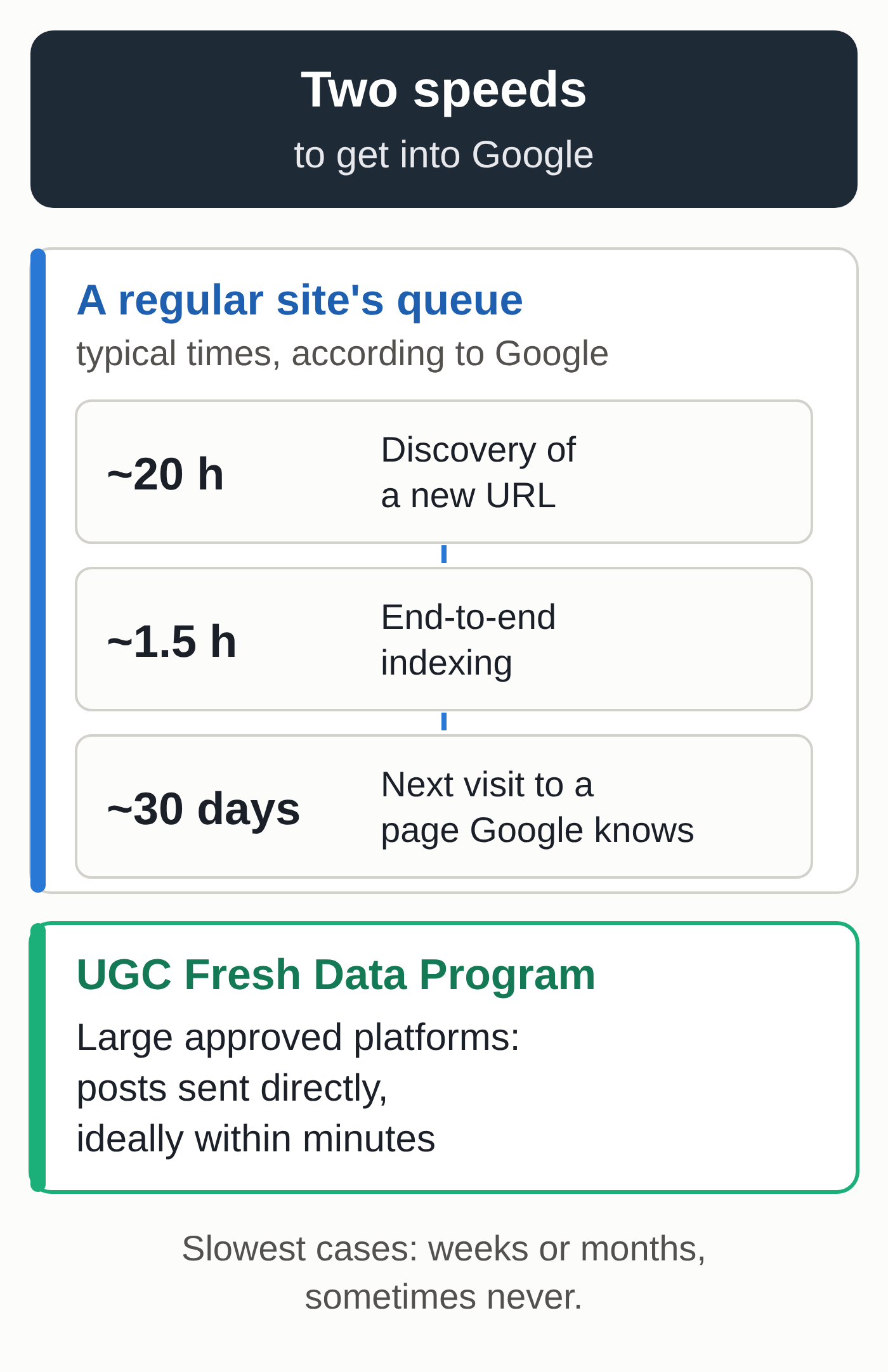
On October 2, 2026, in Barcelona, Google analyst Gary Illyes gave the first public look at how long Google takes to crawl and index pages, based on internal estimates. Discovering a new URL takes about 20 hours, and end-to-end indexing takes about 90 minutes. Google returns to a page it already knows after roughly 30 days.
Six days later, on October 8, Google published documentation for a program that lets large user-generated content platforms send their new posts straight to Google, ideally within minutes. Taken together, the two announcements describe a two-speed search engine. For site owners, they answer two practical questions about Google indexing time: how long to wait after you publish or fix a page, and why a forum thread can show up in Google before your page does.
Google’s estimated timelines
Illyes presented the figures on the last day of Search Central Live Deep Dive Europe, which Google held in Barcelona from September 30 to October 2, 2026. The slides state that the times are estimates based on internal analysis. John Campbell of the agency ROAST published them the same day in his event recap, and Search Engine Roundtable picked them up on October 5. After the Search Engine Roundtable post went up, Illyes told its author, Barry Schwartz, that the slides were an exercise to see whether the audience could relate to numbers pulled internally.
| Step | Typical time | Slowest cases |
|---|---|---|
| Discovering a new URL | about 20 hours | weeks, or never |
| Recrawling a known URL | about 30 days | weeks, or never |
| Processing a sitemap | about 24 hours | up to 14 days, or never (quality) |
| Picking up a robots.txt change | about 24 hours | 25 hours |
| End-to-end indexing | about 90 minutes | months, or never (quality) |
| Showing a new title or snippet in results | 1 to 2 days | several weeks to several months |
| Lifting a manual action | 1 to 2 weeks | 4 to 6 weeks, much longer for a dormant site |
| Recovering from a core update | 3 to 6 months | 6 months to 1 year, at the next core update |
Campbell also reported a caveat from Illyes: each step depends on the one before it. A page can’t be indexed until it has been crawled, so the delays stack up. For sitemaps and for end-to-end indexing, the slides tie the “never” case to quality. Our guide to indexing walks through the whole chain, from crawling to ranking.
Google documents a fast lane for large platforms
On October 8, Google added a page about the UGC Fresh Data Program to its documentation. UGC stands for user-generated content. Approved platforms get a dedicated channel, reserved for trending content, to send Google their posts and interaction signals. Google says this channel is separate from the Indexing API and from regular web crawling, and that it doesn’t guarantee the content will appear in search results.
Most sites won’t qualify. A platform has to host mostly user-generated content, social posts or forum discussions, each at a stable URL. It needs a large volume of content, a significant user base, pages anyone can open without logging in or paying, and a public profile for the author of every post.
On the technical side, Google asks for OAuth 2.0 authentication, strictly validated JSON-LD and valid schema.org markup on the pages, such as SocialMediaPosting or DiscussionForumPosting. It also requires active moderation with a way for users to report content, submissions sent ideally within minutes, and regular updates to engagement counts within the first 72 hours after the content is created. Google responds to applications within six to eight weeks, and acceptance isn’t guaranteed.
Google doesn’t name any participating platforms. Barry Schwartz of Search Engine Roundtable says the program looks like an API that user-generated content sites like Reddit can use to push content to Google faster.
How long should you wait for your pages?
New pages fare well. If a page is well linked from the rest of your site, Google typically finds it in about 20 hours and indexes it quickly after that. If it clears the quality bar, it can show up in Google within about a day.
Existing pages are a different story. In the typical case, Google comes back to them only after about 30 days. A corrected price, an updated product page or a new title can sit for several weeks before Google sees it, and the change can take another 1 to 2 days to show up in results. This week, a site owner on Reddit asked how to get freshly updated articles recrawled as quickly as possible.
With breaking news, the gap widens. A platform in the program can send a discussion to Google within minutes while your article waits for the crawler. When the query is about a recent event, a forum thread can reach Google before your page does.
The table also helps set expectations after a manual action or an algorithm update. A manual action typically takes 1 to 2 weeks to be lifted, and recovering from a core update takes 3 to 6 months. For a spam update like the one in September 2026, the slide gives 1 to 2 weeks in the typical case, when processing is continuous, and several months when the change has to wait for a batch refresh.
Six things to do this week
- Link to every new page from pages Google visits often: your homepage, a category page, a popular article. Google finds new URLs by following links on pages it already knows, or through your sitemap. Our internal linking guide explains how.
- Keep each page’s last-modified date (the lastmod tag) accurate in your sitemap. Google uses that value only if it is consistently and verifiably accurate, and it ignores the priority and changefreq fields. Update it after a significant change to the main content, structured data or links; a new copyright year doesn’t count. Our sitemap guide covers the details.
- For a few key pages, use “Request indexing” in the Search Console URL Inspection tool. There’s a daily cap on requests, and Google warns that requesting a recrawl multiple times for the same URL won’t get it crawled any faster. For a large number of URLs, submit a sitemap instead.
- Check before you worry. The URL Inspection tool shows the date of the last crawl. If that date is earlier than your change, the page is simply waiting its turn.
- Watch your server: according to Google’s slide, crawl capacity can drop within seconds when Google backs off, for example because your server is struggling to respond. In the slowest cases, it then takes one to three weeks to recover. Google’s documentation says slow responses, 5xx errors and 429 status codes reduce crawling, so an overloaded host can delay the discovery of your new pages. Our technical SEO guide lists the basic checks.
- If you run a large community, such as a forum or a review platform, read the UGC Fresh Data Program requirements. DiscussionForumPosting or SocialMediaPosting markup is a good place to start.
Open questions
Google hasn’t added these figures to its documentation. Its help page on recrawl requests still says crawling “can take anywhere from a few days to a few weeks,” and the URL Inspection help says indexing generally takes a day or two, sometimes much longer. An update to those pages would show that Google stands behind these ballpark figures.
Two things are still unknown about the UGC Fresh Data Program: which platforms have been approved, and which Google Search features will show their content. Once a month, count how many forum discussions and social posts show up on the first page for your own queries.
The limits of these numbers
The figures in the table are typical values that Google estimated from internal analysis, and Illyes presented them as an exercise. None of them is a guaranteed timeline. How long your site waits depends in part on the crawl demand Google assigns to it: its documentation says more popular URLs tend to be crawled more often, and that its systems try to detect changes. A small site with few inbound links may wait longer than the typical times in the table.
These timelines come from photos of the slides taken by attendees. The UGC Fresh Data Program is documented, but no one has yet published a measurement of its effect on search results.
Want to know whether your important pages are being crawled and indexed on a normal timeline? Request our free SEO audit.