
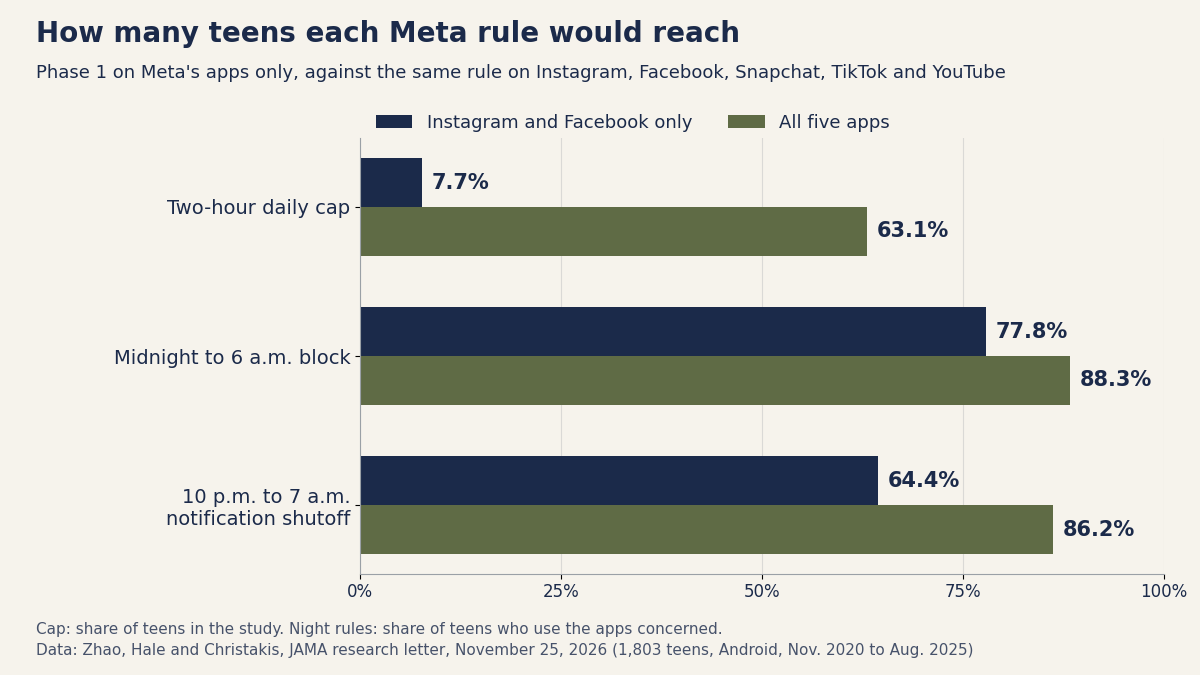
Three researchers estimate that the two-hour daily cap Meta must put on teens’ Instagram and Facebook use would have affected about 1 teen in 13. They reported the result in a research letter published in JAMA, a medical journal, on Wednesday, November 25, 2026. Applied to the recorded phone use of 1,803 U.S. teens, the rule would have reached 7.7 percent of them.
That is because Instagram and Facebook accounted for roughly 20 percent of the teens’ daily social media use. Snapchat, TikTok and YouTube took the other 80 percent, and the cap does not cover them. If the same two-hour limit applied to all five apps, it would have affected 63.1 percent of the teens, the researchers estimate.
The rules Meta agreed to
The cap comes from a settlement Meta announced on August 26, 2026, with 47 states, Washington, D.C., and three U.S. territories. The states had alleged that Meta built Instagram and Facebook to be addictive to children; Meta did not admit wrongdoing.
It agreed to pay up to $17.1 billion, according to Washington Attorney General Nick Brown. The same day, Chief U.S. District Judge Yvonne Gonzalez Rogers in Northern California entered the deal as a consent judgment, a court order both sides agreed to.
The settlement agreement sets its rules in two phases. In the first, users aged 13 to 17 get a default limit of two hours a day across Instagram and Facebook combined, reset at midnight. Messaging, settings and video or audio of at least 22 minutes do not count toward it. A teen can loosen the limit only if a parent who supervises the account approves.
The first phase also blocks the two apps by default from midnight to 6 a.m., except for messaging and settings. It turns off push notifications from 10 p.m. to 7 a.m. A separate rule mutes notifications on school days from 8 a.m. to 3 p.m. Teens can choose a feed that Meta’s recommendation system does not rank.
Meta has six months from the agreement’s effective date, which followed court approval, to put these rules in place. The tech news site GeekWire reports they are set to take effect by late February. They then run for five years.
A second phase starts if Snap, TikTok and YouTube, which run the other three apps, all take on equivalent obligations. Meta’s limit then drops to 60 minutes a day on each app, and the night block starts at 10 p.m. instead of midnight.
About $5 billion, roughly 30 percent of the payments, also depends on the rivals. Meta owes it only if those three companies adopt the same time rules and those with annual profits above $10 billion also owe the states at least as much. If not, Meta keeps the money.
Inside the phone logs
Dimitri Christakis of Seattle Children’s, a hospital, led the work with Yihong Zhao of Columbia University and Lauren Hale of Stony Brook University. They used data from the Adolescent Brain Cognitive Development Study, a long-running U.S. study of teen brain development. In it, an app on participants’ Android phones logged their app use between November 2020 and August 2025.
In press releases, Stony Brook and Seattle Children’s call the result an estimate of the maximum impact of the three settlement rules tested.
The two night rules would reach far larger shares, counted among teens who use the apps rather than all teens in the study. Blocking Meta’s apps from midnight to 6 a.m. would affect 77.8 percent of the teens who use them, and 88.3 percent of users if all five apps did it.
The 10 p.m. to 7 a.m. notification shutoff would affect 64.4 percent of participants on Meta apps, against 86.2 percent across the five.
The first phase leaves the apps open in the two hours before midnight. The researchers found nearly as much use between 10 p.m. and midnight as in the six hours from midnight to 6 a.m.
“The simple workaround right now is that you just switch platforms, and we already know that teens are on three to four platforms on average,” Christakis told GeekWire. He also said: “But these are the right kinds of restrictions. We need to make them universal, and we need to enforce them.”
“These restrictions are a step in the right direction. The settlement will affect some teenagers but not enough,” he said in the Stony Brook release. “I think many people hailed that settlement with a huge sigh of relief, but unless the other companies join suit, these data suggest it’s not going to make a huge difference.”
Hale said the midnight block “should benefit teen sleep by reducing late-night use,” then added: “However, teens could simply shift to using other platforms if the non-Meta social media apps don’t make the same restrictions.”
Meta says teens switch apps too
Meta made the same argument when it announced the deal. “We know that when teens are restricted on one app, they simply move to another,” the company wrote in its August 26 post. It urged TikTok and YouTube to “join us and state attorneys general in adopting this new standard.”
In an open letter the same day, it said the protections “will only be truly effective if we work with our peers,” naming the two companies.
Neither TikTok nor YouTube has joined so far, and YouTube CEO Neal Mohan dismissed the idea in September. “We have invested in making sure that young people are safe on our platform… for a very long time,” he told CNN, pointing to a tool that lets parents limit how long teens scroll YouTube Shorts.
Meta, Snap, TikTok and YouTube all face hundreds of lawsuits from families and school districts, CNN reported. Bloomberg reported on November 20 that YouTube is close to a payout of about $3 billion to U.S. school districts.
No major social media platform has opted into similar limits on teen accounts, the news site EdSource reported in a story The Almanac republished on November 28. In September, TikTok agreed to teen usage restrictions in Alabama, its first settlement of a state case, GeekWire reported, citing Reuters.
California Attorney General Rob Bonta has said the states are willing to take TikTok and YouTube to court if needed, CNN reported.
Some states are also writing their own rules for children’s technology. Vermont’s Kids Code is set to bar covered apps from using a minor’s data to pick their feed from January 1, 2027, and the trade group NetChoice has sued to block it. New York has banned the sale of toys with built-in AI chatbots.
Limits of the study and the authors’ ties
The figures describe past behavior on Android phones only, recorded before any of these rules existed. The study cannot say how teens will react once the cap takes effect. “We also don’t know the extent to which teens will find ways to circumvent the proposed platform changes,” Hale said.
GeekWire reports that the cap estimate is based on average daily use. The releases do not say how the estimate treats messaging and long videos, which the cap does not count.
The authors disclose ties to social media litigation. According to the letter’s conflict-of-interest statement, Christakis received legal consulting fees for social media litigation from the law firm Motley Rice and from the attorneys general of California, New Mexico, Virginia and Washington. California, Virginia and Washington are among the states that signed the settlement.
Hale reported fees for serving as an expert witness in social media litigation. A Columbia University award to Zhao supported the study in part.
What it means
One reading is that the cap covers about a fifth of teens’ social media time. On the study’s numbers, it would affect 7.7 percent of the teens, against 63.1 percent if all five apps applied it.
The hours from 10 p.m. to midnight stay open, and no rival has opted into similar limits. Christakis, who led the study, still calls the rules “a step in the right direction.”
The other reading is that a daily cap is aimed at heavy users, and this one would reach them. By the study’s estimate, about 92 percent of the teens would not be affected by it, while the night block would reach 77.8 percent of the teens who use Meta’s apps.
Parents can tighten the defaults, and the settlement holds back its tighter phase and about $5 billion until Snap, TikTok and YouTube follow. Meta urges them to, and on one point it agrees with the researchers: teens restricted on one app move to another.
The cap is due by late February 2027, and an independent auditor and the states will check how it works.
The tighter phase can start in three ways. Snap, TikTok and YouTube can sign equivalent settlements, take on the rules voluntarily under an audit, or become subject to laws that impose them. It applies state by state, and only once all three companies are covered in that state.
Sources
- Teen Social Media Use and Potential Impact of Platform-Based Safety Restrictions, JAMA, November 25, 2026
- Study Says Meta Settlement Will Have Limited Impact on Teen Social Media Practices, Stony Brook University, November 25, 2026
- Study: Meta settlement will have limited impact on teen social media practices, Seattle Children’s via EurekAlert, November 25, 2026
- Meta to pay up to $17 billion and implement sweeping child-safety reforms on Instagram and Facebook, Washington State Office of the Attorney General, August 26, 2026
- Settlement agreement, Meta and State Attorneys General (Exhibit 1), U.S. District Court for the Northern District of California, August 26, 2026
- Our Agreement With Bipartisan Attorneys General: Calling on TikTok and YouTube to Join Us in Supporting Teens, Meta, August 26, 2026
- Meta’s teen restrictions have a gap: TikTok, Snapchat and YouTube leave teens room to scroll, GeekWire, November 25, 2026
- YouTube CEO: We’re focused on internal safety efforts, following Meta calls to join settlement, CNN, September 23, 2026