

Tasmania’s parliament has passed a bill to protect people from attempts to change, suppress or eradicate their sexual orientation or gender identity, the practices often called conversion therapy. The Australian state’s upper house, the Legislative Council, passed the Conversion Practices Prohibition Bill 2026 on November 25, 2026, the parliament’s bill page shows. The lower house, which passed the bill first, agreed to the upper house’s one amendment the same day, Australia’s ABC News reported. One in 20 young queer Tasmanians have been through these practices, according to research by La Trobe and Macquarie universities reported by the ABC.
Once the law takes effect, people harmed by conversion practices from then on can report them to a new Conversion Practices Commissioner. A state tribunal can order the person responsible to pay them compensation, according to the parliament’s fact sheet on the bill. Intentionally subjecting someone to a conversion practice that injures them will be a crime, and so will taking a person out of Tasmania to have it done. Prayer and sermons do not count as conversion practices on their own, and neither do parents talking with their children about sexuality, gender identity or religion.
The bill still needs Royal Assent, the Governor’s formal signature that turns it into an Act, and the bill page showed none on November 29. The bill’s sponsor, Tasmanian Greens leader Rosalie Woodruff, said in a statement that it “has passed the Tasmanian Parliament and will become law.”
What the bill prohibits
The bill defines a conversion practice as conduct directed at a person because of their sexual orientation or gender identity. The conduct must aim to change, suppress or eradicate that orientation or identity. It does not matter whether the person agreed, according to the parliament’s fact sheet on the bill.
The bill’s first layer is a general ban on conversion practices, plus a duty on people and organizations to take reasonable and proportionate steps to eliminate them. Breaking either one is not, by itself, a crime or grounds for a lawsuit, the fact sheet says. It calls this an “education and prevention first” approach.
The second layer is the criminal law. Under the main offense, a person must intentionally engage in a conversion practice directed at someone else, the practice must cause injury, and the person must have been negligent about whether it would.
Taking someone out of Tasmania for a conversion practice that injures them, or arranging it, is a separate offense. Both are indictable offenses under the state’s Criminal Code, serious crimes that go to Tasmania’s Supreme Court, as the ABC explained. Targeting a child or a person with impaired decision-making makes the offense more serious. Advertising conversion practices is a lesser offense.
Who it protects
Woodruff’s statement says the bill protects everyone at risk, including “lesbian, gay, bisexual, transgender, gender diverse, asexual, aromantic and agender people.”
The La Trobe and Macquarie study compared young LGBTQIA+ Tasmanians who had been through conversion practices with other members of the queer community. Those survivors were three and a half times more likely to be diagnosed with PTSD and almost four times more likely to attempt suicide, ABC News reported in its explainer.
One survivor who went through five years of conversion practices told ABC News she was relieved “that this ends here, this ends now.” She added: “We’re not broken, we’re not degenerate, we’re not evil, we’re not dangerous. We are fabulous.” Another survivor, who spent 10 years campaigning for a ban, told the ABC after the lower-house vote in October: “I feel like I can breathe and stop holding my breath.”
Rodney Croome, a spokesperson for the advocacy group Equality Tasmania, called the bill “a tribute to the bravery of Tasmania’s conversion survivors.” He said it is “the most comprehensive and effective of its kind in Australia.”
A commissioner, reports and compensation
The bill creates a Conversion Practices Commissioner, a role taken on by Tasmania’s existing Anti-Discrimination Commissioner. Anyone can report a conversion practice to the Commissioner, who can decline the report, refer it elsewhere or offer education. Other options are helping both sides settle it or sending it to the Tasmanian Civil and Administrative Tribunal, a court-like state body.
That tribunal can order the person responsible to pay compensation to the person affected, according to the bill as introduced and the fact sheet. Woodruff’s statement says the law “gives survivors the ability to seek financial compensation.” Under the bill as introduced, reports can only concern conduct from the day the law starts, so people harmed before then cannot use this route for what was done to them.
The Commissioner can also investigate serious or systemic cases and issue compliance notices, formal orders to follow the law. The Greens say Tasmania is “the first state to establish a Conversion Commissioner.”
Health care, prayer and parents
The ban does not cover a registered health practitioner who, in good faith, provides care they consider appropriate within legal, professional and ethical rules. Nor does it cover support that helps a person cope, develop or explore their identity to meet their needs.
The bill also lists conduct that “does not, of itself” count as a conversion practice, meaning that conduct alone is not enough. The list includes public debate, expressing a belief in prayer, explaining what a religion teaches, and parents discussing sexual orientation, gender identity or religion with their children. During the October debate, the lower house added sermons, religious education and pastoral care alongside prayer, the Daily Declaration, a Christian news site, reported.
In the upper house, members voted down amendments that would have turned those protections into outright exemptions, the news site PinkNews reported. The only change they made removed the words “intimate or sexual relationship with” from the bill’s definition of sexual orientation.
How it passed
A 2022 report by the Tasmanian Law Reform Institute, which advises on changes to state law, found conversion practices were still happening in Tasmania and recommended outlawing them. The state government drafted a bill in 2023, but advocates criticized it, and it was never introduced in parliament.
Woodruff introduced the Greens’ bill on September 10, 2026. The lower house passed it by voice vote on October 29, after almost 20 hours of debate. Supporters included the Labor Party, four independents and several members of the center-right Liberal Party, among them Premier Jeremy Rockliff, who leads the state government. Liberal members were allowed to vote their conscience.
Rockliff said that, in his personal view, Tasmania had “taken a significant step forward.” The lower house also amended the bill, dropping a clause that would have made employers liable for offenses committed by their employees.
The opponents’ case
Treasurer Eric Abetz and Deputy Premier Guy Barnett, both ministers in Rockliff’s government, called the bill “overreach” during the lower-house debate, the ABC reported. Before the final vote, Rafael Demarchi, Tasmanian director of the Australian Christian Lobby, said the bill offers “weak and uncertain protections for families and religious expression.” He asked for a parliamentary inquiry, the Daily Declaration reported.
Mike Southon, executive director of the Christian legal group Freedom for Faith, said in October that “the words ‘of itself’ mean pastoral care is not fully protected.” Women Speak Tasmania supports a ban on coercive practices aimed at sexual orientation but opposes including gender identity, the Daily Declaration reported.
Greens upper-house member Cassy O’Connor defended the words “of itself.” Without them, she told the chamber, someone “could continue conducting conversion practices under the guise of prayer,” the Daily Declaration reported. Independent upper-house member Bec Thomas told parliament that “reasonable people have raised genuine questions about its reach.” She added that “freedom of religion does not include a right to harm another person.”
What it means
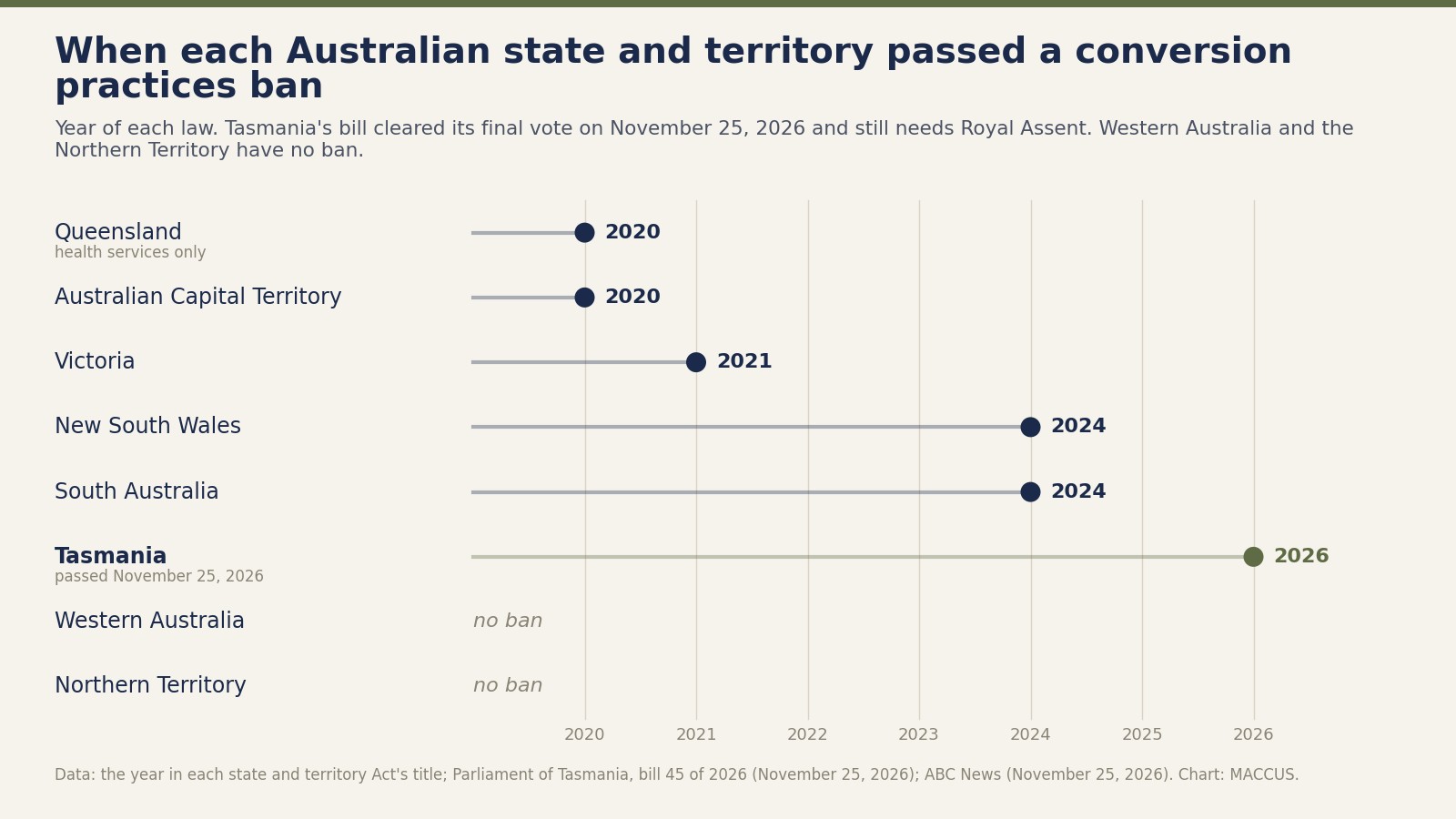
Once the law starts, conversion practices will be prohibited in Tasmania, and carrying one out in a way that injures someone will be a crime. People harmed after that date will have a commissioner to report to and a tribunal that can award compensation, but under the bill as introduced, harm done earlier cannot go through this route. Prayer, sermons and parents talking with their children about sexuality or religion will not count as conversion practices on their own. Tasmania’s bill is closest to Victoria’s law, according to the ABC, and once it is in force, Western Australia and the Northern Territory will be the only parts of Australia without a ban.
The crime requires intent, injury and negligence. The start date is not set: the bill as introduced says it takes effect on a day the government proclaims, at the latest 12 months after Royal Assent. Other protections have waited too: New York’s ban on talking AI toys begins 90 days after it was signed, and Vermont’s limits on feeds built from kids’ data, signed in 2025, start in January 2027. Some face a court challenge, as New York City’s rent freeze did before a judge upheld it.
No challenge to Tasmania’s bill has been announced, and opponents had asked for a parliamentary inquiry before the final vote. The next steps are Royal Assent, a proclaimed start date and the first reports the new commissioner receives.
Sources
- Conversion Practices Prohibition Bill 2026 (45 of 2026), Parliament of Tasmania, November 25, 2026
- Fact Sheet: Conversion Practices Prohibition Bill 2026, Parliament of Tasmania (Internet Archive copy), archived October 25, 2026
- Conversion Practices Prohibition Bill 2026 (No. 45), text as introduced, Parliament of Tasmania (Internet Archive copy), September 10, 2026
- Conversion Ban Passes Tasmanian Parliament, Tasmanian Greens, November 25, 2026
- Tasmania to have ‘most comprehensive’ protections against conversion practices in Australia, ABC News, November 25, 2026
- Conversion practice ban passes Tasmania’s lower house of parliament, ABC News, October 29, 2026
- Tasmania bans conversion practices after decade-long campaign, PinkNews, November 25, 2026
- Prayer Protections Up for Debate as Tasmania’s ‘Conversion Practices’ Ban Clears First Vote, The Daily Declaration, November 25, 2026