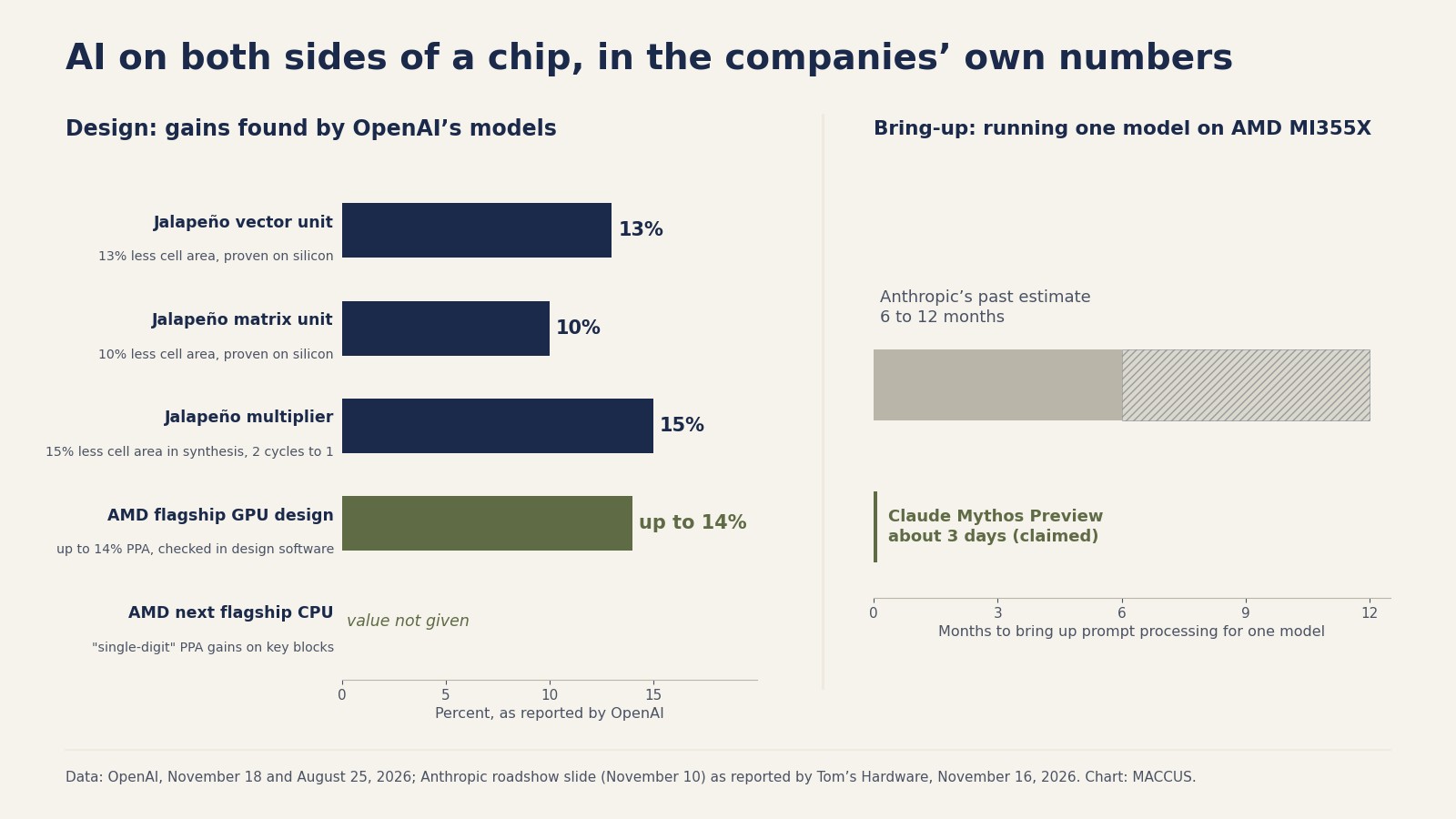

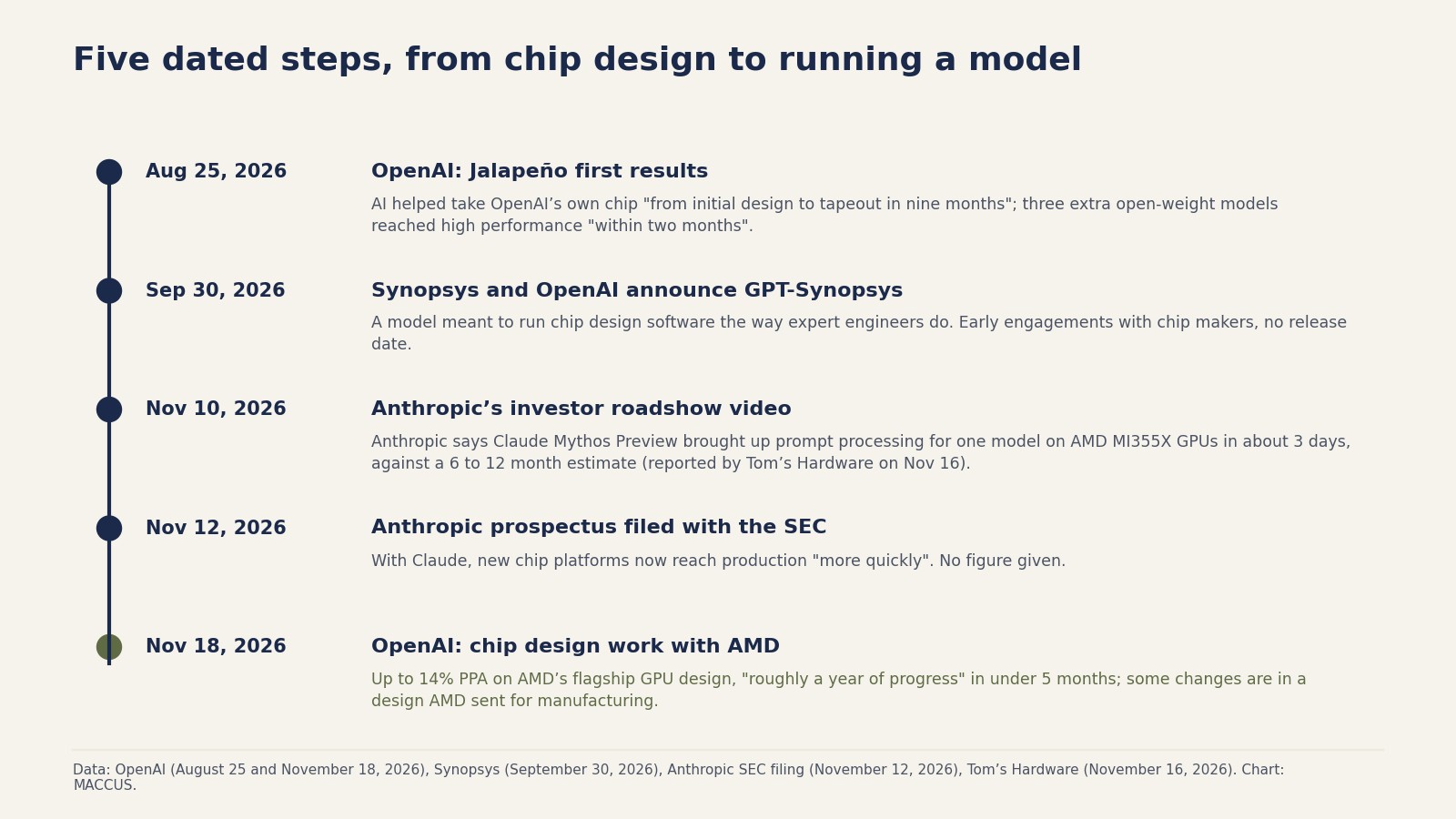
On November 18, 2026, OpenAI said its AI models had found design improvements for chipmaker AMD’s next flagship GPU, the type of chip most AI runs on. OpenAI puts the gains at up to 14% in PPA, chip designers’ shorthand for power, performance and area. It says they are worth “roughly a year of progress,” found in less than five months, and that AMD has already used some in a design sent for manufacturing.
Two days earlier, Tom’s Hardware reported a similar claim Anthropic made in an investor video ahead of its stock market listing. Anthropic says its Claude Mythos Preview model wrote nearly all the low-level code needed to get one of its models reading prompts on AMD GPUs in about three days. It says the same job used to take its engineers 6 to 12 months.
Taken alone, each claim comes from a company promoting its own model. Read together with OpenAI’s work on its own chip, they show AI being used at both ends of a new chip’s life: design before manufacturing, software after delivery. Neither company has published the designs or the code.
Up to 14% on AMD’s flagship GPU design
Working with AMD, OpenAI’s model rewrote parts of the GPU’s RTL, the code that describes a chip’s circuits before they are laid out physically. That code is written in SystemVerilog, a chip design language. For each rewrite, the model used Synopsys design software to check that the changed block of the chip still worked as before and to measure the power, performance and area trade-offs.
OpenAI says the result, measured against “heavily optimized baselines” of AMD’s design, was “up to 14% improvement” in PPA. The “year of progress” is OpenAI’s estimate, with no method given. The post does not say whether the 14% is in power, performance or area, or which blocks it covers, so it does not mean the GPU runs 14% faster.
According to OpenAI, “AMD has already included some of these changes in a recent design it sent for manufacturing, and added others to its production design files for use in future versions.” By OpenAI’s account, AMD put the changes into its own design files. OpenAI names no chip on sale that carries them.
OpenAI also says AMD verified “single-digit percentage gains” in PPA on key blocks of its next flagship CPU, a computer’s main processor, using designs written by the model. AMD had published no statement of its own on the work as of November 19.
The same method on OpenAI’s own chip
The AMD work grew out of Jalapeño, the chip OpenAI designed to run its models in its own data centers. OpenAI says it started using GPT-4o, one of its AI models, on the design in early 2025.
Across the project, OpenAI’s team estimates that changes proposed by its models shrank standard-cell area, the space taken by the chip’s basic logic circuits. The estimated cuts were about 13% in the vector unit and 10% in the matrix unit, two of the chip’s main computing sections. OpenAI says these savings were “silicon proven,” meaning they held up on the physical chips.
In the matrix unit, a redesigned multiplier circuit used about 15% less cell area. That figure was measured in synthesis, the step where design software turns code into a circuit plan. The multiplier also finished its calculation in one clock cycle, the chip’s basic time step, instead of two.
OpenAI’s first results for Jalapeño, published on August 25, 2026, said AI let the team go “from initial design to tapeout in nine months.” Tapeout is the moment a finished design is handed over for manufacturing. Using Codex, OpenAI’s AI coding agent, with its GPT-Astra model, the team then brought three open-weight models outside the original plan “to high performance within two months.” Open-weight models can be downloaded and run by anyone.
Three days on AMD hardware, Anthropic says
Anthropic’s claim covers the next step: making AI models run on a new chip. Models depend on kernels, small programs that carry out a model’s math on a specific processor. Much of that code was written for Nvidia’s CUDA software platform and has to be converted for AMD’s chips, Tom’s Hardware notes.
Tom’s Hardware reported on November 16, 2026, that the claim comes from Anthropic’s investor roadshow video, dated November 10. In it, Tom Brown, Anthropic’s co-founder and chief compute officer, says Claude Mythos Preview “got Claude running on AMD in just three days with basically no human intervention.” Claude “ported or wrote almost 100% of the kernels,” work that, according to the video, “took dozens of engineers months.”
A footnote on a slide in the video narrows the claim. The “~3 day timeline” covers bringing up, or getting working, “prompt processing for one Anthropic model on AMD MI355X GPUs at a useful level of performance.” Prompt processing is the stage where a model reads a request before it starts writing its answer. Anthropic does not define “a useful level of performance.”
The 6 to 12 month comparison is an estimate drawn from Anthropic’s “historical experience bringing up new accelerators,” meaning chips built for AI work.
A prospectus document Anthropic filed with the US Securities and Exchange Commission on November 12 makes the same point without a number: “Historically, bringing a new chip platform into production required intense engineering effort over many months. By leveraging Claude, our engineering teams can now bring new chip platforms into production more quickly.” The three-day figure does not appear in it.
The same filing says Anthropic trains and runs Claude on four chip families: Amazon’s Trainium, Google’s TPUs, Nvidia GPUs and AMD GPUs. Its largest commitments are listed in a roundup of the compute deals Anthropic has signed.
A model being trained to run chip design software
Synopsys makes electronic design automation software, the tools engineers use to design and check chips. On September 30, 2026, it announced GPT-Synopsys with OpenAI. The new model is meant to run those tools the way expert engineers do and to revise a design repeatedly for an engineer to review. The companies cited “early technology engagements” with chipmakers and gave no release date.
OpenAI’s November 18 post says it is working with Synopsys to train the model. Greg Brockman, OpenAI’s president, said in September: “We’re using our most advanced technology to improve the systems that power AI.”
Caveats and early criticism
OpenAI’s post also describes a test on open-source processor designs, with its own caveats. Its models were given two small RISC-V processor cores, PicoRV32 and Ibex, and asked to raise their throughput, the number of instructions a core runs per second. RISC-V is an open standard for designing processors. Designs were checked in simulation and scored against the best result observed, across 9,881 scored runs in total.
Tokens are the chunks of text a model reads and writes. At a budget of about 112,000 tokens per run, GPT-6.2 Astra, the OpenAI model released on November 17, had the best average score on both cores. On PicoRV32, its score was about twice that of the earlier GPT-6 Astra.
The models scored higher when they designed a core from written requirements than when they improved an existing one. OpenAI says those designs could omit features of the original cores, such as performance counters, which track a core’s activity. It adds that requiring those features, a tighter area limit and timing checks after physical synthesis “would make the test more representative of production chip design.”
On Hacker News, a technology discussion site, OpenAI’s post had about 150 points, or upvotes, by early November 19. Commenters objected that the charts show scores without units and that the RISC-V designs were not released. Some read the timing of the post, in the run-up to Anthropic’s stock market listing, as publicity.
What it means
Taken at the companies’ word, the claims show AI speeding up two slow stages of new hardware: designing a chip and getting AI software running on it.
That bears on a limit Anthropic names in its filing, a shortage of computing power. It says it has “consistently operated in a compute-constrained environment where customer demand exceeds available compute.” Shorter design cycles and faster bring-up on new chips would let AI labs add chip suppliers and put new hardware to work sooner.
On November 10, Anthropic said it had reached the safety threshold it set for AI that speeds up its own research. This week’s reports apply that idea, AI speeding up its own development, to the hardware it runs on.
So far, the results are percentage gains on blocks of existing designs and one model’s prompt processing brought up on one AMD chip model. No outside party has published a measurement. The next checks are an AMD statement naming the products that carry changes from OpenAI’s models and the release of OpenAI’s RISC-V designs. OpenAI plans to start running Jalapeño in its data centers by the end of 2026, and GPT-Synopsys has no release date yet.
Anthropic’s first AMD MI450 chips are expected in the first half of 2027, Tom’s Hardware reports. That rollout will show whether a bring-up of about three days repeats on a new generation of chips.
Sources
- Advancing chip design with OpenAI models, OpenAI, November 18, 2026
- Jalapeño’s first results show industry-leading speed and efficiency in AI inference, OpenAI, August 25, 2026
- Anthropic says Claude Mythos slashed software work to onboard AMD GPUs from up to 12 months to around three days, Tom’s Hardware, November 16, 2026
- Issuer Free Writing Prospectus (EEA Prospectus), Anthropic, PBC, SEC filing, November 12, 2026
- OpenAI and Synopsys Announce GPT-Synopsys: Frontier Intelligence to Revolutionize Chip Design, Synopsys, September 30, 2026
- Advancing chip design with OpenAI models (discussion), Hacker News, November 18, 2026
Header image: chart by MACCUS, data from OpenAI (November 18 and August 25, 2026) and Anthropic’s roadshow slide as reported by Tom’s Hardware (November 16, 2026)