
On November 18, 2026, Cloudflare made two of its AI models free to download. Called Clairic and Clairic-flash, they pull data out of documents such as invoices and receipts. A company can now run these models locally, on its own servers, without sending its documents to an online service.
Both models read a block of text, a photo or a PDF page. They pick out specific pieces of information, such as a supplier’s name, a total amount or a date.
Cloudflare is the US company best known for the network that protects and speeds up websites. It released both models under Apache 2.0, an open-source license that allows commercial use and modification. The release covers the models’ weights. These are the billions of numbers, called parameters, that a model learns during training.
Clairic has 27 billion parameters and Clairic-flash has 9 billion. Cloudflare still sells both as a paid service on Workers AI, its platform for running AI models on its own network.
Two models that fill in fields
Both models work by filling in a form. They receive a document and a list of fields, and each field has a set type: text, number, date, duration, list, estimate or forecast. For each field, they return one value plus a confidence score that says how sure the model is. When the value appears word for word in the document, they also give its exact position.
Cloudflare files these models under a category it calls “System One,” named after the fast mode of thinking described by psychologist Daniel Kahneman. Cloudflare credits the idea to TypeSafe, a company whose Jev model was built for one specific job and priced low.
Cloudflare says its models of this kind usually answer in under a second. By its account, a large language model, the general-purpose kind of AI behind chatbots, takes several seconds to reason through the same step.
One month after the preview
Cloudflare first showed Clairic on October 19, 2026, as a preview: a test version available only as an online service. The announcement said Cloudflare intended to release the weights “soon.”
The October post also explained the name: Clairic partly comes from “clair,” the French word for “clear,” as in “Clair de lune.” Cloudflare said the model is meant to extract data clearly and keep the books accurate.
The versions released on November 18 can read PDFs, which the preview could not. They accept up to four images or PDF pages per request. They can also return the line items of an invoice as rows that keep each description, quantity and price together.
Clairic follows Clef and Clef-flash, two models Cloudflare released under the same license on October 1. These are “decision” models, which sort a piece of content into one of several options and give a probability for each.
The November 18 post is signed by Alex Reneau, Michelle Chen and Kevin Flansburg. In it, Cloudflare says it has become a “neolab,” meaning a lab that builds its own cutting-edge AI models. The team calls itself the Workers AI “superintelligence team.”
The scores Cloudflare reports
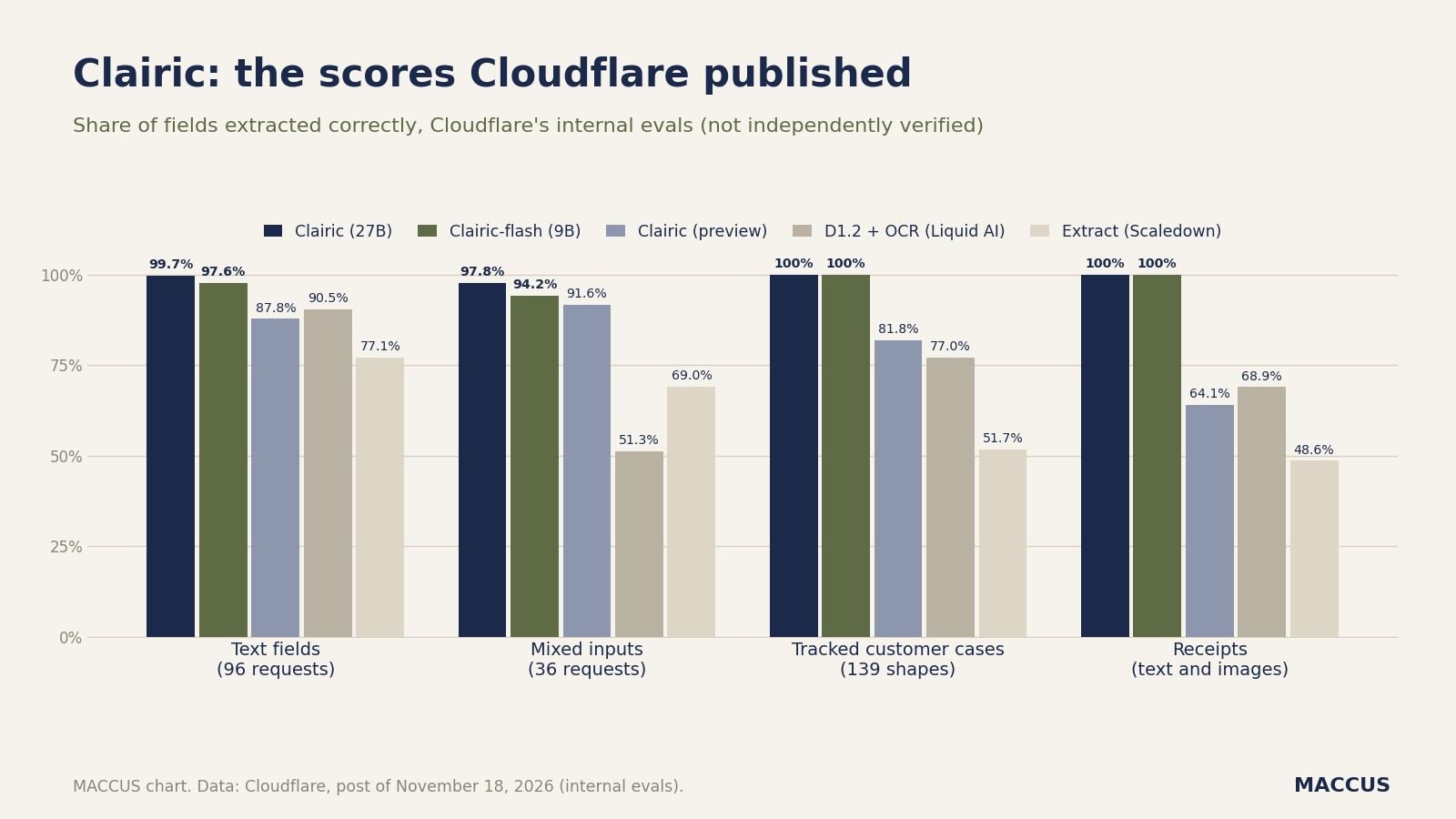
Cloudflare published four internal evaluations. The first covered 336 text fields drawn from 96 requests. Clairic extracted 335 of them correctly, Clairic-flash 328 and the October preview 295.
The second test used 576 fields from made-up receipts, shown as text and as images. Both new models got all 576 right, while the preview made 207 errors. In the third test, on 226 fields from mixed inputs, Clairic got 221 right and Clairic-flash 213.
The November 18 post also compares the Clairic models with two rivals. One is D1.2, from the company Liquid AI, run together with Apple’s text recognition tool. The other is Extract, from a company called Scaledown. On the 576 receipt fields, D1.2 got 397 right and Extract 280.
The fourth test used 1,263 checks drawn from customer cases that Cloudflare tracks. Both Clairic models passed all 1,263. D1.2 passed 973 and Extract 653.
Cloudflare also measured how fast each model returns a complete answer on a server it runs itself. On text fields, Clairic-flash returned half its answers in under 155 milliseconds, or thousandths of a second, and 95% in under 328. Clairic, nearly three times larger, was slower: 358 milliseconds for half its answers and 736 for 95%.
Built on Alibaba’s Qwen, and demanding to set up
The blog post does not say what the models are built on. Their pages on Hugging Face, a site for sharing AI models, do: Clairic is built on Qwen3.8-27B and Clairic-flash on Qwen3.5-9B. Both base models come from Qwen, a family of open models made by China’s Alibaba. Cloudflare gave them extra training for data extraction and added components that output numbers, dates, estimates and calculations.
The files are large. Clairic’s weights take up about 56 gigabytes and Clairic-flash’s about 20. Each model’s download also holds 72 files of code in Python, a programming language. They include modules for receipt totals, tables and the lines of a document that hold numbers.
The model page asks for Python 3.11 or later, and its code loads the model onto an Nvidia graphics card. Several of the libraries it lists for faster math can be installed only on Linux machines with Intel or AMD x86 processors.
Cloudflare has not released the models in GGUF, the file format used by Ollama, llama.cpp and LM Studio, common tools for running AI on a personal computer. The blog post, model pages and documentation do not list the supported languages.
Pricing and terms on Workers AI
On Workers AI, Cloudflare bills only for the tokens the model reads, meaning the small units of text sent to it. The tokens it writes in reply are free.
Until December 1, both models cost $0.10 per million tokens read. After that, Clairic’s price rises to $0.24, while Clairic-flash stays at $0.10.
According to the documentation, the models reread the document for each text field requested. Each reread bills the whole document and its images again. A request with ten text fields is therefore billed, in principle, for ten reads. Fields are grouped together only when a document is too long for the model’s working memory, the amount of text it can handle at once.
The Workers AI documentation says the data customers send is not kept (“zero data retention”). It still labels both models as previews, although the blog post says Clairic is out of preview.
During the preview, Clairic’s address on Workers AI served a 9-billion-parameter model. That model is moving to a separate address under the name Clairic-flash. Apps still connected to the old address will get the new 27-billion-parameter Clairic automatically as the rollout proceeds.
In-house tests and a reworked design
Cloudflare itself acknowledges the limits of its numbers. It writes that there is no public benchmark for extraction yet, meaning no standard test that anyone can run to compare models. It asks readers to treat its internal evaluations as a rough guide. On November 18, Unite.AI, a trade site that covers AI, noted that these results do not allow an independent ranking of extraction models.
The new Clairic also works differently from the preview. In October, Cloudflare said the preview produced each answer in a single computation instead of writing it out one token at a time. On that basis, it argued the preview could not “hallucinate,” meaning invent an answer the way a large language model does. Cloudflare added that the preview could still make mistakes.
The new Clairic, by contrast, writes its answers one token at a time for ordinary text and number fields. The November 18 post admits that it “technically” produces output tokens, which Cloudflare chooses not to bill.
In October, Cloudflare also listed the preview’s weak spots: multistep calculations, the reliability of its error margins, and its forecasts, which it called “basic.” At the time, it advised leaving the math to ordinary code. The new Clairic adds components trained for arithmetic and date calculations. The November 18 post gives no results specific to those calculations.
What it means
The release matters most to companies that do not want to send their invoices, contracts or expense reports to an online service. Both models can now run on a company’s own hardware. Their license also carries none of the limits that French AI company Mistral added for resellers with its Large 4 model.
Similar products launched this fall remain hosted services that apps call over the internet. They include OpenAI’s Decisions API and the document-reading API that Chinese AI company DeepSeek has sold since November 13.
Installation is still demanding. The model page calls for an Nvidia graphics card, a Linux server and room for 20 to 56 gigabytes of weights, with no compressed version released. Ollama and LM Studio users cannot yet launch these models in a few clicks.
Every accuracy figure comes from Cloudflare’s own test sets. Several things remain unknown: how well the two models handle non-English documents, how they perform on real company invoices in tests run outside Cloudflare, and the minimum recommended hardware.
Two signs will show whether the models catch on outside Cloudflare. The first would be a compressed or GGUF version, released by Cloudflare or by outside developers. After Clef came out, Cloudflare says, it saw many experiments and retrained versions. The second would be a first independent test on real documents.
The December 1 price change will show whether Workers AI customers pay $0.24 per million tokens for Clairic or switch to Clairic-flash at $0.10.
Sources
- An updated Clairic and Clairic-flash are now open-weight, from the new Workers AI Superintelligence team, Cloudflare, November 18, 2026
- Cloudflare/clairic (model card), Hugging Face, November 18, 2026
- Cloudflare/clairic-flash (model card), Hugging Face, November 18, 2026
- clairic (Workers AI documentation), Cloudflare, retrieved November 19, 2026
- clairic-flash (Workers AI documentation), Cloudflare, retrieved November 19, 2026
- Introducing Clairic, a new System One class of extraction models, Cloudflare, October 19, 2026
- Introducing Clef: our open-source decision models, and new RL fine-tuning platform, Cloudflare, October 1, 2026
- Cloudflare Releases Open-Weight Clairic Models for Data Extraction, Unite.AI, November 18, 2026
Header image: MACCUS chart, data from Cloudflare (post of November 18, 2026).