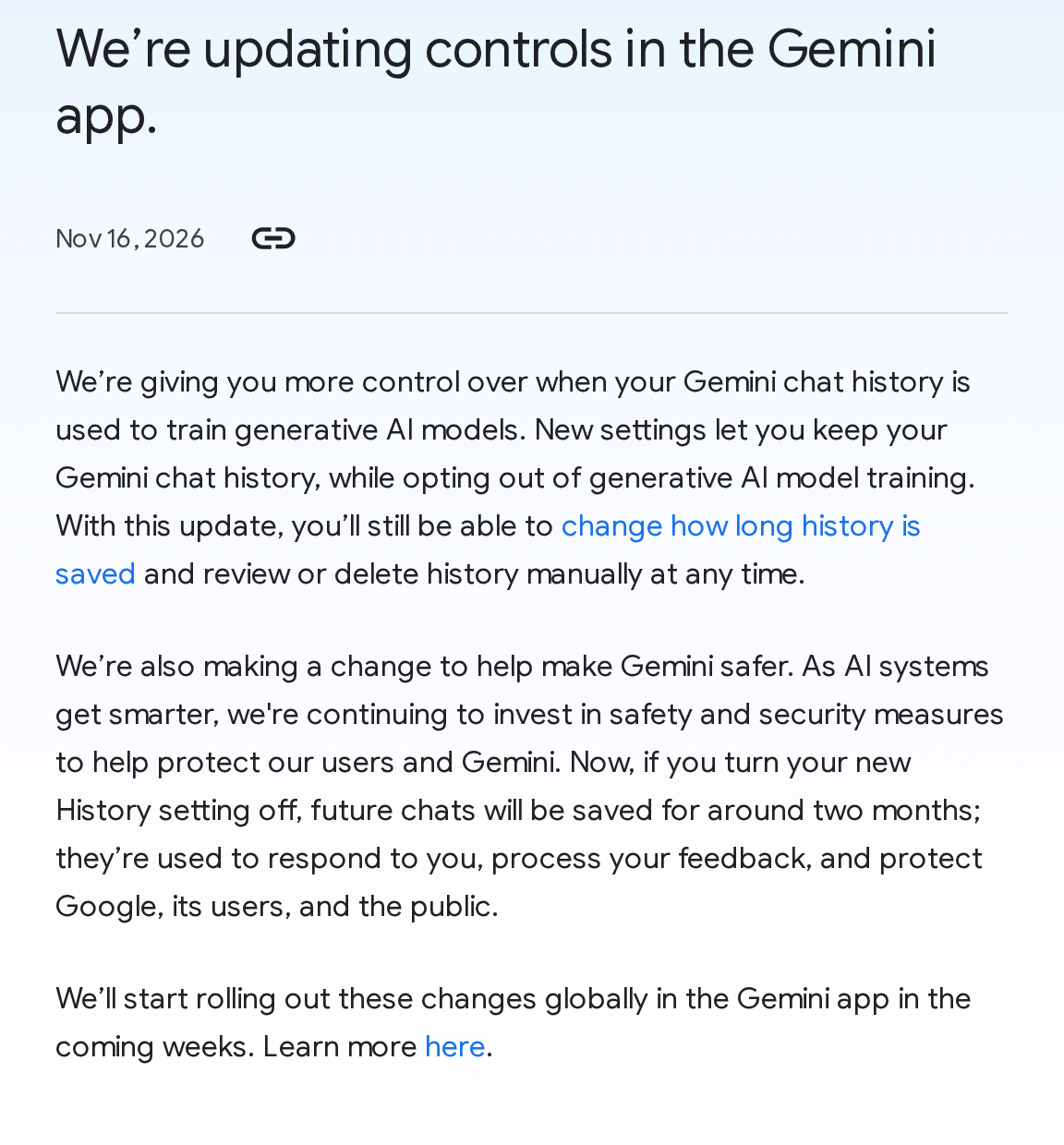
On November 16, 2026, Google announced two changes to the Gemini app, its AI assistant. When chat history is off, future chats will be saved “for around two months.” Gemini’s privacy hub, a Google help page, still said 72 hours in its October 26 version. The other change separates two choices that one setting used to make: keeping your chat history, and letting Google train its AI models on your chats.
Google announced the changes on The Keyword, its blog. It says it will start rolling them out globally “in the coming weeks.” The privacy hub has described the new rules since November 17, but not every account will get them on the same day. Temporary chats, an option that leaves a conversation out of your history, will also be kept for around two months.
The changes cover personal Google accounts. Work and school accounts fall under different terms and are managed by an administrator through Google Workspace, Google’s office suite. On October 16, Google had already amended a 2023 promise about human review of emails linked to Gemini.
One setting for history, another for training
Until now, keeping your chats out of Google’s AI training meant turning off one setting, Keep Activity, and losing your history with it. “New settings let you keep your Gemini chat history, while opting out of generative AI model training,” Google now writes. You can still delete any chat by hand.
The privacy hub names the two new settings. One is called “History.” The other, labeled “Chat content including text & uploads” in Google’s help page, decides whether Google trains its generative AI models on your conversations.
When Chat content is on, Google uses the content of future chats for training. The hub lists what that covers: your prompts and audio transcripts, photos, files, audio or video attachments, screens you ask about, and Gemini’s responses. It also covers tasks and tool calls (requests Gemini sends to other tools), location info, product usage data such as language and device type, and data from connected apps. Connected apps are services, such as Gmail or Drive, that you let Gemini access.
Chats used for training are separated from your account before they go to the outside contractors who review them. Reviewed chats are kept for up to three years, “even if you delete them or turn this setting off later,” the hub says.
When Chat content is off, future chats are no longer used for training unless you send Google feedback. According to the hub, they “will be reviewed and used to improve Google services in other ways, and to protect Google, its users, and the public.”
A third setting, which already existed, covers audio recordings, plus videos and screen shares in Gemini Live, the assistant’s spoken conversation mode. Google warns that turning this setting off doesn’t keep everything out of training. If Chat content is on, transcripts of your Gemini Live chats and attachments you share with it are still used to train Google’s models.
Both training settings, for chat content and for audio, “are off by default,” according to the help page “Manage & delete your history in Gemini Apps.” They can only be turned on when History is on.
Neither the post nor Google’s help pages say what will happen to choices people have already made. According to TechCrunch, a US tech news site, Google says users who had turned off Keep Activity will find both History and the training setting off. Everyone else will keep their history and can decide on training separately, TechCrunch reports. The site doesn’t say whether the training setting will start on or off for them.
Our tool-by-tool guide to AI training settings covers other AI assistants. Its Gemini entry, checked on October 10, still describes the old single setting.
From 72 hours to around two months
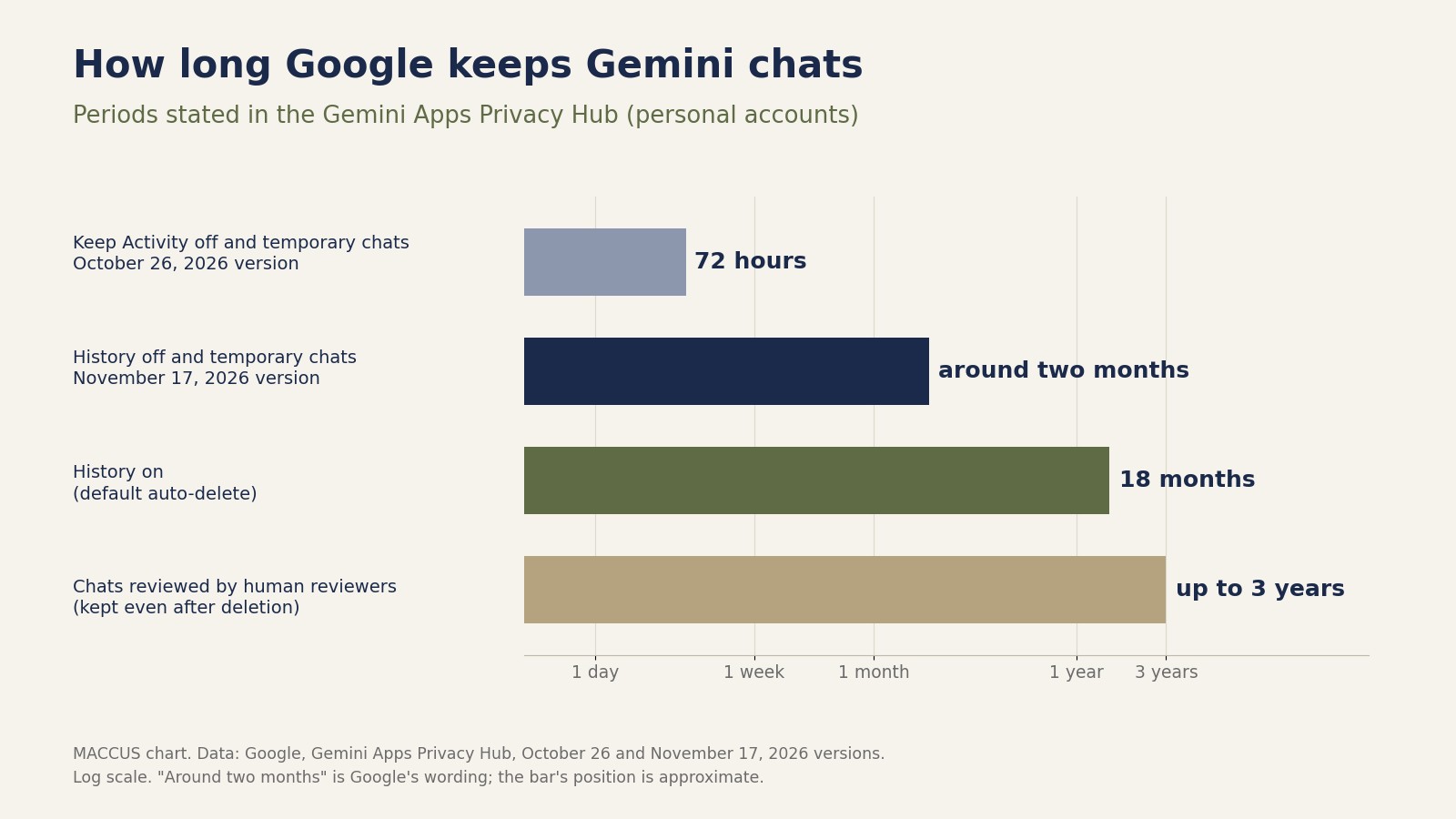
Two versions of the privacy hub show the change. The Wayback Machine, the Internet Archive’s web page archive, saved the October 26 version on November 11. That version said, “Temporary chats and chats you have when Keep Activity is off are retained with your account for 72 hours.” The November 17 version says, “Temporary chats and chats you have when your History setting is off are retained with your account for around two months.”
Gemini Live conversations changed the same way. With Keep Activity off, they were stored “for up to 72 hours.” They are now stored “for around two months.” Google doesn’t give a number of days.
According to the hub, chats kept outside your history are used to respond to you, with the last 24 hours of chats as context. They are also used to “help protect Google, our users, and the public.” Google gives one example: it keeps them in your account “so they are available in case of a potential system failure.” The hub adds that these chats are used “with help from human reviewers.”
“Temporary chats are not used to train Google’s AI models,” Google writes. Chats with History off aren’t used either, as long as you don’t send feedback. If you do, Google collects the feedback along with your last 24 hours of chats and their content, attachments included. Once reviewed, that material is kept for up to three years, disconnected from your account.
Several rules from before November 16 stay the same, including that 24-hour rule. With Keep Activity off, the old version of the hub said Google used your chats to respond to you and help protect Google, its users and the public. It added: “including with help from human reviewers.” With History on, chats are still deleted after 18 months by default, a period you can change to 3 months, 36 months or no auto-delete.
Google cites safety but doesn’t explain the longer period
Google describes keeping chats longer as “a change to help make Gemini safer.” “As AI systems get smarter, we’re continuing to invest in safety and security measures to help protect our users and Gemini,” the company writes. The system failure example was already in the old version of the hub, when the period was 72 hours.
Google doesn’t explain why it chose around two months. According to TechCrunch, the company didn’t answer the site’s questions about what prompted the change or whether it would affect how conversations are accessed or reviewed. Google pointed to its blog post instead.
The hub sets no separate period for the European Economic Area (the EU plus Iceland, Liechtenstein and Norway). There, as in Switzerland, Gemini is provided by Google Ireland Limited. Google also hasn’t given a rollout date by country or by account.
Other assistants also keep a copy of chats left out of your history. OpenAI, which makes ChatGPT, says it may keep a copy of a temporary chat for up to 30 days for safety purposes. According to TechCrunch, Anthropic keeps incognito chats in its Claude assistant for 30 days by default.
Different rules for work accounts
“If you have a work or school Google Account, your use of Gemini Apps may be subject to different data handling terms,” the hub says. According to the help page “Manage & delete your history in Gemini Apps,” the Workspace administrator controls history settings for those accounts. Users may not be able to see how long their chats are kept, it adds. Google’s November 16 post doesn’t mention Workspace.
Workspace has its own privacy hub for generative AI, last updated on October 6, 2026. It still says that when Gemini conversation history is off, new chats are saved in user accounts “for up to 72 hours.” It adds that in the Workspace plans it covers, content is not reviewed by humans or used to train models outside the organization without permission.
Some organizations decide for themselves whether staff can use consumer AI assistants. On October 26, Sweden’s government blocked ChatGPT and Claude on its ministries’ work computers and steered staff to approved tools.
What it means
The update affects two groups of personal-account users. People who kept their history but didn’t want their chats used for training now have a new choice. They can refuse training and still keep their chats. They also keep connected apps such as Gmail or Drive, which don’t work with History off.
People who turned history off to limit what Google keeps will see their chats retained for around two months instead of 72 hours. According to Google, human reviewers may read those chats to protect the company, its users and the public. The chats aren’t used for training as long as no feedback is sent.
Google cites safety but gives no detail beyond the system failure example it already gave when the period was 72 hours. Several points remain unclear. Only TechCrunch describes what happens to existing choices. Google has given no date by country, and its Workspace page still says 72 hours.
Three things are worth watching in the coming weeks: the screen European users will see when the change reaches them, a possible update to the Workspace privacy hub, and any explanation Google gives for keeping chats around two months.
Sources
- We’re updating controls in the Gemini app, Google (The Keyword), November 16, 2026
- Gemini Apps Privacy Hub, Google, November 17, 2026
- Gemini Apps Privacy Hub (October 26, 2026 version), Google, archived by the Internet Archive on November 11, 2026
- Manage & delete your history in Gemini Apps, Google, accessed November 18, 2026
- Generative AI in Google Workspace Privacy Hub, Google, October 6, 2026
- Google to keep Gemini chats for 2 months, up from 72 hours, even with history off, TechCrunch, November 17, 2026
- Temporary chat in ChatGPT, OpenAI, accessed November 18, 2026
Header image: MACCUS diagram. Data: Google, November 16, 2026 post and Gemini Apps Privacy Hub, October 26 and November 17, 2026 versions