

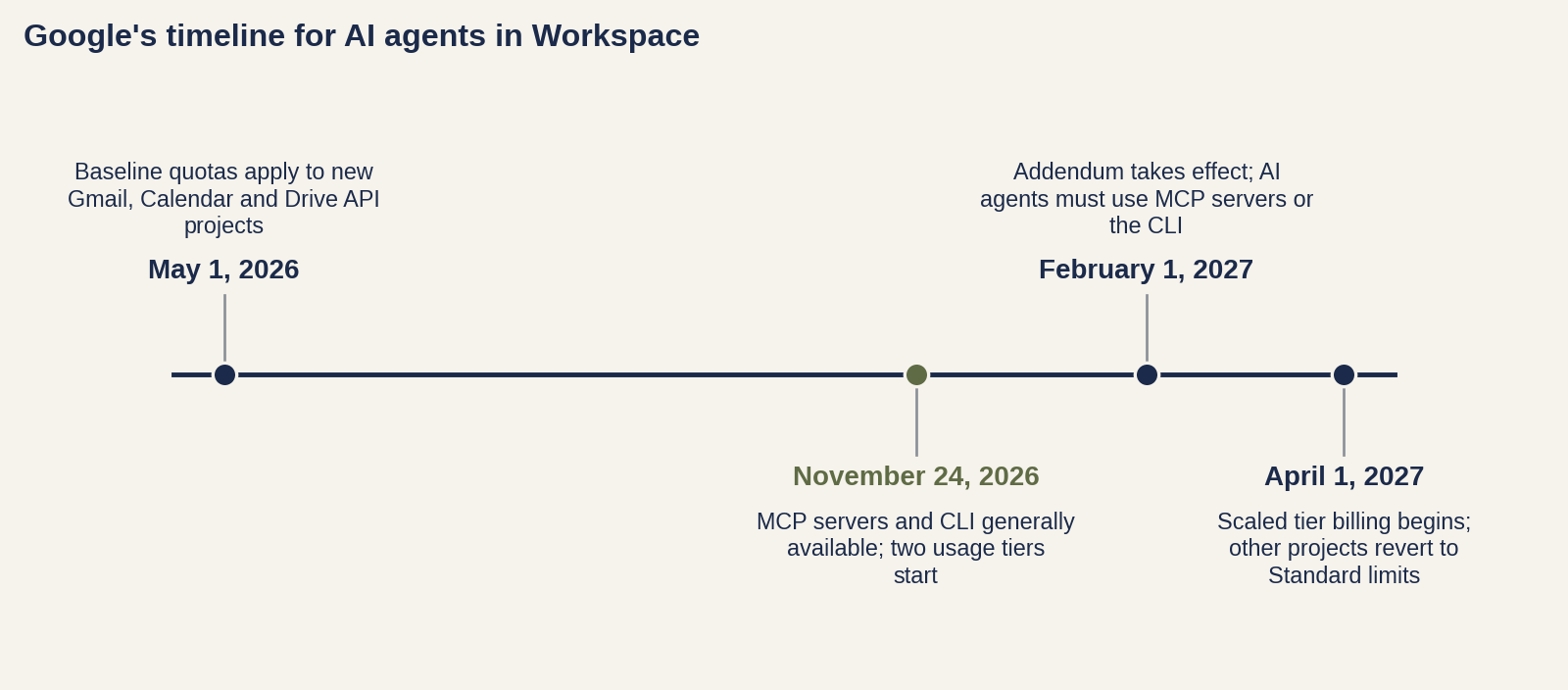
Starting February 1, 2027, AI agents must reach Google Workspace apps such as Gmail and Drive through Google’s own MCP servers or its command-line tool. Unlike ordinary apps, they may no longer call the Workspace REST APIs directly. The new terms also limit what any tool, AI or not, may keep from users’ data.
Google set the rule on November 24, 2026, in a Workspace AI Tools Addendum to its API terms, the day it made the servers and its command-line interface, the Workspace CLI, generally available. REST APIs are the standard interfaces apps use to read and change data.
MCP, short for Model Context Protocol, is an open standard that lets AI applications connect to outside tools and data. Google’s setup guide names two AI applications that can use the servers: Anthropic’s Claude and Google’s own Antigravity. Claude adds them as connectors, explained in this guide to connecting Claude to Gmail, Drive and a calendar.
Eight servers and a command-line tool
Google’s announcement on its Workspace Updates blog covers eight generally available MCP servers, one per product: Gmail, Drive, Docs, Sheets, Slides, Calendar, Chat and Tasks. Keep, Google’s notes app, is listed as “coming soon.” The CLI, called gwscli, is meant for agents working from developer terminals, virtual machines and isolated software containers.
In the Admin console, administrators can manage agent access, require users to confirm some actions and read agent audit logs. Existing data loss prevention (DLP) rules apply to agents automatically. The rollout takes two weeks from November 24 and covers “all Google Workspace customers and developers.”
New terms for any tool that reaches Workspace data
The Addendum supplements the Google APIs Terms of Service. Its first clause reads: “The GWS Access Tool must use a Google MCP where the GWS Access Tool is or is driven by an AI Agent, an AI Harness or an AI model or service employing an AI model.” GWS means Google Workspace, and an access tool can be any “software, application, AI model” or other tool that reaches user data. Disguising one to dodge the rule is forbidden.
The second clause covers every access tool, with or without AI. It allows processing user data only “to fulfill active, user-authorized tasks.” Derived information, “including vector embeddings, memory indexes, user profiles, organizational graphs, and findings,” may not be stored for more than 30 days.
Embeddings and memory indexes are what an assistant builds to search and remember past content. Neither the data nor anything derived from it may be kept once a tool is disconnected or its access revoked.
Scraping beyond a user’s task is banned. The data may not feed model training, fine-tuning, evaluation datasets or distillation, or be used “to develop a product or service that is similar to” a Workspace service. If Google “reasonably believes” a tool broke these rules, it “may immediately” restrict or remove the tool’s access, or “suspend or terminate” the access of whoever uses or authorized it.
Apps without AI keep the REST APIs: “traditional apps continue to run on existing REST APIs,” Google’s Cloud blog says. They escape the MCP requirement only; the data rules still apply. Developers are asked to check “Use this client for an AI-powered agent” on their agent’s OAuth client, the registration an app uses to request Google data. The MCP servers “reject non-agent OAuth clients.”
MCP use is free up to 5,000 requests a day
Since November 24, the Workspace APIs, MCP servers and CLI have two usage tiers, starting with Gmail, Drive and Calendar. The free Standard tier allows up to 5,000 MCP requests a day, per project and per product, with no billing account.
Quotas, or request limits, also enforce the rule. From February 1, 2027, AI agents that call the REST APIs directly are limited to Standard tier quotas, whatever tier their project has chosen.
The paid Scaled tier raises quotas, with billing from April 1, 2027. Google’s pricing page sorts requests into four price categories by how much work and data they involve. Each has a price per 1,000 billable requests: $0.10 for Light, $0.20 for Medium, $0.25 for Plus and $0.50 for Premium. That is about €0.09 to €0.46 at the European Central Bank rate of November 26, 2026.
On the Scaled tier, the Gmail REST API gets free daily allowances of 70 million Light, 10 million Medium and 1 million Premium requests, shared by all projects on one billing account. Gmail’s MCP server gets none and is billed “from the first request.” Google says “over 99% of active developers currently operate within the Standard tier.”
Google says a valid token is no longer enough
Google’s reasoning comes from a Cloud blog post of November 25, 2026. Its authors are Chandu Thota, vice president of engineering for Workspace, and Brad Calder, president of Google Cloud Platform and SRE (site reliability engineering). They note that Workspace APIs “now handle more than 2.8 trillion calls a month.”
A token is the pass an app gets once a user grants access. The authors argue: “Traditional REST APIs were built for human-paced apps where a valid OAuth token implied user intent. As AI agents shift from reading information to acting autonomously at machine speed across email, documents, datasets, and cloud infrastructure, a valid token is no longer enough.”
The post says the servers and the CLI “enforce explicit user confirmation before agents send email, change Drive sharing permissions, or make bulk edits.” Drafts and summaries need no confirmation.
Google’s pages disagree on sending email
The Gmail MCP setup guide, updated November 26, lists 10 tools, or actions an agent can call; none sends, replies or forwards. It still counts sending among the “sensitive actions” that trigger an approval form.
The Gmail MCP reference page, updated the same day, lists 30 tools on its main endpoint, the address agents connect to, including send_message, reply and forward. A fallback endpoint for apps that cannot show Google’s approval forms lists 25, without those three. An archived copy of the page from November 4 listed 10, none for sending.
Two write-ups published November 26 say the sending tools exist but are reserved for partners. Flavio Copes counted 23 tools in the server’s list, none for sending. Eight unlisted tools, send_message among them, answered with HTTP 200, the success code, on their OAuth metadata address; a made-up name got a 404 not-found error. His conclusion: “Those operations exist on the server, gated behind partner access.”
Tech Stackups reported that the server “can’t send a message, reply, forward, or change a draft after creating it.” It quoted Google’s quota page as saying those tools “require partner access and aren’t generally available,” and added that “Google hasn’t said who qualifies for partner access.”
That partner note was not on Google’s Gmail quota page when checked on November 27. It lists send_message, reply and forward with quota costs and no partner restriction.
Anthropic’s help page says Claude’s Gmail connector “can send, reply to, and forward emails,” asking for approval before each action by default, except in Auto mode. The page does not say which route the connector takes or whether it must change by February 1, 2027. No public statement on the rule from Anthropic or OpenAI could be found as of November 27.
On Hacker News, a technology discussion site, a thread on the Tech Stackups piece drew more than 200 points and 180 comments on November 27. Commenters complained that agents can only leave drafts. Some mentioned homemade scripts that send by other routes; others warned these may break Google’s terms.
An edited announcement and an unchanged Addendum
Google edited its announcement on November 26. An Internet Archive capture from 02:58 UTC that day says agents “must use MCP to access Workspace data.” The current text says they “must use Workspace MCP servers or the Workspace CLI.”
The Addendum, still marked “Last modified: November 24, 2026,” does not name the CLI. It says a tool “must use a Google MCP,” defined as “a model context protocol server, endpoint, or tool interface, if made available by Google.” Google’s Cloud blog reads that as requiring “Workspace MCP servers or the Workspace CLI.”
What it means
Agent developers have the most to change: flagging their OAuth client as an agent and moving to Google’s MCP servers or CLI before February 1, 2027. A 30-day limit on derived data such as a memory index rules out a permanent index of an inbox. Makers of ordinary apps are affected too, since the data rules cover any access tool.
Google’s announcement, aimed at developers and administrators, asks nothing of people who use Claude with Gmail. A personal script that feeds someone’s own inbox into an AI model may count as a tool driven by AI under the Addendum’s broad definitions, a case Google’s pages do not address.
Google cites security. Tech Stackups noted that the rule’s design also gives Google a say over what each agent may do, what data it may keep, and whether anything built on that data may compete with Google’s own products. If the partner restriction holds, Gmail’s sending tools are a visible case of that control.
The Addendum’s limits bind outside tools; Google’s own services, including its AI assistant Gemini, follow Google’s own policies. Since October 16, 2026, excerpts of a Gmail account connected to Gemini can be reviewed by humans and used for training. Google can also personalize ads with what Search draws from connected Gmail and Google Photos, a connection it does not offer in the EU.
No statement from Google on who may use the Gmail sending tools could be found as of November 27; one would settle the disagreement between its pages. Its pages do not say how it will detect an agent that calls the REST APIs without declaring itself. The other open question is how connector makers such as Anthropic will respond before February 1, 2027, when technical enforcement begins.
Sources
- Simplifying agent access while keeping organizations in control: MCP servers, CLI, standardized usage tiers, and admin policies, Google Workspace Updates, November 24, 2026
- Workspace AI Tools Addendum, Google, November 24, 2026
- Built for trust and control: Powering the next wave of AI agents across Google Workspace and Google Cloud, Google Cloud, November 25, 2026
- Usage tiers and quotas for Google Workspace APIs and MCP servers, Google for Developers, November 26, 2026
- Understand Google Workspace API and MCP server pricing and billing tiers, Google for Developers, November 24, 2026
- MCP Reference: gmailmcp.googleapis.com, Google for Developers, November 26, 2026
- Google Will Make AI Agents Use Its Workspace MCP Servers. The Gmail One Can’t Send Email, Tech Stackups, November 26, 2026
- Google is requiring AI agents to use its Workspace MCP servers, Flavio Copes, November 26, 2026