

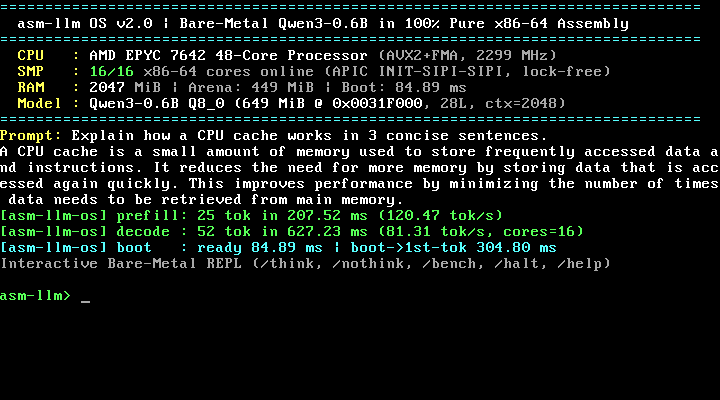
On November 25, 2026, developer Alexey Fateev published llm.asm on GitHub: three programs written entirely in x86-64 assembly, the low-level language of PC and server processors. The one drawing attention is a bootable operating system that needs no Linux or Windows. Its kernel, the core program, is 24,252 bytes. In the author’s virtual-machine tests, a chat with Qwen3-0.6B, a small free-to-download model from Alibaba, opened 74 to 94 milliseconds after the kernel started.
Fateev’s benchmarks show his code generating text faster than llama.cpp, the open-source engine many people use for local AI, meaning models on their own computers. No independent test of those numbers had been published by November 27, and they cover only writing new text. By the author’s own note, his engine reads prompts more slowly than llama.cpp.
Three programs and 17,252 lines of assembly
The project went up on November 25 at 07:28 UTC under the MIT license. Its README counts 17,252 lines of assembly, with “zero C, zero C++, zero Rust” and no runtime dependencies, meaning no outside code libraries at run time.
The first program is a 14,712-byte Linux application that runs Qwen3-0.6B with 8-bit weights, the model’s 0.6 billion learned numbers stored in compact form. The second is the bootable system. The third, at 32,944 bytes, trains a small GPT-style model from scratch.
Fateev announced the operating system on X on November 26, Japan time, according to Japanese trade site GameBusiness.jp. On Hacker News, the forum run by startup investor Y Combinator, a post titled “Bare Metal Qwen” had 228 points and 55 comments by November 27. GitHub showed 1,508 stars, or bookmarks, and 217 forks, or copies, early that day, about 41 hours after launch.
A keyboard, a screen and no disk driver
The 24,252 bytes cover the program alone. The model’s weights sit in a separate 614 MiB file, which the boot loader copies into memory before the kernel starts. So the 74 to 94 milliseconds leave out model loading and firmware start-up. The system sets aside another 449 MiB of RAM for scratch work and the KV cache, the model’s working memory of the conversation.
The README lists the hardware the system can drive: a serial port, a VGA text screen, a PS/2 keyboard, a timer and ACPI power-off. It has no disk driver, GameBusiness.jp notes, so everything runs from memory, even in a virtual machine with a 0 GB disk. The list has no network driver either, so questions go in through the keyboard or the serial port.
A chat remembers several turns, up to a default limit of 2,048 tokens, the word fragments a model reads and writes. The official model card allows 32,768. When the limit is nearly reached, the system wipes the conversation.
The system needs an x86-64 processor with the AVX2, FMA and F16C math instructions: “Intel Haswell / AMD Excavator or newer”, per the README. Intel’s Haswell chips date from 2013.
The README describes no code for graphics processors (GPUs). Like LlamaIndex’s OCRia-nano-1 document reader, llm.asm runs on the main processor alone. It handles one model, Qwen3-0.6B, converted beforehand into the project’s own format with a Python script.
Where the “54% faster” headlines come from
Fateev ran his comparison on one AMD EPYC 7642 server processor, with 47 cores switched on and no graphics card. Both engines ran Qwen3-0.6B at the same 8-bit precision (Q8_0), with a 34-token prompt and 64 tokens of output. llama.cpp, maintained by the ggml-org community, ran in its own benchmark tool. Its figures and the Linux program’s are averages of three runs.
On one thread, his Linux program generated 20.70 tokens per second, versus 16.63 for llama.cpp. On 16 threads, it was 121.86 versus 103.03. He sums up the gap as “+18% to +36% faster than llama.cpp CPU (Q8_0) across 1..40T”, meaning one to 40 threads.
The bootable system ran in a QEMU KVM virtual machine, with one virtual processor per thread. It reached 23.67 tokens per second on one thread, 78.89 on four, 118.08 on eight and 134.94 on 16. Fateev says the system “gains another ~10%” over his Linux program by using large 2 MiB memory pages, which cut memory lookups.
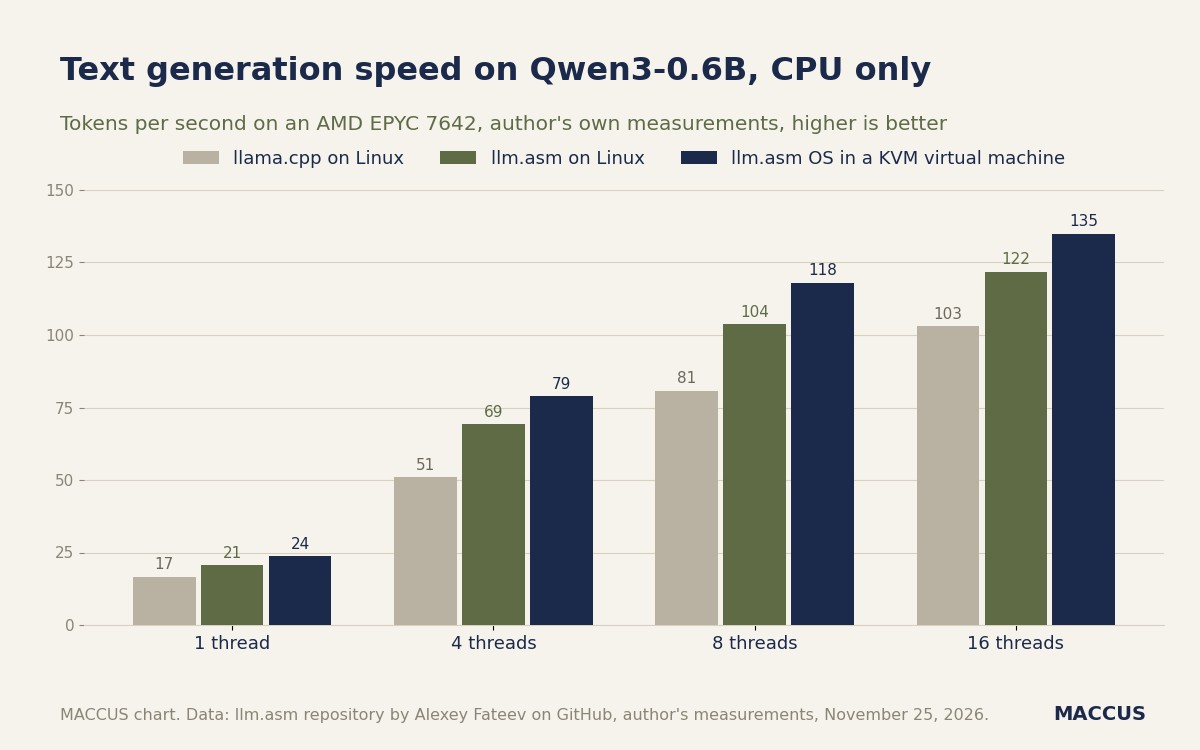
The 54% comes from the bootable system’s results. GameBusiness.jp worked out the system’s lead over llama.cpp at each thread count: 42% on one, 54% on four, 46% on eight and 31% on 16. The site noted that all these numbers were Fateev’s own. Its Japanese headline led with that maximum, and BigGo Finance’s English headline said the system “runs up to 54% faster than llama.cpp”.
At one and four threads, though, the system’s 23.67 and 78.89 are the values its detailed table marks as peaks, while llama.cpp’s figures are averages. That table’s main values are 23.46 and 78.17, which put the four-thread gap at 53%.
The 54% maximum also compares the operating system inside a KVM virtual machine with llama.cpp on Linux. KVM is built into the Linux kernel, so Linux still ran underneath the virtual machine. With both engines on Linux, his own figure is 18% to 36%.
Is it really faster than llama.cpp?
For writing text on his server, the author’s numbers say yes. For reading the prompt, the figures in his own note say no. llama.cpp reads a prompt in batches, at 56 to 1,113 tokens per second across one to 40 threads. llm.asm reads it one token at a time, at 26.7 to 160.8 tokens per second over the same range.
The author also tested whether the speed comes from changing the model’s answers. His baseline was the reference version of Qwen3-0.6B, run in the PyTorch AI toolkit at full 32-bit precision. The Linux program picked the same 64 tokens in a row, and its output scores matched the reference’s at a cosine similarity of 0.9996517, where 1 is a perfect match. The bootable system, the author says, gives output “100% token-exact and byte-for-byte identical” to the Linux program on five test prompts, from one to 32 virtual CPUs.
No outside benchmark had appeared by early November 27. All the author’s published runs took place in virtual machines, under QEMU KVM and Proxmox VE. The project says nothing about larger models.
On Hacker News, one commenter called the setup a “Token Appliance”: prompts go in, text comes out, and the agent software stays on another computer. Another argued that having no operating system underneath leaves attackers fewer openings and keeps system updates from breaking the device. A third compared it to a “brain in a jar” with little real-world use. A fourth asked whether 134.9 tokens per second is even good for a model this small.
A wave of custom engines chasing speed
On November 26, the devnull.land blog wrote that “as of November 2026, an explosion in the number of bespoke inference engines has taken place”. The post names Strata, Basalt and RustingStrata but not llm.asm, and says such projects chase ever-higher generation speeds.
Strata, the post warns, prefers “to poll experts loaded in VRAM”, the graphics card’s memory, even when other experts “would have been normally chosen”. In a mixture-of-experts model, only a few sub-networks, called experts, handle each token, so Strata’s shortcut changes which parts of the model answer. Amazon researchers cut half the experts from Qwen3.5-35B, and the model kept its coding-test score.
One Hacker News commenter, without naming llm.asm, explained why so many projects claim to beat llama.cpp. In that view, llama.cpp is built to run acceptably on any hardware, so an engine tuned for one model can outrun it. Some builders also cheat without realizing it, the commenter added, for example by deleting part of the model. llm.asm’s matching tests check what devnull.land says Strata gives up: fidelity to the original model.
What it means
For most companies running models in-house, llm.asm changes nothing for now. It runs a single small model, with no graphics-card support and no network driver. Its speed claims rest on the author’s tests alone. llama.cpp runs many models, on CPUs and GPUs.
The project shows how small the software under a local model can get. Once the weights are in memory, 24 KB of code and a handful of drivers take a machine from kernel start to a working chat in under a tenth of a second, by the author’s measurement in a virtual machine.
The speed claim also depends on the workload. Faster generation helps most with short prompts and long answers. Slower prompt reading costs most when the model must first take in a long document. By the author’s figures, llm.asm favors the first kind of job and llama.cpp the second.
Both engines ran the model at the same 8-bit precision. If the output really matches the reference token for token, the gain comes from engineering, such as 8-bit whole-number math and the 2 MiB pages.
The next test has to come from outside the author’s machines: other processors, long prompts where reading speed counts, and models larger than Qwen3-0.6B. Another question is whether llama.cpp adopts some of these techniques, such as large memory pages, which the author credits for part of his system’s lead.
Sources
- llm.asm, Alexey Fateev on GitHub, November 25, 2026
- Phase 2: Bare-Metal Bootable Qwen3-0.6B OS in 24 KB of Pure Assembly, Alexey Fateev on GitHub, November 25, 2026
- Phase 1: Qwen3-0.6B Inference in a 14 KB Pure x86-64 ELF, Alexey Fateev on GitHub, November 25, 2026
- 24KBの「LLM専用OS」が登場, GameBusiness.jp, November 27, 2026
- AMD-specific fork of llama.cpp, devnull.land, November 26, 2026
- Bare Metal Qwen, Hacker News, November 25, 2026
- Qwen3-0.6B, Qwen team (Alibaba) on Hugging Face, April 27, 2025