NVIDIA released two open models in its Nemotron 3.5 family on October 15, 2026. The company announced them on its blog and posted the weights on Hugging Face the same day. The first, Nemotron 3.5 Bolt 74B-A9B, has 74 billion parameters, most of them compressed to about 2 bits so the model fits in 24 GB of memory. That’s small enough for a single machine; NVIDIA’s test hardware includes a PC with a GeForce RTX 5090 and a DGX Spark.
The second, Nemotron 3.5 Super VL, has 120 billion parameters and was built for AI agents: it reads text, images, short videos and PDFs. Both ship under the OpenMDW-1.1 license, which allows commercial use.
For a small business, a professional firm or an agency, that means a model this size, built for agents and able to work in French, runs on one high-end workstation. Client documents don’t have to be sent to an online service. Our guide to local AI for business walks through choosing the machine and the model.
The scores and speeds cited below come from NVIDIA or its partners, even when NVIDIA points to the Artificial Analysis leaderboard.
Two models out now, a third on October 23
| Model | Parameters (active) | Max context | Hardware NVIDIA names | Availability |
|---|---|---|---|---|
| Super VL 120B-A12B | 120 billion (12) | 1 million tokens | 1 DGX Spark, 1 H200, 2 H100 or 1 GB200 | October 15, 2026 |
| Bolt 74B-A9B 24GB | 74 billion (9) | 256,000 tokens | GeForce RTX PCs (RTX 5090 tested), DGX Spark, RTX Spark laptops | October 15, 2026 |
| Bolt E4B 4GB | not disclosed | not disclosed | GeForce RTX, Jetson, RTX Spark and DGX Spark | October 23, 2026 |
Super VL and Bolt 74B are mixture-of-experts (MoE) models, so only some of their parameters do the work on each token: 12 billion of 120 in Super VL, 9 billion of 74 in Bolt. Compute per token is roughly that of a 12-billion- or 9-billion-parameter model, but memory still has to hold the entire model.
Super VL reads tables, charts and PDFs
NVIDIA aims Super VL’s vision skills at what agents run into at work: text recognition (OCR), tables, charts, web pages and PDFs. Its Hugging Face model card says it takes JPEG or PNG images and MP4 videos up to two minutes long, and it responds in text. Beyond English, NVIDIA focused post-training on French, German, Italian, Japanese, Spanish and Chinese.
The card lists scores of 52.3 on OSWorld-Verified, which measures how well an agent operates a computer, and 68.34 on OCRBench v2 (English). NVIDIA also claims up to five times the throughput of other open models its size on agent tasks. The chart behind that claim, in its technical blog, plots open models by Artificial Analysis index score against speed with 100,000 input tokens. Super VL tops 600 output tokens per second there, on Baseten’s endpoint, five times the speed of Inkling Small.
Super VL isn’t meant for an ordinary office PC. Its card lists four deployment options: a single DGX Spark (a compact box with 128 GB of memory), one H200 GPU, two H100s or one GB200. For local use, it also mentions RTX Spark laptops and the RTX PRO 6000 professional graphics card.
The weights are on Hugging Face and ModelScope, and the model is also available as an NVIDIA NIM microservice and on OpenRouter, which offered a free version on October 15. The technical blog adds the major clouds (Amazon, Google, Microsoft and Oracle) and hosting providers such as Together AI.
Running Bolt 74B on a workstation
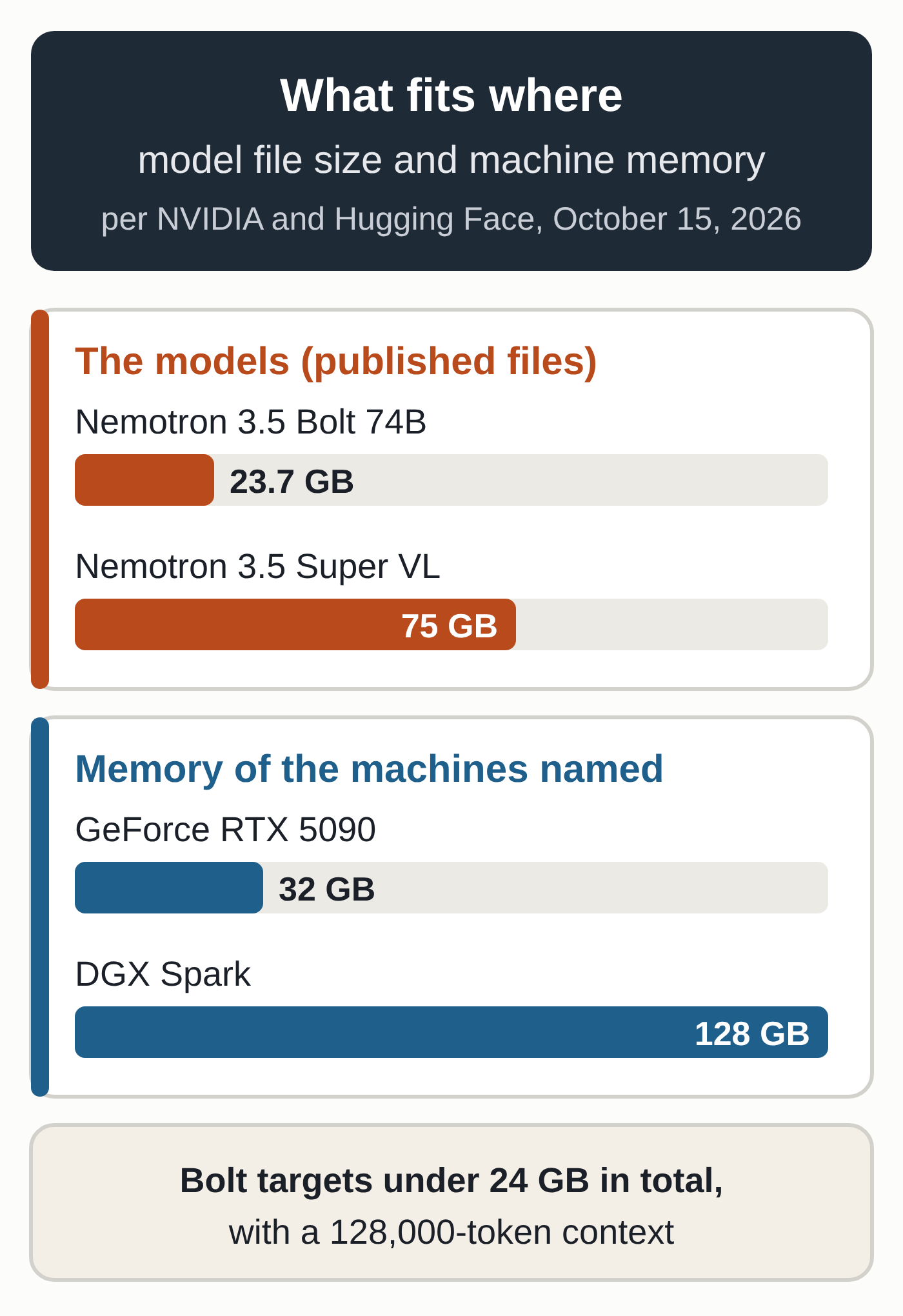
Bolt 74B-A9B is a compressed version of Super VL. Its experts are stored at about 2 bits per parameter (2.0625, to be exact, in the IQ2-XXS format), down from 16 bits in the reference version. NVIDIA’s target was under 24 GB for one request at a time with a 128,000-token context; the maximum context is 256,000 tokens. The GGUF file NVIDIA published (GGUF is the format llama.cpp uses) is 22 GB, plus 1.7 GB for the vision component.
Bolt’s model card pitches it for agent software running on your own machine and for tasks that involve tool calling, web browsing or terminal use. English and programming languages come first, with Spanish, French, German, Italian and Japanese “also being supported,” per the card. Like Super VL, it reads text, images and video.
NVIDIA says it designed Bolt for RTX Spark laptops, due October 16, and that it also runs on GeForce RTX PCs, the DGX Spark, the DGX Station and RTX PRO workstations. The RTX 5090 that NVIDIA tested has 32 GB of memory. Neither the card nor the announcement mentions the 24 GB RTX 4090.
NVIDIA says llama.cpp, Ollama, LM Studio, Unsloth and vLLM support the model. As of late afternoon on October 15 (Paris time), though, Bolt wasn’t in Ollama’s library yet; the only Nemotron 3.5 model listed there was Lightning, released in August.
Bolt’s card also pits it against two other open models, Alibaba’s Qwen3.6-35B-A3B and Google’s Gemma 4 26B-A4B, both tested uncompressed (BF16). Bolt scores 66.75 on BrowseComp (web research) to their 48.74 and 26.30, and 50.98 on Terminal-Bench 2.1 (command-line tasks) to their 44.38 and 37.22. NVIDIA’s blog calls it the top open model in its class on PinchBench, but the card’s own table gives it 87.82, just behind Qwen’s 88.07.
The companies building on Super VL
NVIDIA lists six software makers integrating Super VL: Atlassian for search across Jira and Confluence, Dassault Systèmes for engineering design and simulation, Salesforce for automating government workflows, plus CrowdStrike, Perplexity and Synopsys.
Others have fine-tuned it on their own data. According to the technical blog, Scale AI adapted it to automate vendor credit processing at Skydance, which should cut inference cost 40-fold and latency 5-fold. Ramp is using it to turn receipt photos into structured data and expects up to 50% more throughput.
NVIDIA built Super VL with the Nemotron Coalition, a group of AI labs it launched on March 16, 2026; members include Mistral AI, Perplexity, LangChain and Cursor. The technical blog credits Perplexity with datasets and Prime Intellect with training environments, but doesn’t spell out a role for Mistral AI.
Testing the models in four steps
- Pick a repetitive document task that’s easy to check, such as pulling amounts and dates from vendor invoices, finding a clause in contracts or summarizing a 50-page file.
- Try Super VL first on documents with no personal data, through a hosted service such as OpenRouter. Before you upload a client file, read the data retention policy of whichever provider is hosting the model.
- If the results hold up, run the test again locally with Bolt, on a PC with an RTX 5090 or a DGX Spark, for example. Since Bolt is a compressed version of Super VL, its results may differ. Your documents then stay in the office, which makes your clients’ privacy questions easier to answer. Before you install an agent, our guide to preparing for an AI agent lists the access rights, rules and test phase to plan for.
- Run the same documents (about 20 is enough) through the tool you already use, Claude or ChatGPT, compare the results and log every error. Our guide to choosing an AI model includes a figure-extraction and reconciliation exercise built on this idea, with sample files.
The license allows commercial use
The OpenMDW-1.1 license lets you use, modify and redistribute the model free of charge and “without restriction,” as long as you include the license and the original notices when you redistribute it. It puts no restrictions on the model’s output and leaves it to you to check third-party rights. Your rights terminate if you sue someone claiming the model infringes a patent or copyright, unless your suit responds to one filed against you first.
“Open” here means NVIDIA published the weights, some datasets and the training recipes. You still have to buy or rent the hardware. Meta’s Muse Wonder, unveiled three days earlier, is available through Meta’s API and its Muse Code tool, as our article on Meta’s Muse Wonder explains. With Nemotron 3.5, you download the model itself.
On October 15, 2026, the day Nemotron 3.5 came out, Meta released the weights of Muse Spark Open, an 816-billion-parameter model, under a license that requires a “Built with Muse Spark Open” notice (see our article on the Muse Spark Open license).
The numbers still need outside testing
As of the evening of October 15, we hadn’t found any independent benchmarks of Bolt, and its own model card shows weak spots. On AA-Omniscience, a non-hallucination test designed by Artificial Analysis (the higher the score, the better), Bolt scores 61.27, versus 65.85 for Qwen3.6 and 68.81 for Nemotron 3.5 Lightning, the smaller model released in August. NVIDIA hasn’t published any pricing. The real cost depends on the machine you buy or the host you choose.
From downloaded model to working tool
A downloaded model does nothing on its own. You have to install it, connect it to your documents and decide what it’s allowed to do. If you’d rather have a tool set up for your line of work, our AI assistant is configured with only the access you choose.