

Germany is paying into two satellite networks at once, both meant to give Europe an alternative to Starlink, the network run by Elon Musk’s SpaceX. Each of their satellites would cost dozens of times more than a Starlink satellite, according to the Kiel Institute for the World Economy, a German economics institute. The institute published its calculation on November 23, 2026.
The policy brief puts each low-orbit satellite of IRIS², the European Union’s planned network, at about 33 million euros. For SATCOMBw 4, a network planned by Germany’s armed forces, the figure is 40 to 100 million euros a satellite, depending on how many are built. A Starlink satellite comes to about 1.2 million euros. All three figures are for satellites in low orbit, the band closest to Earth.
“Der deutsche Steuerzahler ist aktuell gleich an zwei Systemen finanziell beteiligt,” the authors write: German taxpayers are currently paying into two systems at once. Germany’s own network, SATCOMBw 4, is estimated at 8 to 10 billion euros in total. Germany’s contribution to IRIS², paid through the EU budget and the European Space Agency (ESA), comes to another 2.5 to 3 billion euros, the authors estimate. The brief is signed by Johannes Binder, Lionel Chambon, Georg Rösel and the institute’s president, Moritz Schularick.
The brief opens with Ukraine, where front-line communications, fire control and drone defense rely on Starlink and Starshield, its military version. In October 2026, Starshield terminals were throttled when used on the move, the authors note. That mainly hit the defense against Russia’s new jet-powered attack drones.
“Access to a capability on which Europe’s security also depends is today decided outside Europe. Instead of closing this gap together, Europe is ordering two networks at once,” Binder said in the institute’s press release.
Two networks for overlapping jobs
The two networks differ in their capabilities but overlap at their core, the authors say. Both are meant to give government and military users secure links from low orbit. Whether a separate German network would add much to IRIS² remains unclear, they write.
The European Commission, the EU’s executive, launched IRIS² in 2023. According to the brief, the plan calls for a constellation, or fleet, of 358 satellites. Of these, 340 would fly in low or very low orbit and 18 higher up, in medium orbit. Of the 340, 66 would be reserved for defense and security.
The Commission put the main constellation at 348 satellites in August, 330 of them in low orbit. The brief adds 10 satellites that would fly below 750 kilometers.
Three satellite operators, Eutelsat, SES and Hispasat, are to run the network. The first launches are planned for 2029. Unlike the German project, IRIS² will also serve commercial customers.
SATCOMBw 4 is the planned fourth stage of SATCOMBw, the satellite communications system of the Bundeswehr, Germany’s armed forces. It would add a layer of 100 to 200 satellites in low orbit. The first 40 are to be in service in 2029 over NATO’s eastern flank, the alliance’s easternmost members, with full operation from 2030.
The contract has not been awarded yet. The institute expects the award around the turn of the year. The German tech news site heise online reports that the contract is expected to go to the arms maker Rheinmetall and the space company OHB.
The two companies founded a joint venture in Bremen to deliver the network, the German defense news site bundeswehr-journal reported in June. The site described Ariane 64, the most powerful version of Europe’s Ariane 6 rocket, as the ideal launcher for the constellation.
How the authors calculated the cost per satellite
The per-satellite figures are the authors’ own calculations. For Starlink, they took the value at which SpaceX carried its roughly 10,000 satellites on its books, before depreciation and with launch costs included. SpaceX reported it on May 20, 2026, in a registration statement filed with the US market regulator, the Securities and Exchange Commission. According to that filing, it stood at 12.9 billion dollars on March 31, 2026, or about 11.2 billion euros at the authors’ exchange rate.
For IRIS², they started from the program’s total of 15.6 billion euros, subtracted the medium-orbit satellites and the ground stations, and spread the rest over the 340 low-orbit satellites. For SATCOMBw 4, they divided the network’s estimated 8 to 10 billion euros by its 100 to 200 satellites.
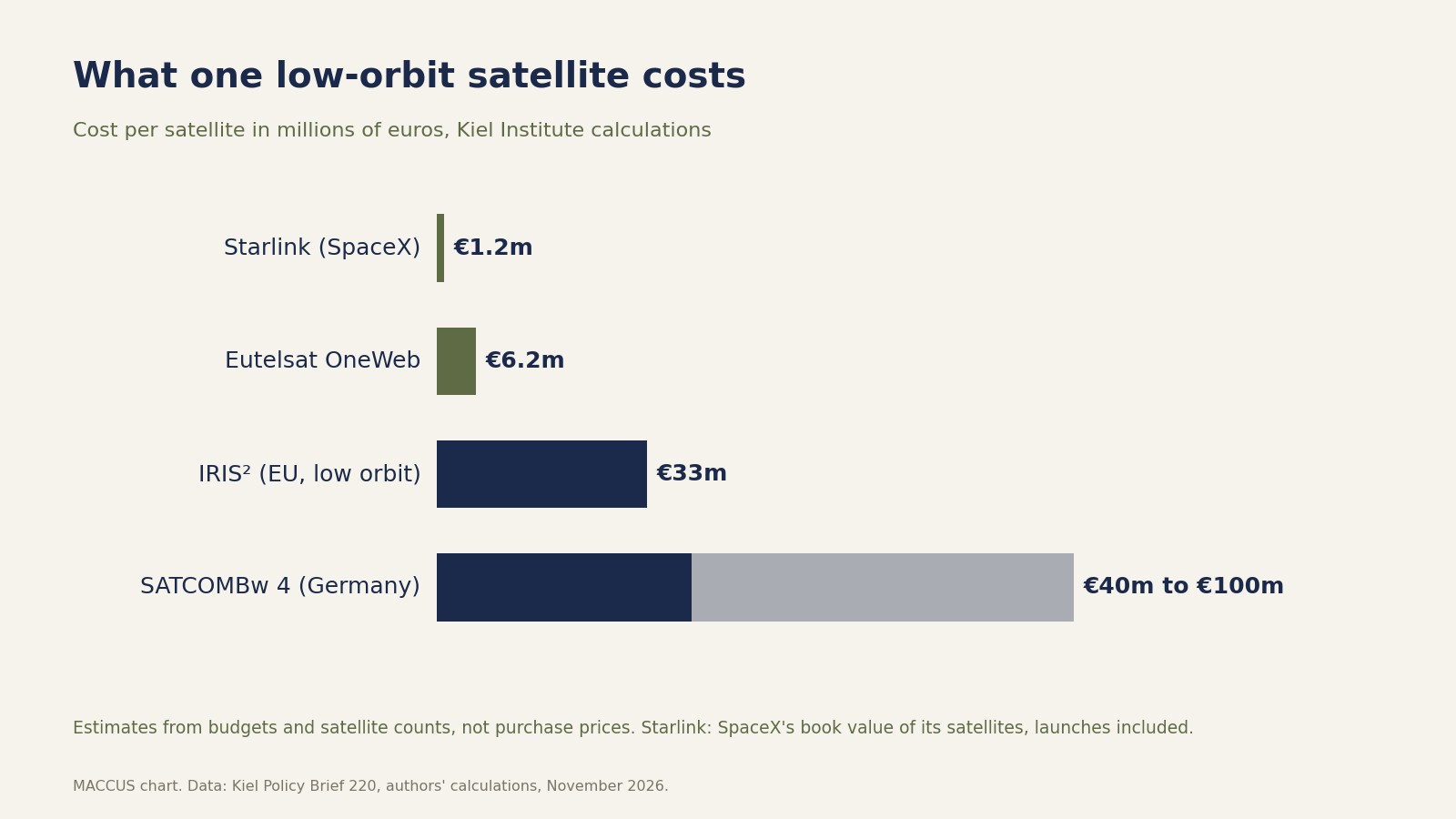
The authors put Eutelsat’s OneWeb, a commercial European network already in low orbit, at about 6.2 million euros a satellite. Starlink is cheaper because of mass production and SpaceX’s fleet of reusable rockets, the brief says. SpaceX flew fewer than half of the world’s orbital launches this year but carried about four-fifths of the mass sent to orbit, largely because of Starlink.
Together, IRIS², SATCOMBw 4 and an expansion of OneWeb are budgeted at about 27 to 29 billion euros, about 20 billion of it public money. The authors put that at about three times the value SpaceX gives its Starlink satellites in its accounts, launches included. At 8 to 10 billion euros, SATCOMBw 4 alone comes close to that Starlink figure, they estimate.
Why the authors say Europe pays twice
The brief treats satellite communications as a “club good,” a service shared by the members who pay for it. The institute’s release likens it to cable television. Almost all of the cost comes when the network is built, through research, satellites, launches and ground stations, and each extra user adds little. Building two constellations means paying those fixed costs twice.
Smaller orders also keep the cost per satellite high, the brief argues, and two buyers with small contracts negotiate worse prices than one buyer with a large contract. ESA’s rules add to the problem, according to the authors. The agency awards contracts largely in proportion to what each member country pays in, rather than to the best bidder. As recently as 2023, Germany got more money back in contracts than it paid in, they note.
The authors see the same pattern in radar reconnaissance from space. Germany, Poland and Finland each bought radar satellites separately from ICEYE, the Finnish maker that bid 2.05 billion euros for Italy’s rocket builder Avio this month. “Europe’s search for a Starlink alternative is emblematic of the fundamental problem of European defence: instead of pooling their strength, countries pursue national projects side by side. Germany should use its defence billions as leverage for an integrated European defence,” Schularick said.
What the numbers leave out
The figures are the authors’ estimates. Forschung und Wissen, a German science news site, points out that they rest on planned project budgets and satellite counts rather than on purchase prices for identical satellites. It also notes that the brief has not been peer-reviewed by outside experts. The Starlink figure covers satellites and launches as SpaceX values them in its accounts.
Satellite counts alone do not allow a technical comparison, the authors write in a footnote. Most IRIS² satellites would fly at 1,200 kilometers, compared with 330 to 500 kilometers for Starlink, so each would cover a larger area. Because no European program publishes how much capacity it needs, the brief cannot say whether either network would be enough for a war like the one in Ukraine.
Neither German amount is final: the SATCOMBw 4 contract is not signed, and the IRIS² figure is an estimate based on Germany’s shares of the EU and ESA budgets. The institute says 2.15 billion euros are already earmarked for SATCOMBw in Germany’s draft budget for 2027. The budget committee of the Bundestag, Germany’s parliament, approved an amended version of the budget on November 13, and the final vote is scheduled for November 27.
What it means for Europe
Our reading: if IRIS² is built as planned, Europe will have a network of 340 low-orbit satellites that it controls, run by European operators. Poland, Hungary and Spain have made additional contributions, Norway and Iceland are joining, and South Korea is considering linking its planned military constellation to IRIS², the brief says. “When we have IRIS², it will be better than Starlink,” Andrius Kubilius, the EU commissioner for defense and space, told Euronews in January.
The gap with the US company is still wide: Starlink already has roughly 10,000 satellites in orbit, while the first IRIS² launches are planned for 2029. The Kiel figures put the combined budget of the three European projects at about three times the accounting value of SpaceX’s Starlink satellites. By the same figures, each EU or German satellite would cost about 30 times more than a Starlink satellite.
The next decision is Germany’s: the authors propose that it bring SATCOMBw 4 into a common European system as its contribution. Under their proposal, contracts would be awarded by competition rather than by national quotas, and each country’s usage rights would match its funding. The window is the SATCOMBw 4 award, expected around the turn of the year. Once terminals and interfaces are bought, the authors write, the split will be locked in for decades.
Sources
- Völlig losgelöst: Deutschland, Europa und die Kosten der Starlink-Alternativen (Kiel Policy Brief 220), Kiel Institute for the World Economy, November 23, 2026
- Disconnected and paid twice: Europe’s costly fragmentation in space, Kiel Institute for the World Economy, November 23, 2026
- Teure Doppelstrukturen im All: Europas Starlink-Alternativen werden zu teuer, heise online, November 23, 2026
- Satelliten der Bundeswehr kosten bis zu 80-mal so viel wie Starlink, Forschung und Wissen, November 23, 2026
- Commission accelerates IRIS² deployment with enhanced security and expanded satellites network, European Commission, August 7, 2026
- SATCOMBw Stufe 4: Joint Venture von OHB und Rheinmetall, bundeswehr-journal, June 12, 2026
- Bereinigungssitzung: Ausschuss beschließt Bundeshaushalt 2027, German Bundestag, November 13, 2026
- EU can’t replace Musk’s Starlink yet, but is on right track, Kubilius tells Euronews, Euronews, January 28, 2026