

About 27 million songs on Tidal are tagged as made entirely by AI, and 96% of them have not been played once in the last three months. The music streaming service gave those figures on November 24, 2026, when it announced on X that it will reject and remove every wholly AI-generated track starting December 9. Those songs make up 6.3% of Tidal’s catalog. Robert Andersen, who runs Tidal, expects all of them to be gone by the beginning of 2027, according to Rolling Stone.
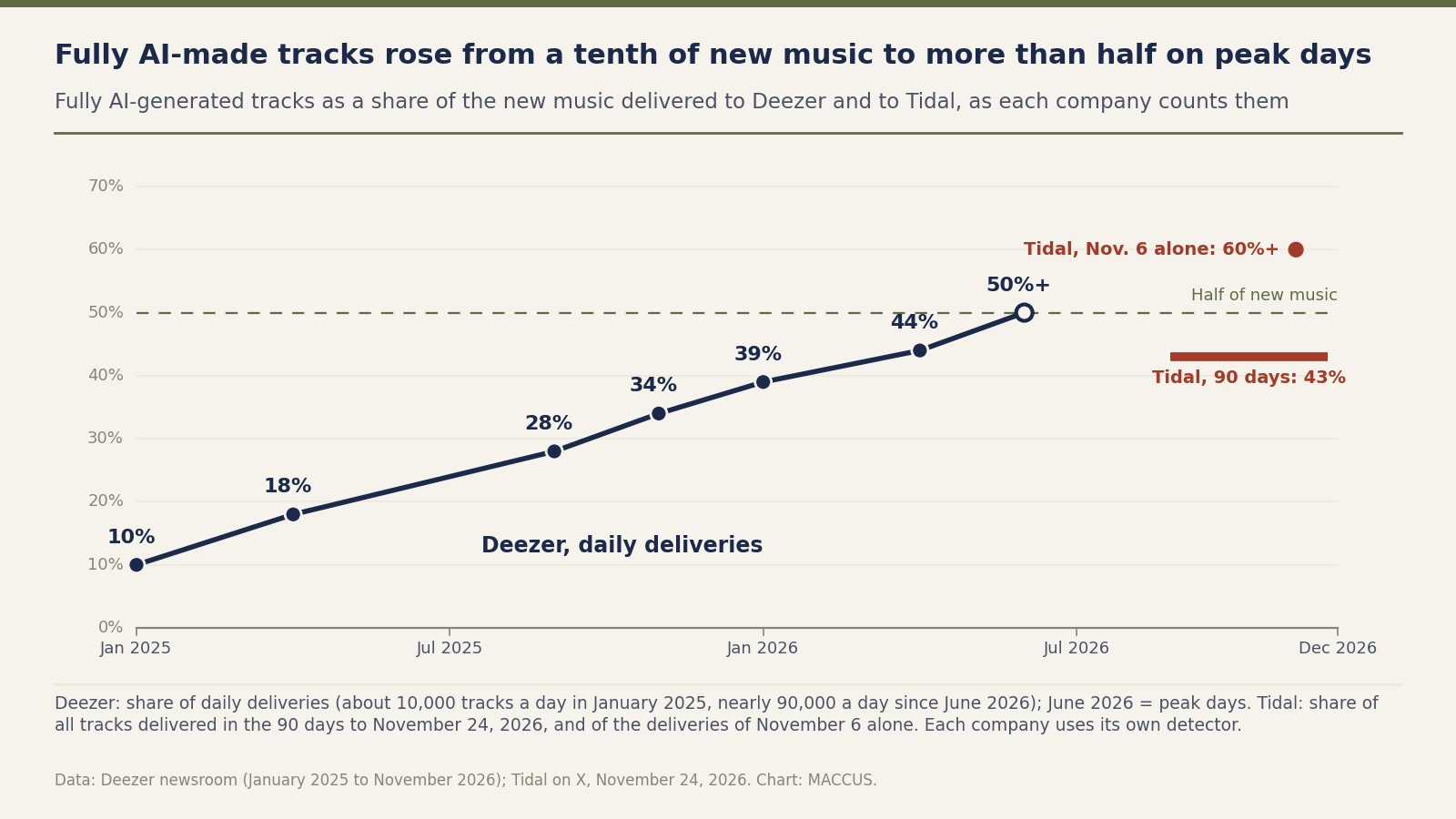
Tidal ties the timing to the volume of uploads: over the past 90 days, 43% of all tracks delivered to it were detected as wholly AI-generated. On November 6 alone, such tracks made up more than 60% of the day’s deliveries; Tidal called it “the greatest influx of AI music yet.” To decide which songs count, Tidal uses detection software from its partner Ircam Amplify and the track details sent by distributors, the middlemen that deliver songs to streaming services. A track whose details say it was made solely with AI tools will be turned away; songs made with the help of AI tools, but not by them alone, will stay.
A flood of songs almost nobody plays
Tidal’s figures are in line with what Deezer, a Paris-based streaming service, has measured since it started detecting AI music in January 2025. At the time, about 10,000 fully AI-generated tracks reached Deezer each day, roughly 10% of the new music delivered. That share passed 18% in April 2025, 28% in September and 34% in November.
In 2026, fully AI-generated tracks averaged about 39% of new deliveries to Deezer in January and about 44% in April. In June, when about 90,000 arrived each day, they made up more than half of all new deliveries on peak days. Deezer said on November 17 that it still receives nearly 90,000 a day. Tidal anticipates a similar flow: according to Rolling Stone, Andersen expects to reject 80,000 to 85,000 songs a day once the ban takes effect.
Listening has not followed the uploads. Deezer says fully AI-generated music accounts for 1% to 3% of all streams on its service. It puts that low share down to keeping those tracks out of its recommendations and editorial playlists.
By Deezer’s count, up to 85% of the streams those tracks did get in 2025 were fraudulent, compared with 8% of streams across its whole catalog. Deezer says generating fake streams remains the main reason people upload AI music. It removes the fake plays it detects before paying royalties.
Tidal points to a second problem: songs falsely released under real musicians’ names. It has taken down more than 65,000 tracks flagged as suspected impersonations of artists. Such songs divert “streams and royalties away from the artists,” the company wrote, and they confuse fans.
Tidal goes further than its rivals
Tidal’s first step came in June. From July 15, wholly AI-generated tracks were labeled for listeners and earned no royalties. Andersen wrote at the time that Tidal received “an overwhelming amount of AI-generated music from 3rd party distributors.” In its new post, Tidal says labeling those tracks and cutting their royalties were “not enough.”
The other large streaming services have stopped short of a blanket ban. Deezer tags AI tracks and keeps them out of its recommendations and editorial playlists. In July, it said it would also take down AI tracks used for streaming fraud and those not streamed for six months or more.
Spotify said on October 20 that it had taken more than 50 million “slop and spam” tracks out of its recommendations this year, but those tracks remain on the service. “Slop” is slang for low-quality content churned out in bulk. The Hollywood Reporter reports that Spotify and Apple Music label AI tracks or keep them out of recommendations, yet both still accept fully generated uploads. Variety, citing Billboard, reported that Apple Music told partners in a March memo that AI music made up less than 1% of its plays each week.
According to Rolling Stone, Andersen wrote on X that the decision makes Tidal the first streaming platform to ban AI music. He urged others in the industry to “follow suit.” Bandcamp, an online music store popular with independent musicians, banned AI-generated music outright in January 2026, Digital Music News notes.
The same rise shows up outside music. Steam, an online store for PC games, asks developers to declare content made with generative AI. According to a count by the games site PCGame.com, about half of the new games released there in October carried that flag. Roblox, an online game platform, says two games created almost entirely with AI reached its top 20.
The limits of AI detection
The upload and listening figures above come from the companies themselves, which count AI tracks with their own detectors. Tidal’s post gives no error rate for its detector. A Tidal spokesperson told Rolling Stone that “the vast majority of appeals we have received have been reaffirmed upon closer review, which means the detection success rate is very high.” The spokesperson added that “a small amount of false positives is inevitable,” meaning some songs made by people will be wrongly flagged as AI.
Deezer does publish an error rate. It says its tool is 99.8% accurate, may miss about 2 of every 1,000 AI-generated tracks and may wrongly flag fewer than 1 in every 10,000 tracks made by people. The tool looks for traces that AI song generators leave in the audio and that people usually cannot hear.
Mass removals can still hit real artists. Earlier this year, Rolling Stone recalls, the distributor DistroKid took down real music by mistake during takedowns linked to a lawsuit filed by the record company Universal Music Group. DistroKid apologized and denies Universal’s accusations.
Tidal’s post bans tracks that are the “sole outputs” of AI tools, but it does not say how it tells them apart from songs made with AI’s help. The 96% figure also covers only tracks already tagged as AI, and only the last three months. By Tidal’s own figures, that leaves roughly a million tagged songs that did get at least one play in that period.
Listeners mostly cannot hear the difference. In a blind test of three tracks, 97% of respondents failed to pick out the AI-generated songs. The test was part of a Deezer survey run by Ipsos, a polling firm, and the results came out in November 2025.
In this year’s edition of the survey, published November 17, 80% of the 9,000 people surveyed in eight countries said all AI music should be labeled. Deezer also found that nearly 57% of the more than 53,000 people who switched to it from other services in October already had at least one fully AI-generated track in their playlists. In the survey, 74% of streaming users thought their playlists held none.
What it means
Making a song with AI now costs close to nothing, and supply has surged: in about a year and a half, fully AI-generated tracks went from roughly a tenth of Deezer’s daily deliveries to more than half on peak days. Listening has not kept up, partly because Deezer keeps these tracks out of its recommendations, and Tidal says almost none of its AI tracks are played. According to Deezer’s chief executive, Alexis Lanternier, most of the AI music uploaded to Deezer is meant to commit fraud.
Tidal, Deezer, Spotify and Apple Music all accept music made with the help of AI and differ on fully generated tracks. Tidal will delete them, and Deezer hides them from recommendations and takes down those used for fraud or left unplayed for six months. Spotify takes what it calls slop out of recommendations, and Apple Music relies on labels.
Starting December 9, Tidal’s detector will decide each day which tens of thousands of uploads are turned away, while most people cannot make that call by ear. Two things are worth watching: how many real artists win appeals after being flagged, and whether Spotify or Apple Music follow Tidal or keep labeling and filtering.
Sources
- Tidal Is Deleting, Rejecting, and Banning Fully AI-Generated Music, Tidal (X), November 24, 2026
- Tidal Is the First Streaming Service to Ban AI Music, Rolling Stone, November 24, 2026
- Tidal Bans Wholly AI-Generated Music: “Serious Problem That Has Only Increased in Scale”, The Hollywood Reporter, November 24, 2026
- Breaking: TIDAL Fully Bans AI-Generated Music, Digital Music News, November 24, 2026
- Tidal to Label AI-Generated Music, Ban Royalties from AI Song Streams, Variety, June 29, 2026
- Deezer confirms demonetization of up to 85% of AI-music streams due to fraud and moves to sell AI-detection Technology, Deezer, January 29, 2026
- Deezer: AI music has surpassed 50% of new music uploads for the first time, Deezer, July 21, 2026
- Deezer/Ipsos: 80 % of people agree that all AI music should be labeled, both fully AI-generated tracks and AI-assisted creations, Deezer, November 17, 2026