

On Monday, November 23, 2026, OpenAI and Cisco released Shirudo, open-source software for Linux servers. It lets teams place a temporary “shield” on a running machine: a small program that blocks attacks on a known flaw until the real patch is installed. AI agents, programs that carry out a chain of tasks on their own, write and test the shield. According to OpenAI, a human operator then approves its deployment.
The people behind Shirudo say AI now finds flaws faster than teams can fix them, and the software is aimed at that gap. On November 4, OpenAI said an unreleased AI model had found 948 flaws in the Linux kernel that let a local user take full control of a machine. The kernel is the core of Linux. Nine days later, the number of software flaws published in 2026 passed 100,000.
Shirudo is not ready for ordinary servers yet: its GitHub page calls it a pre-release. In production, it needs a modified Linux kernel and a TPM 2.0, a hardware security chip. The only published demonstration against a real flaw is a controlled test run by the project’s own teams. It targeted Java4Shell, a serious flaw in Java.
Blocking the attack without stopping the service
OpenAI’s case rests on a simple point: testing and rolling out a patch can still take days or weeks. “Finding a bug today doesn’t mean you can patch every system tomorrow,” said Greg Brockman, OpenAI’s president and co-founder. In the meantime, blocking the Linux operation that an attack relies on can take the service down, because normal requests sometimes go through it too. A shield has to stop the attack and let everything else through.
Shirudo, Japanese for “shield,” is built on eBPF. eBPF is a Linux technology that runs small programs at specific points in the system without restarting the machine. The kernel checks each program for safety before loading it.
According to OpenAI, teams can watch how a shield affects their applications before switching it on. “Once an operator approves the shield, it can be deployed while the service continues running,” the company writes.
Signatures, a TPM chip and a human sign-off
Each shield is signed with a cryptographic key and verified before it loads. According to the GitHub page, once Shirudo starts at boot, the machine accepts only eBPF programs loaded by signed tools. The project’s FAQ says root, the administrator account with full rights over the machine, cannot turn Shirudo off without the signing key. The FAQ adds that a flaw giving access to the kernel itself would get around all of these checks.
Each time the machine starts, the TPM chip keeps a record of every shield loaded and removed. The shirudo attest command turns that record into evidence an operator can check offline. “Security teams control what gets deployed,” OpenAI writes. Cisco describes agents doing the legwork while “people keep the keys and set the boundaries.”
Three of Shirudo’s five core maintainers work at Isovalent, which Cisco acquired. Isovalent’s technical post adds a caveat to that split between agents and people. Screenshots of its demonstration show a “fully automated process” run from Codex, OpenAI’s coding agent. The deployment step, Isovalent writes, “can be designed to be more or less autonomous.”
A Java4Shell demo with a shield written in Java
Java4Shell, the flaw picked for the demonstration, was disclosed on November 17 by Calif, a security research firm. It affects OpenJDK, the most widely used open-source version of Java. The bug sits in its Base64 decoder. Base64 is a common format that turns data into text.
On some Intel and AMD processors, malformed input makes this decoder write outside the memory area it was given. An attacker can use that to take control of a server remotely. The flaw is rated 9.2 out of 10 on CVSS 4.0, the standard scale for rating security flaws.
The bug had already been reported publicly in June, but it was not fixed at the time. Calif says it found the bug independently on October 24 with Codex, without knowing about that report. The firm says it then exploited the flaw in several applications, including the enterprise search engine Elasticsearch.
Oracle, which develops Java, released the fix on November 17, along with an OpenJDK security advisory. Calif also lists two Java startup settings that neutralize the flaw. Using them means restarting the application.
To test Shirudo, the project team described the flaw to Codex, which produced the shield. According to OpenAI, the shield adds a check on the data the Base64 decoder receives. The company says the team attached it to Elasticsearch while the search engine was running.
Isovalent says the shield was “written as Java bytecode.” Bytecode is the low-level code that Java runs. The test ran on Elasticsearch version 9.5.5, and “the exploitation was not successful,” Isovalent writes.
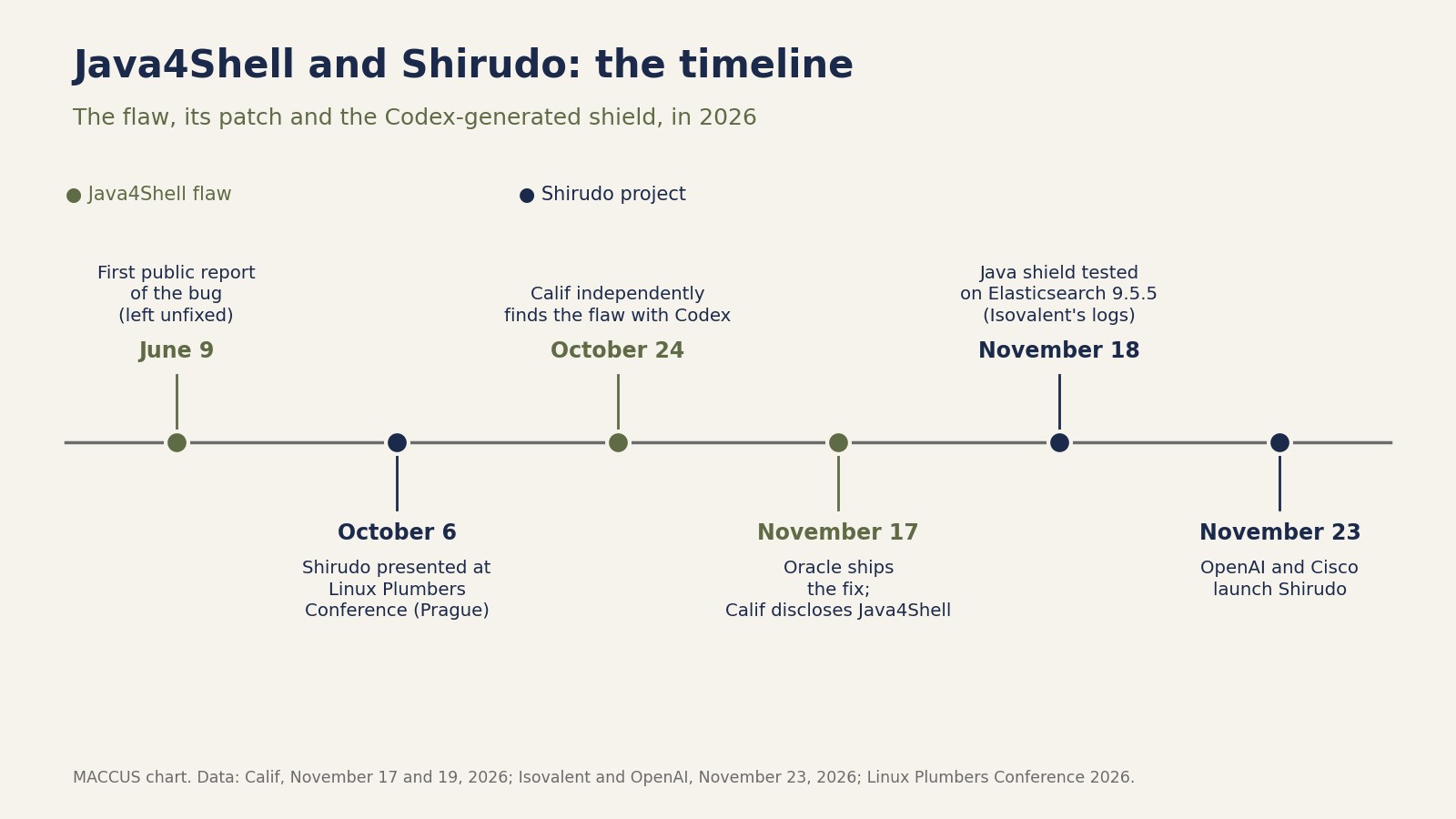
The Elasticsearch activity logs Isovalent published are dated November 18, the day after Oracle’s official fix. Cisco also says that in testing, Shirudo wrote code that blocked attempts to exploit a flaw in PHP, a programming language for websites. The company does not name the flaw and gives no figures.
A pre-release that requires a modified Linux kernel
The project’s documentation is more cautious than the announcements. Its FAQ asks, “Is shirudo ready for production?” and answers, “Not yet.” It adds that the software has no stable release and no maintained release branch, meaning no version that keeps receiving fixes. As of November 24, the only release on the project’s GitHub page was a test kernel.
Every protected machine needs a TPM 2.0 chip, with no exceptions. The kernel must come from bpf-next, the development version of Linux where new eBPF features are built, with several changes added for Shirudo. There is no compatibility mode and no fallback for older kernels. Common security tools such as Falco or Cilium do not run unmodified on a protected machine.
Java shields have limits of their own. Java applications run inside a program called the Java virtual machine. According to the documentation, that program loads shields only when it starts, so new shields take effect after a restart. In the demonstration, though, the shield was added to Elasticsearch, a Java application, while it was running, and neither OpenAI nor Isovalent says how.
The documentation also notes that a Java shield works inside the application, and the kernel does not enforce it. It adds that Shirudo does not replace kernel updates: a shield covers the time until the patched kernel is installed.
Shirudo, a rewrite of Tetragon, is open to contributors
In 2022, Isovalent released Tetragon, an open-source security tool built on eBPF. Tetragon is the foundation of Live Protect, according to two Isovalent executives, Thomas Graf and Liz Rice. Live Protect is the protection against security flaws built into Cisco products. Graf and Rice describe Shirudo as “a rewrite of Tetragon designed for agents.”
They argue that AI agents work better when they write code than when they use rule languages designed for humans. The project was presented on October 6 in Prague at the Linux Plumbers Conference, an annual gathering of kernel developers. OpenAI contributes its AI models to the project.
The code is released under the BSD 2-Clause open-source license, and the eBPF programs are available under both the BSD and GPL licenses. Both companies are inviting developers and researchers to contribute. A simulated test computer with a software version of the TPM chip lets anyone try Shirudo without dedicated hardware. A technical webinar is scheduled for December 15.
What it means
The problem Shirudo targets is real. According to Isovalent, a critical fix still takes days, weeks or even months to reach most systems. Attackers exploit that delay. On November 16, Google described an AI tool that turns published patches into attacks on its own.
For most companies, the benefit is still a long way off. All the use cases the project lists assume a team that runs its own kernel. They include containers and Kubernetes pods, two ways of isolating applications on a server. They also include AI agents and embedded devices (computers built into other equipment) that rarely get updates.
On shared hosting, where many customers use the same server, the kernel belongs to the hosting provider. Shirudo is unlikely to change anything there in the short term. For everyone else, installing a modified development kernel on live servers is a project in its own right.
The published evidence is thin. It comes down to one documented test, run by the project’s own teams on a flaw patched the day before. That test used a Java shield rather than an eBPF one.
As of November 24, no independent test had been published. Neither had any figure on how often shields block legitimate requests by mistake. The “industry-first” label attached to Shirudo comes from Cisco itself.
There is no date yet for a stable release, or for when Shirudo’s kernel changes might reach the standard versions of Linux. OpenAI says it wants to publish tested shields alongside public announcements of security flaws.
It is not yet clear who will write those shields or who will stand behind them. Nor is it clear whether flaws that OpenAI finds, such as the 948 in the kernel, will come with shields. The December 15 webinar may offer first answers.
Sources
- OpenAI and Cisco introduce Shirudo, OpenAI, November 23, 2026
- Cisco and OpenAI Launch Shirudo, A New Project to Safeguard Agentic AI, Cisco Newsroom, November 23, 2026
- Cisco and OpenAI introduce Shirudo, Isovalent (Thomas Graf and Liz Rice), November 23, 2026
- shirudo-dev/shirudo (README), GitHub, accessed November 24, 2026
- FAQ, Shirudo documentation, accessed November 24, 2026
- System requirements, Shirudo documentation, accessed November 24, 2026
- Java agent upatches, Shirudo documentation, accessed November 24, 2026
- Java4Shell: Write once, RCE everywhere, Calif, November 17, 2026