On the evening of October 8, 2026, European time, ChatGPT stopped adding the utm_source=chatgpt.com parameter to a large share of its outbound links and started opening them without passing a referrer. Google Analytics 4 could no longer tell where those visits came from, so it counted them as Direct. The tagging came back between October 15 and the morning of October 16, UTC. Where the ChatGPT line collapsed that week, most of those visitors probably still showed up.
Cedric Huesler, a senior director of product management at Adobe, says OpenAI confirmed to him on October 14 that it was a known bug. OpenAI hasn’t published anything about it, and its ChatGPT release notes, which we reread on October 17, don’t mention the problem or the fix. Normally, GA4 files these visits under its AI Assistant channel.
A week of mislabeled visits
It started with GPT-6, according to Huesler and Profound, a company that sells a tool for tracking brand visibility in AI answers. OpenAI’s release notes say the model and its new answer format, Intelligent UI (comparisons, diagrams and small tools built into the answer), rolled out to paid plans on October 7 and to Free and Go plans starting October 8.
Every half hour, Profound collected ChatGPT answers that cite links and tracked the share with at least one tagged link. Its data, published on its blog, and Huesler’s account produce the timeline below, with times converted to UTC.
| Date and time (UTC) | What happened |
|---|---|
| October 8, 6:30 p.m. | Profound sees the share of answers with a tagged link start to fall |
| October 8, around 9 p.m. | Per Huesler, visits attributable to ChatGPT fall to about a third of their usual level within hours |
| October 14, 7 p.m. | Profound sees a second drop: 5% to 12% of answers keep a tagged link for about 27 hours |
| October 15, 9 a.m. | The fix starts rolling out, per Huesler; by 4 p.m., tagged clicks are back to 95% to 100% of their level a week earlier |
| October 16, 6:30 a.m. | Profound again records about 99% of answers with a tagged link |
The two sources don’t measure the same thing. Profound counts answers it collects itself; Huesler counts clicks recorded in Adobe’s data across thousands of domains. SEO consultant Glenn Gabe replied to Huesler that he wasn’t yet seeing the tags come back on his free or paid accounts, Search Engine Journal reports.
The numbers point to a tagging problem
Huesler compared October 9 through 13 with the week before, across about 500 pages where ChatGPT drove at least 5% of visits. On those pages, ChatGPT lost about 31,000 visits a day, while Direct gained about 26,000. Direct grew on two out of three pages that lost ChatGPT traffic, compared with about one in two the week before. Huesler calls the findings preliminary, based on four days of sampled data.
LLM Pulse, another tool vendor, measured a roughly 46% drop in ChatGPT sessions from October 9 through 11 on the sites it monitors. On those same sites, total traffic held steady and visits from Perplexity and Claude didn’t move. Graphite, an SEO services firm cited by Search Engine Journal, puts the drop at 22% to 57% depending on the site, or about 45% overall. Search Engine Journal notes that these companies sell SEO tools or services.
On Reddit, an analyst with access to a large online store’s server logs reported the same break in the data and placed it within a single hour, on October 8 between 9 and 10 p.m. UTC.
Two signals lost at once
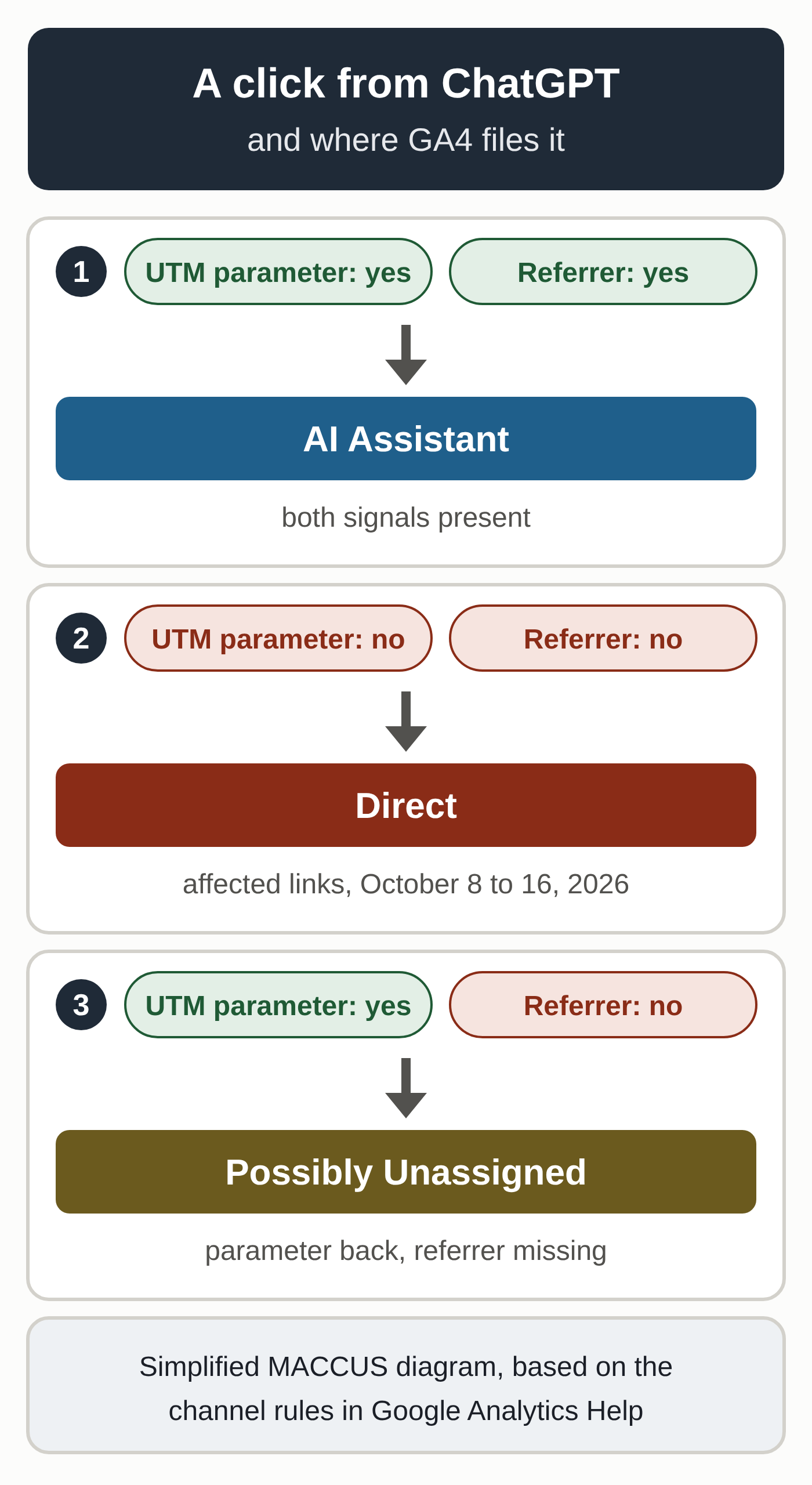
Two signals identify a visit from ChatGPT: the utm_source=chatgpt.com parameter added to the link, and the referrer (the address of the previous page, which the browser passes along to the site). According to Huesler, GPT-6 opened links in a new tab without the parameter and with the “noreferrer” option, which strips the referrer. Without either signal, GA4 has no record of the source and files the visit under Direct.
Some links escaped the problem. Graphite CEO Ethan Smith, cited by Search Engine Journal, found that inline links in the answer text lost the parameter, while links in the Sources panel and shopping links kept it. He says that on the sites Graphite tracks, 95% of ChatGPT visits on mobile relied on that parameter alone. That made clicks from the app the most exposed.
Getting the parameter back doesn’t fix everything. On October 15, Huesler wrote that the referrer was still missing on most ChatGPT clicks. Google’s help page on default channel groups says GA4 sets the medium to “ai-assistant” when the referrer matches its list of AI assistants. So a visit that arrives with utm_source=chatgpt.com but no referrer and no medium matches neither the AI Assistant rules nor the Direct rules, and may end up in Unassigned.
Two questions still open
As of October 17, OpenAI hadn’t said anything publicly about the bug. The confirmation comes from one person, Huesler, even though his numbers line up with those from Profound, LLM Pulse and Graphite. If OpenAI ever describes the incident differently, the timeline above will need revising.
Then there’s the referrer. As long as it’s missing, the classification of ChatGPT visits depends entirely on the parameter, and a URL that gets copied and shared without the parameter will land in Direct. According to LLM Pulse, Gemini also appears to have changed how it tags its links between September 28 and October 2. On October 15, Cloudflare and OpenAI said they had brought hundreds of millions of pages into ChatGPT’s index, without publishing any traffic figures, as our article on the Cloudflare and OpenAI pilot explains.
The limits of the data
Visits classified as Direct between October 8 and 16 will stay that way. No analytics tool can recover a source that was never sent, and nobody has announced a backfill. LLM Pulse flags another limit: ChatGPT’s new answer format may resolve more questions without a click, and analytics tools can’t measure that effect while part of the traffic goes unlabeled.