Meta launched its Muse personal agent in Japan on Friday, October 23, 2026 (Japan time), on iOS, Android and the muse.ai website. Japan is the first country outside North America to get it: Muse went live in the US on September 8, then in Canada. The agent sends emails, manages a calendar, books travel and places online orders, and it asks for the user’s approval before buying anything or sending an email.
Two days earlier, as Meta reported its quarterly results, Mark Zuckerberg shared usage figures: more than 10 million people in the US and Canada set up Muse in its first six weeks, and shopping is its top use. Meta’s CEO also explained why the agent is not available everywhere yet: it is compute-intensive to run, and each country requires adaptation and connector work. Meta has given no date for France, Belgium or the rest of the European Union.
Muse is the app, not to be confused with the models that power it, and the app is what launched in Japan. According to Zuckerberg, Muse Spark is the default model in the free tier, and Muse Wonder, unveiled on October 12, is available in the paid tier. Meta released an open-weights version of Muse Spark on October 15.
Global connectors, with three Japanese integrations in the works
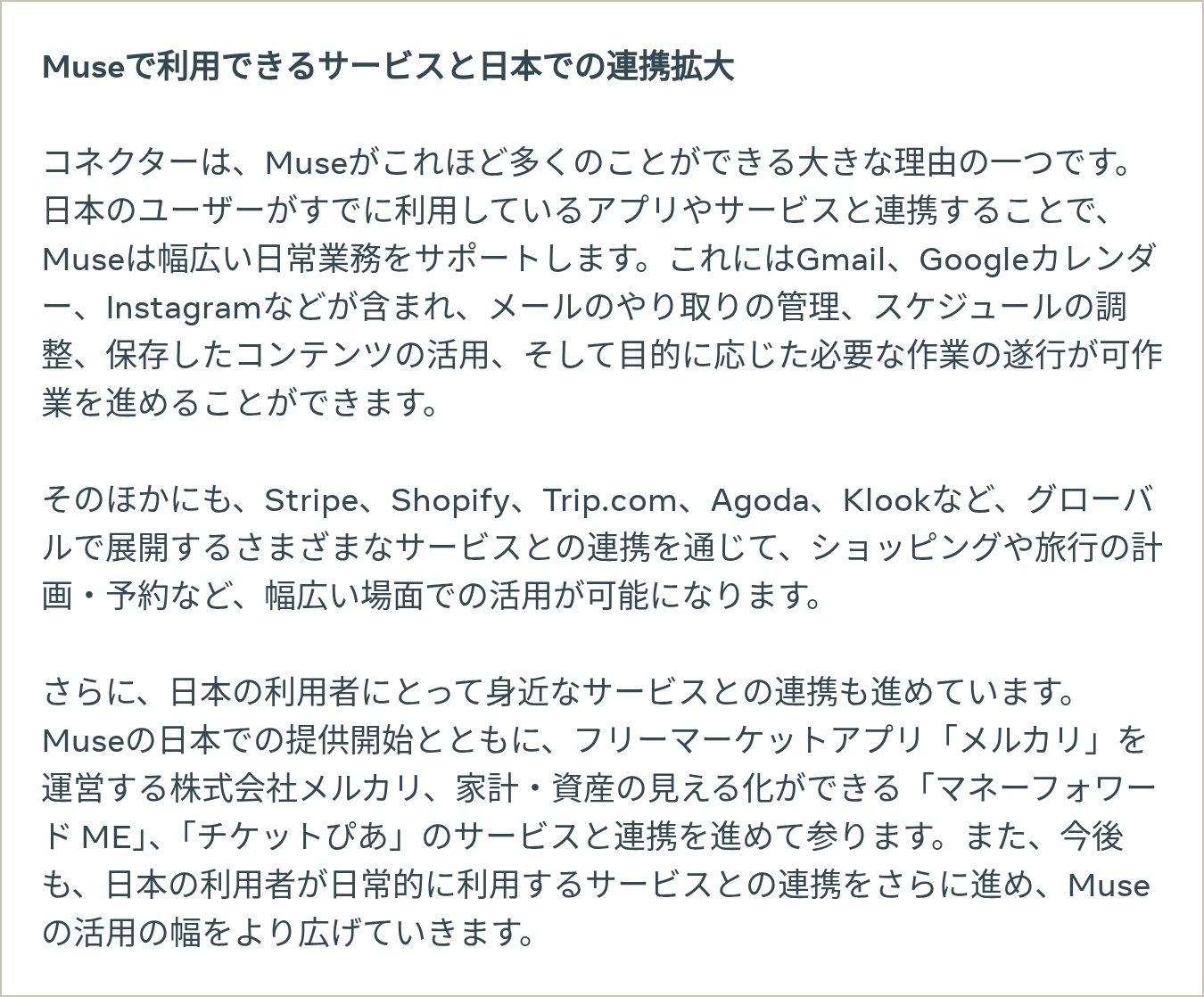
Meta’s announcement in Japan focuses on connectors, the links that let the agent act inside a user’s other services. At launch, Muse connects to Gmail, Google Calendar and Instagram, among others, to handle email, schedule appointments and use saved content. For shopping and travel, Meta lists services that operate worldwide: Stripe, Shopify, Trip.com, Agoda and Klook.
Three Japanese names round out the list: the secondhand marketplace Mercari, the budgeting app Money Forward ME and the ticketing service Ticket Pia. Meta says it is working on these integrations but does not describe them as available at launch. Masahiro Ajisawa, who heads Meta’s Japan unit, lists the companies behind these services among its Japanese partners and says he wants Muse to be useful for shopping, travel and day-to-day scheduling.
According to Meta, many basic features are free, and a subscription plan is available for heavier use. The announcement gives no price. The Japanese tech news site Impress Watch reports a Meta subscription starting at 2,799 yen a month, about $18 at the European Central Bank’s October 22 reference rates. On the Japanese App Store, the app is free with in-app purchases and rated 18+.
Meta will give details separately on the availability in Japan of three features it showed at its Meta Connect conference: the advanced voice mode, the Muse Realtime Avatar (English only) and a dedicated email address for each agent.
The figures Meta gave investors on October 21
On the third-quarter earnings call, Mark Zuckerberg said that “in just a month and a half, more than 10 million people in the US and Canada have set up Muse personal agents.” He said about a quarter of them use it on any given day, and that the app has been “#1 in the App Store almost every day.”
Zuckerberg called shopping the most common use case, “with more than a quarter of people who are using Muse engaging in this with an average purchase size over $200.” Asked by an analyst, he said that figure includes travel. CFO Susan Li put it differently: shopping is “being used by over 25% of Muse weekly actives.”

According to Zuckerberg, the fintech company Plaid told Meta it had never seen this much activity through its connector on any other service. In the first week, Meta had to work with Stripe to raise credit limits because volumes exceeded everyone’s expectations. Meta also released its advertising figures that day, which we covered in our article on Facebook and Instagram ad prices.
The business model Meta described keeps the product free for most people. Meta wants to collect a fee on the transactions the agent helps complete, which Zuckerberg expects businesses to pay, and to sell subscriptions to people who want the most advanced models or more tokens. Businesses will also be able to subscribe to use Muse for work.
Some merchants open the door, others block it
Susan Li sized the business opportunity: based on a user survey, Meta estimates that at least 500 million self-identified small businesses use its apps. Muse could help them find customers, she said, and over time “consumer and business agents could connect and transact directly.”
An extension of Muse for small businesses, launched in late September inside the app, connects to a company’s Instagram account, Facebook pages or Meta ad accounts, as well as services like Shopify, QuickBooks and Canva. According to Li, the agent can then analyze ad and content performance, draft campaigns and write replies to customers.
Li also said some businesses are “understandably focused on protecting customer relationships.” Meta is betting on structured exchanges between agents: earlier in October, it previewed the Personal Agent Protocol, an open standard it is developing with Sierra, Walmart, Stripe and Shopify, among others, to define how a consumer’s agent deals with a business’s agent.
In the US, Amazon began blocking Muse on its site on September 20, TheStreet reported, citing Bloomberg. The next day, Shopify said it would open every store on its platform to the agent, with no integration work required of individual merchants and with checkout through Shop Pay. According to Meta, Muse opens its own browser and fills out forms on the user’s behalf. Our guide to agent-ready websites explains how this kind of software reads a store’s pages.
In Japan, the business daily Nikkei notes that if these features catch on, consumers could use shopping sites and travel booking services less, and the companies behind them could lose direct contact with their customers.
Figures without outside verification
The usage figures come from Meta, which gave them to investors without a breakdown or an audit. The base changes depending on who is speaking: “more than a quarter of people who are using Muse” for Zuckerberg, “over 25% of Muse weekly actives” for Li, with no count of buyers and no total spend. The 10 million figure counts people who set up the agent; Meta gives no absolute number of active users. Impress Watch reports more than 10 million downloads in a month, wording Meta does not use.
“The world’s first personal AI agent” is Meta’s own description. The Japanese App Store listing itself warns that Muse may give inaccurate information or act unexpectedly, and asks users to check its work.
On security, too, the details come from Meta. Each user gets an isolated virtual machine in the cloud, Muse Secure VM, which stores the data and credentials of connected services, and a separate agent, Sentinel, controls internet access. Meta also says Muse cannot see passwords or payment methods, users can opt out of having their interactions used to train its models, and conversations are not shared with its ad systems. An encrypted version with a key only the user holds, Muse Confidential VM, was promised in September for later this year.
What it means
For the first time, the agent that shops on its users’ behalf has left North America. For merchants in Europe, Muse is still a North American story, and now a Japanese one: the agent is not offered in Europe, and Meta has announced nothing for the region. Anthropic is taking the same path with Claude Duet, its proactive agent launched in preview on October 21, limited to US subscribers and with no date for Europe.
Where it runs, Muse relies on existing payment and commerce infrastructure, notably Stripe and Shopify. In the US, Shopify’s open door and Amazon’s block exist side by side, and Meta is betting on an agent-to-agent standard to bridge the two.
Zuckerberg named two constraints on expanding to new countries: compute costs and the work of adapting the product to each market, connectors included. On compute, Meta expects to improve Muse’s cost efficiency by more than 10x in the next year. Zuckerberg did not cite regulation to explain the timing, and Meta has not said why Japan came first.
Still to watch: whether the Mercari, Money Forward ME and Ticket Pia integrations go live; which country is next and where Europe fits in the rollout; subscription prices in Japan, which Meta has not published; and how much Muse is used for shopping in Japan.
Sources
- Meta、パーソナルAIエージェント「Muse」を日本で提供開始, Meta (Japan newsroom), October 23, 2026
- Meta Platforms, Inc. (META) Third Quarter 2026 Results Conference Call, Meta (investor relations), October 21, 2026
- Introducing Muse: The World’s First Personal AI Agent Built for Everyone, Meta, September 8, 2026
- Muse from Meta, App Store (Japan), read October 23, 2026
- MetaのパーソナルAIエージェント「Muse」、日本でスタート, Impress Watch, October 23, 2026
- メタのAIエージェント「Muse」、日本で開始 メルカリなどと連携, Nikkei, October 23, 2026
- Amazon blocks Meta’s Muse but Shopify opens the door, TheStreet (Opeyemi Babalola), September 23, 2026
Header image: MACCUS chart, based on Meta’s Japan newsroom post, its September 8, 2026 Muse announcement and its October 21, 2026 earnings call transcript