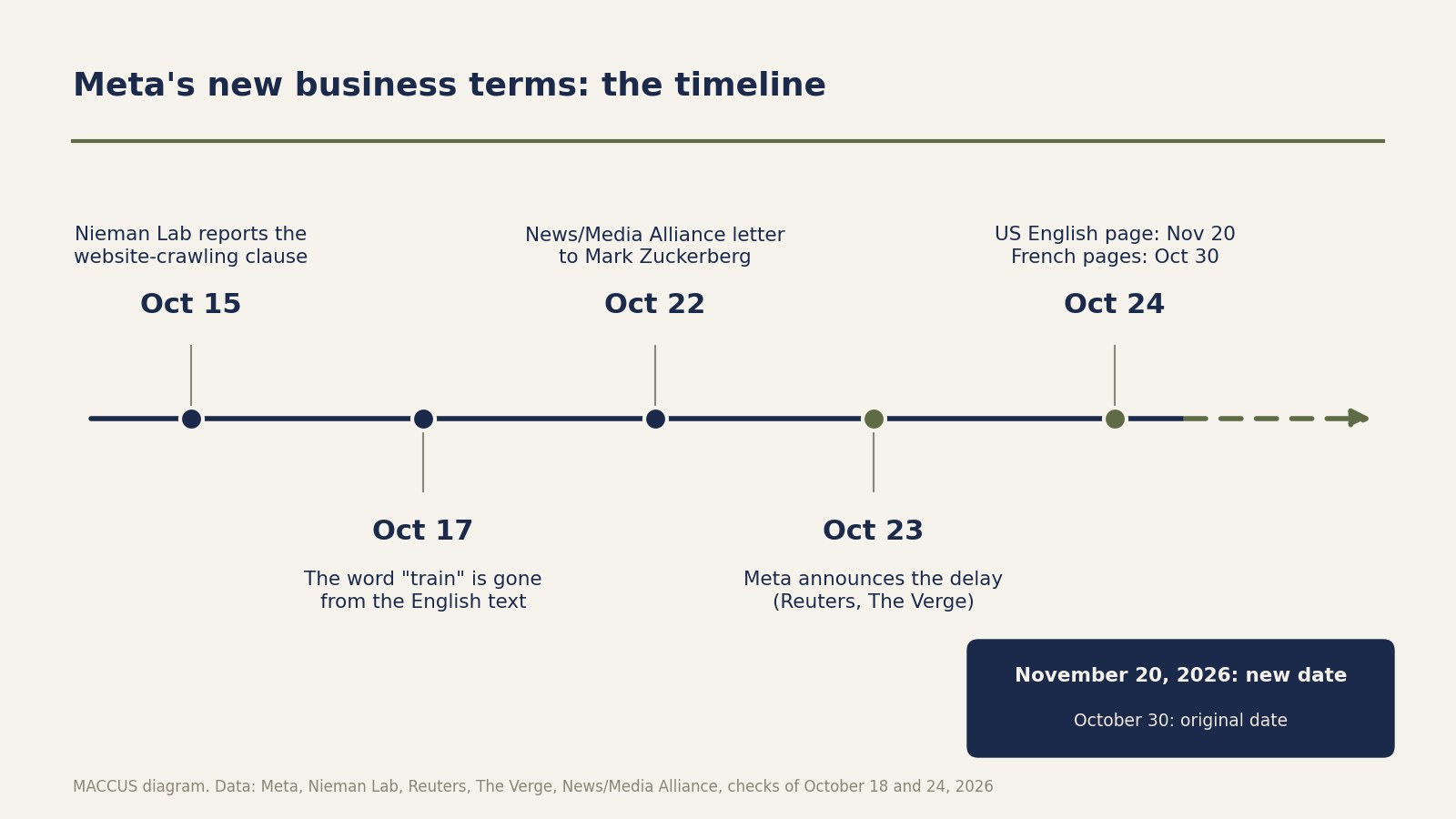

Meta has pushed back the effective date of its updated Commercial Terms and Self-Serve Ad Terms from October 30 to November 20, 2026. A spokesperson announced the delay in statements to Reuters and The Verge on Friday, October 23, after publishers and advertisers complained to competition authorities in the European Union and the United Kingdom. The terms apply to any company that uses Meta’s services for business purposes: ads, Page management, product catalogs, Ads Manager.
The disputed clause lets Meta send automated crawlers to websites associated with those companies’ products or services. The delay moves the effective date and leaves the wording of the clause as it was. On October 16, maccus.fr covered the terms announced for October 30, and on October 18 it reported the rewrite of the English version.
Three more weeks to explain the changes
Reuters reported the delay from Brussels on October 23. In an email quoted by the wire service, the Meta spokesperson said: “We are extending the effective date of our updated Commercial Terms and Self-Serve Ad Terms to 20 November to allow more time for us to explain to our partners and stakeholders what’s changing and what’s not.” The Verge attributed the same explanation to spokesperson Daniel Roberts.
According to the spokesperson, Meta will also explain how it uses web crawlers and make clear that content owners will still be able to signal their preferences with robots.txt. The file sits at the root of a website and tells crawlers which pages they may visit. Our article on AI crawlers and robots.txt covers which crawlers honor it.
Reuters wrote that the delay could stave off potential regulatory action. The European Commission, the EU’s antitrust enforcer, welcomed the decision, according to the same report. It added that it had sent requests for information to companies that have not yet published summaries of the data used to train their AI models. Reuters did not say whether Meta was one of them.
Pages that still say October 30
On October 24 at 1:17 a.m. Brussels time, maccus.fr checked Meta’s pages. The US English previews of both documents now show November 20, 2026. The UK English preview of the Commercial Terms and both French-language previews still show October 30, 2026, in the banner and on the effective-date line. The trade site PPC Land had flagged the same discrepancy on the UK page on October 23, about seven hours after the Reuters report.
| Preview of the update, checked October 24 at 1:17 a.m. | Date shown | Sentence on training |
|---|---|---|
| Commercial Terms, English (US) | November 20, 2026 | Gone |
| Self-Serve Ad Terms, English (US) | November 20, 2026 | Gone |
| Commercial Terms, English (UK) | October 30, 2026 | Gone |
| Commercial Terms, French | October 30, 2026 | Gone (still there on October 18) |
| Self-Serve Ad Terms, French | October 30, 2026 | Gone (still there on October 18) |
The French text has changed since October 18, though. That morning, the French clause still included a sentence saying Meta could use any content from those domains, web pages or URLs to provide, develop, improve, research, “train” (« entraîner ») and maintain the integrity of its products. By October 24, that sentence was gone.
The French version now follows the wording adopted in English in mid-October, which The Verge reported on October 17. In English, crawling is authorized “in order to provide, develop, improve, research, and maintain advertising and business products” and to “maintain the integrity and security of Meta Company Products.” It is not known exactly when the French page changed.
A clause the delay leaves untouched
No new wording came with the delay. In every version checked, Meta “(or any entity acting on our behalf)” may “use automated software (such as web scrapers, bots, robots, spiders, crawlers, and user agents) and create test credentials.” Those tools can reach the domains, web pages and URLs associated with the business’s products or services, and the clause also gives Meta the right “to periodically pull updates” from them.
Acceptance is still implied. The “Updates” clause says that by continuing to use Meta’s products for business purposes after notice of an update, a business agrees to be bound by it. The text offers one alternative: “you may stop all access or use of our Products for business or commercial purposes.”
Until the new documents take effect, the current versions apply. The current Self-Serve Ad Terms, in effect since August 22, 2025, already say that by placing an order, an advertiser grants Meta the right to access the content of its domains “for developing and improving advertising and other business-related products and related uses, research and training.”
Publishers keep up the pressure
The News/Media Alliance, which represents more than 2,000 newspaper, magazine and digital media publishers in the United States, sent a letter to Meta CEO Mark Zuckerberg on October 22. Its president, Danielle Coffey, asked Meta to withdraw the revised Commercial Terms before October 30 and to respond publicly by October 26. The letter says publishers “cannot practically disallow or block Meta’s crawlers without harming their ability to promote content as a business account user,” and that they “generally must allow Meta’s ads crawler for their advertising to function.”
In Europe, the European Publishers Council and other groups want regulators to suspend the new terms while they investigate. After the delay was announced, the council’s executive director, Angela Mills Wade, said that “maintaining a business page or advertising a subscription should not confer general rights over a publisher’s website and archive,” Reuters reported. The wire service also said EU and UK antitrust authorities have received complaints, and The Next Web reported that Britain’s competition watchdog has asked Meta to explain the terms.
Meta’s assurances versus the text
Meta rejects the claim, made by publishers and advertisers, that its terms give it an unlimited right to use their content for its AI services, Reuters reported. Its spokesperson has promised to explain “what’s changing and what’s not.” Those assurances sit outside the contract: the published text mentions neither robots.txt nor which crawlers are involved.
The phrase “advertising and business products” is followed by examples introduced by “including,” and the list is open-ended. The News/Media Alliance notes that the term is undefined and quotes a law professor who called it “still broad enough to drive a truck through.” The spokesperson announced no changes to the text, which is now set to take effect on November 20.
What it means
The delay changes only the timeline. By the spokesperson’s account, businesses that run a Page or ads on Meta, in France, Belgium or elsewhere, have three more weeks before the new crawling clause starts applying to anyone who keeps using Meta’s tools. The statement names only the two delayed documents: Meta’s plan to turn on product browsing in existing ads, set for October 28, is a separate change. The clause reads as it did before the announcement: it allows crawlers and test credentials on websites associated with the business, for open-ended “advertising and business products.”
The gap between Meta’s statements and its terms comes down to robots.txt: the company cites the file when it talks to reporters, and its terms never mention it. Businesses accept these terms without negotiating them, and the published text is what binds them.
The French pages show another gap. Their clause now matches the English version, but their date has not caught up. A French-speaking reader who opens Meta’s page is still told that the updates « prendront effet le 30 octobre 2026 » (will take effect on October 30, 2026).
Several things are worth watching. The News/Media Alliance expects a public response by October 26. Meta has yet to publish the promised explanation of its crawlers. It remains to be seen whether the European Commission will go beyond welcoming the delay, what Britain’s competition watchdog will do after asking Meta to explain the terms, and whether any mention of robots.txt makes it into the text before November 20.
Sources
- Meta postpones new commercial terms to address concerns over content rights, Reuters (via The Globe and Mail), October 23, 2026
- Meta delays new business terms after publisher pushback on AI scraping, The Verge, October 23, 2026
- Conditions commerciales de Meta, aperçu de la mise à jour, Meta, accessed October 24, 2026
- Meta Commercial Terms, preview of the update, Meta, accessed October 24, 2026
- Self-Serve Ad Terms, current version, Meta, accessed October 24, 2026
- An Open Letter to Mark Zuckerberg: Meta’s New Terms Take Publishers’ Journalism Without Permission or Payment, News/Media Alliance, October 22, 2026
- Meta delays website-crawling terms to Nov 20 after publisher complaints, PPC Land, October 23, 2026
- Meta delays its website-crawling terms after a publisher backlash, The Next Web, October 23, 2026
Header image: MACCUS diagram, data from Meta, Nieman Lab, Reuters, The Verge and the News/Media Alliance (October 15 to 24, 2026)