Google has carved out an exception to one of its advertising promises. In the version of its Privacy Policy that took effect on October 16, 2026, the sentence “We don’t show you personalized ads based on your content from Drive, Gmail, or Google Photos” now continues: “unless you choose to make data from these services available to other Google services that support personalized ads.” Android Authority reported the change on October 23, a week after it took effect.
The exception applies first of all to people who connect their Gmail account or Google Photos library to Google Search, a feature the company calls Personal Intelligence. According to Google’s Search Help page, ads will not be based directly on the inbox or the photo library. The summaries, excerpts and inferences that Search draws from those apps may, however, be used to show ads.
That connection is not offered in the European Union, the rest of the European Economic Area, the UK or Switzerland. AI Mode itself has been live in France since July 22, 2026, but without the option to plug in Gmail or Google Photos. Yet the French version of the Privacy Policy, marked “À compter du 16 octobre 2026” (effective October 16, 2026), already contains the exception.
Three changes to the ads section
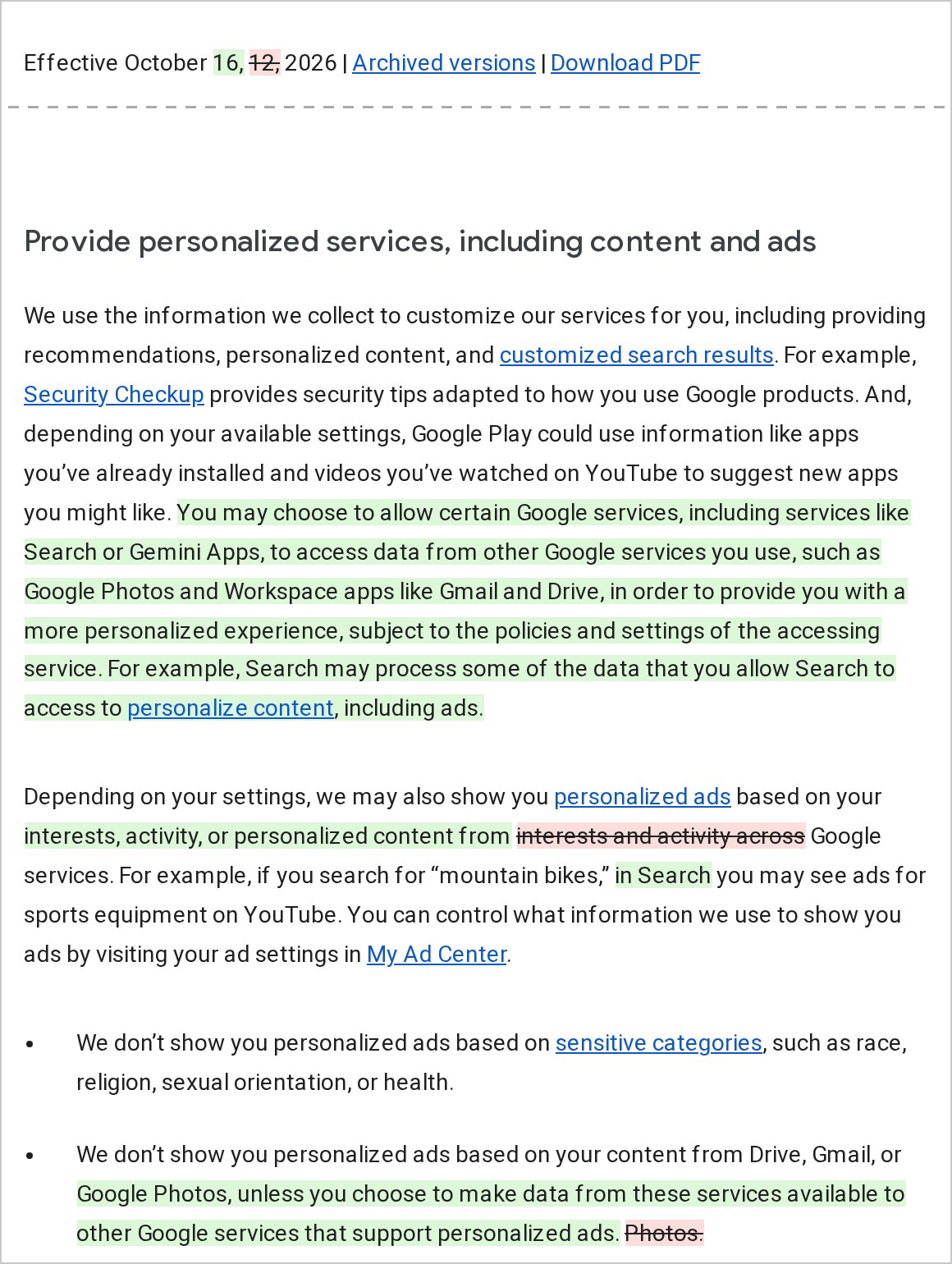
Google’s Privacy Policy went through three versions in October 2026: October 1, October 12 and October 16. Google publishes its own page comparing the last two, with additions and deletions in color. The changes are concentrated in the section titled “Provide personalized services, including content and ads.”
Two sentences added at the end of the section’s first paragraph describe data sharing between services. The first reads: “You may choose to allow certain Google services, including services like Search or Gemini Apps, to access data from other Google services you use, such as Google Photos and Workspace apps like Gmail and Drive, in order to provide you with a more personalized experience, subject to the policies and settings of the accessing service.” The second: “For example, Search may process some of the data that you allow Search to access to personalize content, including ads.”
The general sentence on advertising changed too. In the October 12 version, Google could show personalized ads “based on your interests and activity across Google services.” The October 16 text adds personalized content to the list: “based on your interests, activity, or personalized content from Google services.”
The third change concerns the sentence on Drive, Gmail and Photos. It had carried no qualification since at least the July 1, 2021, version, and the October 12, 2026, version still had it unchanged. Since October 16, it ends with the exception quoted above.
The glossary also has a new entry, “personalize content,” which names Personal Intelligence. Its example: if a user asks Search about a recent hotel booking, Search may use booking details from an email to help suggest things to do near the hotel.
Google’s two answers on ads
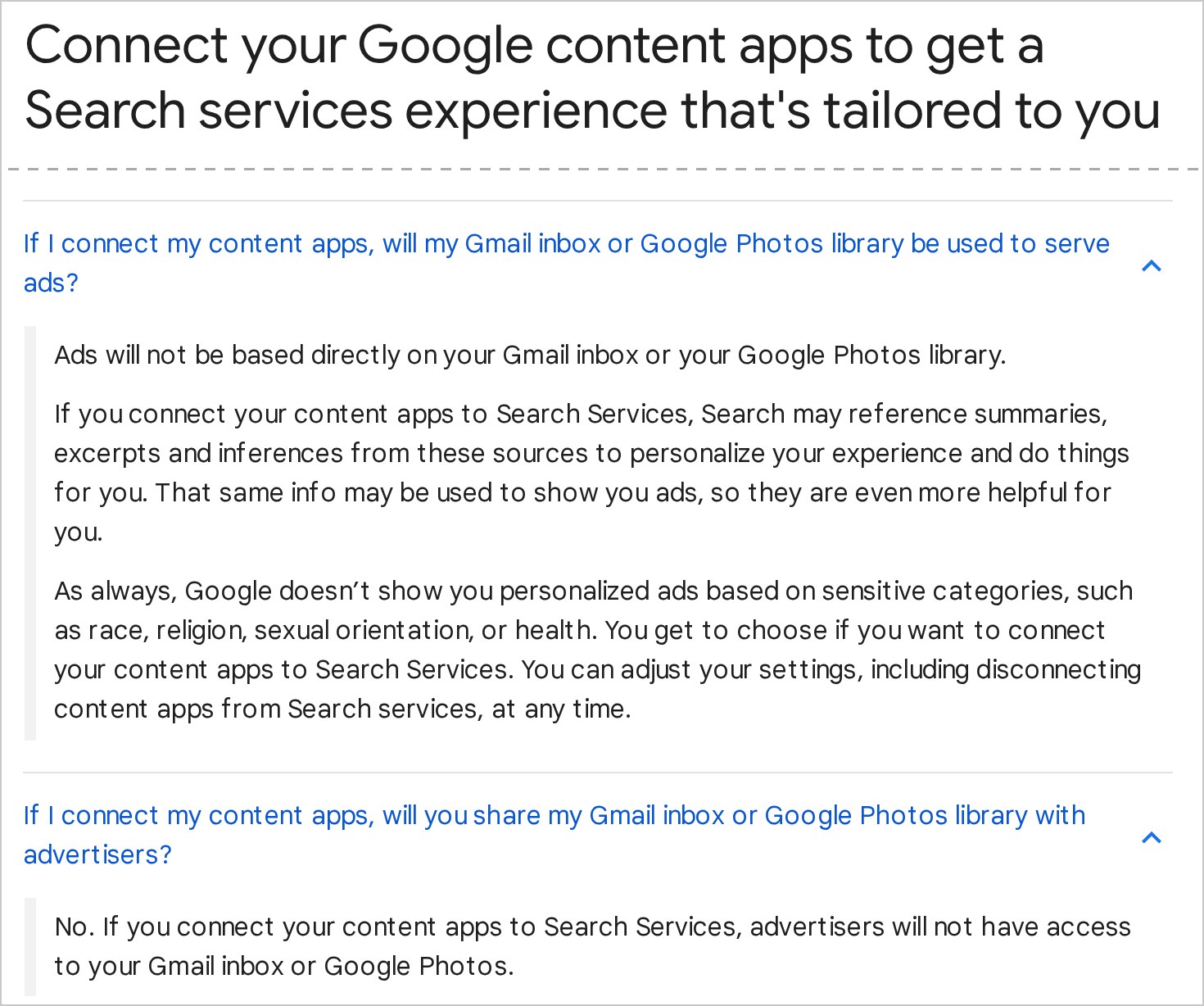
The Search Help page on connecting apps answers two questions about advertising. The first asks whether the Gmail inbox or the Google Photos library will be used to serve ads. Google’s answer: “Ads will not be based directly on your Gmail inbox or your Google Photos library.” It goes on: Search may reference “summaries, excerpts and inferences from these sources,” and “that same info may be used to show you ads, so they are even more helpful for you.”
In the same answer, Google says it doesn’t show personalized ads based on “sensitive categories, such as race, religion, sexual orientation, or health.” It also notes that connecting is a choice users can reverse in their settings. The second answer is a no: “advertisers will not have access to your Gmail inbox or Google Photos.” The French version of the same help page, checked on October 24, does not yet include these two questions.
The page also lists the apps that can be connected to Search: Gmail, Google Calendar (US and English only) and Google Photos (not in all regions). Drive appears in the Privacy Policy, but not on this list. Google says other Workspace apps are coming soon.
Users need to be signed in to a personal Google Account, be 18 or older and have Personalized Recommendations turned on. Once apps are connected, all of Google’s Search services are permitted to access them: Search, including AI Mode and Discover, plus Maps, Shopping, Flights, Hotels, Translate and News.
The same page says that data from connected apps may be used to improve Google services, including by training its generative AI models. Disconnecting an app or deleting an email doesn’t remove anything from Search Services History, where that data can still be used for the same purpose.
A feature that skips the European Union
The availability list on the help page counted 191 countries and territories as of October 24, 2026. No EU member state is on it, and neither are Iceland, Liechtenstein, Norway, the UK or Switzerland. Other European countries do appear, such as Serbia, Albania and Ukraine. So do several French-speaking countries: Canada, Morocco, Algeria, Tunisia, Senegal, Côte d’Ivoire and Cameroon.
Gemini’s help page on connected apps says that “for now,” the feature is not available in the European Economic Area, Nigeria, Switzerland or the United Kingdom. Google doesn’t explain on these pages why it leaves those countries out.
Questions Google leaves open
Google doesn’t say how its systems produce these inferences or how much weight they carry in choosing an ad. The policy refers to “other Google services that support personalized ads” without listing them. The example the policy gives involves only Search, while the added sentences also name Gemini Apps. Gemini’s help page on connected apps says nothing about ads.
Android Authority’s Shimul Sood stresses the limits of the change: it doesn’t mean Google automatically scans emails to serve ads, since it concerns information that users choose to share. The Verge’s Jess Weatherbed focuses on the effect: people who have connected these services to Google’s search tools may now see ads targeted on the basis of that content.
What it means
The October 16 change gives the system that picks ads a new source of information: what the search assistant learns from the emails and photos of people who opt in. According to Google, advertisers don’t get access to the Gmail inbox or Google Photos, and none of the Google pages cited here mentions a targeting option or an audience built from emails. “Personalized content” becomes a third basis for personalized ads, alongside interests and activity.
OpenAI is taking a similar path with ChatGPT: its European privacy policy provides for personalized ads based on past conversations, with the user’s consent. At both companies, the personal context an assistant gathers can be used to choose ads for people who agree to it. Neither company offers that personalization in the European Economic Area or Switzerland, according to the pages checked on October 9 for OpenAI and October 24 for Google.
In France and Belgium, Google doesn’t let users connect apps to Search, the only case in which the Google pages cited here document an advertising use of that data. The policy text that applies there already contains the exception. Still to watch: whether app connections come to the European Union, whether the French help page adds the questions on ads, and whether Google says more about the role inferences play in choosing ads.
Sources
- Google Privacy Policy, comparison of the October 12 and October 16, 2026 versions, Google, October 16, 2026
- Règles de confidentialité, Google, October 16, 2026
- Règles de confidentialité (version archivée), Google, October 12, 2026
- Google Privacy Policy (archived version), Google, July 1, 2021
- Connect your Google content apps to get a Search services experience that’s tailored to you, Google Search Help, read on October 24, 2026
- Connect your Google apps to personalize your Gemini experience, Gemini Apps Help, read on October 24, 2026
- Google makes a privacy policy exception to use your Gmail and Photos data for ads, Android Authority, October 23, 2026
- Now Google says it might use your Gmail and Google Photos data to target ads, The Verge, October 23, 2026
Header image: MACCUS diagram. Data: Google Privacy Policy (versions of October 12 and October 16, 2026) and Google Search Help, read on October 24, 2026