
On October 26, 2026, Google revised its documentation page on user-generated spam. The guide now also covers tools that let users publish shared pages, generated content, or web apps. It recommends applying the noindex rule by default, or blocking crawling in robots.txt, for pages created to be shared by link rather than found through search.
In its Search Central documentation changelog, Google says the goal is to help platforms keep user-created pages “that aren’t meant for Search” out of the index and to detect spam earlier. The French version of the guide, dated December 18, 2025, still lacked the new text as of the night of October 26-27.
Three passages changed in the guide
The guide is titled “Prevent user-generated spam on your site and platform.” We compared the updated page against the previous version, dated December 10, 2025, using a copy archived on October 15, 2026. Only three passages changed.
The first change is in the opening sentence. The old version mentioned open comment forms, then said that “hosting platforms may be similarly open to abuse.” The new version adds “tools that let users publish shared pages, generated content, or web apps.” Spammers on those services “may create a large number of pages or sites,” whereas the old sentence mentioned only sites.
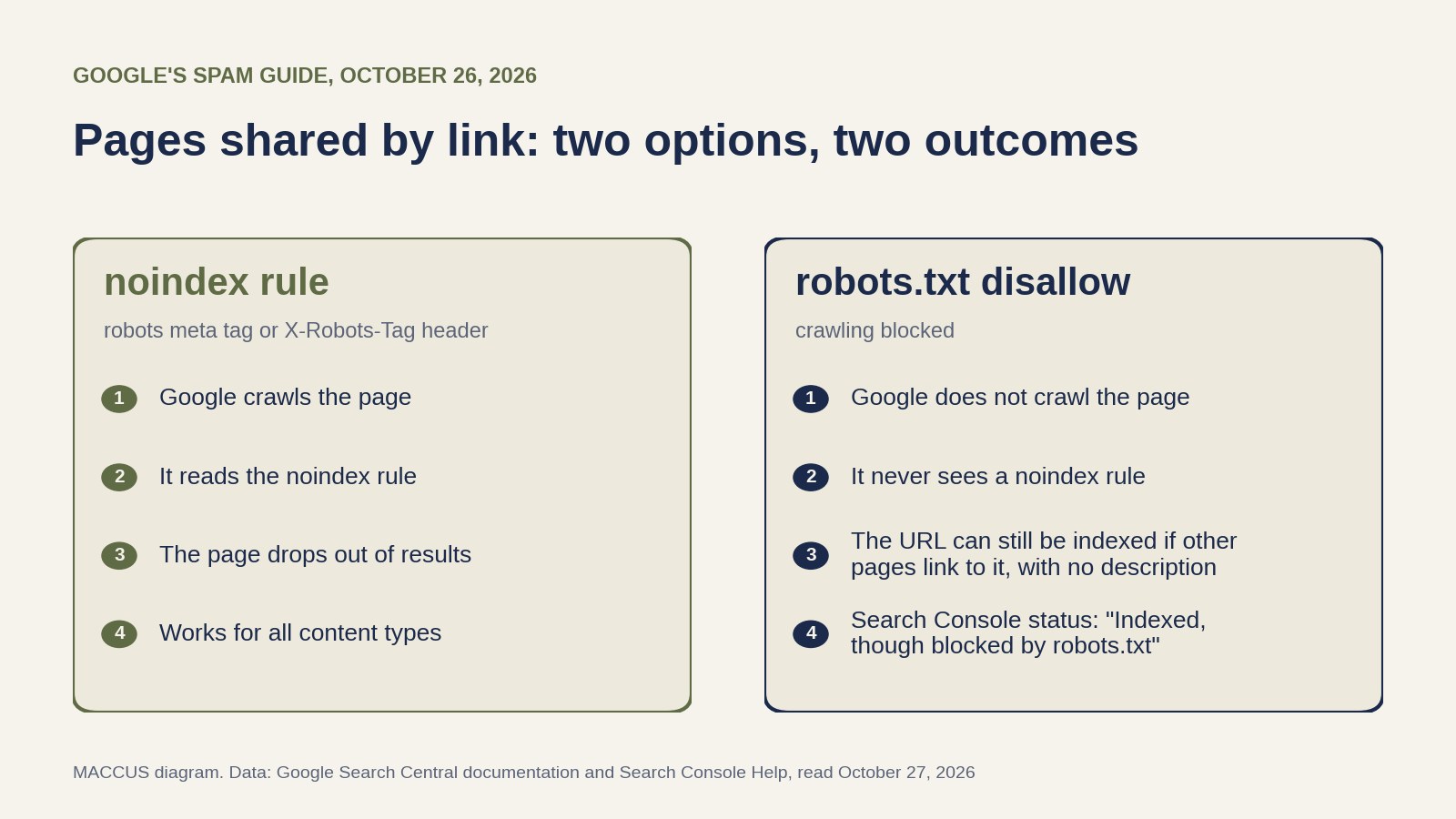
The second is a new section, “Only index content meant for Search.” It asks services whose users create shareable pages, generated outputs, or interactive tools to consider whether that content should be found through search engines or only opened by people who have the link. For pages created for direct sharing, collaboration, or utility, it recommends a default: the noindex rule, through a robots meta tag or an X-Robots-Tag HTTP header, or blocking crawling in robots.txt.
The third adds two items at the top of the “Monitor your service for abuse” list. The first item tells platforms to verify their site or subdomain in Search Console, so they get an email if Google issues a manual action or detects a security issue. It also advises checking the Page Indexing and Search performance reports regularly for unexpected spikes in indexed pages, impressions, or queries that don’t match the platform’s purpose.
The second item recommends tracking platform-level creation and indexing metrics, with alerts for spikes in newly published public pages or for a small number of users generating a large share of indexable URLs. The old version did not mention Search Console at all. The rest of the advice is unchanged, including noindex on posts from new accounts with no reputation, a nofollow or ugc attribute on links in untrusted content, manual moderation, and reCAPTCHA at sign-up.
Google’s spam policies are unchanged
Google files the change as a documentation update. Its spam policies, the rules whose violation can lead to lower rankings or a manual action, have not changed since their August 28, 2026, update. As PPC Land notes, the October 26 changelog entry gives no figures on the scale of the abuse, no examples of services, and no enforcement date.
The revision comes less than three weeks after the end of the September 2026 spam update, which rolled out from September 24 to October 8. On October 8, Google also documented its UGC Fresh Data Program, which lets approved user-generated content platforms push fresh content to Google through a dedicated pipeline. Our piece on Google indexing times covers that program.
Shared chats have surfaced in search before
On October 7, 2026, as it launched chat sharing for its Duck.ai assistant, DuckDuckGo wrote that over the past year, shared conversations from ChatGPT and Claude had appeared in search results, sometimes with users’ names and other personal details. In some cases, the company said, people “had opted in to making their chats discoverable without realizing what it meant”; in others, “share pages simply weren’t blocked from indexing.” Duck.ai share pages carry a noindex instruction both in the page and in the server response, and links expire after 48 hours by default.
Search Engine Roundtable, which reported the change on October 26, pointed to two reactions posted on X. Consultant Marie Haynes asked whether the update means new manual actions are coming for AI tools and app-building platforms.
SEO consultant Lily Ray wrote that her “first thought was Claude artifacts, ChatGPT pages/sites, FB posts, and other social/AI tools that make it easy to churn out indexable UGC at scale.” She saw it as another clue about the new types of spam Google is dealing with. As of the night of October 26-27, Google had not responded to either post or commented on the change beyond its changelog.
Noindex and robots.txt don’t do the same thing
The new section treats noindex and a robots.txt block as equivalent options, while the rest of Google’s documentation draws a clear line between them. Search Engine Journal’s Matt G. Southern and PPC Land’s Luis Rijo both flagged the conflict on October 26.
Google’s introduction to robots.txt says the file “is not a mechanism for keeping a web page out of Google.” It adds that Google “might still find and index a disallowed URL if it is linked from other places on the web.” Google’s noindex documentation says the rule only works if robots.txt isn’t blocking the page; otherwise “the crawler will never see the noindex rule.” Our article on AI crawlers and robots.txt explains what the file controls and what it doesn’t.
Search Console even has a status for blocked URLs that get indexed anyway: “Indexed, though blocked by robots.txt.” Its help page says that “robots.txt is not the correct mechanism to avoid being indexed” and tells site owners to remove the block and use noindex.
The “Control what you share with Google Search” page, updated on October 21, lists a robots.txt block as applicable only to images and video, while noindex applies to all content types. PPC Land points out that share links are made to be pasted elsewhere, on social media, forums, or messaging apps, and that this kind of outside linking can get a blocked URL indexed.
Questions the guide leaves open
PPC Land identified several gaps. The guide sets exclusion as the default without saying what should happen when a user wants a shared page to be found. It gives no threshold for the spikes to watch, doesn’t say what share of indexable URLs would be too much for a small group of accounts, and describes no consequence for a platform that leaves its share pages indexable.
The guide names no product, and Google doesn’t say which services prompted the change. The changelog refers to “link-shared content,” a phrase that doesn’t appear in the guide itself.
What it means
The guide’s scope has changed. Originally written for comment sections and hosting providers, it now covers tools that produce shareable pages, a category that can include a conversation with an assistant, the output of a content generator, a web app, or a collaborative document.
The services most directly affected are makers of AI tools, website and app builders, forums, and collaboration services. As worded, the guidance also reaches any site that creates public pages from a user action, such as a shared list or a saved calculator result. In the guide, Search Console’s Page Indexing report is now a tool for spotting spam as much as for measuring visibility.
Google says it wants to help platforms detect spam earlier, but it has published no figures. The public examples of indexed share pages come from others: DuckDuckGo on October 7, then consultants quoted by Search Engine Roundtable. By offering a choice between noindex and robots.txt, the guide departs from four other pages of Google’s own documentation, and the robots.txt route can leave share URLs showing in results without a description.
Still to watch: a French translation of the new passages, any change to Google’s spam policies, possible manual actions against app-building platforms, and the defaults that AI assistant and app-builder companies choose for their share links.
Sources
- Prevent user-generated spam on your site and platform, Google Search Central, October 26, 2026
- Latest Google Search documentation updates (October 26: Updated guidance on preventing user-generated spam), Google Search Central, October 26, 2026
- Introduction to robots.txt, Google Search Central, December 10, 2025
- Block Search indexing with noindex, Google Search Central, December 10, 2025
- Page indexing report, Search Console Help, accessed October 27, 2026
- Duck.ai now lets you share chats, privately and on your terms, DuckDuckGo, October 7, 2026
- Google Updates User-Generated Spam Guidance To Specify Tools & More, Search Engine Roundtable, October 26, 2026
- Google tells platforms to noindex link-shared pages by default, PPC Land, October 26, 2026
Header image: MACCUS diagram. Data: Google Search Central documentation and Search Console Help, read October 27, 2026