
Google has published a Google Ads Help page titled “About Review summaries” that describes a new element in Search ads: a summary of customer reviews written by its AI. Drawn from reviews collected across the web, the summary keeps only the positive points, and advertisers can’t edit it. Hana Kobzová of the trade site PPC News Feed spotted the undated page on October 24, 2026.
The format applies to Search campaigns served in English in the U.S., the U.K., Australia and India. Google hasn’t announced a timeline for other markets such as France or Belgium. On October 28, requesting the page in French returned the English text.
A short help page
According to Google, review summaries are “AI-powered summaries of online reviews that appear directly as part of your Search ads.” They “highlight positive insights from across the web to help potential customers evaluate your business.”
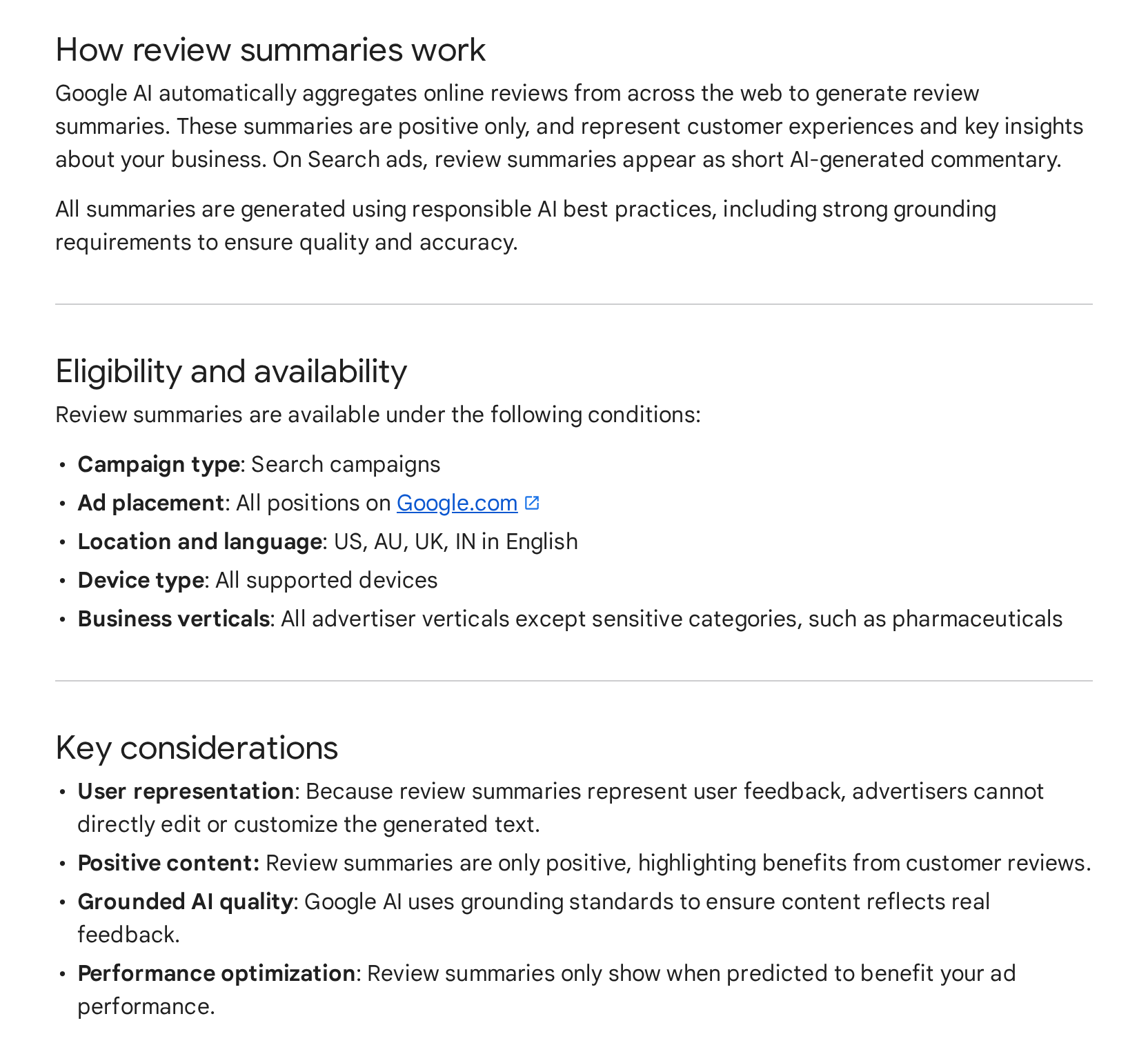
The section on how the feature works runs four sentences. Google’s AI automatically aggregates online reviews and turns them into short commentary shown in the ad. The page says twice that the summaries are positive only. Google adds that they are generated under “strong grounding requirements to ensure quality and accuracy,” which are meant to keep the text tied to real reviews.
Display depends on a prediction: a summary appears only when Google expects it to improve the ad’s performance. The page doesn’t say which metric the prediction targets (click-through rate, conversions or something else). The format covers all ad positions on Google.com and all supported devices. Every vertical is eligible except sensitive categories, and Google names only one example: pharmaceuticals.
Advertisers don’t control the text
The page settles the question of control in one sentence: “Because review summaries represent user feedback, advertisers cannot directly edit or customize the generated text.”
Google describes no way to turn the feature off. The page’s only related link, at the bottom, points to Google’s article on account-level automated assets. That article lists assets such as dynamic sitelinks, dynamic callouts, seller ratings and automated promotions, which advertisers can switch off one by one in advanced settings.
Review summaries aren’t on that article’s list. German site Dr. Web flagged the omission on October 26, and they were still missing when we checked on October 28.
Store ratings, which the automated assets article lists as seller ratings, are the review format Google already shows in ads. They follow different rules.
| Store ratings | Review summaries | |
|---|---|---|
| Content | a rating out of 5, the number of ratings and sometimes a qualifier | short AI-written commentary |
| Threshold | minimum rating of 3.5 for text ads | none published |
| Selection | Google says it doesn’t modify ratings; it filters out reviews it considers untrustworthy (spam, abuse) | positive points only |
| Turning it off | in account-level automated assets | no procedure described |
| Stated effect | 2% higher click-through rate on average on text ads, per Google | no figure |
Google says it gathers store ratings “from reputable websites that aggregate business reviews, as well as from users on Google.” The review summaries page names no platform.
Nearly a year of testing
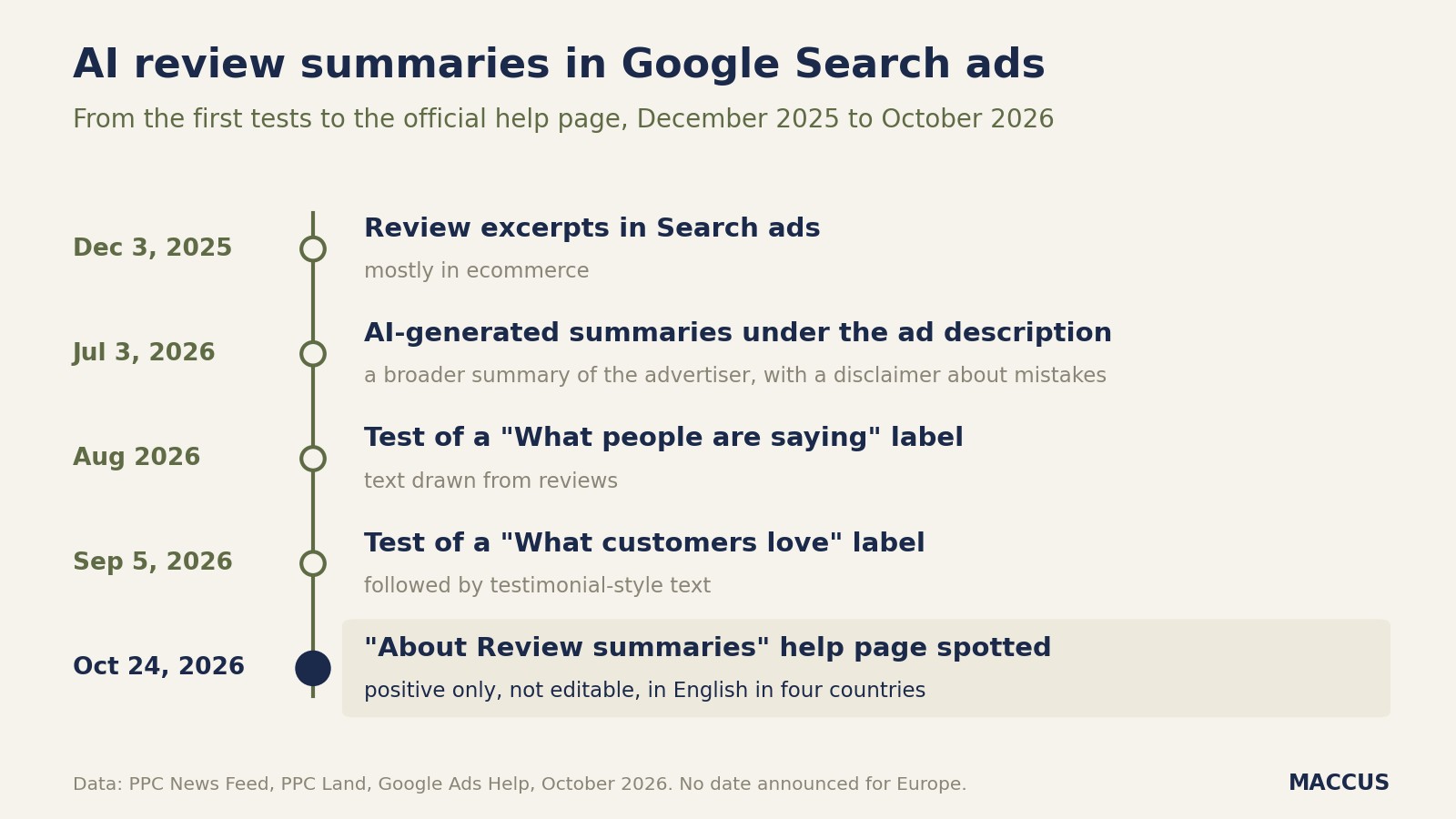
The help page follows a string of tests in sponsored results. According to a timeline compiled by PPC Land, PPC News Feed reported review excerpts in Search ads as early as December 3, 2025, mostly on e-commerce ads. On July 3, 2026, AI-generated summaries appeared just below the description of some ads. They described the advertiser in general rather than its reviews and carried this disclaimer: “Google AI responses are generated independently and can make mistakes, so double-check responses.”
In August, a test showed the label “What people are saying.” On September 5, PPC News Feed described another version, headed “What customers love” and followed by testimonial-style text. PPC Land notes that on October 24, the day the help page surfaced, PPC News Feed also reported a test of a scrolling, marquee-style display of ratings and reviews in sponsored results.
Google’s help content doesn’t say which of these designs it will keep, or whether the July disclaimer accompanies the current summaries.
Claims without numbers
Google lists four benefits: customer trust, better click quality, better ad performance and brand trust. PPC Land, which analyzed the page on October 25, notes that none of these claims comes with a figure: no test results, no click-through rate lift, no case study.
The same site lists other open questions. Google doesn’t say how many reviews are required, how recent they must be, or whether a business with mostly negative reviews can still get a summary built from its minority of positive ones. Nor does the page say whether a label tells searchers the text is AI-generated, or when the format became available in each of the four markets.
In the U.K., one of those four markets, showing only positive reviews also raises a consumer-law question. The Competition and Markets Authority’s guidance on fake reviews, published April 4, 2025, lists “overall summaries” among the consumer review information that must not be published in a misleading way. Among the risky practices it describes is “selecting only favourable reviews to be presented or highlighting certain positive reviews when these do not reflect the experience being reported by reviewers overall.” In the sources we reviewed, Google doesn’t explain how its summaries square with those rules.
What it means
Google already adds some elements to ads on its own: callouts pulled from the advertiser’s landing page, the advertiser’s promotions, a rating out of 5. Those additions come mostly from the advertiser’s own site or boil down to a number, and advertisers can turn them off. With review summaries, Google writes part of the ad copy from what third parties say, and the advertiser paying for the click can’t edit or customize it. The page mentions no preview and no reporting.
Other ad platforms are moving in the same direction. At the end of October, OpenAI is turning on AI rewriting of ChatGPT ads, and starting October 28, Meta is adding a product storefront to ads already running. In both cases the option is on by default and advertisers can opt out. Google’s page describes no opt-in step and no way to opt out.
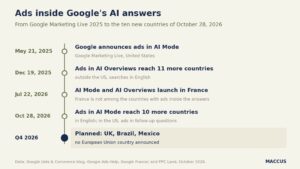
For now, only campaigns served in English in the four countries are affected. That can include advertisers based elsewhere, in France or Belgium for example, that target those markets in English. Google Ads has limited an AI feature to English before: its AI campaign translation tool, in beta, only accepts source campaigns written in U.S. English. On October 28, Google applied the same limit to ads placed inside AI Mode answers, which opened to ten more countries, in English only.
Google pitches the format as a boost to trust and performance without publishing any figure, even though it publishes one for store ratings. It also hasn’t said which review sites it uses, or how it handles a business whose reviews are mostly negative.
Signs to watch include a setting to turn the format off among automated assets, a published list of review sources, the first performance figures and expansion to other languages. How consumer protection authorities view the format will matter too, starting with the U.K.’s CMA, whose fake-reviews guidance already covers “overall summaries.”
Sources
- About Review summaries, Google Ads Help, undated, accessed October 28, 2026
- About account level automated assets, Google Ads Help, accessed October 28, 2026
- About store ratings, Google Ads Help, accessed October 28, 2026
- Google Documents AI Review Summaries in Search Ads, PPC News Feed, October 24, 2026
- Google Tests AI Generated Review Summaries Again, PPC News Feed, September 5, 2026
- Google AI writes positive-only review summaries into Search ads in 4 markets, PPC Land, October 25, 2026
- Google Ads: KI fasst in Suchanzeigen nur positive Bewertungen zusammen, Dr. Web, October 26, 2026
- Fake reviews: Guidance on the prohibition under paragraph 13 of Schedule 20 to the Digital Markets, Competition and Consumers Act 2024 (CMA208), Competition and Markets Authority, April 4, 2025
Header image: MACCUS chart, data from PPC News Feed, PPC Land and Google, October 2026