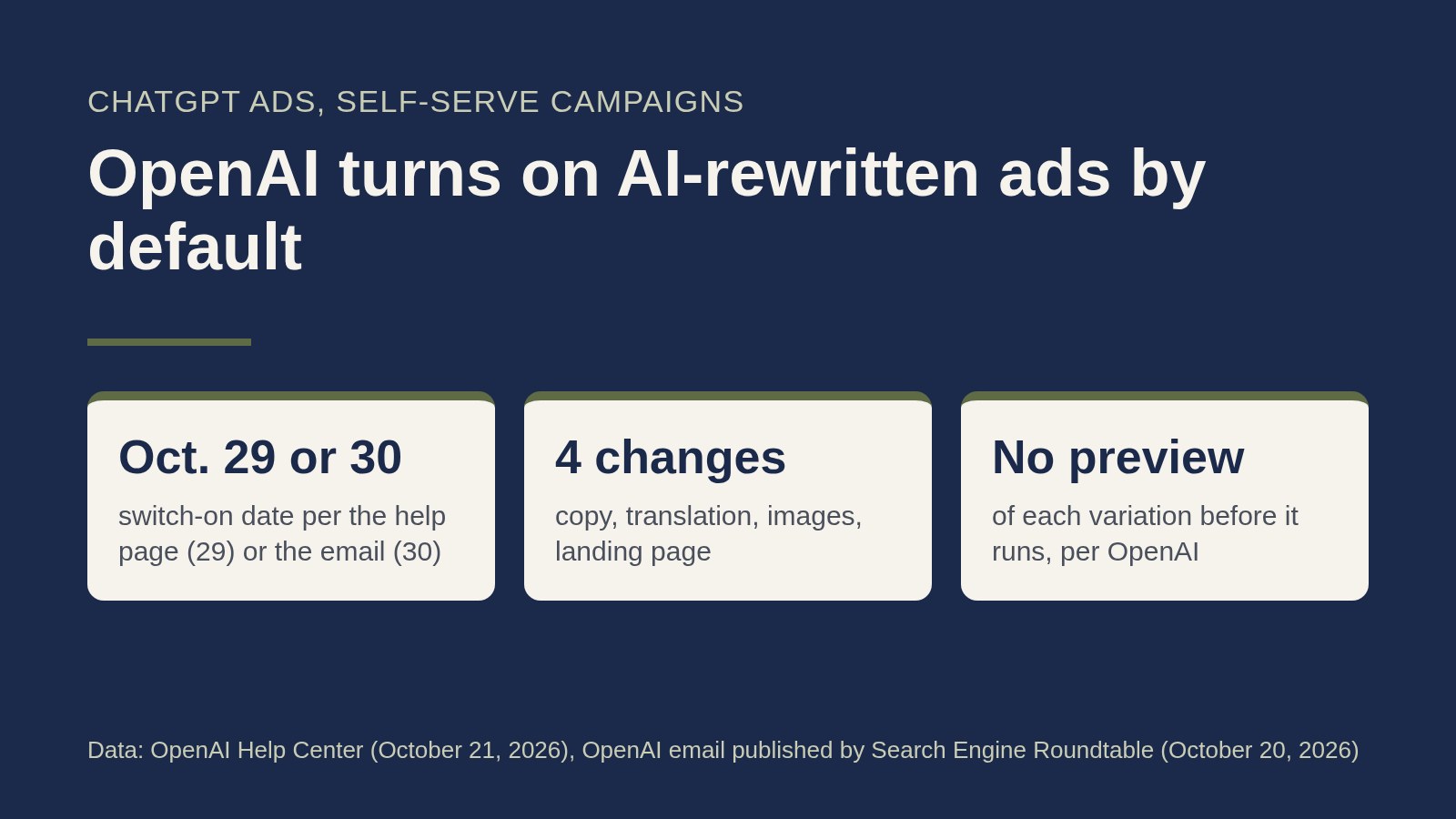

OpenAI has notified ChatGPT Ads advertisers by email that “creative enhancements” will be turned on by default for both new and existing self-serve campaigns. Search Engine Roundtable published the message on October 20, 2026. The AI will be able to rewrite ad headlines and descriptions, translate ad text, resize images and send people to a different page on the advertiser’s site. Advertisers won’t have to approve each version before it runs.
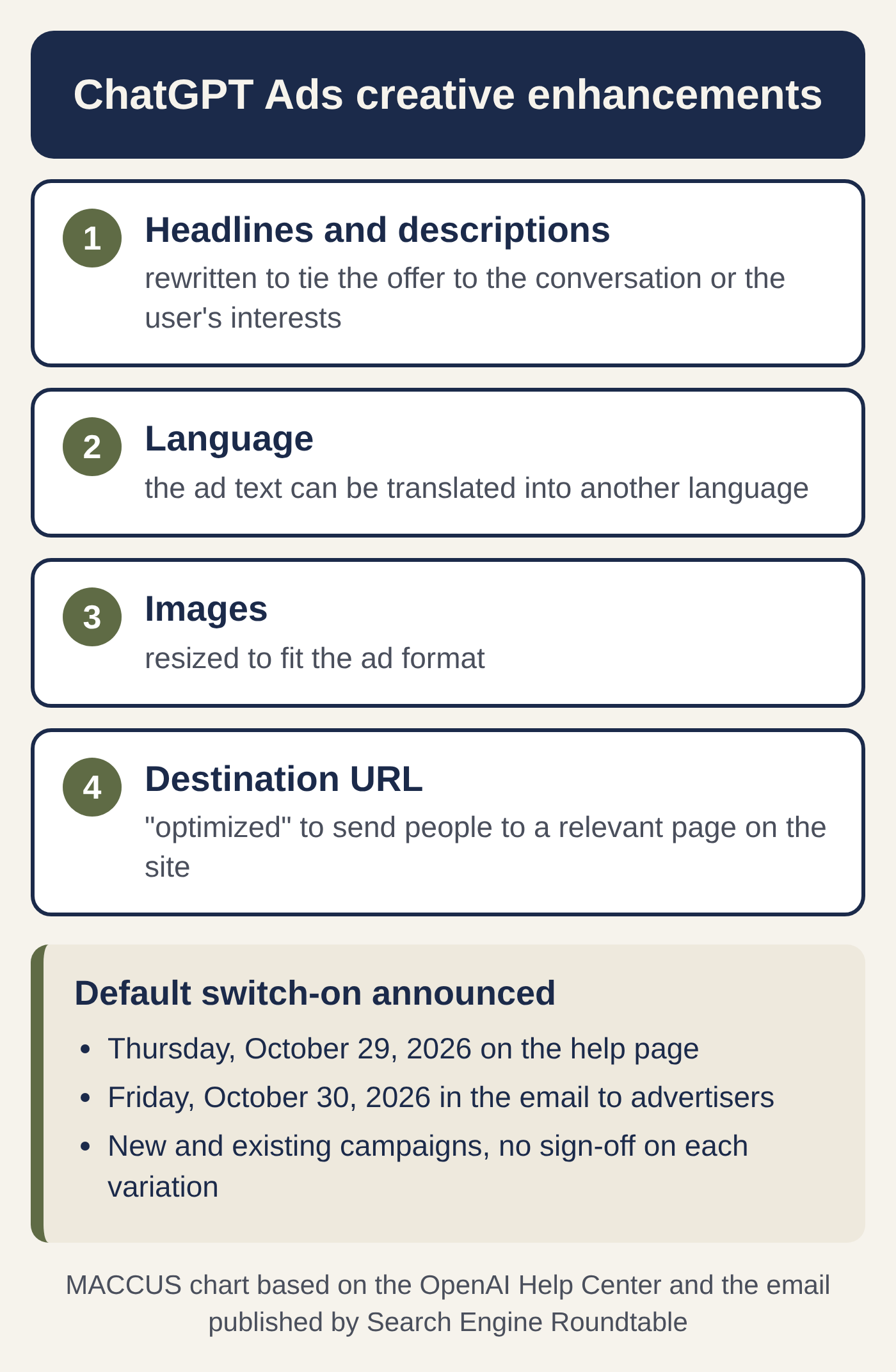
The email and OpenAI’s help page give different start dates: Friday, October 30, in the email and Thursday, October 29, on the help page (as checked on October 21).
An email to advertisers and a help page
Barry Schwartz, who runs Search Engine Roundtable, received the email as an advertiser and posted it on October 20 at 3:35 p.m. ET. “Starting Friday, October 30, 2026, we’ll enable creative enhancements for your new and existing self-serve campaigns,” OpenAI wrote. A screenshot he shared shows the setting already turned on in his ad account.
The help page lists four kinds of changes. The AI can rewrite headlines and descriptions to tie the offer to the conversation or the user’s interests, translate the ad text into another language and resize images to fit the ad format. The destination URL can also be “optimized” to send people to a relevant page on the site.
OpenAI builds these variations from the existing ad, the content of its landing page and the context of the conversation. Variations can be prepared in advance or generated in real time as the chat unfolds. In OpenAI’s example, a grocery delivery ad headlined “Fresh groceries delivered” becomes “Groceries for quick weeknight dinners” in a conversation about planning weeknight meals.
No preview of every variation
According to the page’s FAQ, advertisers don’t need to review or approve each version before it runs, and the tool doesn’t preview every variation. Ads Manager reporting still breaks results down by campaign, ad group and ad: impressions, clicks, spend, click-through rate and attributed conversions when measurement is set up. OpenAI adds a caveat: these metrics describe overall performance, and changes over time “do not, on their own, establish the effect of creative enhancements.”
Advertisers can opt out in their Ads Manager settings before the start date or change the setting at any time afterward, OpenAI says. Existing account-level and campaign-level opt-outs carry over, and a campaign’s setting takes priority over the account default.
Responsibility stays with the advertiser
Section 5.3 of OpenAI’s Advertising Terms, checked on October 21, makes the advertiser “solely responsible” for each campaign, including AI-generated outputs delivered through the service. That responsibility explicitly covers “any optional tool or feature that is enabled by default and remains enabled” for the campaign.
The section also requires advertisers to warrant that every campaign complies with the law, including rules on the truthfulness and substantiation of claims and on promotions. Under Section 4.1, OpenAI can reject, remove or modify any ad, or require changes to it.
A setting already on in September
Part of this was already in place. On September 4, Studio Entête, a communications agency, published a write-up of its ChatGPT Ads test: in Ads Manager, a “Personnalisation du texte” (text personalization) option was on by default, according to a screenshot dated September 1. The text under the toggle said the AI generated personalized and translated versions of headlines and descriptions that could be shown without review or approval.
The October 20 email explicitly covers existing campaigns, and its list of changes now includes images and the landing page.
Google and Meta are also switching features on by default this month. Since October 12, Google Ads has been adding automated promotions pulled from the advertiser’s site to Search and Performance Max campaigns that show a store address. On October 28, Meta will add product browsing to existing ads unless the advertiser opts out.
Early reactions
Search Engine Roundtable rounded up reactions that two pay-per-click specialists posted on X the same day. Melissa Mackey wrote that she had paused her ChatGPT Ads test over poor lead quality and was now glad she did. Anthony Higman argued that when an ad platform frames an option as “less work for you,” it really means serving more ads on topics where the advertiser doesn’t want to appear.
A day earlier, a B2B marketer on Reddit asked whether anyone had gotten results from ChatGPT ads compared with Google Ads or LinkedIn Ads. The platform is still young: ChatGPT ads have only been open to self-serve buyers in France and Belgium since August 31, 2026.
Promises and gray areas
OpenAI pitches the feature as a way to make ads more relevant and “improve performance” while cutting the work of producing multiple versions. The page offers no test results to back that up.
Several questions remain open. The page doesn’t say which languages ads can be translated into, or how the replacement page is picked, beyond saying it will be a “relevant” page on the site. It mentions “user interests,” yet personalized ads are “not initially available” in the European Economic Area (EEA) or Switzerland, according to another OpenAI help page. Neither page says how the two fit together.
The scope also differs between the two documents: the email covers new and existing “self-serve” campaigns, while the help page refers to new and existing campaigns without mentioning self-serve. As of October 21, OpenAI had not explained why its two start dates differ.
What it means
In September, AI-generated ad text could already run without the advertiser’s sign-off; the new setting extends that to images, landing pages and existing campaigns. Advertisers track their ads after they run, and the help page mentions no per-variation report. The change applies to self-serve advertisers who haven’t already opted out. As of October 21, self-serve buying is available in 63 countries, including France, Belgium, Luxembourg, Switzerland and Canada.
Compared with the Google and Meta settings above, OpenAI’s can also translate the ad and replace its landing page with another page on the advertiser’s site. OpenAI’s terms explicitly leave responsibility for the generated copy with the advertiser, even when the platform turned the option on. For a campaign written in French and shown in Belgium or Switzerland, translation into another national language is possible on paper. Google Ads is testing its own AI campaign translation tool, which for now only translates from English.
Four things are worth watching before the end of the month: the start date OpenAI actually goes with, whether a per-variation report appears, the list of translation languages, and how the option applies in the EEA. In Germany, three data protection authorities warned against personalized ads in ChatGPT in early October. OpenAI also hasn’t said how many advertisers have already opted out.
Sources
- Creative enhancements for ChatGPT Ads, OpenAI Help Center, accessed October 21, 2026
- OpenAI Auto Enabling Creative Enhancements In ChatGPT Ads, Search Engine Roundtable, October 20, 2026
- Advertising Terms, OpenAI, accessed October 21, 2026
- Ads Manager Availability, OpenAI Help Center, accessed October 21, 2026
- Ads in ChatGPT, OpenAI Help Center, accessed October 21, 2026
- Profiling im Chatbot: ChatGPT läuft in Europa bald mit hyperpersonalisierter Werbung, Hamburg Commissioner for Data Protection and Freedom of Information (HmbBfDI), October 2, 2026
- On a testé ChatGPT Ads. Premiers chiffres, Studio Entête, September 4, 2026
Header image: MACCUS chart, OpenAI data (help center and email to advertisers, October 2026)