
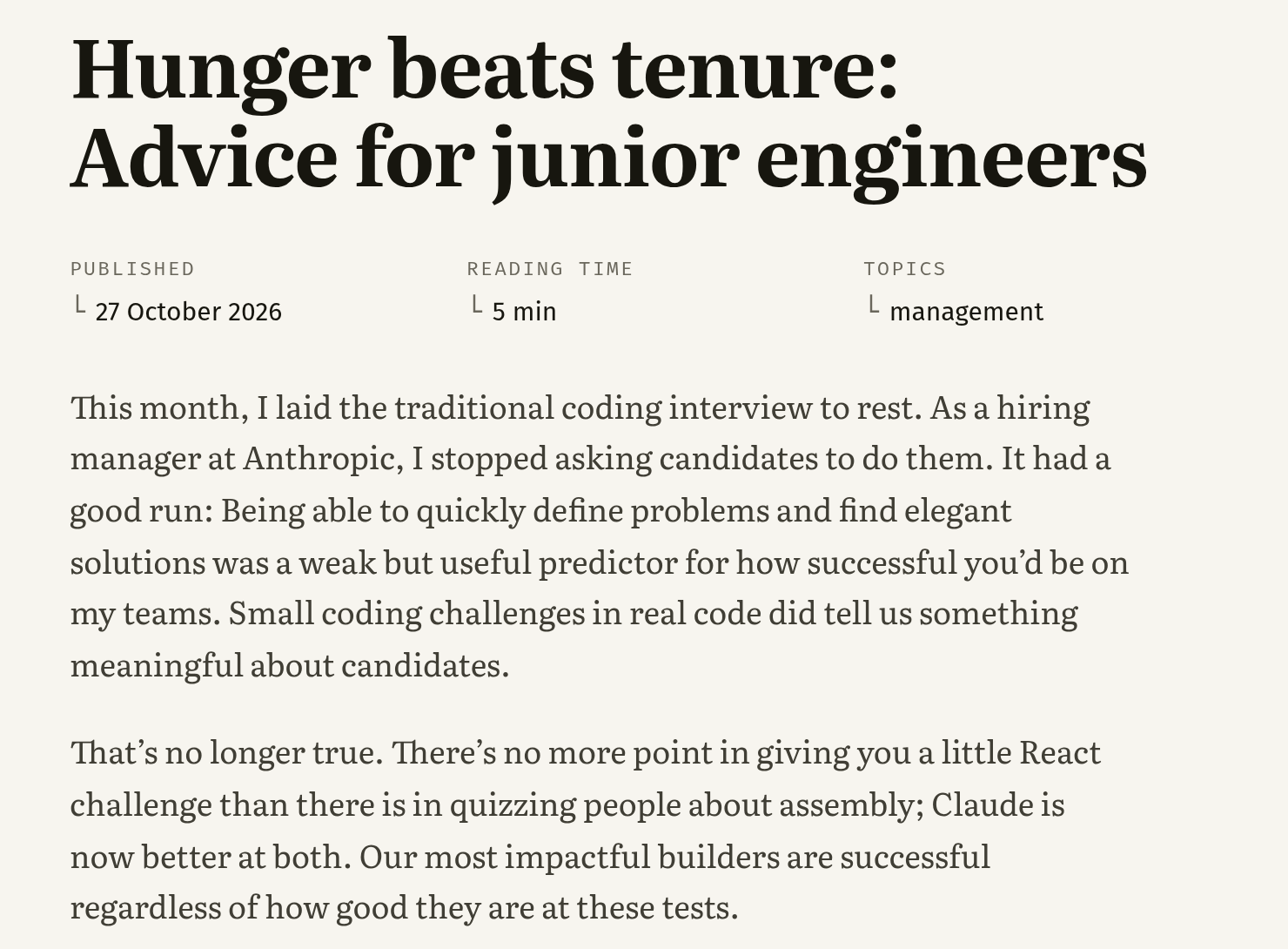
A hiring manager at Anthropic has dropped the coding interview from his team’s hiring loops, and his reason is the company’s own model: Claude is now better at the test. Felix Rieseberg, an engineering manager who has led engineering for Claude.ai, Cowork and Claude Code Desktop, wrote on October 27, 2026, that he had “laid the traditional coding interview to rest” this month. “There’s no more point in giving you a little React challenge than there is in quizzing people about assembly,” he wrote. “Claude is now better at both.”
The change covers one manager’s hiring loop. Company-wide, Anthropic’s careers page still tells technical applicants that it uses “live coding tools like Colab and CodeSignal,” and its guidance for candidates still describes take-home coding challenges and live interviews where, in its words, “This is all you.” Rieseberg drew the same line himself on X: the coding interview is dead “at least for my team at Anthropic.”
From a personal blog to Techmeme in one evening
Rieseberg published the essay, “Hunger beats tenure: Advice for junior engineers,” on his personal site at 2:38 p.m. Pacific time on October 27. Eighteen minutes later he summed it up on X: “The coding interview is dead, at least for my team at Anthropic. I’ve seen enough to know that it no longer provides signal. I removed it from loops this month.”
By Wednesday morning, October 28, that post had more than 770,000 views, and Techmeme ran the story under the line “An Anthropic hiring manager says he stopped giving coding interviews because Claude is better at them.”
Rieseberg credits the old test with some past value. Being able to “quickly define problems and find elegant solutions,” he wrote, was “a weak but useful predictor” of success on his teams, and small challenges in real code “did tell us something meaningful about candidates.” He then wrote: “That’s no longer true.” The people who make the biggest difference on his teams succeed, in his account, “regardless of how good they are at these tests.”
Before Anthropic, Rieseberg worked at Notion, Stripe, Slack and Microsoft, and he co-maintains Electron, the open-source framework that many desktop apps are built on. He expects pushback from his own profession: established engineers, he wrote, will “still have strong reactions to its disappearance,” if only for what it says about how their jobs are changing.
Hunger beats tenure
Most of the essay is about junior engineers, and its tone runs against much of what has been written about them and AI. “Now that I’ve seen junior people work with AI for a bit, I have a more hopeful take,” Rieseberg wrote. Impact, in his view, is now “less bounded by how many years of accumulated knowledge in frameworks and libraries you’ve gathered.” He says he is “seeing engineers who are comparatively new fly past people who are probably better coders and have been around much longer.”
His example comes from inside Anthropic. People there had grown so used to running Claude Code from the command line, he wrote, that it took two relatively new engineers, Anthony Morris and Alice Zhao, to build a working prototype of a graphical interface for it over one weekend. “The first public version shipped roughly eight days later,” he added, noting that a good graphical interface for Claude Code “is a very popular product.”
“Execution isn’t expensive anymore,” Rieseberg wrote, and his advice to newcomers contains no algorithm drills. He tells them first to find out what their manager’s manager is trying to achieve, quoting Patrick McKenzie’s 2011 line that engineers are hired “to create business value, not to program things.”
Then, he wrote, they should pick one ambitious idea that would move that goal and build a working prototype over a weekend instead of writing a requirements document and lobbying for a designer’s time. He insists on one idea per prototype, because juniors tend to hide “three excellent ideas among 20 bad ones.”
The search for a replacement
“I don’t think the coding interview is going to come back,” Rieseberg wrote, but he has no full substitute yet. “I’m probably not the only manager trying to figure out how to interview for people who build well with AI. I haven’t quite gotten there yet.” For now he is “scanning resumes and portfolios for little prototypes that exhibit taste, empathy, and principled thinking.”
Juniors are a shrinking share of Anthropic’s hires
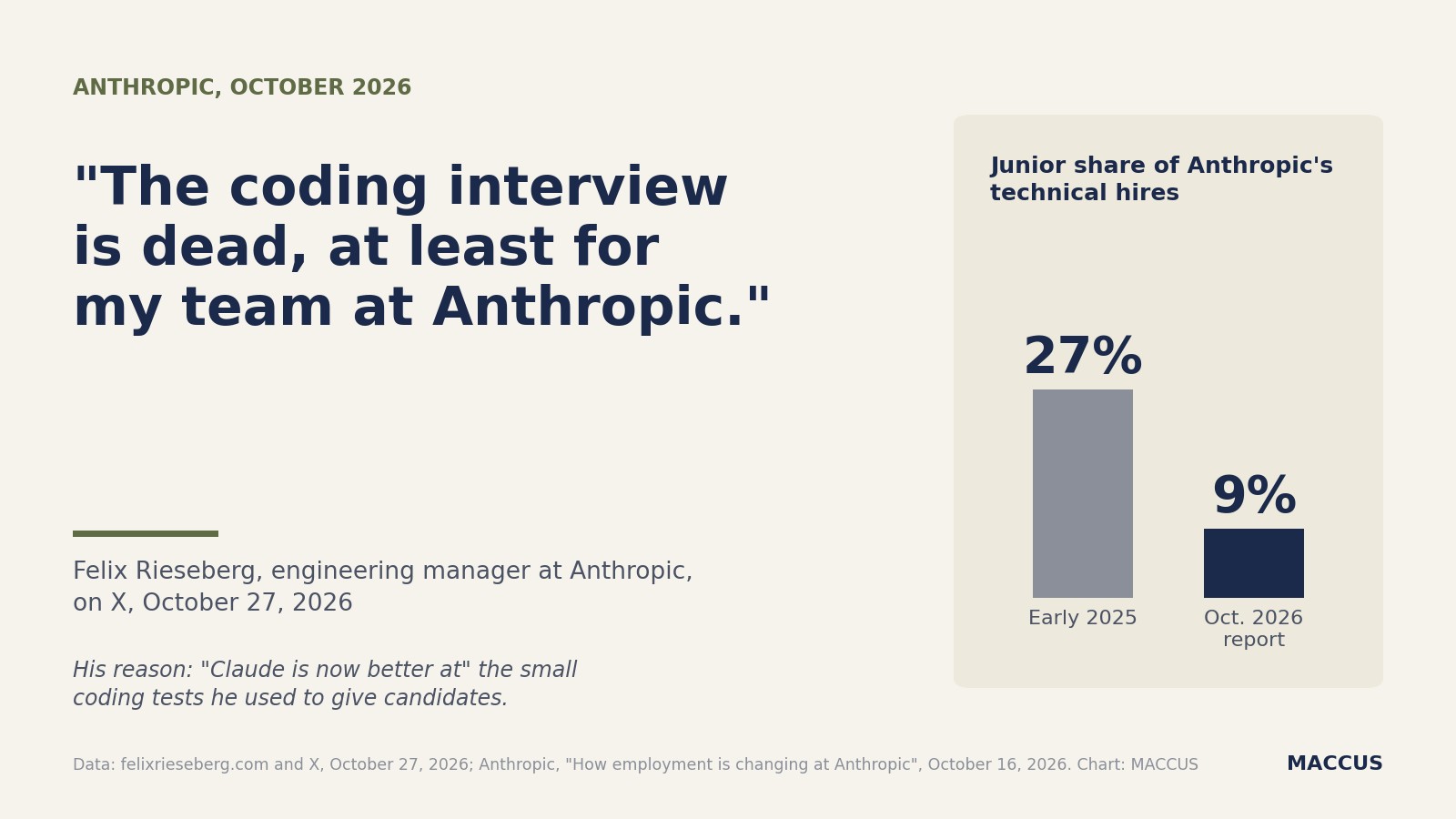
The essay came out eleven days after Anthropic published its own numbers on junior hiring. In a research report on October 16, 2026, the company said the junior share of its technical staff had slipped from 21% to 14% since early 2025, while the junior share of its technical hires fell faster, from 27% to 9%. Postings for juniors, it added, “have fallen particularly sharply since December 2025.” We covered that report when it came out.
Snowflake says it is moving the opposite way. Vivek Raghunathan, its senior vice president of engineering, wrote in Fast Company on September 18, 2026, that junior engineers make up 70% to 80% of Snowflake’s current hiring. If companies cut them now, he argued, “in the future we won’t have senior leaders” who understand AI-native ways of building.
Japan leans the same way as Anthropic: more than one big company in five in a Nikkei survey may hire fewer graduates from 2029, with office work at the top of the jobs they say AI could replace. In the United States, the AI job growing fastest by job ads, according to Lightcast data reported by CNBC, is the engineer who installs AI inside client companies, a role that mixes building with learning how the customer’s business works.
One team, and no test data
Rieseberg backs the claim with no data: no comparison of Claude’s results against candidates’ on his old exercises, no count of hires made under the new approach and no measure of how those hires perform. His “better at both” line covers small exercises such as a short React task or an assembly quiz. The essay does not say whether system design or debugging rounds remain in his loops.
The weekend prototype is his own account of colleagues’ work, and Anthropic did not publish the essay: it sits on his personal blog. The company’s stated process is unchanged. The live coding tools and the “This is all you” rule for live interviews were still on Anthropic’s hiring pages on October 28.
What it means
For two decades the coding interview, a timed puzzle on a whiteboard or in a shared editor, decided who got into software, and a whole market of prep books and practice sites grew around it. It rested on one assumption: solving a small problem fast, alone, says something about how a person will work. Rieseberg’s argument is that the assumption broke once a model could solve those problems better than the candidates, so the score stopped telling him who would do well.
What he screens for in the meantime rewards a different profile: people whose portfolios show small prototypes built with AI. That favors initiative over years in the job, which is his “hunger beats tenure” point. It also fits Anthropic’s own hiring data, which show juniors as a shrinking share of the company’s technical hires while Rieseberg changes how his team selects candidates.
Three things will show whether this spreads beyond one team at Anthropic: whether the company’s careers page drops its live coding tools, whether hiring managers at other AI labs follow in public, and whether any follow-up employment report from Anthropic shows the junior share of technical hires climbing back from 9%.
Sources
- Hunger beats tenure: Advice for junior engineers, Felix Rieseberg, felixrieseberg.com, October 27, 2026
- The coding interview is dead, at least for my team at Anthropic, Felix Rieseberg on X, October 27, 2026
- Careers, Anthropic, page as of October 28, 2026
- How to collaborate with Claude during our hiring process, Anthropic, last updated July 10, 2025
- How employment is changing at Anthropic, Anthropic, October 16, 2026
- An Anthropic hiring manager says he stopped giving coding interviews because Claude is better at them and tells junior engineers that “hunger beats tenure”, Techmeme, October 27, 2026
- Everyone thought AI would replace junior engineers. We’re hiring more of them, Vivek Raghunathan, Fast Company, September 18, 2026
Header image: chart by MACCUS, quote from Felix Rieseberg on X (October 27, 2026), data from Anthropic’s report “How employment is changing at Anthropic” (October 16, 2026)