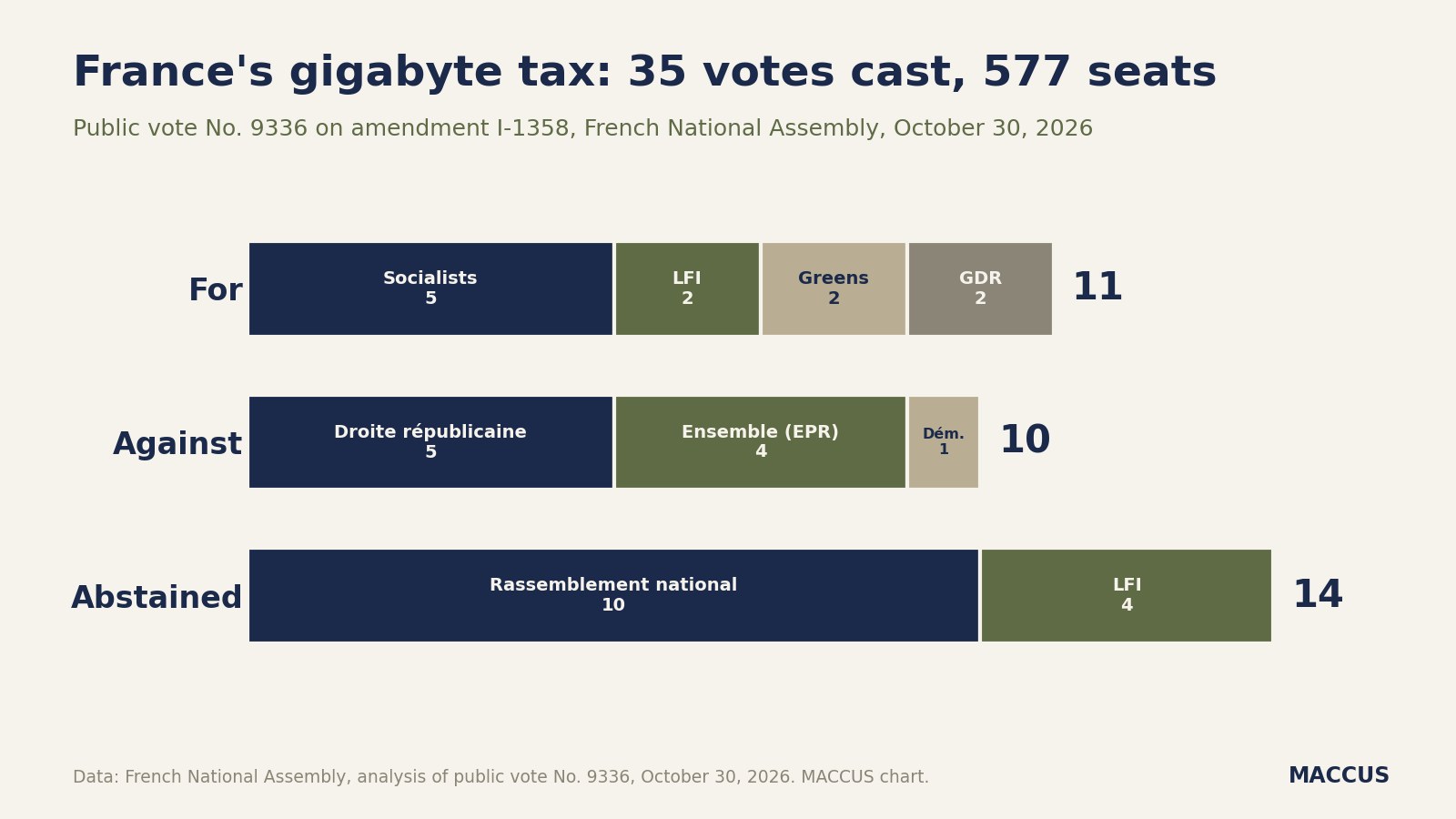

France’s National Assembly adopted a tax of 0.055 euros per gigabyte sent to internet subscribers in France, in a first-reading vote shortly after 9 a.m. on Friday, October 30, 2026. Amendment I-1358 to the 2027 budget bill, filed on October 9 by Laurent Lhardit for the Socialist group, calls it a “tax on producers of digital data.” The margin was one vote: 11 for, 10 against and 14 abstentions, with 35 members voting.
The government opposed the amendment, and so did Philippe Juvin, the finance committee’s general rapporteur for the budget. Juvin explained his position by pointing to the big tech platforms: “The risk is that they pass the burden of this tax on to advertisers.” Nothing is final until the formal vote on the revenue portion of the budget, scheduled for Tuesday, November 3.
A tax based on data volume
The amendment adds four articles to France’s General Tax Code, numbered 302 bis ZP through 302 bis ZS. The tax, “assessed on the flows of digital data sent by content providers and paid by them,” equals the measured volume in gigabytes multiplied by 0.055 euros.
Counting would fall to internet service providers and to any company that sells internet access to households or businesses. Under the supervision of the telecom regulator Arcep and the tax authority DGFiP, they would record each sender’s identity, its registration number with the Internet Assigned Numbers Authority and the amount of data it delivered to their customers. The records could not cover the content or the destination of the data, and a decree would set the technical details.
Content delivery networks (CDNs), the servers that keep copies of files close to users, get separate treatment: for them, the volume counted is the total traffic leaving the network. The tax is capped at 15% of the sender’s revenue in France or 2% of its total revenue.
35 voters in a 577-seat chamber
According to the Assembly’s breakdown of public vote No. 9336, 21 of the 35 members who voted cast a yes or no ballot. The yes side drew five Socialists, two members of La France insoumise (France Unbowed), two Greens and two members of the Gauche démocrate et républicaine group. The no side drew five members of the Droite républicaine, four from Ensemble pour la République and one from Les Démocrates.
The 14 abstentions split between the Rassemblement national (National Rally), with 10, and La France insoumise, with four. Had the 10 National Rally members voted no, the amendment would have failed 20 to 11. The next recorded vote, later in the same sitting, already drew 60 members, according to the official record.
The floor debate
Speaking time was limited to one minute. Lhardit said the tax would raise “an estimated 10 billion euros,” paid “mainly” by “the global digital giants.” Juvin replied that the big tech platforms hold “disproportionate market power” and could therefore shift the cost to advertisers.
David Amiel, the minister for public action and accounts, questioned whether the measurement was workable, saying it would require “flow sensors.” By his account, half of the tax, “no less than 5 billion euros according to your proposal,” would fall on “smaller content providers, including French ones.” He pointed to the tools France already has, its digital services tax (DST) and competition policy, citing the 4.1 billion euro fine imposed on Google for abusing a dominant position.
Lhardit’s reply addressed users rather than advertisers: “I don’t see how a tax could be passed on to users of Facebook, Instagram or TikTok, since those services are free.” He put the cost for French TV group TF1 at “between 200,000 and 300,000 euros” and said five large platforms account for half of the traffic received by subscribers in France.
Google and Meta already pass France’s digital services tax on to advertisers
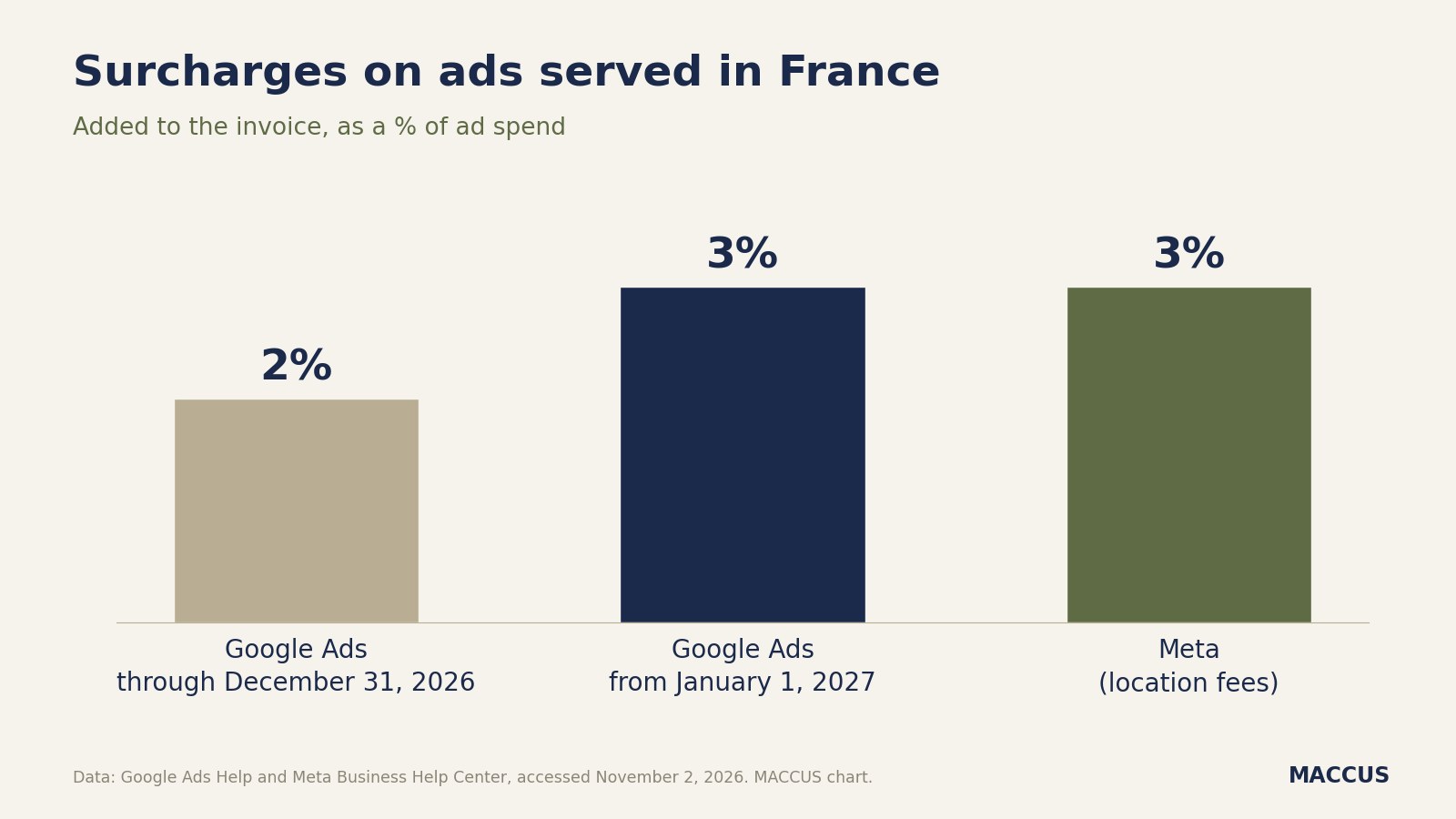
Juvin’s warning has a precedent: France has had a digital services tax since 2019, and Google passes part of it on to advertisers. Google’s “Jurisdiction-specific surcharges” help page, accessed November 2, 2026, says invoices for ads served in France include a “France Regulatory Operating Cost.” The company says the charge is added “to cover part of the cost of complying with Digital Services Tax legislation in France.” The rate rises from 2% to 3% on January 1, 2027.
Meta charges a 3% “location fee” on ads served in France to cover the cost of the DST, according to its help page. The fee sits outside the campaign budget and appears as a separate line on the invoice. The page adds: “Until now, Meta has covered these additional costs.” On both platforms, the charge depends on where the ad is seen, regardless of where the advertiser is based.
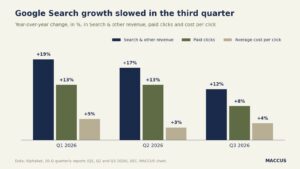
These surcharges come on top of prices that are already rising. At Meta, the average price per ad rose 14% year over year in the third quarter (10% in Europe), according to results the company published on October 21. At Google, the average cost per click rose 4% over the same period, the results Alphabet published on October 28 show.
The surcharges apply only to paid ads. Search engine optimization and unpaid posts, which fall under organic marketing, are not subject to them. The gigabyte tax would apply to any volume of data sent to subscribers, advertising or not. As of November 2, 2026, neither Google’s page nor Meta’s mentions it.
OVHcloud’s founder puts a price on the tax
Octave Klaba, founder of cloud provider OVHcloud, published his calculations on Saturday, October 31, French tech site Clubic reported. Based on average traffic of about 324 gigabits per second to subscribers in France, he puts his company’s bill at between 23 million and 70 million euros a year, depending on how the cap applies. He calls the cap “inconsistent” and warns of a “distortion of competition” at the expense of companies based in France, which he says the tax would hit “for sure.”
Klaba also writes that OVHcloud would have to “collect for the state, and therefore pass it on to” its customers. The amendment’s explanatory statement covers that case for intermediaries: transit providers and CDNs “have no obligation to name their customers” and may “rebill the tax or not, according to their terms of sale.”
Unproven numbers
The explanatory statement projects “revenue of 10 billion euros” without showing the calculation. It cites an Arcep estimate, without saying which year it covers: 200 billion gigabytes a year delivered to the subscribers of internet providers. At 0.055 euros per gigabyte, that volume would bring in 11 billion euros before the caps. The same text attributes half of that traffic to Google, Meta, Amazon, Netflix and Akamai.
The measurement system has yet to be built. Its authors write that “flow measurement is an industry standard” and that France’s four major internet providers would make oversight easier, a claim the minister doubts. The decree that would set the method has not been written. The text says nothing about advertising: any pass-through to advertisers would depend on the prices each platform sets for itself.
The timeline
The formal vote on the revenue portion of the bill is scheduled for Tuesday afternoon, November 3, according to the National Assembly. The parliamentary news site NosParlementaires notes that an amendment adopted on the floor stands only if the full revenue portion passes. The government still has two options: a second deliberation, which would put the amendment to a new vote, or Article 49.3 of the Constitution, which would let it choose which amendments to keep. The bill then goes to the Senate.
Time could also run short. On October 30, Éric Coquerel, chair of the finance committee, said lawmakers had examined a third of the amendments in 50 hours. “We may not finish the examination within the 40 days allowed,” he said.
What it means
Eleven votes were enough on October 30 to put the tax into the draft budget, over the government’s objections. It could still be removed at any stage, up to the Senate. Its revenue estimate and its measurement method remain unproven.
The risk to advertisers that Juvin raised went unanswered during the debate on the amendment. To offset the DST, Google and Meta added a line to advertisers’ invoices. Nothing suggests they would do the same for a tax based on data volume, and neither company had commented publicly on the vote as of November 2.
One change for advertisers is already scheduled, regardless of this vote: Google’s surcharge in France rises to 3% on January 1, 2027.
The next things to watch are the November 3 vote, the version of the text the government keeps if it invokes Article 49.3, and the help pages where Google and Meta list their surcharges.
Sources
- Amendement n° I-1358 au projet de loi de finances pour 2027 (n° 3210), French National Assembly, October 9, 2026
- Analyse du scrutin n° 9336, French National Assembly, October 30, 2026
- Compte rendu de la première séance du vendredi 30 octobre 2026, French National Assembly, October 30, 2026
- Examen de la première partie du projet de loi de finances pour 2027, French National Assembly, accessed November 2, 2026
- Jurisdiction-specific surcharges, Google Ads Help, accessed November 2, 2026
- About location fees for ads on Meta technologies, Meta, accessed November 2, 2026
- Le patron d’OVHcloud fait les comptes, la taxe sur les gigaoctets coûterait un montant colossal à son entreprise, Clubic, October 31, 2026
- Taxe au gigaoctet : l’Assemblée adopte la taxe socialiste dans un hémicycle presque vide, NosParlementaires, October 31, 2026
Header image: MACCUS chart, data from the French National Assembly (public vote No. 9336, October 30, 2026)