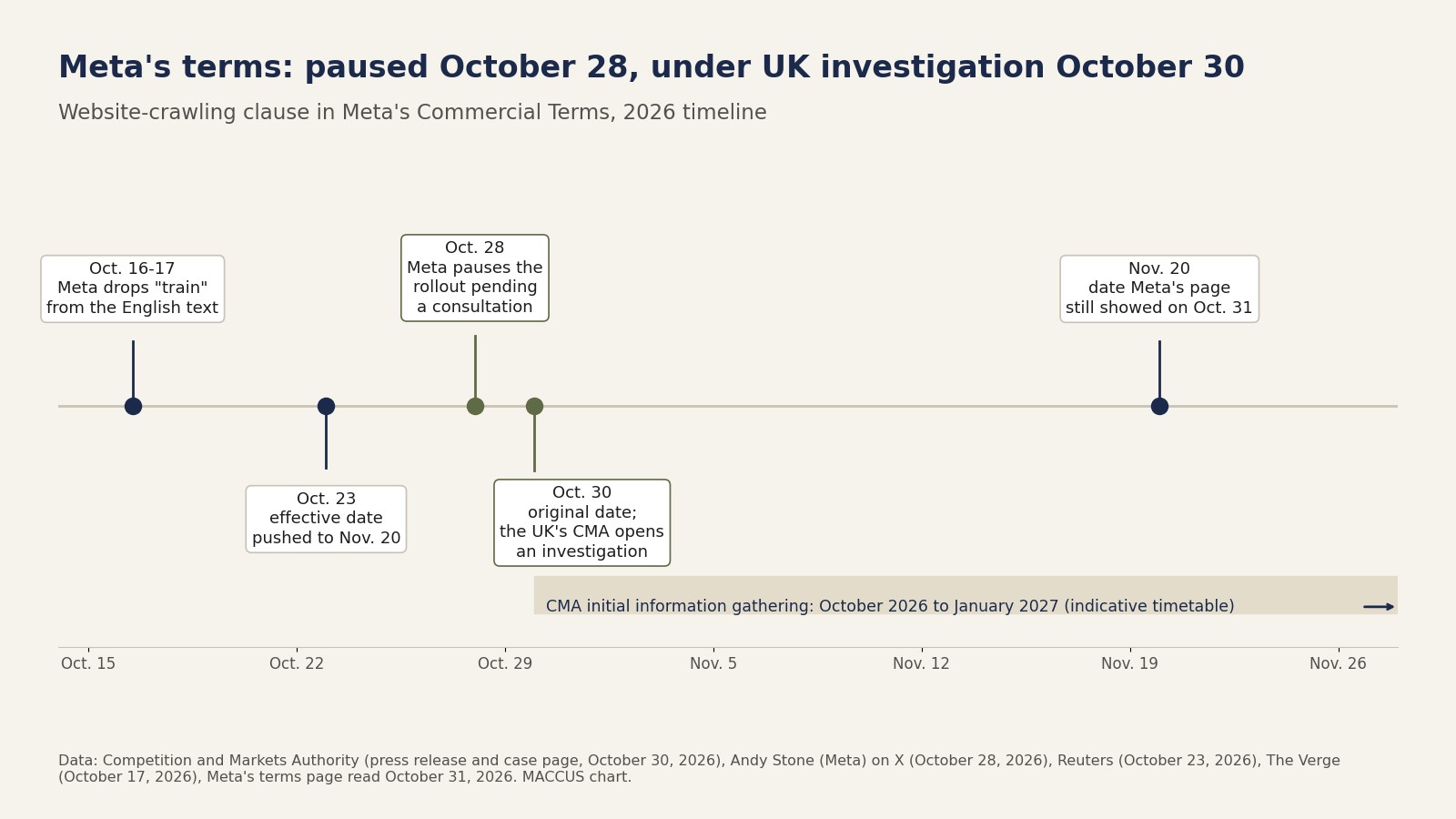

On October 30, 2026, the UK’s competition regulator, the Competition and Markets Authority (CMA), opened an investigation into the commercial terms Meta applies to businesses that use Facebook, Instagram and its other services. The CMA wants to establish whether Meta is abusing a dominant position “by imposing exploitative terms on publishers and advertisers.” Two days earlier, on October 28, Meta had paused the rollout of its new terms pending a consultation with industry groups. No new date has been set, and the current terms remain in force.
The new terms contain the clause maccus.fr has been tracking since October 16: it would allow Meta’s crawlers onto the websites associated with a Facebook or Instagram business account. Meta then removed the word “train” from the English version and pushed the effective date back from October 30 to November 20. According to the CMA, that delay followed “active engagement” with the regulator.
Website content at the center of the case
The CMA is acting under Chapter II of the Competition Act 1998, the UK law that prohibits abuse of a dominant position when it may affect trade within the United Kingdom. The regulator first has to establish whether Meta holds a dominant position in one or more relevant markets in the UK. If it does, the CMA will examine whether Meta’s existing commercial terms, or revisions to those terms, amount to an abuse of that position.
According to the CMA’s press release, the terms could allow Meta to collect content from the websites of businesses and publishers that use its services. Meta could then use that content to develop and provide its own products and services, including its AI features, “without those businesses getting a choice on if or how their content is used.” The CMA is concerned that requiring news publishers and other content businesses to accept these terms “could amount to an unlawful imposition of unfair trading conditions for thousands of UK businesses that rely on its services to reach customers and audiences.”
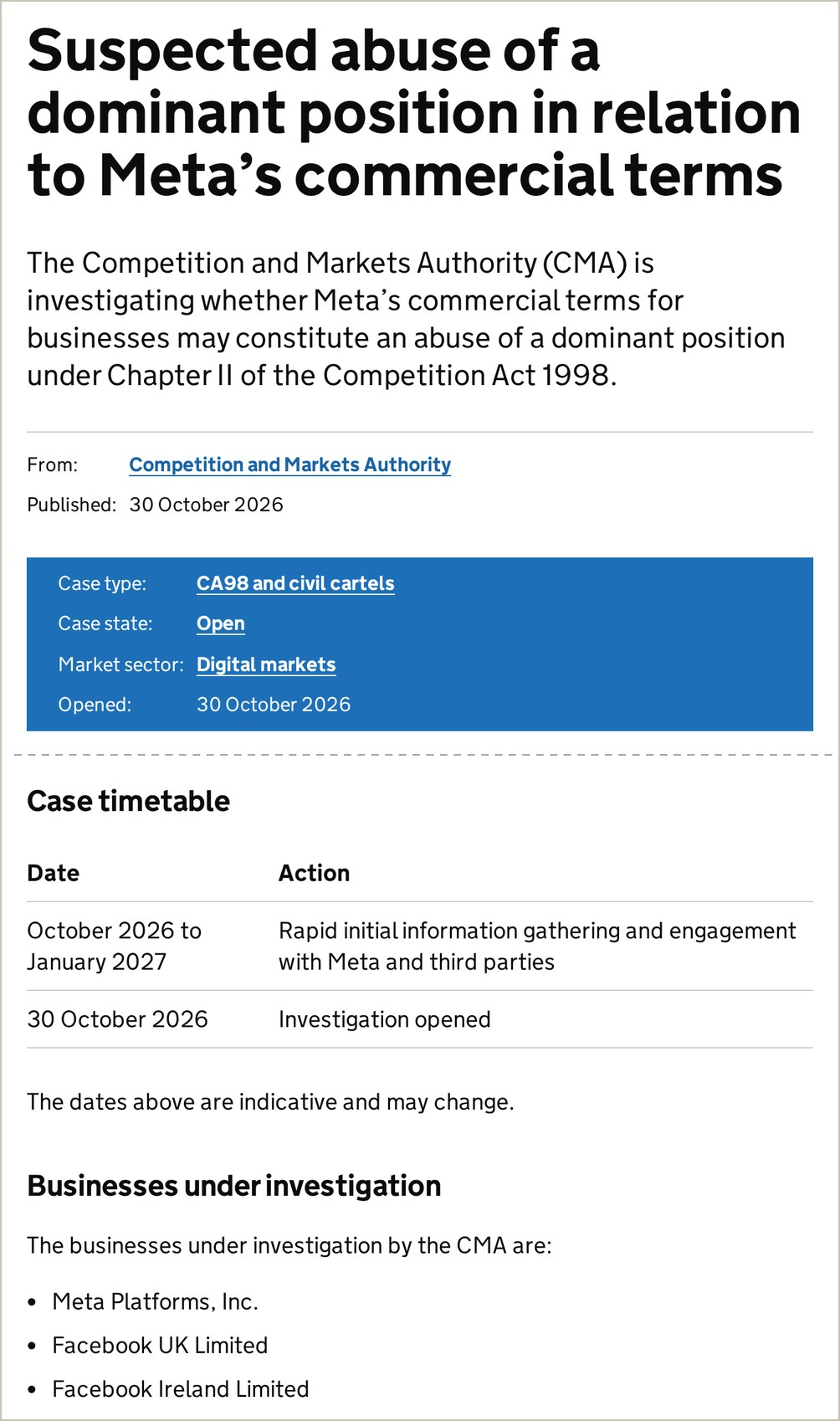
The case names three companies: Meta Platforms, Inc., Facebook UK Limited and Facebook Ireland Limited. The CMA says it is using its Competition Act powers so it can urgently investigate concerns raised by stakeholders including the News Media Association, which represents the British news industry, and Movement for an Open Web.
“Where a company holds a dominant position, it must not use that position to impose unfair terms,” said Sarah Cardell, the CMA’s chief executive. “We will be working to reach a swift and satisfactory resolution to this case.”
A first phase running through January 2027
The case page sets out an indicative timetable: from October 2026 to January 2027, “rapid initial information gathering and engagement with Meta and third parties.” After that, the CMA can close the case or, if it provisionally finds that competition law has been infringed, issue a statement of objections, let the companies respond and then reach a final decision.
The regulator stresses that “no assumption should be made at this stage that competition law has been infringed.” The law lets the regulator impose interim measures to prevent significant damage or protect the public interest. The CMA has announced none in this case.
The press release also notes that the CMA’s other tool, the UK’s digital markets regime, gives it only limited powers over companies that have not been designated with strategic market status. Meta has not been designated. The CMA Board is due to consider the next set of designation proposals in spring 2027.
Meta has not set a new date
Andy Stone, who handles communications at Meta, posted the announcement on X on October 28 at 11:47 a.m. Eastern time: “We’ve heard publishers’ feedback on our proposed ads and business terms update. We care deeply about our partners and do not plan to make policy changes without a full consultation with industry groups and leaders.” He added that Meta expects “this consultation could extend beyond November 20, in which case we’d delay implementation of the updated terms. Until then our existing terms remain in place.” Reuters described the move as an indefinite delay.
Meta’s pages have not changed. At about 10:30 a.m. Brussels time on October 31, the preview of the updated Commercial Terms still said, in English and in French, that the updates “will go into effect on November 20, 2026,” with no mention of the pause. The banner on the Self-Serve Ad Terms page shows the same date.

In a statement quoted by AFP after the investigation opened, a Meta spokesperson said “we’ve already committed not to change our terms without consulting publishers and other stakeholders” and added: “We welcome the opportunity to explain our approach to the CMA.”
Advertisers already grant Meta some access
Meta’s Self-Serve Ad Terms, in effect since August 22, 2025, already say that by placing an order, an advertiser grants Meta “the right to access, index, cache, analyze or crawl the content available through your domains, webpages or URLs.” The listed purposes include developing advertising products, “research and training,” and maintaining the integrity of Meta’s products.
The paused clause is broader in scope. It would apply to any business use of Meta’s services, from running a Page to managing a product catalog, and it would authorize crawlers and test credentials on the associated websites. It does not mention robots.txt.
Meta has said it will respect robots.txt blocks on AI scraping, but that commitment is not written into the terms, Press Gazette notes. The robots.txt file and its limits are covered in maccus.fr’s guide to AI crawlers and robots.txt.
Publishers welcome the investigation
On October 22, the News Media Association asked the CMA to secure an immediate pause on the new terms while the regulator negotiated voluntary commitments with Meta, InPublishing reported. After the delay to November 20, its chief executive, Theo Bamber, said: “This delay is welcome, but it is a pause, not a solution.”
On October 30, he welcomed the investigation in a statement quoted by Press Gazette. “Meta has given publishers an invidious choice of giving away their content for free to power its AI products or leaving a platform which millions of Britons use to get their news,” he said. He argued that Meta would not have taken such a step had it already been subject to the digital markets regime, and that Meta “must now be the primary candidate for the next Strategic Market Status investigation.”
Tim Cowen, co-founder of Movement for an Open Web, said the investigation, “combined with Meta’s delay in introducing their new rules, is a significant win for the wider industry but this is only the start.” Sajeeda Merali, chief executive of the Professional Publishers Association, also quoted by Press Gazette, said that “access to audiences should not come at the price of publishers’ content.”
Separate questions on Meta One and paid links
In the same press release, the CMA says it is seeking information from Meta on Meta One, its new business subscription service. It is also asking about concerns raised by the Federation of Small Businesses over the potential impact on small businesses of posting external links on Facebook and Instagram without paying a subscription fee. According to Press Gazette, Meta is running a trial that requires Facebook Pages to pay for a Meta One subscription to post external links, and news publishers are currently excluded. The CMA has not yet decided whether to take formal action on this point, which falls outside the investigation opened on October 30.
What it means
The CMA knew about the pause, which its own press release mentions, and opened a formal case anyway. The investigation also covers revisions to the terms, so any text that comes out of Meta’s consultation could fall within its scope.
For businesses that run a Page, an Instagram professional account or ads, the new crawling clause is not in effect as of October 31. Meta’s pages still show November 20, but the company expects its consultation could run past that date. The current terms remain in force, including the website access advertisers already grant when they place an order.
The investigation falls under UK law only, while the new terms would also apply outside the UK, including in France and Belgium, where Meta shows them in French. As of October 31, neither the European Commission nor France’s competition authority had announced an investigation into these terms, although complaints have been filed with antitrust authorities in the European Union and the UK, according to Reuters. It is not yet known whether a revision secured in the UK would apply elsewhere.
Several questions remain open: the format, length and participants of the consultation Meta has promised; whether crawlers and test credentials survive in any revised text; the findings of the first phase of the investigation, scheduled to run through January 2027; whether the European Commission acts on the complaints it has received; and Meta’s answers to the CMA’s questions on Meta One.
Sources
- CMA opens investigation into Meta’s commercial terms, Competition and Markets Authority, October 30, 2026
- Suspected abuse of a dominant position in relation to Meta’s commercial terms, Competition and Markets Authority, case page, October 30, 2026
- We’ve heard publishers’ feedback on our proposed ads and business terms update, Andy Stone (Meta) on X, October 28, 2026
- Meta delays indefinitely its rollout of new commercial terms after publishers’ concerns, Reuters (via The Spokesman-Review), October 28, 2026
- U.K. probes Meta over ‘exploitative’ new terms for media, AFP (via CP24), October 30, 2026
- UK competition watchdog opens investigation into Meta scraping terms, Press Gazette, October 30, 2026
- NMA calls on CMA to halt Meta’s ‘outrageous assault on journalism’, InPublishing, October 23, 2026
- Meta Commercial Terms, preview of the update, Meta, accessed October 31, 2026
Header image: MACCUS chart. Data: Competition and Markets Authority, Meta, Reuters and The Verge, October 17 to 31, 2026