Adam Fry, ChatGPT’s consumer product lead, said at a dinner hosted by OpenAI in New York on Monday, November 2, 2026, that “ChatGPT’s volume of search-like queries is now roughly one-fifth the volume of queries of Google.” Journalist Alex Kantrowitz, who led the conversation, published a transcript “lightly edited for clarity and length” in his Big Technology newsletter on November 3.
In the published interview, Fry did not say which Google figure he used, what period the comparison covered or which regions it included, Search Engine Journal noted the same day. Referral data shows a much wider gap: in October 2026, across 118,671 sites tracked by Ahrefs, Google sent almost 70 times as many visits as ChatGPT.
One search per web lookup
Kantrowitz asked whether a conversation counted as a single search or whether each question that required a web search counted on its own. Fry’s answer: “Every time you ask a question and go search the web, that’s a search.” By that rule, a single conversation can add up to several searches.
Fry said that about two years ago, people mostly came to ChatGPT for help with writing and coding: “Those wouldn’t be things that you really search for.” Over the past year, they have started asking about people, places and things that require up-to-date information, as well as about finance and health, two areas where ChatGPT runs a web search. He summed up search-like queries as “anything that a user would have traditionally gone to a traditional search engine for.”
The Bing question went unanswered
Bing holds around 5% of the search market, Kantrowitz pointed out, before asking whether that made ChatGPT several times bigger than Microsoft’s search engine. Fry did not address the point in the published transcript. He pivoted instead to ChatGPT’s growth, from 1 billion to 1.2 billion weekly users in two months: “That’s roughly 100 million users in 30 days, and another 100 million in another 30 days.”
Outside estimates range from 4% to 18%
On March 3, 2025, Google said it sees “more than 5 trillion searches on Google annually,” based on internal data from January 2025. Patrick Stox, then a technical SEO at Ahrefs, used that total on February 11, 2026, to put Google at 13.7 billion searches a day. The 2.5 billion prompts sent to ChatGPT each day in July 2025 equaled 18% of that.
Not every prompt is a search, so Stox sorted prompts by type of request. OpenAI’s figure counts web searches instead. A study by OpenAI and Harvard that he cited found that 24% of ChatGPT usage was pure information seeking, which put ChatGPT at 4.4% of Google’s volume.
His own classification produced a higher figure: 65% of prompts were about topics people used to type into Google, which works out to about 12% of Google’s volume. On that basis, he estimated that ChatGPT had already passed Bing, which he put at 1.2 billion searches a day without citing a source.
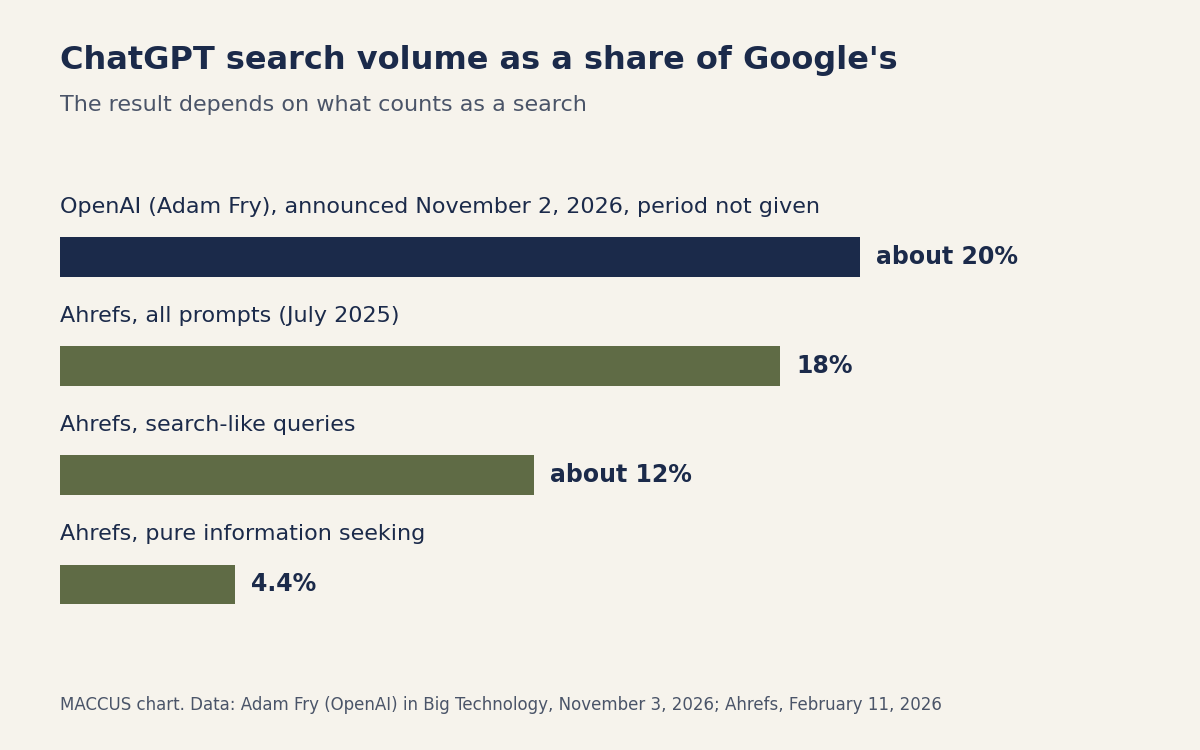
OpenAI’s ratio, roughly one-fifth, is in the same range as Ahrefs’ raw 18%, which counted every prompt from July 2025, searches or not. The two figures, though, cover different periods and rest on different definitions.
Google still sends far more traffic to websites
Ahrefs also tracks, month by month, where visits come from on sites that use its free Web Analytics tool. According to its November 3 update, which covers 118,671 sites, Google sent 297.8 million visits in October 2026 (24.74% of the total), and ChatGPT sent 4.3 million (0.36%). In Europe, Google accounted for 40.17% of visits and ChatGPT for 0.49%. Visits from Google fell 2.3% from the previous month, while visits from ChatGPT rose 0.4%.
Other measurements point the same way. On October 21, consultant Marie Haynes published data from 100 sites tracked for 12 months in Google Analytics 4: ChatGPT sent the equivalent of 0.62% of the visits that came from Google organic search. In its February study, Ahrefs estimated that Google sent 190 times more traffic to websites than ChatGPT.
These series count only visits whose source can be identified. From October 8 to 16, a ChatGPT bug caused some of its referrals to show up as Direct traffic in Google Analytics 4, which usually files them under its AI Assistant channel. Ahrefs’ October figures include that period.
Alphabet reports its fastest query growth in five years
Alphabet, Google’s parent company, released its third-quarter results on October 28. CEO Sundar Pichai said in the release: “Our AI investments are driving overall Search query growth, including commercial queries. In fact, our year-over-year query growth rate is the highest it’s been in the last five years.” The release gives no query count.
Search revenue grew 12% year over year in the third quarter, compared with 17% in the second. Alphabet named several causes for the slowdown, led by currency effects. Among them was AI Mode, which the company said monetizes at a lower rate.
What it means
With this ratio, OpenAI is measuring ChatGPT search volume directly against Google’s, and the figure is higher than Ahrefs’ search-only estimates (4.4% and 12%). Applied to the more than 5 trillion annual searches Google reported in March 2025, a fifth would mean on the order of 1 trillion searches a year in ChatGPT, a total OpenAI has not disclosed.
Sites that depend on Google traffic are the most exposed. According to Fry, some of the questions people once took to a search engine now go to ChatGPT. Search Engine Journal points out that neither his ratio nor the query growth Alphabet reported shows whether those searches are replacing Google searches.
OpenAI counts every question that sends ChatGPT to search the web, including several in a single conversation. That count does not measure visits sent to websites. In visits, the gap is still about 70 to 1, and ChatGPT’s share gained only 0.02 percentage points in October.
The figure came from an executive speaking at a dinner OpenAI hosted, and the company has not published any document detailing the method. OpenAI also sells ads in ChatGPT: Fry noted again the same evening that the business had passed $1 billion in annualized revenue within 200 days. The ratio can therefore double as a pitch to advertisers.
If OpenAI discloses which Google figure it used and over what period, its ratio could be checked against outside estimates. Ahrefs’ monthly series will show whether the rise in ChatGPT searches translates into visits to websites. Alphabet’s next earnings report will tell whether the company publishes a query count or sticks to a growth rate.
Sources
- OpenAI: ChatGPT Search Is About 20% of Google’s, 250 Million People Speak With ChatGPT, and Chat Is Merging With Work, Big Technology, November 3, 2026
- Google’s Search Volume Is About 5x ChatGPT’s, OpenAI Says, Search Engine Journal, November 3, 2026
- ChatGPT Has 12% of Google’s Search Volume but Google Sends 190x More Traffic to Websites, Ahrefs, February 11, 2026
- AI vs Search Traffic Analysis, Ahrefs, updated November 3, 2026
- GEO is a distraction, Marie Haynes, October 21, 2026
- Alphabet Announces Third Quarter 2026 Results, Alphabet, October 28, 2026
- AI, personalization and the future of shopping, Google, March 3, 2025
Header image: MACCUS chart. Data: Adam Fry (OpenAI) in Big Technology, November 3, 2026; Ahrefs, update of November 3, 2026.