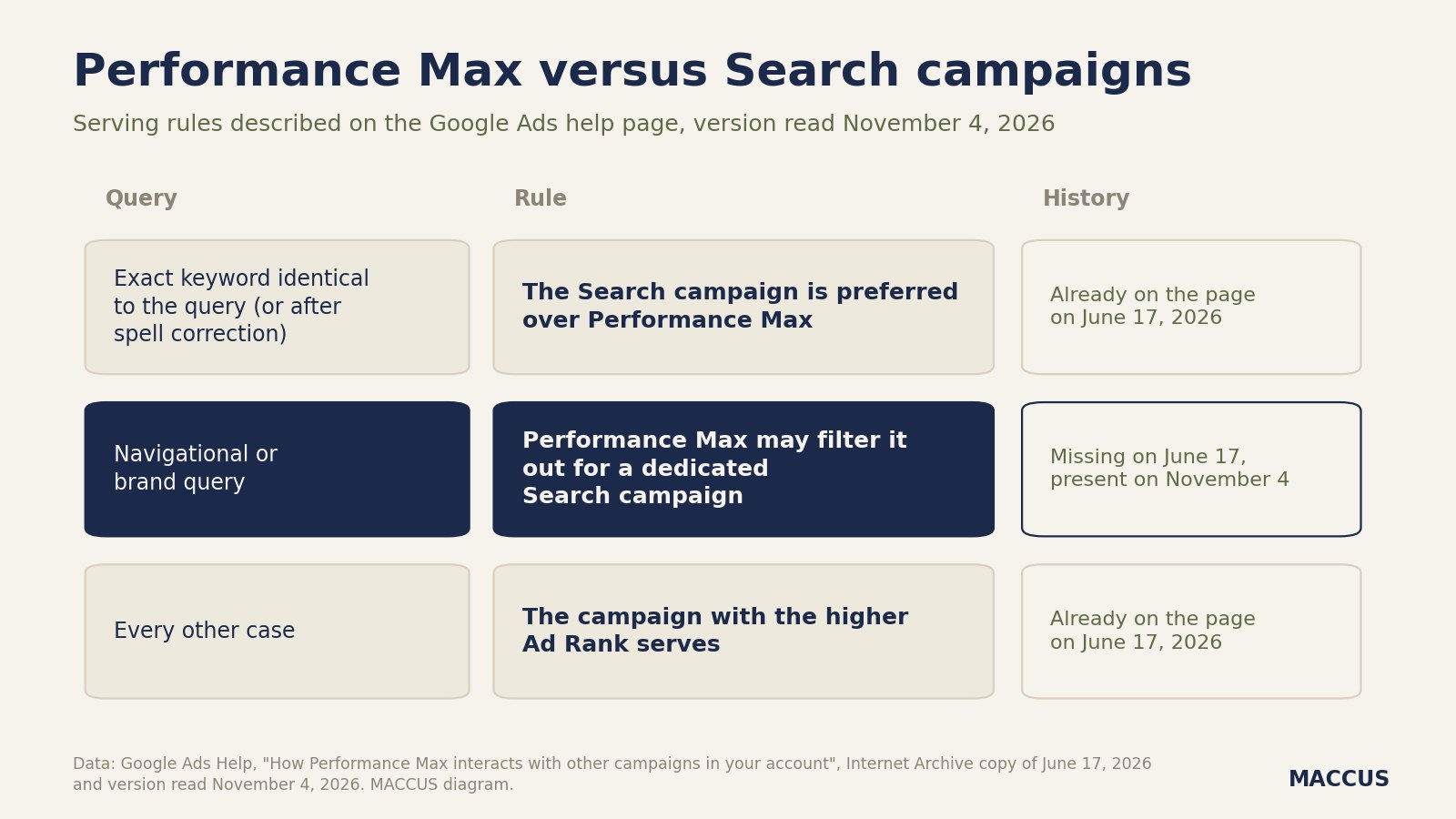

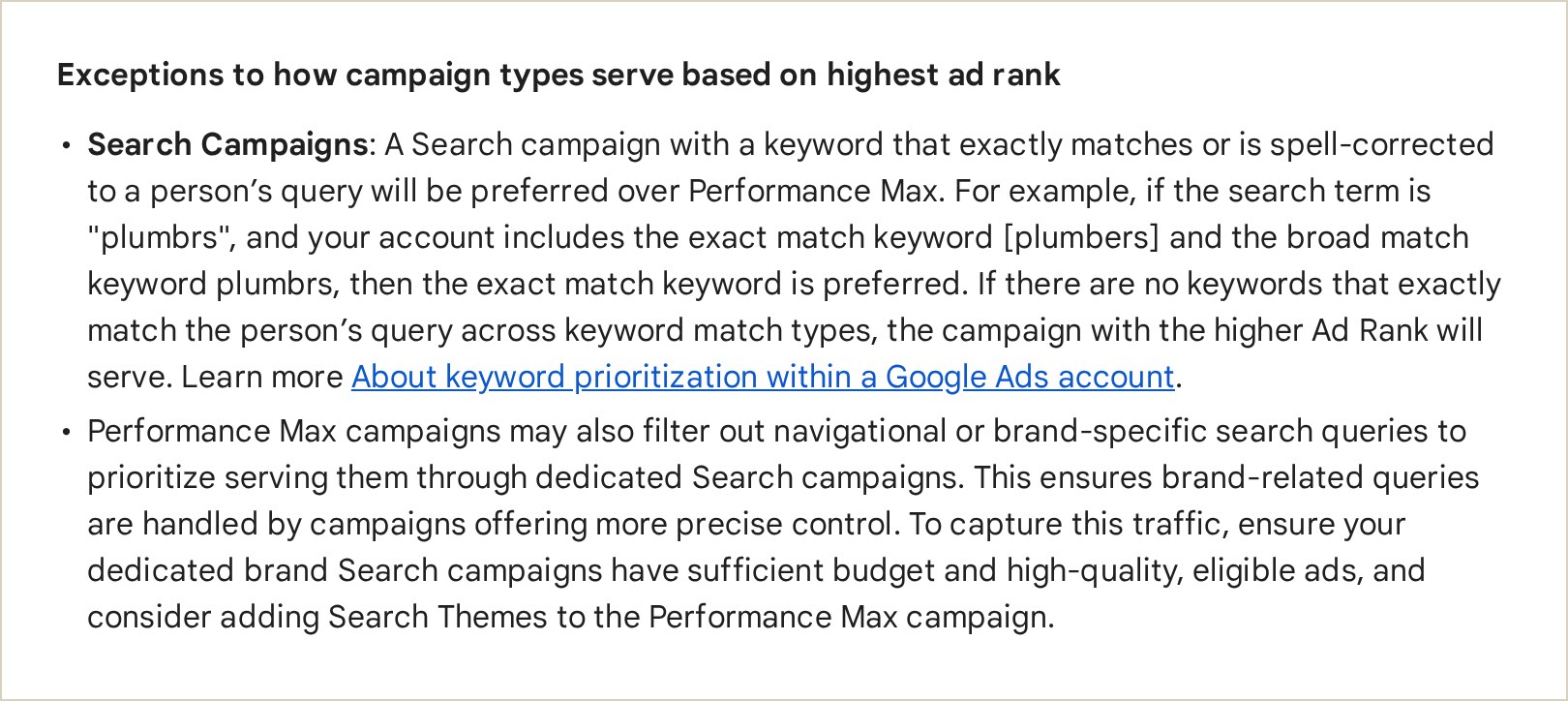
Google has added a paragraph to the help page that explains how Performance Max works alongside the other campaigns in a Google Ads account. Performance Max campaigns “may also filter out navigational or brand-specific search queries to prioritize serving them through dedicated Search campaigns,” the page now reads.
Google did not announce the change. Hana Kobzová, founder of the trade site PPC News Feed, spotted and reported it on November 2, 2026, and Search Engine Roundtable picked it up on November 3.
An undated addition
The paragraph appears in both the English and French versions of the page as of November 4, 2026. It is missing from the copy of the English page that the Internet Archive saved on June 17, 2026. That puts the addition between June 17 and November 2, the date of the PPC News Feed report, but the page gives neither the exact date of the change nor the date the rule took effect. The Google Ads & Commerce blog is silent too: its latest post, from October 28, covers ads in AI Mode.
Google explains the filtering in one sentence: “This ensures brand-related queries are handled by campaigns offering more precise control.” The page then recommends brand Search campaigns with “sufficient budget and high-quality, eligible ads,” and suggests advertisers “consider adding Search Themes to the Performance Max campaign.”
Search themes are optional hints that advertisers give Performance Max about the queries they want to reach. According to the help page on the feature, advertisers can add up to 25 per asset group. On Search inventory, search themes get the same priority as phrase match and broad match keywords in a Search campaign, and an exact match keyword identical to the query always takes priority over them.
The page before and after
Before the addition, the page described a single exception to the general rule that the campaign with the highest Ad Rank serves. A Search campaign with a keyword that exactly matches the query, or matches it after spell correction, is preferred over Performance Max. The page illustrates this with a search for “plumbrs” and the exact match keyword [plumbers]. The Internet Archive copies from January and June 2026 mention only that exception.
The new paragraph describes a second exception, specific to navigational and brand queries. It sets no keyword condition: the text does not require a Search campaign to include the brand name as an exact match keyword to pick up those searches.
Advertisers already have a setting for this traffic. In June 2023, Google began rolling out brand exclusions for Performance Max to all advertisers, in an announcement from Ginny Marvin, Google’s Ads Liaison. Google said at the time that the exclusions would also help block brand misspellings and brand searches in a foreign language.
According to the current help page, those exclusions apply to Performance Max’s Search, Shopping and YouTube inventory, with an option to keep Shopping ads running on searches that mention excluded brands. With exclusions, the advertiser makes the call. The new sentence says the system may also do that sorting on its own.
A floor of 15 conversions in 30 days
A second Performance Max help page, on performance fluctuations, was updated in the same period. Its English version now says these campaigns “require minimum data for stable performance” and that “achieving stable performance requires at least 15 conversions over 30 days.” According to Google, meeting that threshold “helps ensure consistent spend and strong ROAS.”
That sentence was not in the copy of the page archived on June 8, 2026. Hana Kobzová spotted it and PPC News Feed reported it on November 1; Adriaan Dekker, a Google Ads specialist, covered it the same day on his blog. The French version of the page, checked on November 4, does not include it: in the same spot, it only mentions sudden increases or drops in pings or tag fires.
The figure joins other guidance on how campaigns learn. In the October 15 episode of Google’s Ads Decoded podcast, product manager Tal Akabas said an established campaign does not go back into a learning period when its budget or target changes. Meta’s help page gives a rough benchmark for its own system: an ad set usually exits the learning phase after about 50 results in the week following its last significant edit.
The page leaves several points unclear
The text says Performance Max “may” filter these queries, but not how often that happens or how Google decides that a query is “navigational.” Nor does it say whether this is new behavior or an existing practice that Google is only now documenting.
Accounts without a brand Search campaign are not addressed: the page does not say whether Performance Max keeps serving on those queries or drops them. Search Engine Roundtable concludes that Google recommends search themes to advertisers who want to target that traffic in Performance Max.
The paragraph refers to “search queries” and says nothing about Shopping ads, which Performance Max also serves on searches. Adriaan Dekker notes that Google gives no indication of how the filtering shows up in reporting. Neither PPC News Feed nor Search Engine Roundtable quotes any comment from Google.
On Reddit, three threads posted to r/PPC on November 3 deal with feed-only Performance Max campaigns. Two compare them with Standard Shopping campaigns; in the third, an online store owner describes results that have been sliding “for months.” None of the posts ties those problems to the filtering of brand queries.
What it means
The new paragraph is about who sorts brand queries, the advertiser or Google. Since 2023, an advertiser who wants to keep brand queries out of Performance Max can use a brand exclusion. The documentation now says Google may do the sorting itself and hand those queries to a dedicated Search campaign, with no setting required from the advertiser.
Accounts that already run a brand Search campaign may see some brand queries move from Performance Max to that campaign, which would also change how conversions split between the two. For accounts that run only Performance Max, the question stays open. Google’s two recommendations (a well-funded brand campaign and search themes) still point to the setup it expects.
Google presents the sorting as a way to send brand queries to campaigns “offering more precise control.” The page provides no data and no date to back that up. The 15-conversion floor follows the same pattern: a number added to a help page, with no announcement and no explanation of how it was set. In October, Hana Kobzová had already spotted two other changes in help pages: Performance Max sourced videos turned on by default and AI-written review summaries appearing in Search ads.
Several things remain to watch: any clarification from Google on accounts without a brand campaign, the 15-conversion floor reaching the French version of the page, and whether the filtered queries show up in Performance Max search terms reports.
Sources
- How Performance Max interacts with other campaigns in your account, Google Ads Help, read November 4, 2026
- How Performance Max interacts with other campaigns in your account (archived copy), Internet Archive, June 17, 2026
- Troubleshoot performance fluctuations and changes in Performance Max campaigns, Google Ads Help, read November 4, 2026
- Apply brand exclusions to Performance Max or Search campaigns, Google Ads Help, read November 4, 2026
- Unlock new relevant traffic on Performance Max with search themes, Google Ads Help, read November 4, 2026
- Google Updates How Performance Max Handles Brand Searches, PPC News Feed, November 2, 2026
- Google Ads PMax Campaigns May Filter Out Navigational & Brand Queries, Search Engine Roundtable, November 3, 2026
- Google Names 15 Conversions in 30 Days as the PMAX Stability Threshold, PPC News Feed, November 1, 2026
Header image: MACCUS diagram, data from Google Ads Help (Internet Archive copy of the English version of June 17, 2026 and version of November 4, 2026)