
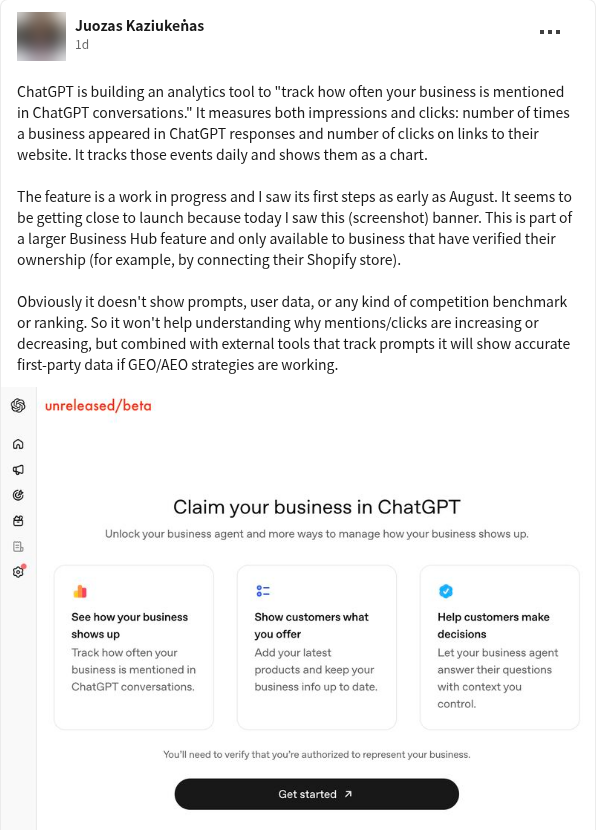
On November 6, 2026, Juozas Kaziukėnas posted a screenshot to LinkedIn showing an unreleased page in ChatGPT, OpenAI’s AI assistant. The page invites businesses to claim their presence in ChatGPT and track how often it mentions them. It would be the first time OpenAI has given businesses figures on how they show up in ChatGPT’s answers. OpenAI has made no announcement.
Kaziukėnas, who founded the e-commerce research firm Marketplace Pulse, says the tool would also count clicks to a business’s website. Search Engine Roundtable, a site that covers search engines, picked up the screenshot the same day. It compared the project to Search Console, a free Google tool for site owners. Search Console shows how often their pages appear in search results, called impressions, and how many clicks they get.
The unreleased page offers businesses three things
The screenshot shows a page titled “Claim your business in ChatGPT.” A red label in the top-left corner reads “unreleased/beta.” The subtitle promises a “business agent” and more ways to manage how a business shows up.
Three cards spell out the offer. The first lets a business track how often it is mentioned in ChatGPT conversations. The second lets it add its latest products and keep its information up to date. The third hands customer questions to an agent, an automated assistant that answers from information the business controls.
Below the cards, a line of text says users will need to prove they are authorized to represent the business. A “Get started” button sits at the bottom of the page.
Impressions and clicks, according to Kaziukėnas
In his post, Kaziukėnas adds details the banner does not show. He says the tool would measure impressions, meaning the number of times a business appears in ChatGPT’s answers. It would also count clicks to the business’s website. Both figures would be recorded daily and shown in a chart.
Kaziukėnas says he first saw signs of the project as early as August. Now that the banner has appeared, he expects a launch soon. As he describes it, the feature would be part of a larger “Business Hub.” It would be limited to businesses that have verified their ownership, for example by connecting their store on Shopify, a platform for running online stores.
He also lists what the tool would lack. It would not show the questions users typed or any data about those users. It would offer no comparison with competitors and no ranking, so it would not explain why mentions or clicks go up or down.
Still, he says, the tool would give businesses data straight from OpenAI. Combined with outside tools that query ChatGPT themselves, that data would help businesses judge their GEO strategy. GEO, short for generative engine optimization, is the work of getting a site cited by AI assistants.
By early on November 8, the post had drawn 779 reactions and 112 comments. Barry Schwartz, who founded Search Engine Roundtable, sees the tool as separate from ChatGPT’s ads. As he reads it, the tool covers ChatGPT’s regular answers.
OpenAI already courts merchants, in the US only
OpenAI already runs a public program for merchants, separate from the unreleased page. OpenAI’s merchant page, as viewed on November 8, 2026, lets merchants submit a product feed so their items can appear in ChatGPT’s shopping results. A product feed is a file that describes each item, with its images, price and availability. Catalogs from Shopify sellers and from the Etsy marketplace are already included, with no setup required.
According to that page, shopping in ChatGPT is live only in the US for now. The page carries no date. It says OpenAI is building a self-serve platform for merchants “later this year,” then plans to expand to more regions, with no date given.
The unreleased banner also promises a way to add products. It is unclear whether the two projects are linked.
Google Analytics already counts visits from ChatGPT
ChatGPT adds a tracking tag, utm_source=chatgpt.com, to its links. Google Analytics 4 (GA4), Google’s web analytics tool, reads that tag. From October 8 to 16, a glitch stripped that tag from a large share of those links. GA4 then filed those visits as direct traffic, its bucket for visits of unknown origin.
Since May, GA4 has also sorted part of this traffic into a separate category, the AI Assistant channel. Answers that mention a business but get no click remain invisible to these tools.
Google counts impressions in its AI answers
By August 31, 2026, Google had rolled out a Search Console report on generative AI performance to all websites. According to its help page, the report counts impressions in two places where Google’s AI writes the answers. AI Overviews are the summaries shown at the top of search results, and AI Mode is Google’s conversational search. An impression is counted each time a user sees a link to the site.
The help page mentions no click counts and no breakdown by search query. On July 22, three French publisher groups, CPA, GESTE and Spiil, complained that Search Console did not let them measure clicks from AI Overviews. That was the day the summaries launched in France. The three have since filed a complaint against the summaries with the European Commission.
On November 2, Search Engine Roundtable reported on a LinkedIn post claiming that a Google employee had mentioned clicks and queries coming to the report. Google’s Gary Illyes replied that the team was “super interested in giving more data, data that makes sense.” He added: “we don’t have anything to announce yet.”
Microsoft details citations in Copilot and Bing
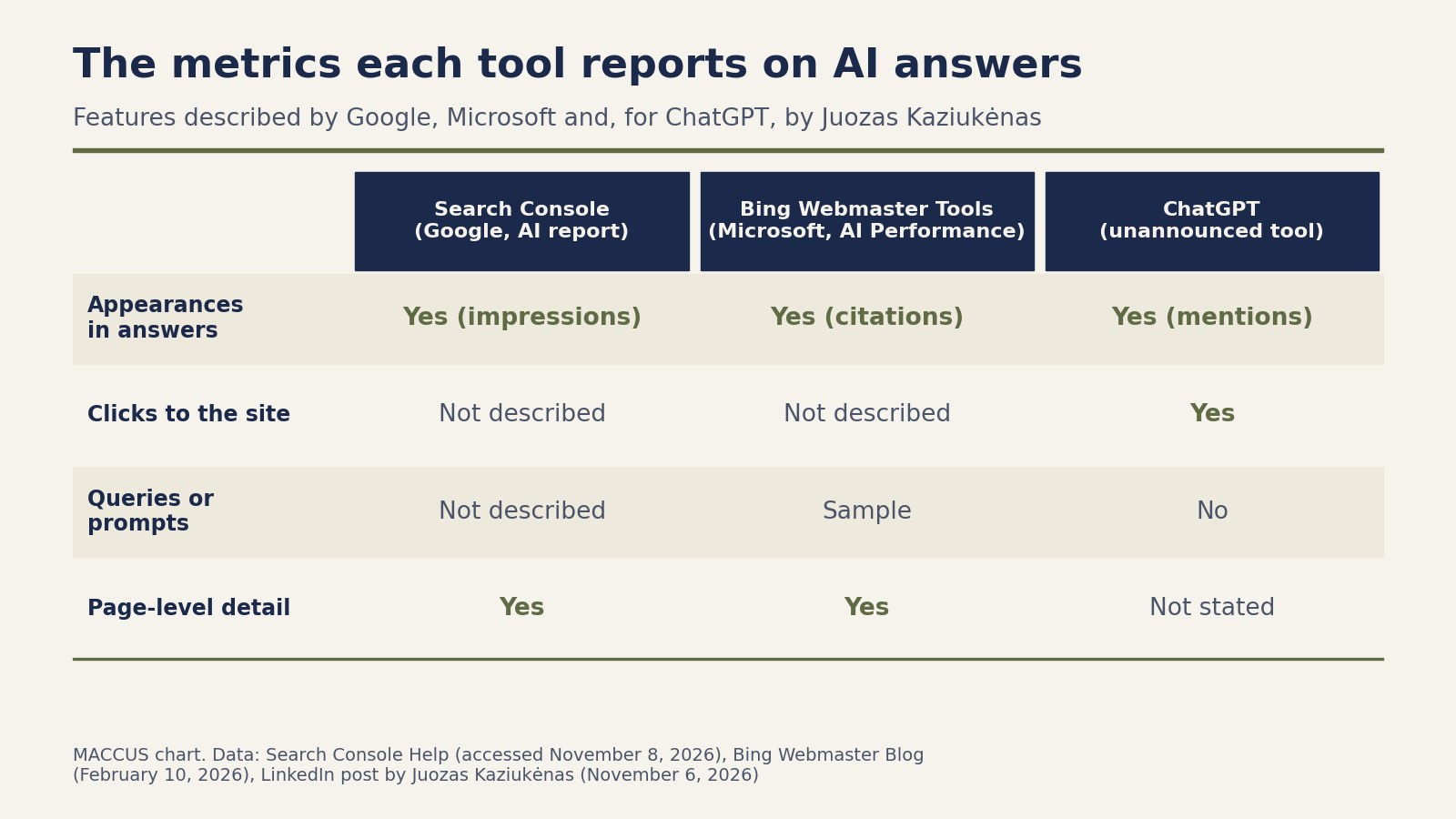
Since February 10, 2026, Bing Webmaster Tools has offered a report called AI Performance as a public preview, meaning an early version open to the public. Bing Webmaster Tools is Bing’s counterpart to Search Console. Page by page, the report counts how often Copilot, Microsoft’s AI assistant, and Bing’s AI-generated summaries cite a site as a source.
The report also shows a sample of the queries the AI ran to find the content it cited. Since June 16, it has calculated the site’s share of all citations for each of those queries and grouped the queries by topic. Since October 13, a beta view has added how many citations each topic gets and how many sites are cited. Microsoft says these figures do not indicate where a page is placed in an answer or what role it plays.
None of these updates adds clicks. If Kaziukėnas is right, OpenAI would be the only one of the three companies to show clicks from its AI answers in a dedicated report. Bing, by contrast, provides a sample of queries, and OpenAI’s tool would show none.
One source, no confirmation from OpenAI
The story rests on one screenshot and one person’s post. The banner itself promises to track mentions. The impressions, clicks, daily chart and “Business Hub” name all come from Kaziukėnas alone.
Search Engine Roundtable quotes no response from OpenAI. As of November 8, MACCUS had found no announcement of the tool from the company. The launch date, price and countries covered are unknown, as are verification methods other than Shopify. It is also unclear what would count as a mention: a name in the text, a link or a product listing.
The business agent is the vaguest part. The banner says only that it will answer customers. It does not say where: in ChatGPT, on the business’s own website or both.
What it means
If the tool ships as described, businesses would see for the first time how often ChatGPT names them, including in answers that produce no click. Until now, they could directly measure only the visits that reached their sites. The outside tools Kaziukėnas mentions estimate those unclicked mentions by querying ChatGPT themselves.
ChatGPT is widely used but sends sites little traffic. On November 2, OpenAI’s Adam Fry said ChatGPT handles roughly a fifth as many searches as Google. Yet across 100 sites tracked by search consultant Marie Haynes, ChatGPT sent the equivalent of 0.62% of the visits that came from Google’s unpaid results. A count of mentions would show how much of that presence produces no click at all.
Merchants would be affected first. Kaziukėnas cites Shopify verification, and shopping in ChatGPT is live only in the US. Both point to a US-first launch. Whether and when the tool would reach publishers and businesses in Europe is unknown.
The screenshot shows a page marked unreleased. Click counts, daily figures and Shopify verification remain Kaziukėnas’s claims, and OpenAI has not confirmed them.
Several signs will show whether the project moves forward. They include an announcement or help page from OpenAI, a list of countries and any data on what users actually ask. At Google, the open question is whether Search Console’s AI report will add the clicks publishers want.
Sources
- ChatGPT is building an analytics tool to “track how often your business is mentioned in ChatGPT conversations.”, Juozas Kaziukėnas, LinkedIn, November 6, 2026
- OpenAI Working On ChatGPT Tools For Business For Analytics & Citations, Search Engine Roundtable, November 6, 2026
- Power product discovery in ChatGPT, OpenAI, accessed November 8, 2026
- Generative AI performance report (Search), Search Console Help, Google, accessed November 8, 2026
- Gary Illyes Implies Click Data Not Coming To Google Search Console AI Reporting, Search Engine Roundtable, November 2, 2026
- Introducing AI Performance in Bing Webmaster Tools Public Preview, Microsoft Bing Webmaster Blog, February 10, 2026
- New AI Visibility Insights in Bing Webmaster Tools: Intents, Topics, Citation Share, Compare, Microsoft Bing Blog, June 16, 2026
- Juozas Kaziukenas, The Marketplace 50, accessed November 8, 2026
Header image: MACCUS chart. Data: Search Console Help (accessed November 8, 2026), Bing Webmaster Blog (February 10, 2026), LinkedIn post by Juozas Kaziukėnas (November 6, 2026).