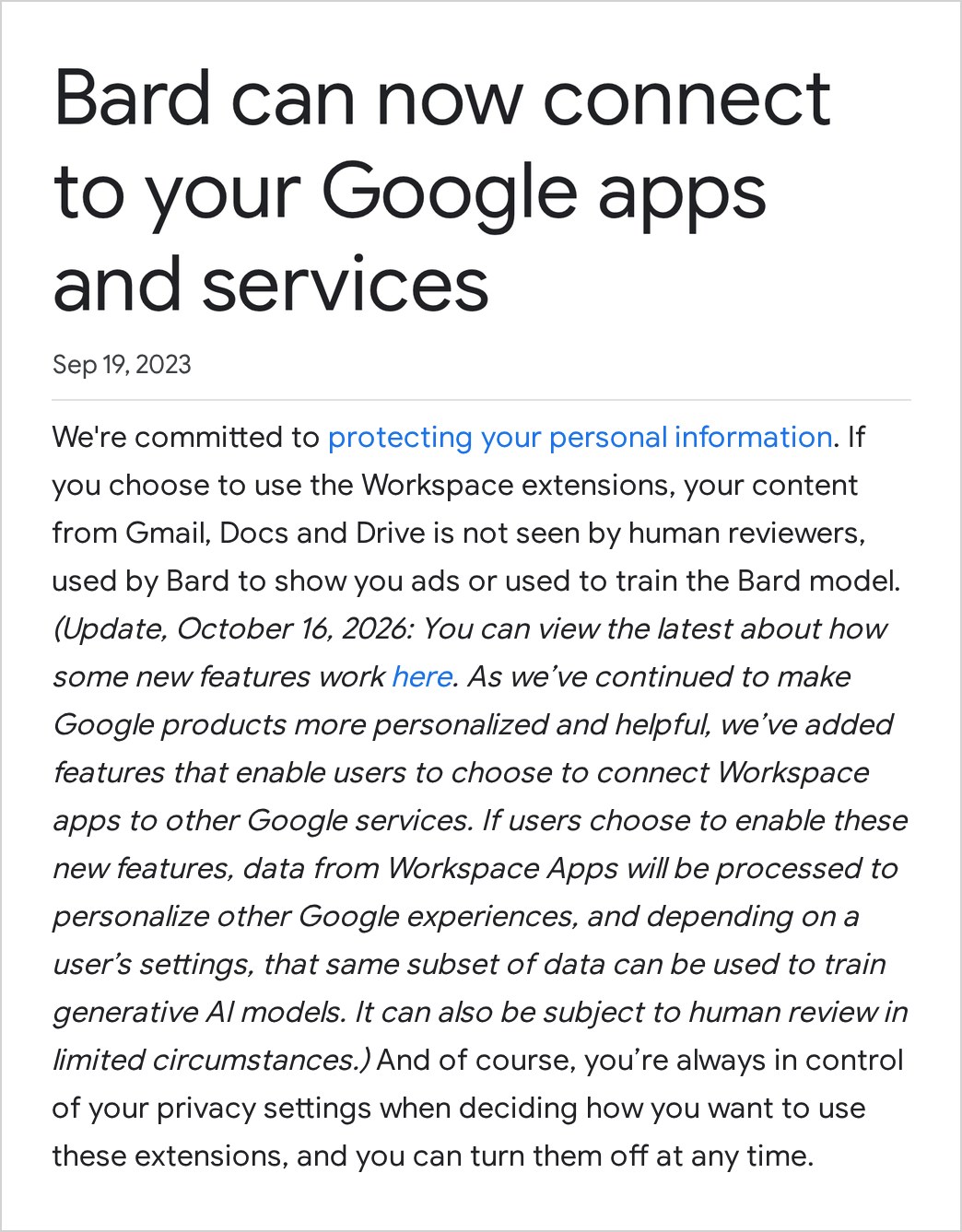
Google has amended a privacy promise it made in 2023 about its AI assistant, then called Bard and now called Gemini. A September 2023 blog post said that Gmail, Docs and Drive content connected to the assistant “is not seen by human reviewers.” It also said that content would not be used to train the model. A note dated October 16, 2026, now adds an exception for newer features that link those apps to other Google services.
For those features, the note says, “that same subset of data can be used to train generative AI models. It can also be subject to human review in limited circumstances.” Gemini’s help pages add that the reviewers include contractors. When a message is short, the excerpt they see can be the entire email. Google asks people not to connect apps that hold confidential information.
These rules cover Personal Intelligence, a feature that lets Gemini draw on Gmail, Drive or Google Photos in a personal Google account. It is not offered in the European Economic Area (the EU plus Iceland, Liechtenstein and Norway), Switzerland or the UK. Even so, two of Gemini’s human-review rules already apply there.
On November 8, a Reddit user flagged the note in the r/artificial forum. The note’s date, October 16, is also the day Google’s new privacy policy took effect. That policy lets Google target ads using information Google Search draws from a connected Gmail account. That connection isn’t offered in the EU (our October 24 report).
A note added to a 2023 post
The original post is dated September 19, 2023, and signed by Yury Pinsky, then director of product management for Bard. It announced “extensions” that let the assistant look up information in Gmail, Docs or Drive. Google groups those apps under the Workspace name. For anyone who turned on the Workspace extensions, Google wrote, content from Gmail, Docs and Drive “is not seen by human reviewers, used by Bard to show you ads or used to train the Bard model.”
That sentence is still online, followed by the October 16, 2026, note in parentheses. The note says that if users turn on features Google has added since then, data from those apps is used to personalize other Google services. Depending on the user’s settings, that data can then be used to train AI models and be reviewed by people “in limited circumstances.”
Email excerpts, and sometimes the whole message
The help page “About personalization with Connected Apps” sets out Gemini’s rules. Connected Apps are the Google services a user links to the assistant: Gmail, Calendar, Drive, Docs, Photos, Google Wallet, YouTube and Search. The page says that “a subset of Connected Apps data processed by Gemini is reviewed by human reviewers (including trained service providers) to debug our services, help keep them safe, and improve them.”
That subset includes “interactions, summaries, excerpts and inferences from your relevant emails and files.” Inferences are what the AI concludes from that content. Google says that when an email or file is brief or especially relevant to the answer, “the summary may just be the email or file,” meaning the full text.
Before review, Google says, it disconnects the conversations from the user’s Google account and reduces the amount of personal information in them. It makes an exception in cases of abuse or harm. If a user sends feedback on an answer, “human reviewers may also review some of your Gmail inbox.” The page carries this warning: “Please don’t connect your apps to Gemini Apps if they contain confidential information that you wouldn’t want a reviewer to see.”
As for training, Google says it does not train Gemini’s models “directly” on a Gmail inbox or on Drive. The models are trained on the summaries, excerpts and inferences drawn from that content, and sometimes on a whole short message.
A rule on the help page since January
The rule is not new. On January 14, 2026, the day Personal Intelligence launched, the English version of the help page already contained the same sentences about reviewers and whole emails. The Internet Archive, a nonprofit digital library that archives the web, saved a copy that day.
So the October note brings the 2023 post in line with a rule in place since launch. For nine months, that post made no mention of it.
On January 14, Google introduced the feature as a beta, or test version, for paying subscribers in the US. In the launch post, Josh Woodward, the Google vice president whose responsibilities include the Gemini app, wrote that “the emails in Gmail are not directly used to train the model. They are referenced to deliver the reply.” The launch post did not mention human review, although the help page already described it that day.
Personal accounts only, and not in Europe for now
Personal Intelligence requires a personal Google account. Users must also be 18 or older and have Gemini’s “Keep Activity” setting turned on. That setting saves a user’s chat history with Gemini.
The feature isn’t available for work or school accounts, which organizations manage through Google Workspace. Those accounts are covered by Google’s privacy guide for generative AI in Workspace, last updated October 6, 2026. It says: “Your content is not human reviewed or otherwise used for Generative AI model training outside your domain without permission.”
According to Gemini’s eligibility page, the feature is “not available in the European Economic Area, Nigeria, Switzerland, or the United Kingdom.”
In Google Search, the same feature links Gmail to AI Mode, the tab where an AI writes the answers. That version is available in a long list of countries that includes the United States, Canada, Brazil, India and Japan, as well as Morocco, Senegal and Côte d’Ivoire. Google’s FAQ for that version describes the same human review of email excerpts.
Two rules that also apply in Europe
Two rules on the Gemini Apps Privacy Hub, Google’s privacy page for the assistant, have no country restriction. The page was last updated October 26, 2026. The first rule covers feedback a user sends about an answer and “any included content (like files or your personal content from Connected Apps).” All of it is “reviewed by specially trained teams” and kept for up to three years, disconnected from the account.
The second rule covers chats that humans have reviewed. They aren’t erased when a user deletes their activity, and they are also kept for up to three years.
Users have two ways to stop future chats from being used, with reviewers’ help, to improve the models. They can use temporary chats, which aren’t saved to their history, or turn off “Keep Activity.” Our guide to turning off AI training walks through that setting. Even then, Google keeps the chats for 72 hours and may have them reviewed for safety.
Missing figures and unverified Reddit claims
Google gives no figures. Its pages don’t say how large the reviewed “subset” is or what the note’s “limited circumstances” cover.
The author of the Reddit thread says his claims rest on his own tests. According to him, Gemini sometimes pulls up emails when a conversation turns to a trip or a bill, even if the user never mentions Gmail. He describes his method and results but shares no screenshots or raw data. We could not verify them. Google says Gemini can draw on connected apps to personalize its answers but does not say how often.
The same author calls the change a quiet reversal and cites the October 16 note. Yet the rule had been on the help page since January. Google has not published an explanation of why the note appeared in October.
What it means
The 2023 promise fit in one sentence and named emails and documents explicitly. It no longer holds for Google’s 2026 personalization features. When those features are on, reviewers, including contractors, can read excerpts of messages disconnected from the account. Sometimes they see entire short messages. Google also reserves the right to train models on those excerpts.
The professionals most exposed are those who work out of a personal Gmail account: freelancers, microbusinesses and sole practitioners such as lawyers or accountants. Their inboxes hold proposals, contracts and client data, exactly the kind of information Google asks people not to connect. Workspace accounts are still covered by Google’s Workspace commitment, which rules out review and training without permission. Anthropic, which makes the Claude AI assistant, says conversations in its new personal finance feature are not used to train its models (our report on Claude Personal Finance).
In the European Economic Area, Switzerland and the UK, the email review tied to Personal Intelligence remains hypothetical until the feature launches there. The rules on feedback and on reviewed chats already apply to Gemini users in those places. In January, Google said it would expand to more countries over time but gave no timeline.
Two questions remain open: whether Google will spell out what “limited circumstances” means, and whether it will say what share of the data gets reviewed. The terms of any European launch are also unknown. So is the response from privacy regulators in countries where the feature is already live.
Sources
- Bard can now connect to your Google apps and services, Google (The Keyword), September 19, 2023, updated October 16, 2026
- About personalization with Connected Apps, Gemini Apps Help, accessed November 9, 2026
- About personalization with Connected Apps, Gemini Apps Help, Internet Archive copy of January 14, 2026
- Connect your Google apps to personalize your Gemini experience, Gemini Apps Help, accessed November 9, 2026
- Connect your Google content apps to get a Search services experience that’s tailored to you, Google Search Help, accessed November 9, 2026
- Gemini Apps Privacy Hub, Gemini Apps Help, October 26, 2026
- Gemini introduces Personal Intelligence, Google (The Keyword), January 14, 2026
- Generative AI in Google Workspace Privacy Hub, Google Workspace Help, October 6, 2026
Header image: MACCUS chart, data from Google (The Keyword, September 19, 2023 and January 14, 2026; Gemini Help, Internet Archive copy of January 14, 2026)