On November 4, 2026, eight Apple researchers posted a paper on arXiv, a public site where papers appear without peer review. It describes HALO, a system that teaches a humanoid (human-shaped) robot to move around homes. Its training data was produced, in the paper’s words, “entirely in simulation.”
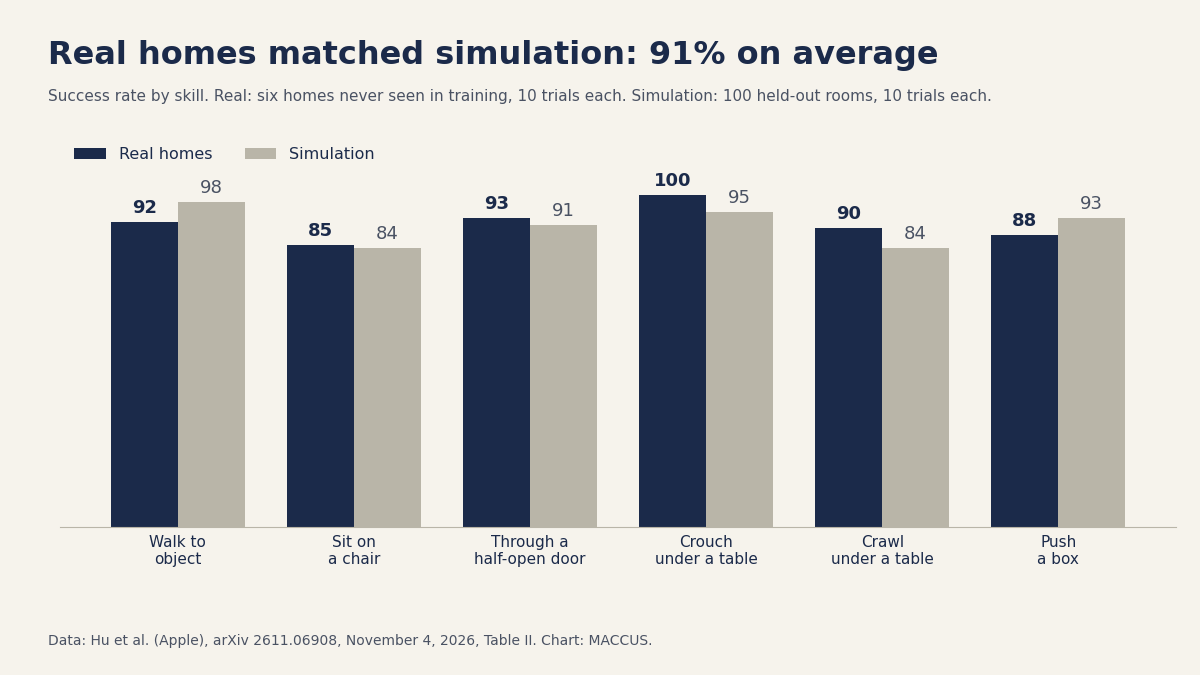
Tested on the G1, a humanoid from the Chinese maker Unitree, HALO succeeded in 91% of 360 real-world trials. The six test homes were new to the robot, and nobody had scanned or mapped them. Apple released the code on GitHub.
The authors write that 300 hours of practice runs, called episodes, were generated in 48 hours on 250 Nvidia H100 AI chips “without human intervention.” Twelve days earlier, the BBC had described the opposite approach: hundreds of thousands of workers paid to film themselves at work as training footage for robots.
Robot training data usually comes from people
A robot that moves its whole body needs data the internet does not hold. Each example records what the robot sees, the instruction it received and how every joint moved in response.
Two methods are common. In teleoperation, a person steers the robot by remote control. In motion capture, a person wears gear that tracks their movements. The Apple paper says both “require at least an hour of human time to produce an hour of data.”
That need has built an industry. On October 23, the BBC reported that the worker it followed “is one of hundreds of thousands of workers across the world paid to record their activities.” One data firm, Humyn Labs, has 96,000 collectors in Latin America and Southeast Asia, the BBC wrote.
The BBC summed up the view of Humyn Labs founder Manish Agarwal: robots meant for the real world “can’t just be trained inside computer simulations.” In his own words: “That data has to be captured from scratch, in the real world, across diverse environments.” We covered the workers filming their hands for robot companies on October 24.
300 hours of training data in two days
HALO makes that data with software instead of cameras. Infinigen, a free, open-source scene generator from a Princeton University lab, created the 1,000 virtual rooms used for training. They include living rooms, offices and bedrooms with 20 to 80 objects each.
Kimodo, an AI model trained on recordings of human movement, produced whole-body motions such as walking to a chair, turning and sitting down. A simulator then placed each motion in a room and rendered what the robot’s head camera would see.
The result is 162,698 episodes, or 296.3 hours, each pairing video with an instruction and the robot’s joint motion. Producing them took “48 hours across 250 H100 GPUs, operating without human intervention,” the paper says. By our calculation, that is about 12,000 GPU-hours (250 chips times 48 hours). The paper says its data set, or corpus, grows with computing power: “The corpus scales with compute rather than human labor.”
A stock robot with a Mac mini on its back
The robot is not an Apple product. Unitree lists the G1 from $13,500. China says it built 40,000 humanoid robots in six months, as we reported on October 30.
The Apple team added a wide-angle camera on the robot’s head. A case on its back holds a Mac mini M4 Pro, Apple’s small desktop computer, with 64 GB of memory. The robot runs without cables.
The software has three layers. The top one runs on the Mac mini: a vision-language model, an AI model that reads both images and text. About every two seconds, it turns a spoken request, such as “push box away” in the team’s demo, into a list of steps.
That model is Qwen3.6-35B-A3B, an open-weights model from Alibaba released under the Apache 2.0 license, meaning anyone can download and run it. The team runs a compressed 4-bit version.
About three times a second, a second AI model looks at the camera image and plans the next five seconds of whole-body movement. A third runs 50 times a second on the robot’s built-in Nvidia Jetson AI computer. It turns that plan into motor commands, helped by a depth camera that measures distance. By default, none of it needs an internet connection.
Six skills, 10 trials in each home
The team tested six skills: walking to a named object, sitting on a chair, side-stepping through a half-open door, crouching under a table, crawling under one, and pushing a box. Each skill ran 10 times in each of the six homes, for 360 trials. A trial counted as a success only if the robot finished the task without falling or getting stuck.
Success ranged from 85% for sitting to 100% for crouching, an average of 91%. That matches the 91% average in 100 simulated rooms the robot never trained in. Clips on the project page show the robot sitting on a sofa, crawling under a desk and pushing a box.
More generated rooms raise success, up to a point
One test in the paper measures how much room variety matters. Keeping everything else fixed, the team trained the system on 1, 10, 100 and 1,000 generated rooms. It then measured how often the robot sat down successfully in unseen simulated rooms. Success rose from 43% with one room to 64% with 10, 81% with 100 and 84% with 1,000.
The curve flattens at the top: going from 100 to 1,000 rooms added 3 percentage points. New rooms come from the generator rather than from scans of real places. Making all 1,178 rooms, the 1,000 used for training plus 178 held back for testing, took 26 hours on up to 300 GPUs, the paper says.
The limits the paper lists
Results dropped when the robot chained two or three skills. In one real room, with 10 trials per sequence, the robot went through a door and then walked to an object every time. It crouched under a table and then sat in 6 of 10 trials. It crouched, walked to a box and pushed it in 5 of 10.
That averages 70% across the three sequences, compared with 91% for single skills across six homes. In three of the five failed three-step trials, the robot finished its crouch facing away from the box and never brought it into view.
People still shape the data. Kimodo learned from human movement. The low-level controller, which drives the motors, also trained on LAFAN1, a set of human motion-capture clips. The pushing motion reuses a motion-capture recording of a person pushing a box.
The crawling and crouching motions were generated from six key poses, snapshots of body position taken from phone videos of a person going under a table. The simulated robot was tuned with measurements from the real one.
The authors add that “adding a new physical task still requires a human to write its prompt and author the keyframes,” meaning the key poses. Covering the paper on November 7, China’s 21st Century Business Herald made the same point: the simulated data “has not completely shed human involvement” (our translation).
None of the six skills involves picking up or holding an object; the robot moves only a box, by pushing it. The robot relies mostly on vision and has no sense of touch. Once an object leaves the camera’s view, “the policy has no signal that it is still there,” the paper says. The policy is the robot’s learned controller.
Hand work is central to what the data firms film. Agarwal told the BBC that no dataset exists of “a car being assembled by hands that know exactly how much force to apply.”
The paper compares HALO with four earlier systems on features and trial counts. It reports none of their success rates, so it offers no head-to-head comparison. It is a preprint and has not been peer reviewed.
The code comes under Apple’s own license rather than a standard open-source one. The repository ships no trained model weights and no dataset, so anyone rerunning the work must first generate the data and train the models.
What it means
For whole-body movement in rooms a robot has never seen, training data no longer has to come from people acting out each episode. Eight researchers generated 300 hours of such data in two days, and the robot scored the same 91% in real homes as in simulation.
On November 6, we reported on AI agents that ran an 11,382-step DNA experiment while humans mostly refilled the reagents. HALO removes people from a different step: making the training data. The human work moved earlier, to describing each new task once. The paper names that step as the limit on how fast the robot can learn new skills.
Whether simulated data costs less than filmed data is unknown: the paper puts no price on its GPU time. Its data needed no one in front of a camera and was produced on many chips at once.
The paper concerns research on another company’s robot and announces no Apple product. The next tests are outside review of the preprint and other labs rerunning the released code. HALO also leaves out hand skills, the work the filming industry is built on.
Sources
- Perceptive Humanoid Motion from Simulation, Siyuan Hu, Abulikemu Abuduweili, Yue Meng, Shipeng Liu, Quentin Leboutet, Chen Chen, Matthias Müller and Vladlen Koltun (Apple), arXiv, November 4, 2026
- HALO: Perceptive Humanoid Motion from Simulation, Apple, project page, November 2026
- apple-aiml-research/ml-halo, Apple, GitHub, November 5, 2026
- The Indian workers filming their work to train AI, BBC News, October 23, 2026
- Qwen3.6-35B-A3B, Qwen (Alibaba), Hugging Face model card, April 15, 2026
- Unitree G1, Unitree Robotics, product page, retrieved November 9, 2026
- Infinigen, Princeton Vision & Learning Lab, retrieved November 9, 2026
- 苹果研究团队披露机器人“大脑”进展, 21st Century Business Herald (21jingji), November 7, 2026
Header image: chart by MACCUS, data from Hu et al. (Apple), arXiv 2611.06908, November 4, 2026