On November 6, 2026, Anthropic, the company behind the Claude assistant, published tests showing that its AI agents score higher when they keep notes between sessions. On a database task, Opus 5.5’s mean score rose from 0.655 to 0.838 with a notes folder. A cleanup of those notes, which Anthropic calls “dreaming,” didn’t help in every test.
Agents are AI programs that carry out multistep tasks on their own. Lance Martin wrote the engineering post, “The components of agent memory.” It describes dreaming as a later pass in which Claude rereads its past sessions to correct and reorganize its notes. It announces no new feature or price.
The post is about agents that developers build. The Claude app’s own memory, which keeps facts about its users, is separate. Our guide explains what Claude actually keeps between conversations.
Four layers, from raw history to notes loaded up front
Anthropic defines an agent’s memory as knowledge Claude gains from experience and keeps between sessions, saved as text it can read later. Training, which changes the model itself, isn’t part of it.
That memory has four layers. At the bottom are transcripts, the full record of past sessions, which Claude can search. Above them are the notes Claude writes as it works. Next come more organized formats, such as a wiki, a set of linked pages. At the top is a small set of notes loaded at the start of every session.
Dreaming works from the transcripts and can write to any of the three layers above them. Anthropic builds on a 2025 idea from researchers at the company Letta and at UC Berkeley. A model, they proposed, can use idle time between interactions to reorganize the context it already has. Anthropic compares this to sleep, during which the brain replays recent experiences.
A notes folder lifts scores on a database test
CL-Bench 1.0 is a benchmark, or standard test, of how well an agent uses its memory on long tasks. In the task Anthropic picked, Claude answers a series of questions by searching a database. After each answer, it gets the correct solution and can write a note. Each question starts in a fresh session, and only the memory folder carries over.
Anthropic ran the test on Claude Managed Agents, its service that hosts developers’ agents. Sonnet, Opus and Fable are three families of Claude models, from least to most capable. The scores are averages, which Anthropic calls mean rewards: higher means better answers.
| Model | No memory | With memory folder |
|---|---|---|
| Opus 5.5 | 0.655 | 0.838 |
| Sonnet 5.5 | 0.644 | 0.833 |
| Opus 5 | 0.564 | 0.828 |
| Opus 4.7 | 0.383 | 0.700 |
| Sonnet 5 | 0.306 | 0.610 |
| Sonnet 4.6 | 0.330 | 0.364 |
The models also kept their notes differently. Sonnet 4.6, which gained the least, piled up scattered files of untested guesses.
Opus 5 was “the first of these models to close the loop,” Anthropic writes. It recorded a failure, tested theories about the cause and turned what it found into a rule. It also noted how it knew the rule was true. Opus 5.5 and Sonnet 5.5 did the same.
Newer models need less guidance on note-taking
“It helps to tell Claude what memory is for, but not how to use it,” Anthropic writes. On CL-Bench, the team simply told Claude a memory folder was available. Adding a stricter rule, “record only failures,” weakened the results. Opus 5 lost 0.234 points of mean reward, much of the gain memory had given it. Opus 4.7 lost 0.150.
Instructions help older models the most. Sonnet 4.6 often didn’t read its notes. Prompting it to read them before answering, then to test its theories, nearly doubled its score, from 0.330 to 0.641.
In Pokémon Red, fewer notes went further
Anthropic also used the video game Pokémon Red to test what Claude judges worth noting. About 10,000 steps into the game, the older Sonnet 3.7 had written 413 files holding nearly 978,000 characters of notes. It had earned one badge, the game’s marker of progress. Fable 5, a much newer model, had kept 10 files with 43,406 characters and earned four badges.
Fable 5 noted only what the screen doesn’t show: plans, strategies and tested rules. Opus 5.5 kept a small folder, rewrote it as it played and beat the game.
Dreaming corrected a wrong note in the game
A wrong note can mislead Claude in later sessions. In the game, Claude had to cross Mt. Moon, a cave, from west to east. Its landmark was the Pokémon Center, a building at the entrance on the west side.
Claude noted wrongly that the building was on the east side. So it thought it had cleared the mountain and wrote “Mt Moon DONE.” It then walked off a ledge that dropped it back on the route it had come from.
Anthropic ran a dreaming pass on that folder. Claude compared the note with the session transcript, caught the error and rewrote it. With the fixed note, it went straight back into the cave and reached Cerulean City, the next town, at action 1,935.
In a run that kept the wrong note, Claude fell back three times. It then wrote, “I’m going to stop rather than keep looping.” An automatic reply told it to keep going, but it never reached Cerulean City. Neither did the run with no memory.
A wiki helps when the answers are spread out
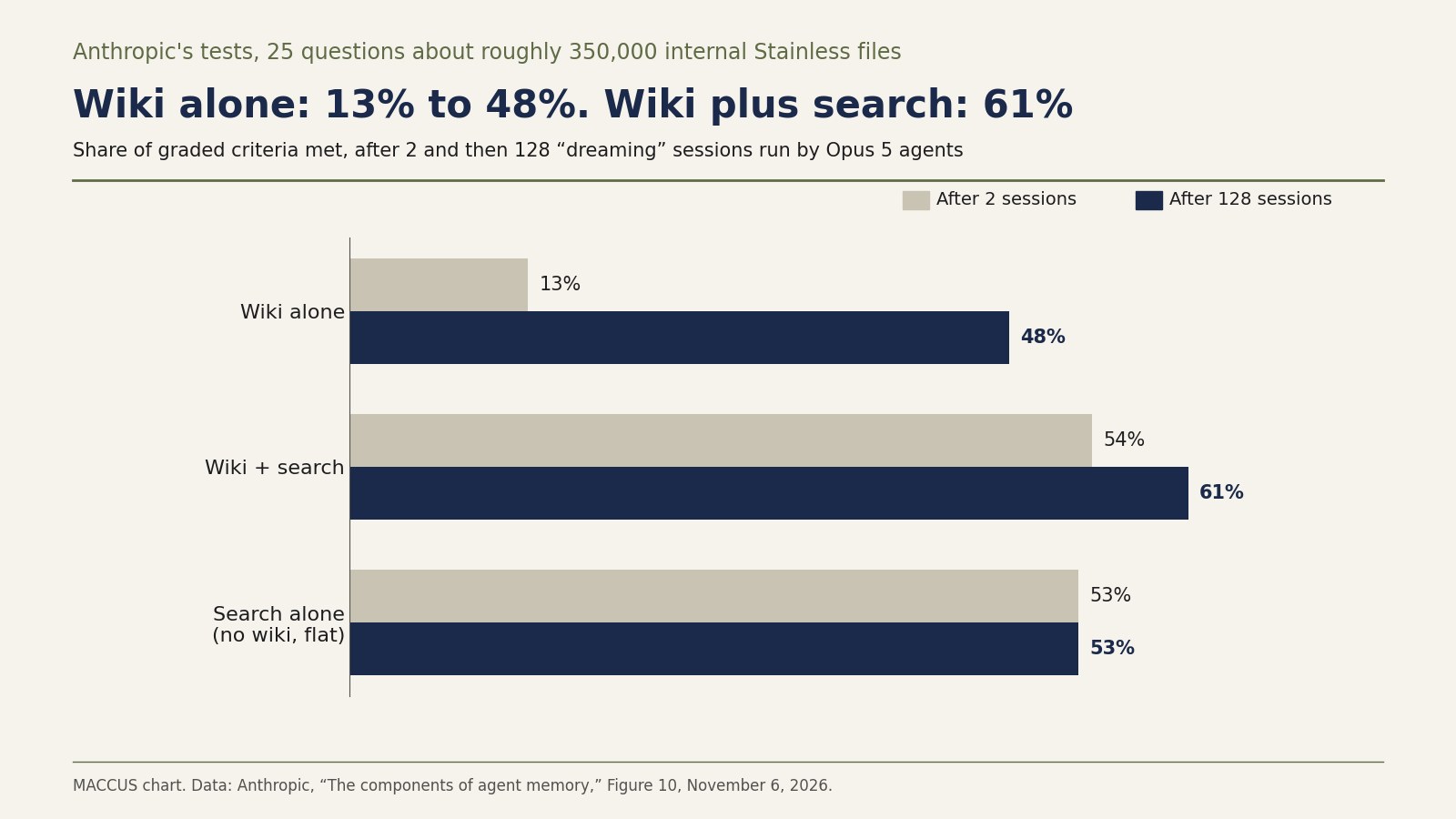
Dreaming can also build wikis. Anthropic tested this on about 350,000 internal files from Stainless, a software company it says it acquired in May. The test used 25 questions about those files. Over 128 dreaming sessions, Opus 5 agents built a wiki from the files and checked its claims against them.
Answering from the wiki alone, Claude met 13% of the graded criteria after 2 sessions and 48% after 128. It did best, though, with the wiki plus a tool for searching the files. That pairing rose from 54% to 61% as the wiki grew, compared with 53% for search alone.
Anthropic also tested which tasks a wiki helps with. It used documents about a merger, along with LAB, a benchmark from the legal AI company Harvey. LAB gives Claude a set of documents, has it write a legal brief and grades the brief against a list of criteria.
Of 24 questions about the merger, more than half required pulling information from several documents. On those, Claude scored 87% with the wiki, compared with 73% with search alone. On a LAB task where most criteria sat in a single document, the wiki showed no clear gain.
On another LAB task, the wiki reached 203 KB, more than the 115 KB of documents it came from. Anthropic compares it to a map in a story by Jorge Luis Borges, drawn as large as the empire it depicts. That wiki, it writes, “effectively abstracted nothing.”
Better instructions, fewer notes up front
Another LAB task is built around the contracts in a company acquisition. While Claude built the wiki, several agents wrote to one shared table at once and overwrote each other’s work. The brief written from that wiki included only 41 of the 57 facts it was graded on (72%). Claude then reviewed its failures and rewrote the wiki-building instructions: one page per contract, one agent per page, terms quoted word for word. The new score was 57 out of 57.
The top layer, the notes loaded up front, has to stay small, Anthropic stresses. Those notes cost tokens, the units of text that AI services bill for. A wrong one gets carried into every session, and longer instructions are followed less closely.
Claude Code, Anthropic’s coding assistant, loads only the first 200 lines or 25 KB of MEMORY.md, the index of its notes. The post also names Claude Duet, the proactive assistant launched in October, as a tool whose memory often benefits from being organized around the person it helps.
Still a developer-only feature
Dreaming isn’t new. SiliconANGLE, a tech news site, reported that Anthropic introduced it on May 6, 2026, at its Code with Claude developer conference. It launched as a research preview feature of Managed Agents, an early version that developers have to request access to. As of November 8, Anthropic’s documentation still lists it that way.
A dream takes an existing memory store, meaning a saved set of notes, plus 1 to 100 past sessions. It writes a new memory store and leaves the original untouched. A run typically takes from a few minutes to a few hours and is billed at the chosen model’s standard token rates.
Dreaming isn’t offered in the Claude app or in Claude Cowork, Anthropic’s tool for handing off office tasks. The post doesn’t say it’s coming to either.
Anthropic’s own numbers, with no outside check
Every figure comes from Anthropic, on document sets and benchmarks it chose. No one has replicated them independently. In Pokémon Red, each comparison is based on a single run per model.
Anthropic lists its own open questions. Writing notes during a task pulls Claude’s attention away from the work, while dreaming’s output may not be available right away. Dreaming also costs computing power, so it may need to focus on information that’s likely to change. Wikis need upkeep so they don’t pile up errors or made-up facts.
On Hacker News, a tech forum run by the startup accelerator Y Combinator, the post had 159 points on November 8. One reader cited Figure 10, the Stainless wiki results, to argue that dreaming adds only a marginal gain on top of search. The reader assumed search is much cheaper. Our chart above uses the data from that figure.
What it means
The post measures what memory adds for agents and documents cases where dreaming doesn’t help. It matters most to teams building agents on Claude, and next to Claude Code users, whose MEMORY.md file follows the same logic. In these tests, the strongest models did best with a general instruction, and a wiki helped most when answers were spread across documents.
These results come from a company that sells Managed Agents and bills dreaming at its token rates. The post landed the same week as an audit by METR, a nonprofit that evaluates AI models. It found that Anthropic is likely improving its models about twice as fast as before October 2025, mostly thanks to Claude.
It’s unclear whether a mechanism like this will reach the Claude app, Cowork or Duet, and what a dream actually costs on a large memory store. The post doesn’t address how dreaming handles documents in languages other than English. Worth watching next: the end of the research preview and any independent results on CL-Bench.
Sources
- The components of agent memory, Anthropic, November 6, 2026
- Dreams, Claude Platform Docs (Anthropic), accessed November 8, 2026
- How Claude remembers your project, Claude Code Docs (Anthropic), accessed November 8, 2026
- Sleep-time Compute: Beyond Inference Scaling at Test-time, Kevin Lin et al. (Letta, UC Berkeley), arXiv, April 17, 2025
- Anthropic is letting Claude agents ‘dream’ so they don’t sleep on the job, SiliconANGLE, May 6, 2026
- The Components of Agent Memory (discussion), Hacker News, November 7, 2026
Header image: MACCUS chart. Data: Anthropic, “The components of agent memory,” Figure 3, November 6, 2026