In May, US employers named artificial intelligence as the reason for 38,579 planned job cuts, 4 in 10 of the cuts they announced. In October, they named AI for 1,265 cuts, about 3% of the month’s total and the lowest monthly figure of 2026. That same month, the government’s jobs count showed consulting firms, law offices and accounting firms adding workers. Those are office industries often ranked among the most exposed to AI.
The counts come from Challenger, Gray & Christmas, a Chicago outplacement firm. Employers hire firms like it to help laid-off workers find new jobs. Each month, Challenger also tallies the job cuts US employers announce and the reason given for each. May’s figure was the highest for any month since Challenger began tracking AI as a reason in 2023, and October’s was about 97% lower.
Studies of payroll records point to a quieter shift: fewer young people are being hired into the jobs most exposed to AI.
Five months as the top reason, then a slide
AI first became the leading reason for announced job cuts in March. Challenger’s May report, released June 4, showed AI cited as the reason for 40% of the 97,006 cuts announced that month. That share had been 7% in January and 26% in April.
By the end of May, employers had cited AI for 87,714 cuts in 2026, more than the 54,836 they attributed to it in all of 2025. Technology companies cited AI more than any other industry. They announced 38,242 cuts in May alone, for all reasons.
“AI isn’t yet the jobpocalypse some predicted,” Andy Challenger, the firm’s chief revenue officer, said in the May report. He added that companies were “already acting on it.”
AI stayed the top reason in June and July. July’s 10,970 AI-cited cuts were a third of all cuts announced that month.
The streak ended in August, when AI dropped to fourth place among reasons, with 3,462 cuts. In September, it was fifth, with 3,961 cuts, about 9% of the total.
The October report, released November 5, counted 43,994 announced job cuts, the lowest October total since 2023. AI was cited for 1,265 of them. Market and economic conditions were the top reason for a second straight month, with 16,407 cuts.
With 130,531 cuts so far this year, market and economic conditions have overtaken AI as the leading reason for 2026. AI has been cited for 121,401 cuts this year, about 20% of the total.
“The reasons employers give have shifted from technology to the economy,” Andy Challenger said. “AI dominated layoff announcements through the spring and summer, but this fall companies are pointing to demand and economic conditions.”
The October count also leaves out a large workforce move: Microsoft’s offer of voluntary buyouts to about 60,000 employees that month. Challenger counts such programs only by how many people accept or by a stated reduction target, so the offers are not in the total. Microsoft’s announcement of the buyouts did not mention AI.
The government’s jobs count points the other way
On November 6, the Bureau of Labor Statistics, the federal agency behind the official jobs count, reported that US employers added 165,000 jobs in October. The unemployment rate was little changed at 4.1%.
Professional and business services, the sector that includes consultants, lawyers and accountants, added 70,000 jobs. It had averaged 15,000 a month over the previous 12 months.
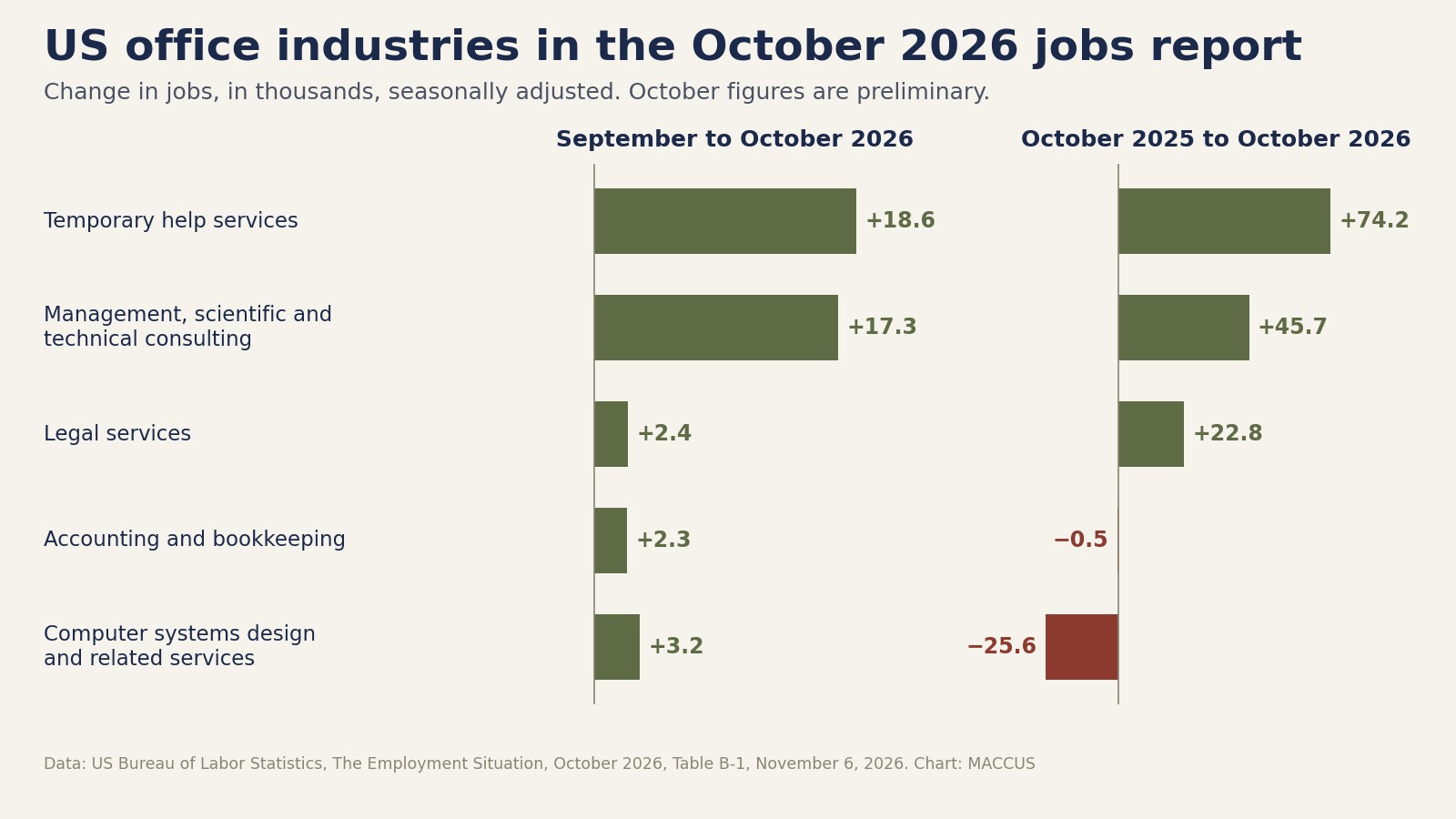
The industry table shows where the gain came from. From September to October, management, scientific and technical consulting firms added 17,300 jobs. Legal services added 2,400, accounting and bookkeeping firms 2,300 and temporary help agencies 18,600. The figures are seasonally adjusted to smooth out normal swings such as holiday hiring, and September’s and October’s are preliminary.
“I don’t know how you could look at this report and conclude that we’re entering anything like a white-collar job apocalypse,” Harvard economist David Deming told The Wall Street Journal. The Washington Post called the 70,000 gain the sector’s biggest in several years.
Fewer jobs at programming firms and fewer young hires
One office industry is clearly shrinking: firms that do computer systems design and related work for other businesses. They employed 2,354,100 people in October, about 25,600 fewer than a year earlier, according to the same table. Accounting and bookkeeping employment is about flat over the year, down 500 jobs.
Much of that work is outsourced programming, Bill Adams, chief US economist at Fifth Third Commercial Bank, told The Washington Post. Companies “can do the same work with fewer people in many cases because of AI,” he said.
The clearest signal shows up in who gets hired. In August, economists at the Stanford Digital Economy Lab, a Stanford University research group, updated their study of ADP payroll records. ADP processes paychecks for US employers. The economists compared workers aged 22 to 25 in the jobs most exposed to AI with same-age workers in less exposed jobs.
Employment in the exposed group stood about 19% below where it would be if it had kept pace with the other group. A year earlier, that gap was 15%. Experienced workers show no comparable gap.
The authors say the adjustment appears to work “primarily through reduced hiring of young workers rather than increased separations.” “Separations” means workers leaving, whether they quit or are let go.
A Census Bureau working paper, a study by bureau researcher Lee Tucker published in April, found a similar pattern. Employment of workers aged 22 to 24 in the industries most exposed to AI fell 12% in the 10 quarters after ChatGPT’s release in late 2022. The drop came mainly from fewer hires.
Other evidence points the same way. Internal data from Anthropic, an AI developer, showed the share of junior staff among its technical hires falling from 27% to 9%. In the UK, the Bank of England’s agents found that companies using AI were replacing fewer departing staff and taking on fewer trainees. The agents are central bank staff who report on local businesses.
Demand for one kind of AI worker is rising. Lightcast, a firm that analyzes job ads, ranks the engineers who install AI systems inside client companies as the fastest-growing AI job in US job ads.
What the numbers cannot show
Challenger counts announced plans, which may differ from the layoffs that follow. A stated reason also does not prove that AI did the work. A drop in AI-cited cuts could mean fewer cuts driven by AI, or fewer companies willing to say so. Whether companies have changed how they word their announcements is an open question.
A few large announcements can swing a monthly total. May’s record came in a month when tech companies announced 38,242 cuts for all reasons.
The government’s October figures are preliminary and will be revised. Brian Bethune, an economist at Boston College, told the Post the jump could be “a head fake” caused by election spending on consultants, ads and temporary workers. He expects agencies to cut about 20,000 jobs in November as that work dries up.
A separate private payroll count disagrees. The ADP National Employment Report showed professional and business services losing 27,000 jobs in October, the sector’s third straight monthly decline.
Industry totals have a blind spot. The government’s table sorts workers by their employer’s industry, whatever job they do. A firm could cut administrative staff while hiring for other roles, and the table would show only the overall change.
The hiring studies have limits too. The Stanford team calls its findings “descriptive patterns, not causal estimates.” They do not prove that AI caused the trend. The Census paper has not gone through the bureau’s review for official publications.
What it means
The wave of AI layoff announcements that peaked in May has not shown up as falling payrolls in law or consulting. Accounting employment is about where it was a year ago. Employers have also largely stopped naming AI when they announce cuts. Where the 2026 data fit an AI effect, the pattern is narrower: fewer entry-level hires in exposed jobs and fewer workers at programming firms.
For people starting their careers, the measurable change is a hiring gap. A young worker who is never hired does not show up in any layoff count. Experienced workers in exposed jobs show no such gap, and engineers who put AI to work at client companies are in demand.
Two December reports will test these readings. The government’s November jobs report is due December 4, and Challenger’s November count comes out in early December. They will show whether October’s office hiring holds, whether election-related temporary jobs disappear as Bethune expects, and whether employers start naming AI again.
Sources
- Challenger Report, October 2026: job cut announcement report, Challenger, Gray & Christmas, November 5, 2026
- Challenger Report, May 2026: job cut announcement report, Challenger, Gray & Christmas, June 4, 2026
- The Employment Situation, October 2026, US Bureau of Labor Statistics, November 6, 2026
- Table B-1. Employees on nonfarm payrolls by industry sector and selected industry detail, US Bureau of Labor Statistics, November 6, 2026
- ADP National Employment Report: Private-Sector Employment Increased by 86,000 Jobs in October, ADP, November 4, 2026
- Is AI taking white-collar jobs? Latest hiring report suggests not yet., The Washington Post (Steve Thompson), November 8, 2026
- No Widespread Displacement, but the AI Employment Gap for Young Workers Has Widened to 19%, Stanford Digital Economy Lab, August 12, 2026
- You’re (not) hired: Artificial intelligence and early career hiring in the Quarterly Workforce Indicators, US Census Bureau, Center for Economic Studies (Lee C. Tucker), April 2026
Header image: chart by MACCUS, from Challenger, Gray & Christmas monthly job cut reports, June 4 to November 5, 2026