On November 18, 2026, Google launched Gemini 4 Neon, a new artificial intelligence (AI) model. In France, it comes with Google AI Pro, a €21.99-a-month plan that does not include Carbon, Google’s most powerful model. Yet Neon’s model card, the technical fact sheet from Google’s AI lab, Google DeepMind, says Neon is “adapted from Gemini 4 Carbon.”
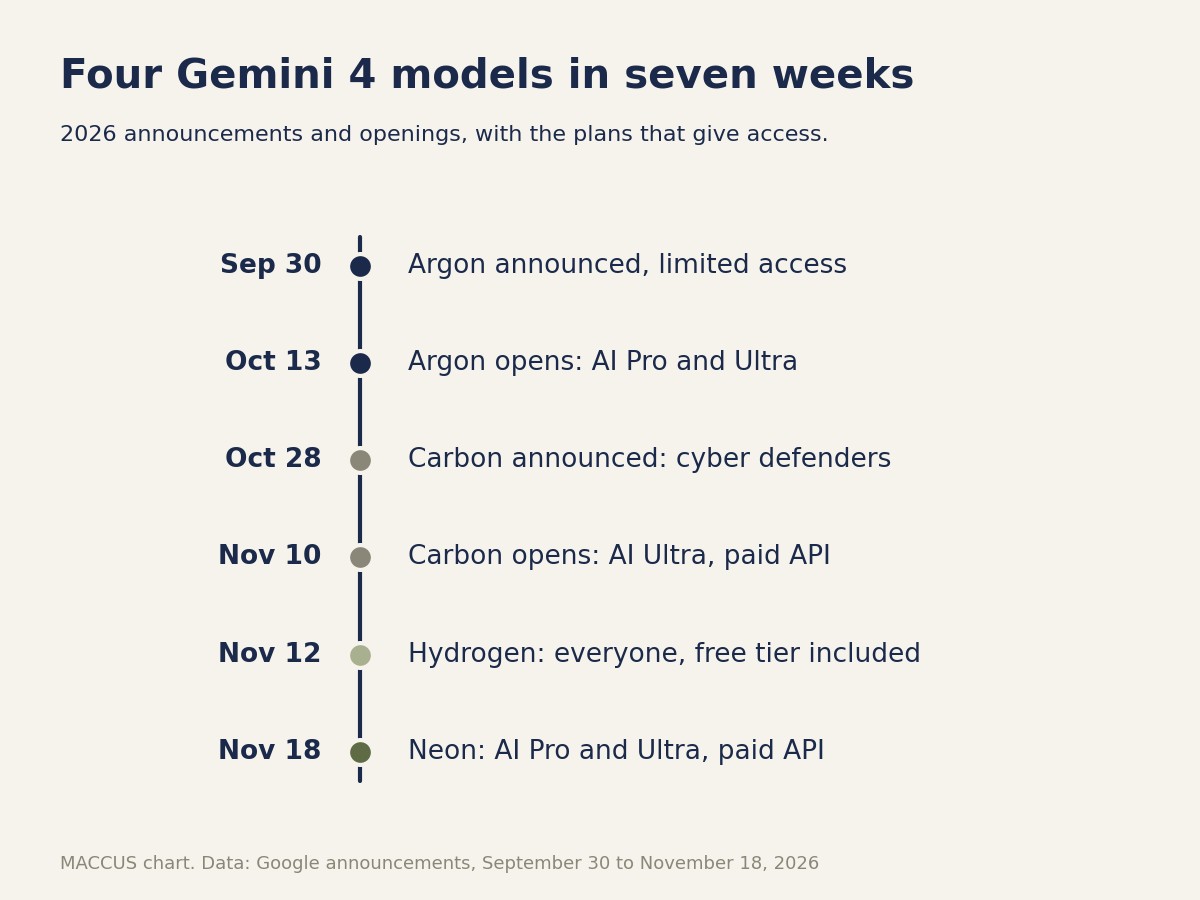
Neon is the fourth Gemini 4 model in seven weeks. In Google’s lineup, it sits between Carbon and Hydrogen, a fast model Google describes as open to everyone. Developers pay by the token, a word fragment that AI models process. Neon costs $3 per million tokens sent to it and $15 per million tokens it produces.
Artificial Analysis, an independent evaluator, ranks Neon third on its overall index, behind Anthropic’s Claude Fable 5.2 and OpenAI’s GPT-6.2 Astra. The same evaluator calls Neon “notably slow per task and very verbose” at its highest reasoning setting, where it thinks longest.
Four Gemini 4 models since September 30
Google introduced Gemini 4 Argon on September 30 and opened it to the public on October 13. Gemini 4 Carbon, announced on October 28, first went only to cybersecurity teams. Since November 10, it has been open to Google AI Ultra subscribers and to developers who pay for API access. The API (application programming interface) lets them build the model into their own software.
Hydrogen followed on November 12 and, like Neon, was announced and released the same day. It is free and became the model behind AI Mode in Google Search, the search feature that answers with written text.
Neon’s launch post, signed by Koray Kavukcuoglu, senior vice president of Google DeepMind, describes the lineup in three tiers. Carbon “tackles your hardest, long-horizon projects,” Hydrogen “handles fast everyday execution,” and Neon “balances depth and efficiency.”
Argon is missing from that lineup. On November 10, when Google opened Carbon to more users, it still called Argon “the ideal choice for the majority of software engineering and knowledge work.” The French tech site Frandroid noticed the same gap and summed it up in its headline: “on s’y perd un peu,” roughly “it’s getting a bit confusing.”
Google does not say how Neon was adapted from Carbon. Neon’s model card points to Carbon’s card for the architecture (the model’s design), the training data and the hardware. Neon’s knowledge ends in March 2026.
Neon joins the Pro plan, Carbon stays with Ultra
AI Pro and Ultra subscribers can pick Neon from the model menu in the Gemini app, Google’s assistant. Carbon remains limited to Ultra in the app. Ultra costs €99.99 or €219.99 a month in France, depending on the usage tier.
The AI Plus plan, at €4.99 a month, gives access to Hydrogen, according to Google’s plans page for France, checked on November 19. Google says the free version reaches Hydrogen only when automatic model selection picks it. AI Pro adds Neon.
Google does not publish usage limits for each model. Its help pages only say that AI Pro’s limits are four times those of the free version. The Pro plan also includes a context window of one million tokens, the amount of text the model can handle at once.
Argon’s place in the Pro plan is unclear. The plans page leaves it off the Pro model list, yet a banner at the top still points anyone who wants Argon to AI Pro or Ultra.
On Hacker News, a forum for developers, a Pro subscriber said Argon and the older Gemini 3.1 Pro had disappeared from their menu, replaced by Hydrogen and Neon. The launch post does not mention any such change.
Businesses get Neon through Gemini for business, Google’s service for companies. Pro and Ultra subscribers also find Neon in Antigravity, Google’s tool for building AI agents, programs that carry out steps on their own to complete a task.
Google adds that Neon can now power Tasks in Gemini, a mode where the assistant carries out a multistep job on its own. On November 17, Google began rolling out this mode for free in the United States, Japan, Korea, Canada, Australia and India, according to Google’s post. France and Belgium are not on that list.
Pricing for developers
How Neon compares with Carbon depends on the date. Carbon and Argon sell at an introductory price through November 30, and their rates double on December 1. Until then, a Neon token costs 50% more than a Carbon token. Starting December 1, it will cost 25% less.
Gemini API prices (paid tier, standard), as listed by Google:
| Model | Price per million tokens sent | Price per million tokens produced |
|---|---|---|
| Gemini 4 Hydrogen | $1.50 | $7.50 |
| Gemini 4 Neon | $3 | $15 |
| Gemini 4 Carbon and Argon, through November 30 | $2 | $10 |
| Gemini 4 Carbon and Argon, from December 1 | $4 | $20 |
The API’s free tier does not include Neon. Cached tokens, which were already sent and are kept in memory, cost 95% less than other tokens sent.
Google also says Neon costs 32% less per task than Carbon at its default setting. It does not say whether it used Carbon’s introductory or full price.
The scores Google cites
Google cites many outside rankings. One is the Artificial Analysis index, which combines nine tests of knowledge work, coding, science and general knowledge. Neon scores 61 points on it at its highest setting.
Counting only each model’s best setting, Neon comes third. Anthropic’s Claude Fable 5.2 leads with 65 points, and OpenAI’s GPT-6.2 Astra, launched on November 17, follows with 62. At its default setting, called “high,” Neon scores 60. Once the scores are rounded, that ties Carbon at the same setting.
Vals AI, another evaluator, ranks Neon second on its overall index as of November 18, with 70.87%. The index covers finance, coding, legal and tax tasks, and weights each one by its share of the US economy. Neon trails the leader, Claude Fable 5.2, by 0.44 points. It sits 0.02 points ahead of Claude Sonnet 5.5.
Neon also tops two Vals AI tests on US law and taxes. In legal research, it scores 56.25%, compared with 55.77% for Carbon. In corporate tax, it scores 54.89%, ahead of Hydrogen at 52.30%.
Based on its own internal tests, Google also claims its “lowest fabrication rate yet” for Neon, meaning how often the model makes up results.
Speed and cost measured outside Google
Google presents Neon as a model built for “fast end-to-end task completion.” At the highest setting, Artificial Analysis measures an average of 21.5 minutes per task in its index. The median for models in the same price range is 12.4 minutes. The first word of an answer arrives after 56 seconds, versus a median of 13 seconds.
Neon also produces a lot of text: 283 million tokens across the whole index, versus a median of 65.1 million in its price range. At the default setting, these figures drop to 14.8 minutes per task and 123 million tokens.
Plotly, a company that makes data analysis tools, ran Neon through its 43-question test on November 18. Neon got 42 right, like Carbon, but twice as fast: a median of 46 seconds per question, versus 93.
The test cost more with Neon: $17.03, versus $11.55 with Carbon, at the prices Plotly recorded for each run. Hydrogen cost $6.36 and got all 43 questions right. Plotly notes that it ran each model only once and that a gap of one or two points is close to a tie.
The safety report is still to come
Neon’s full safety and security report “will be available in the coming days,” according to the model card. For Neon, Google did not run its complete set of “critical capability” evaluations, the tests that look for abilities that could cause severe harm. The card says Argon was the last model to go through that full set. Neon’s gains over Argon fall below the threshold that would require a new one, so Google carries over Argon’s results.
What it means
In the Google AI Pro plan, Neon is the Gemini 4 model that Artificial Analysis ranks highest. At the default setting, that evaluator ties it with Carbon, which the Gemini app reserves for Ultra, at €99.99 a month or more in France. The legal and tax tests where Neon ranks first cover US law, so they say little about how it handles French or Belgian law.
Which model to use remains unclear. Google describes its lineup without Argon and publishes no usage limits per model. It also does not say clearly whether Argon stays in the Pro plan.
For developers, the token price is not enough to compare models, because the bill also depends on how many tokens a model uses. The two outside measurements also use different comparisons. Artificial Analysis compares Neon with models in the same price range and finds it slow and very verbose at its highest setting. Plotly compares it with Carbon and finds it faster, but more expensive, on its test.
Three things to watch: the promised safety report, Carbon and Argon’s switch to full price on December 1, and whether Tasks in Gemini launches in Europe.
Sources
- Introducing Gemini 4 Neon, Google, November 18, 2026
- Gemini 4 Neon Model Card, Google DeepMind, November 18, 2026
- Gemini Developer API pricing, Google AI for Developers, accessed November 19, 2026
- Google AI Pro et Ultra : accédez à Gemini 4 Neon et plus, Google, accessed November 19, 2026
- Gemini 4 Neon: Intelligence, Performance & Price Analysis, Artificial Analysis, accessed November 19, 2026
- Vals Index, Vals AI, November 18, 2026
- Gemini 4 Neon Benchmark Results for Data Analysis, Plotly, November 18, 2026
- Google lance Gemini 4 Neon, son quatrième modèle d’IA en moins de 2 mois… et on s’y perd un peu, Frandroid, November 18, 2026
Header image: MACCUS chart, data from Artificial Analysis (Intelligence Index v5.0.1, accessed November 19, 2026)