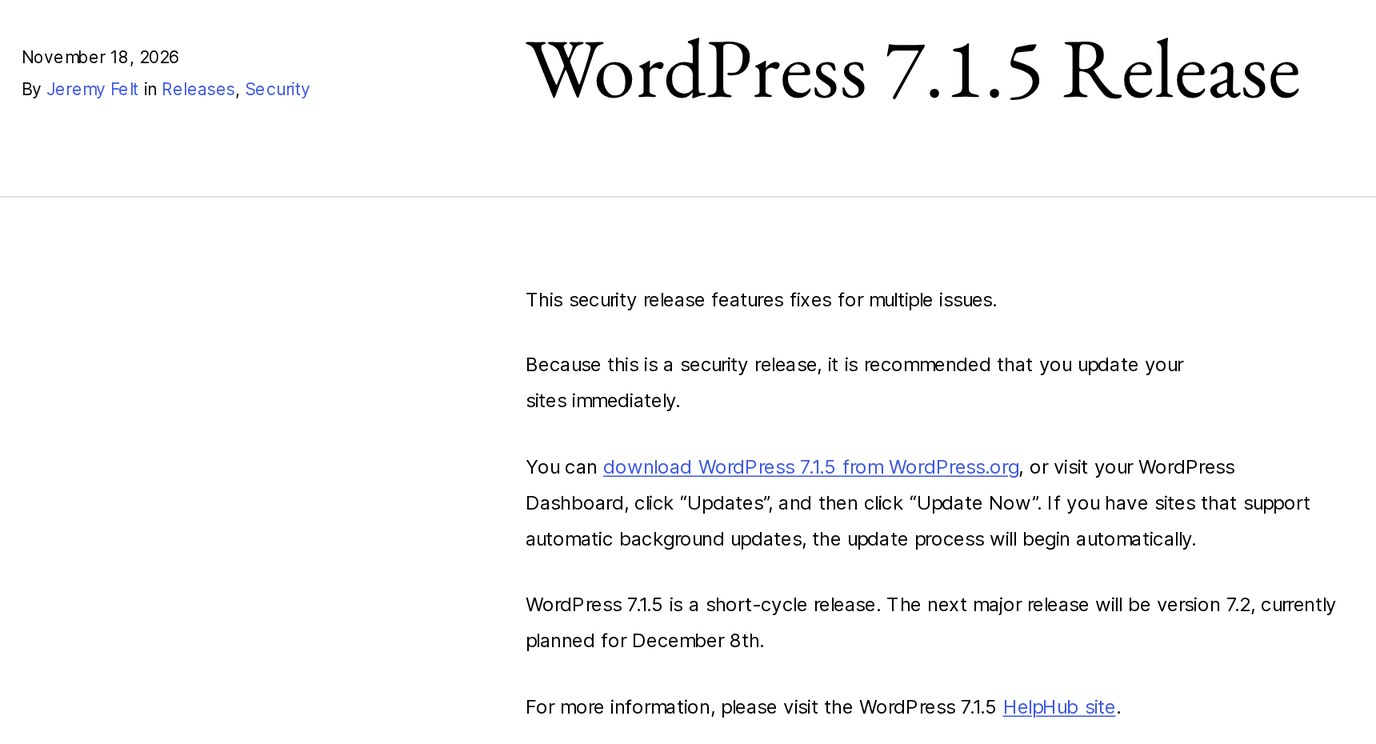
WordPress released version 7.1.5 of its website software on November 18, 2026. The security update fixes 18 flaws. Four of them can be exploited without an account on the site. WordPress recommends installing it “immediately.”
One of those four is a privilege escalation, a flaw that gives an attacker more rights than intended. According to WordPress, it “could lead to remote code execution,” meaning an attacker could run their own code on the site’s server.
A published fix, or patch, also shows where the flaw was. On November 16, a Google team that tracks hackers described an AI tool that turns published patches for widely used web software into attacks on its own, without naming the software.
The update makes 20 changes to WordPress core, the base software without add-on plugins or design themes. Eighteen fix flaws, and two are preventive hardening changes.
Sites that accept automatic background updates get the fix on their own. Fixes are also available for older versions, back to 4.7.
Four flaws that need no account
WordPress’s list labels these four “Unauthenticated,” meaning no login is needed. The only one WordPress says could lead to code execution is an “Unauthenticated privilege escalation via Template Part block attributes.”
Blocks are WordPress’s units of page content. The Template Part block inserts a piece of a template, such as the header or footer, on themes built with blocks. Logan Homolka reported the flaw. The Repository, a publication covering WordPress, describes him as a software engineering student.
Patchstack, a WordPress security company, analyzed the patched code on November 18. Dave Jong, its security research lead, said the flaw counts as unauthenticated because the attacker only has to “get the block markup in front of someone who can open it.” Block markup is the code that stores a block in a page.
In Patchstack’s analysis, when a logged-in user opens that booby-trapped block in the editor, the editor sends a request under that user’s login. It goes to a site address, or endpoint, that the attacker chose. According to Jong, the next step to code execution goes through the plugin installation endpoints, reached with the administrator’s own credentials.
The second no-login flaw exposes private taxonomy terms, the labels WordPress uses to sort content, such as categories. The leak goes through the search endpoint of the REST API, the interface other software uses to query the site. Anthropic, the company behind the AI assistant Claude, reported it.
The third is a stored XSS (cross-site scripting) flaw: a script saved on the site runs in visitors’ browsers. The attacker uses comments containing shortcodes, the bracketed codes that insert an element into text. According to Patchstack, it works only on pages showing the Latest Comments block. Rafie Muhammad of Awesome Motive reported it.
The fourth, reported by Giovanni Cintolo, is a denial of service, an attack that knocks the site offline. It relies on pingbacks, the notices one blog sends another when it links to it. They are sent in batches through XML-RPC, an older remote publishing interface.
Fourteen more flaws, including two SQL injections
The list also includes two SQL injections, which slip commands into the queries a site sends to its database. One affects WP_Meta_Query, the component that queries content metadata. The other goes through the homepage setting in previews of the Customizer, WordPress’s site customization tool.
Patchstack gives the access level these two flaws require, which WordPress’s list omits. The first can be exploited without an account only if other code, such as a plugin, passes it data sent by a visitor. The second requires an administrator account.
Another flaw affects only multisite installations, which run a network of sites from a single WordPress install. It lets the administrator of one site on the network take over a Super Admin account, the account that manages the whole network.
Eight more flaws require an account. Account roles rise from Subscriber, the most limited, to Contributor, Author, Editor and Administrator. One flaw works from Subscriber up, three XSS flaws from Contributor up, two from Author up and one from Editor up. The eighth, an XSS flaw, requires an administrator account.
Three more XSS flaws are listed with no access level, including one in the legacy media library popup, reported by Anthropic. That leaves the two hardening changes. One fixes a text-matching rule that matched too broadly, and the other removes the block editor’s embed for Imgur, an image hosting service.
Fixes going back to WordPress 4.7
WordPress ships these fixes to every branch, or series of versions, that still gets security fixes, “currently through 4.7.” It adds that “only the most recent version of WordPress is actively supported.”
According to its documentation, branches 7.0 through 6.5 are affected by all 20 issues, fixed in versions 7.0.9, 6.9.12, 6.8.13, 6.7.12, 6.6.12 and 6.5.15. Older branches are affected by fewer: just 11 for 4.7, fixed in version 4.7.40. Versions 4.6 and earlier no longer receive security updates.
The November 18 post said these older-version fixes were “in progress.” By November 20, WordPress.org’s update service was offering all of them. For sites without automatic updates, WordPress points to the Updates screen in the dashboard.
According to WordPress.org statistics checked November 20, about two-thirds of the installations it counts run the 7.1 branch. Fewer than 1% run version 4.6 or older.
Five security releases in two months
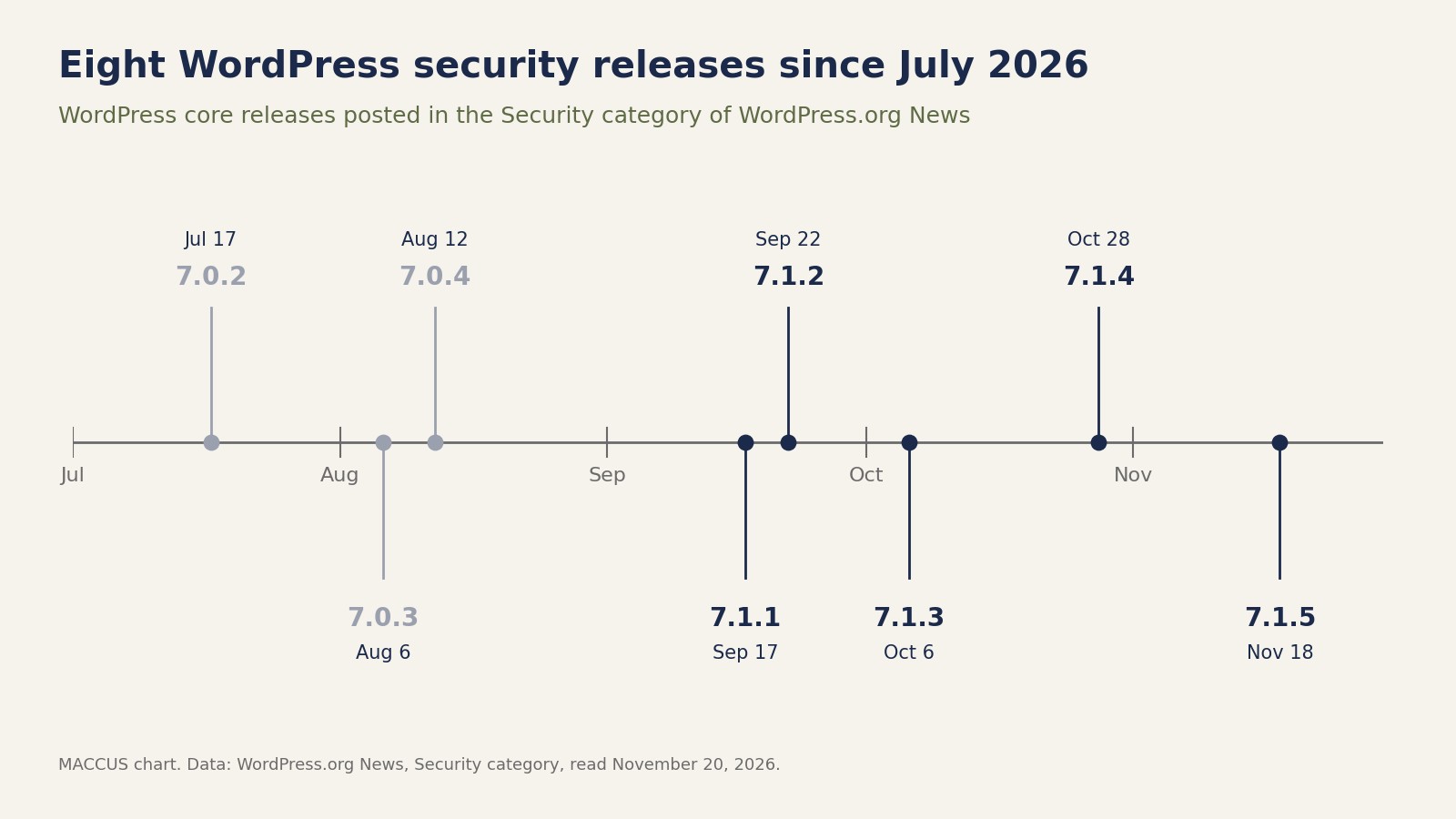
Version 7.1.5 is the fifth security release of the 7.1 branch, which launched in August. The first four came on September 17 and 22, then October 6 and 28. The previous one, 7.1.4, had already fixed “a weakness in the WordPress upgrade process which can lead to remote code execution during the upgrade window.”
Since October 6, releases have come about three weeks apart. According to The Repository, John Blackbourn of the WordPress Security Team said the team was aiming for a security release every three weeks. He said it on November 18 in the project’s Slack chat.
WordPress 7.2, the next major version, is planned for December 8. Its second release candidate, a preview version published the same day as 7.1.5, already includes these fixes.
Plugins had two security incidents of their own in October. Official updates of Rank Math PRO, an SEO (search engine optimization) plugin, shipped a backdoor, a hidden way in for attackers. Connection keys stolen from the maker of the UpdraftPlus backup plugin were used to booby-trap sites.
Anthropic credited again for reporting flaws
Anthropic reported two of the 7.1.5 flaws: the leak of private taxonomy terms and the XSS flaw in the legacy media library popup. According to Patchstack, that XSS flaw works without an account, as long as a user who is allowed to upload files clicks a booby-trapped link.
According to The Repository, 7.1.5 is the fifth core security release since August to credit Anthropic. WordPress credits it with two XSS flaws in 7.1.4 and three of the seven security fixes in 7.1.3, including a SQL injection in content export. The 7.1.3 release also credits the security firm Trail of Bits, “in collaboration with OpenAI.”
WordPress does not say how these flaws were found. Rudy Faile is head of security at Automattic, the company that runs WordPress.com. In early November, he told The Repository that the WordPress Security Team was still testing AI tools to hunt for flaws in core.
Beyond WordPress, the number of software flaws published in 2026 passed 100,000 on November 13, more than double the total for all of 2025. VulnCheck, a company that tracks them, attributes most of the increase to AI-driven vulnerability hunting.
No CVE numbers or severity scores yet
WordPress’s pages give no CVE identifiers, the standard reference numbers for publicly disclosed flaws, and no severity scores. They give no technical detail on the Template Part flaw and do not say whether any of the flaws are being exploited.
On November 19, CovertSwarm, a firm that runs simulated attacks, said no CVE identifiers had been assigned and no scores published. It said public reports showed no sign of exploitation, and none of the flaws were listed in CISA’s catalog of exploited vulnerabilities. CISA is the U.S. cybersecurity agency.
News outlets report different totals for this release. WordPress’s own list has 20 entries, two of them hardening changes.
What it means
Release 7.1.5 stands out for its four no-login flaws, one of which WordPress says could lead to code execution. Patchstack’s analysis describes a narrower attack. It needs a logged-in user to open a booby-trapped piece of content, and then an administrator’s rights. WordPress has published nothing that confirms or contradicts that analysis.
Sites without automatic updates stay exposed until they are updated. Sites on version 4.6 or older no longer get any security fixes. The flaws that require an account matter more for multisite installations and for sites with open registration, where any visitor can create a Subscriber account.
The pace is steady: eight core security releases since mid-July, five of them on the 7.1 branch in two months. The credits have changed too. They now include Anthropic, and Trail of Bits working with OpenAI. The Google report cited earlier describes the attackers’ side: an AI tool that turns published patches into attacks.
Three things are worth watching: whether CVE identifiers and severity scores get assigned, any reports of the Template Part flaw being exploited, and the release of WordPress 7.2 on December 8. If the Security Team keeps to its three-week target, the next security release would land around December 9.
Sources
- WordPress 7.1.5 Release, WordPress.org News, November 18, 2026
- Version 7.1.5, WordPress.org Documentation, November 18, 2026
- WordPress 7.1.4, WordPress.org News, October 28, 2026
- WordPress 7.1.3 Maintenance and Security Release, WordPress.org News, October 6, 2026
- WordPress 7.1.5 Security Release, Patchstack, November 18, 2026
- WordPress 7.1.5 Patches 20 Vulnerabilities as Security Team Aims for a Release Every Three Weeks, The Repository, November 19, 2026
- WordPress Core 7.1.5 – Multiple Vulnerabilities, CovertSwarm, November 19, 2026
- Statistics, WordPress.org, read November 20, 2026
Header image: MACCUS chart. Data: WordPress.org, “WordPress 7.1.5 Release,” November 18, 2026