On November 19, 2026, 54 test takers at South Korea’s college entrance exam were caught with a smart device after the government set off an emergency alarm on every switched-on phone in the country. The alarm went off three times, to expose hidden devices. Under the exam rules, carrying a device counted as cheating, whether it was used or not.
The alarm was the loudest part of a crackdown on AI-assisted cheating that the government put together in four days. The government had planned for about 550,000 test takers. The Ministry of Education counted 111 smart device cases in all, and in five of them a test taker was caught using a device during the exam.
Education Minister Choi Kyo-jin resigned on Sunday, November 22. He took responsibility for the confusion caused by the last-minute changes.
Four days from a confession to a national alarm
The trigger came on Sunday, November 15, when the top scorer of South Korea’s licensing exam for tax accountants said he had cheated. By his account, he photographed the questions with a miniature camera, sent them to an AI tool and read the answers on a smartphone. We covered his confession the next day. Police are investigating, and his account has not been tested in court.
The college entrance exam came four days later. Its official name is the College Scholastic Ability Test, or CSAT, and Koreans call it the suneung. The eight-hour exam largely decides which university a student can attend. According to The Guardian, the country already adjusts its routine around it: flights are rescheduled during the 25-minute English listening test, and the stock market opens an hour late.
On November 17, the president chaired an emergency meeting and the prime minister addressed the nation. The next day, the government listed its measures in a joint press release titled “We will never tolerate CSAT cheating.”
The only writing tool test takers could bring was a black pencil. The test sites gave each test taker the rest, one of each: white correction tape, an eraser and a computer sign pen, the felt-tip pen used to mark answer sheets. For about 550,000 test takers, that came to 700,000 erasers and 663,540 rolls of correction tape.
Every site stocked stickers to cover any button that could hide a camera. Proctors handed them to test takers whose clothes had buttons. Test takers left their bags in the hallways, where extra proctors watched them and scanned for Wi-Fi signals.
The government also promised a reward of up to 100 million won, about $75,000 at the European Central Bank’s November 20 exchange rate, for any tip that confirmed cheating. Anyone confirmed as cheating on this year’s exam would be barred from taking it for ten years, if the law is amended. The current ban is one year, according to The Korea Herald. Cheaters also face criminal complaints, with up to five years in prison, and those already enrolled at a university face expulsion.
An alert nobody could opt out of
In a note dated November 18, the education and interior ministries announced a nationwide alert at the highest emergency level. It would go out first at 8:30 a.m. on exam day, then at unannounced times. A switched-on phone hidden in a pocket or left in a bag would ring and give itself away.
Nobody can opt out of such alerts, according to the note. Every switched-on phone rings for 10.5 seconds at full volume, at least 40 decibels. The alert went to the phones of every citizen and every foreigner staying in the country. It came with an English version and a notice in Emergency Ready, the government’s safety app for foreigners.
The note warned that many phones could ring at once on public transport, at work and in moving cars, and asked drivers not to panic. The first message began “(TEST ALERT)” and said the exam was about to start. The later ones said they were sent to prevent cheating and told the public not to be alarmed. “AI-assisted cheating undermines the foundation of fair competition and can erode social trust, so a stern response is needed,” Interior Minister Yun Ho-jung said in the note.
111 device cases on exam day
The alerts went out at 8:30 a.m., 2:21 p.m. and 2:57 p.m. By late morning, Vice Education Minister Choi Eun-ok said the first alert had exposed 22 smartphones in nine cities and provinces, The Korea Herald reported.
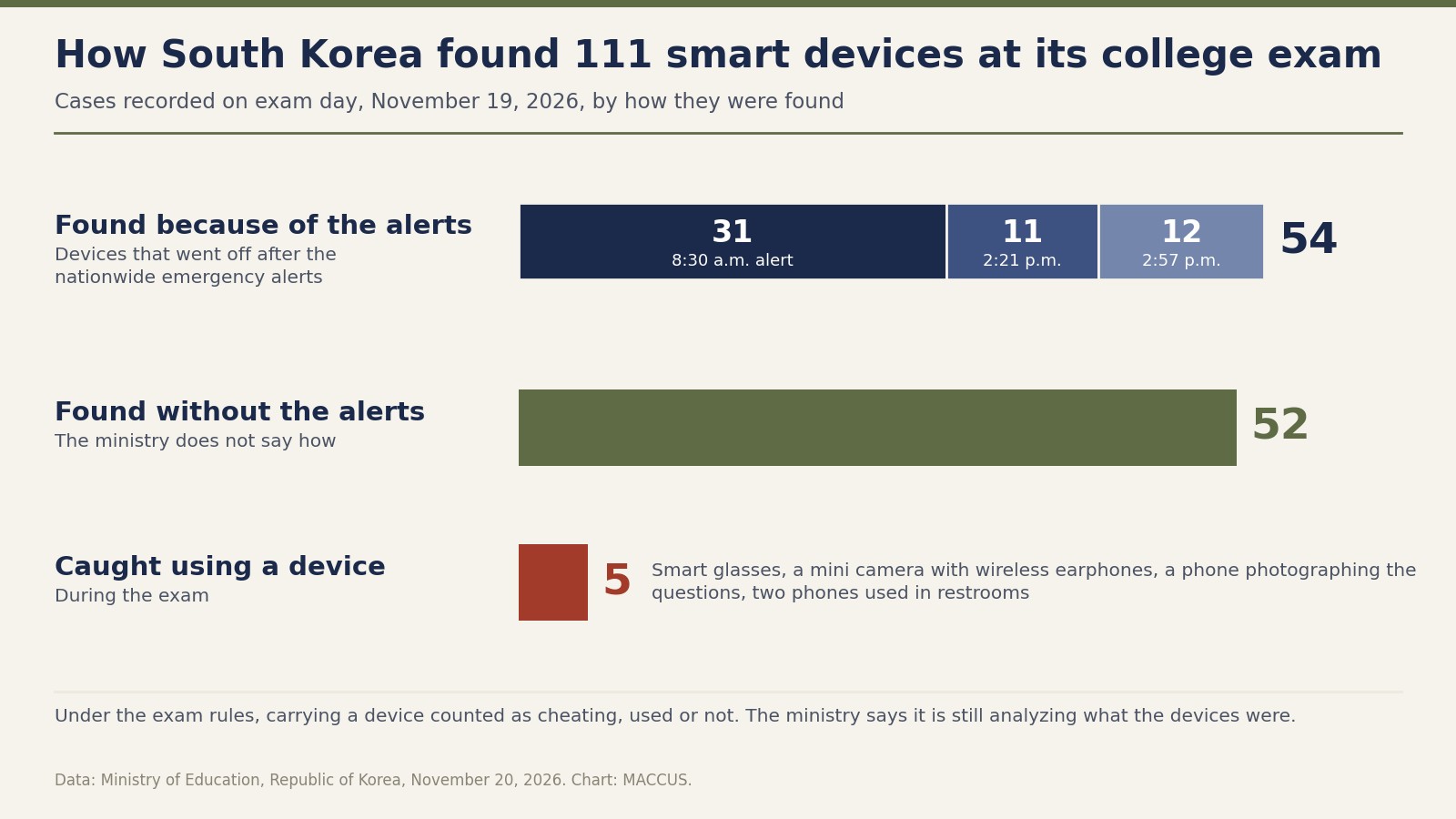
The ministry published its count on November 20, in a one-page note: 111 smart device cases. The alerts accounted for 54 of them. The first alert exposed 31, the second 11 and the third 12. Of those 54, Seoul had the most, with 20, followed by Gyeonggi Province with 8 and the city of Incheon with 6.
Another 52 devices were found without the alerts, and the note does not say how. The remaining five test takers were caught using a device during the exam.
One test taker in South Chungcheong Province wore smart glasses, and one in Gyeonggi Province used a miniature camera and wireless earphones. Police have opened investigations into both cases, The Korea Herald reported. In Seoul, one test taker photographed the question paper with a smartphone. Two others, one in Seoul and one in Gyeonggi, used smartphones in the restrooms.
A misconduct committee is reviewing each case and will decide penalties before scores come out on December 11.
The minister steps down
Choi Kyo-jin, 72, offered his resignation on Sunday. “As the minister, I cannot be free from the criticism that we (ministry) were not prepared in advance,” he said in a statement released by the ministry and quoted by The Korea Herald. President Lee Jae Myung accepted the resignation an hour later, according to the presidential office.
At a parliamentary hearing on Monday, November 16, the minister was asked whether he was confident cheaters could be caught, The Guardian reported. “Due to my age, I am not confident I could,” he said. The answer drew a backlash.
The Guardian also reported that the minister did not appear at the press conferences before the exam, where a vice minister announced the measures instead. Teachers’ unions called the government’s response belated.
The authorities are now considering a review of past entrance exams for AI-assisted cheating, based on credible tips, The Korea Herald reported. Exam papers must be kept at the test sites for at least a year, the newspaper noted.
The limits of the count
The 111 figure counts smart devices that test takers carried or used. The ministry has not said that any of them was used with AI, and it says it is still analyzing the devices and the types of misconduct. The alarm also had a limit: it could expose only a device that was switched on.
Comparisons with last year are rough. At the November 2025 exam, 84 cases involved electronic devices, according to ministry figures obtained by the office of lawmaker Ko Min-jung. The Korean outlet Donghaeng Media Sidae reported the figures. Only 16 were phones; the others included 31 electronic watches and 23 e-cigarettes and other devices.
The ministry has not yet broken this year’s 111 down by item. This year’s checks were also much stricter, so the two counts cannot be compared directly.
Two announced measures are still plans. The ten-year ban needs a change in the law, and that change has not passed. During exam week, the government was still drawing up the rules for the reward.
What it means
In four days, one man’s account of a camera, a phone and an AI tool rewrote the rules for about half a million test takers. The alarm exposed 54 devices, and the ministry has tied none of the 111 cases to AI so far.
Outside the exam room, AI tools are widely used in South Korea: in October, the ChatGPT app had 18.76 million monthly users, up 43.8 percent in a year, according to app-tracking data from Mobile Index reported by The Korea Herald. Over the same year, the Claude app, made by Anthropic, grew from 139,000 to 2.1 million monthly users. In a Bank of Korea survey, Korean workers who use AI said it saves them 3.7 hours a week. In England, the university regulator has already called for more AI-free assessment, such as in-person exams.
South Korea now has to decide what its exam should measure when the answers can be a photo away. It also has to decide how far it will go to keep phones out of exam rooms. Several decisions are pending: penalties for this year’s cases before scores come out on December 11, the law change for the ten-year ban, a possible review of past exams and the choice of the next education minister.
Sources
- 스마트기기 등 전자기기 관련 부정행위 적발 현황, Ministry of Education, Republic of Korea, November 20, 2026
- 수능시험일 위급재난문자가 발송됩니다, Ministry of Education and Ministry of the Interior and Safety, Republic of Korea, November 18, 2026
- 수능 부정행위, 결코 용납하지 않겠습니다, Office for Government Policy Coordination and Ministry of Education, Republic of Korea, November 18, 2026
- 111 test takers caught with smart devices during Suneung, The Korea Herald, November 20, 2026
- Education minister steps down amid Suneung-related controversies, The Korea Herald, November 22, 2026
- South Korean minister quits after AI cheating scandal engulfs university exams, The Guardian, November 22, 2026
- 수능 전자기기 부정행위 111건 적발…작년보다 32% 늘어, Donghaeng Media Sidae, November 20, 2026
- [Graphic News] ChatGPT tops 18 million users in Korea, The Korea Herald, November 23, 2026