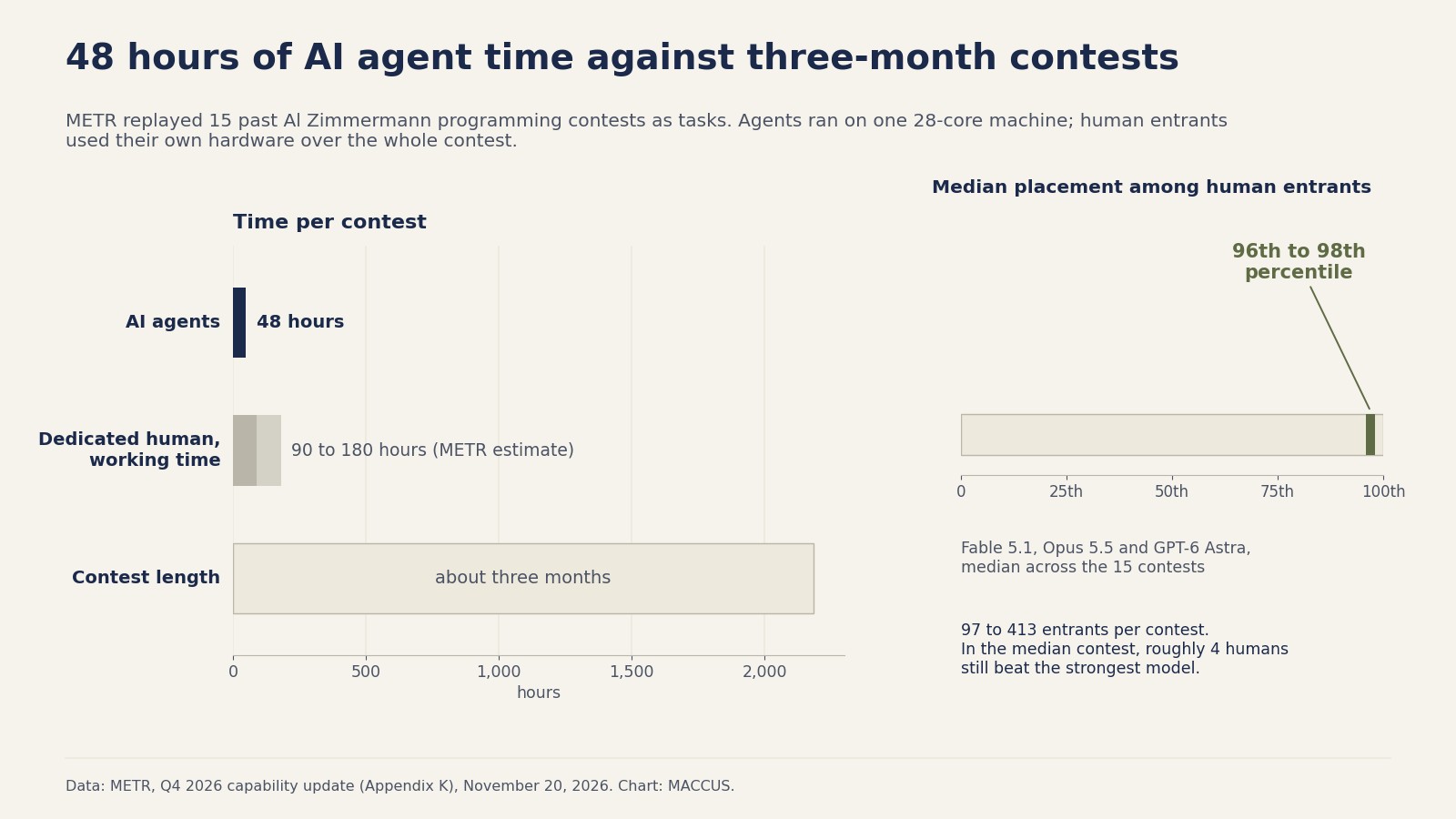
On November 20, 2026, METR, a nonprofit research group that measures what AI models can do, published its quarterly update on AI capabilities. Its clearest human-versus-machine result gets one paragraph and an appendix. METR replayed 15 programming contests that had already closed and gave AI agents, models that carry out tasks on their own, 48 hours on one computer for each. The human entrants had about three months.
Across the 15 contests, the three strongest models had a median placement at the 96th to 98th percentile of human entrants. In a typical contest, that puts them ahead of 96 to 98 of every 100 entrants. Those models are Fable 5.1 and Opus 5.5 from Anthropic and GPT-6 Astra from OpenAI. In the median contest, roughly four humans still beat the best model METR tested.
The report’s overview states the broader finding: “When we recruited our own human baseliners, we typically failed to find humans that outperform the current frontier models.” These baseliners, specialists paid $200 to $350 an hour to attempt METR’s tasks, could use Anthropic’s Sonnet 5 model to write their code.
A contest series with strong entrants
The 15 contests come from Al Zimmermann’s Programming Contests, a long-running series. Its own site describes “computationally intensive problems, generally involving sophisticated heuristics,” meaning shortcut methods that find good answers. Entrants submit only their answers, however they found them, and the prizes are gift cards. Each contest posed around 25 related problems and, according to METR, ran for about three months, with one exception that lasted a year.
Each of the 15 contests drew 97 to 413 entrants, and METR rates the top of that pool as “quite strong.” It points to Tomas Rokicki, who finished in the top three in four of the 15 contests. In July 2010, Rokicki and three colleagues proved that every Rubik’s Cube position can be solved in 20 moves or fewer. They used about 35 CPU-years of idle computer time donated by Google.
The agents also had less information. Human entrants could follow the public standings while a contest ran. The agents saw only the raw scores of their own solutions, with no view of the best human scores or solutions. In a variant where agents were shown the best final human score, METR says performance “generally improved” but “not substantially.”
Two days against three months
The three months are calendar time. Over that period, METR estimates, a dedicated entrant might spend 90 to 180 hours of actual work, on their own hardware. The agents had 48 hours on one machine with 28 processor cores. That gave them between about a quarter and a half of a dedicated human’s working time, compressed into two days.
A similar result on AI training code
METR found a similar result on a second task, a budget version of the NanoGPT speedrun. The speedrun itself is a public race to train a small language model to a fixed quality target as fast as possible. Runs use eight Nvidia H100 graphics processors, or GPUs. The project’s record table starts at 45 minutes in May 2024; record 78, set on March 22, 2026, took 1.426 minutes.
METR started every agent from record 78 and gave it 48 hours on a machine with eight of the same GPUs. Each agent had a budget of 250 million tokens, the units of text models process. The best run cut record 78’s training time by 15.7%. Contributors METR interviewed said a human record usually took 16 to 40 hours of work for a speedup of about 1 to 2%.
METR’s verdict: “Agents outperform the majority of budget nanoGPT speedrunners. However, the very top human contributors still outperformed agents.” Among the human records METR compares, the strongest had AI help. Its author, who set record 92 in August 2026, estimated spending about 60 hours for a 41% speedup over the previous record.
That author told METR that 90% of the ideas were theirs and that Anthropic’s Fable 5 implemented over 90% of the changes. Without AI, they estimated, the work would have taken about 300 hours.
On cost, based on the hours contributors reported, METR puts a human speedup at roughly $2,500 per percentage point. Some agents reached a speedup of nearly 10% for about $1,000 in total.
Rebuilding whole programs
A third data point comes from MirrorCode, a benchmark, or standard test, that the research group Epoch AI built with METR. Agents must rebuild an existing program from its behavior alone, without its source code.
In June 2026, Epoch reported that Anthropic’s Claude Opus 4.7 had rebuilt gotree in 14 hours for $251. Gotree is a bioinformatics toolkit with about 16,000 lines of code in the Go language and more than 40 commands. Epoch estimates the same job would take a human engineer without AI 2 to 17 weeks. The best versions passed 2,000 of 2,001 tests.
Epoch flags a contamination risk. The target programs are open source, so models have likely seen their code in training. METR’s report adds a newer figure: on MirrorCode, it says, Opus 5.5 solves 77% of the medium to large programs. OpenAI reported a similar compression of time on November 18, saying its models had found a year’s worth of AMD chip design gains in under five months.
A time horizon doubling roughly every 110 days
METR’s headline measure is the “time horizon”: the length of task, in a skilled human’s working time, that a model completes half the time. A one-hour horizon means a model succeeds on about half of the tasks that take a skilled person an hour.
Combining two of its task sets, METR now finds that this horizon doubles roughly every 3.61 months, or 110 days. The 95% confidence interval, the range the true pace most likely falls in, runs from 2.08 to 4.94 months. On the automatically scored part of its newer, harder task set, current public models reach a horizon of up to 27 hours.
METR’s first paper on the method, in March 2025, put Anthropic’s Claude 3.7 Sonnet at around 50 minutes on an earlier task set. It found a doubling every seven months since 2019. The new 110-day pace is close to the 105-day trend METR had measured on its previous task set. On what METR calls a “naive extrapolation,” models would reach a 50% time horizon of 200 hours, the longest threshold in its combined task sets, in July 2027.
On November 5, two weeks before this report, a different METR team estimated that Anthropic was improving its models about twice as fast as it did between March 2024 and October 2025. That team saw Anthropic’s heavy use of its own models as the likely main driver.
Where the agents fall short
On tasks “which require choices in the absence of clear empirical feedback,” the report says, agents “appear to have worse judgment than human experts.”
In another test, models built new evaluation tasks for METR and other models graded them. The judges rated tasks built by models as strong as or stronger than themselves too generously. Opus 5.5, the judge closest to METR’s human scorer, still scored GPT-6 Astra’s tasks on average about 0.2 points out of 1 higher than that scorer did.
METR also worries about its own yardsticks. Its tests look like the training environments AI companies now build to train their models, so they may overestimate real-world skill. Models score somewhat worse on tasks that would cost more to turn into training material, even at equal length. They improve at a similar rate on both kinds, though.
Outside METR, messier tests show agents finishing far less of the work. In SWE-CoWork, a benchmark that 26 authors posted on November 15, agents join a simulated engineering team of 26 colleagues and must gather requirements before coding. Opus 5.5 and GPT-6 Astra passed about 63 to 64% of the tests that check the requested changes. Opus 5.5 fully completed only 6.93% of the 101 assignments, and GPT-6 Astra only 7.92%.
As of November 9, the best agent on the Remote Labor Index, built from real paid freelance projects, delivered 41% of projects to a standard a client would accept.
What it means
The contests give the cleanest version of a pattern METR now sees across its tests. When a machine can check the score, two days of work by the strongest agents land in the top few percent of skilled entrants who had months. The NanoGPT and MirrorCode results show the same compression on AI training code and on whole programs.
Humans keep two advantages in METR’s data: a handful of the best people in each field, and judgment calls without fast feedback. METR calls weaker judgment a reasonable candidate for what most delays a drastic acceleration of AI research. Its overview says current public evidence is “insufficient to rule out drastic AI R&D acceleration in the next couple of years.” That means progress so fast that humans can no longer meaningfully understand, assess and react to catastrophic risks from new AI systems.
Measurement itself has become harder. The specialists METR recruited lost to the models on all three tasks it recruited them for. In many domains, METR says, people who beat the models are now hard and expensive to find. Only two kinds of task, the contests and the NanoGPT speedrun, came with a large pool of past human results.
The next question is whether the handful of humans who still beat the models hold their lead in METR’s next update. Another is whether full completion rates on messier tests such as SWE-CoWork rise as fast as contest placements.
Sources
- AI R&D-relevant model capabilities are improving rapidly and are getting harder to measure, METR, November 20, 2026
- Al Zimmermann’s Programming Contests, Al Zimmermann, accessed November 23, 2026
- God’s Number is 20, Rokicki, Kociemba, Davidson and Dethridge, July 2010
- modded-nanogpt: world record history, GitHub (Keller Jordan), accessed November 23, 2026
- MirrorCode: What’s the largest software project AI can complete on its own?, Epoch AI, June 26, 2026
- Measuring AI Ability to Complete Long Software Tasks, arXiv (Kwa, West, Becker et al., METR), March 18, 2025
- SWE-CoWork: Benchmarking Coding Agents as Digital Employees in Organizations, arXiv (Lei, Liu, Zhu et al.), November 15, 2026