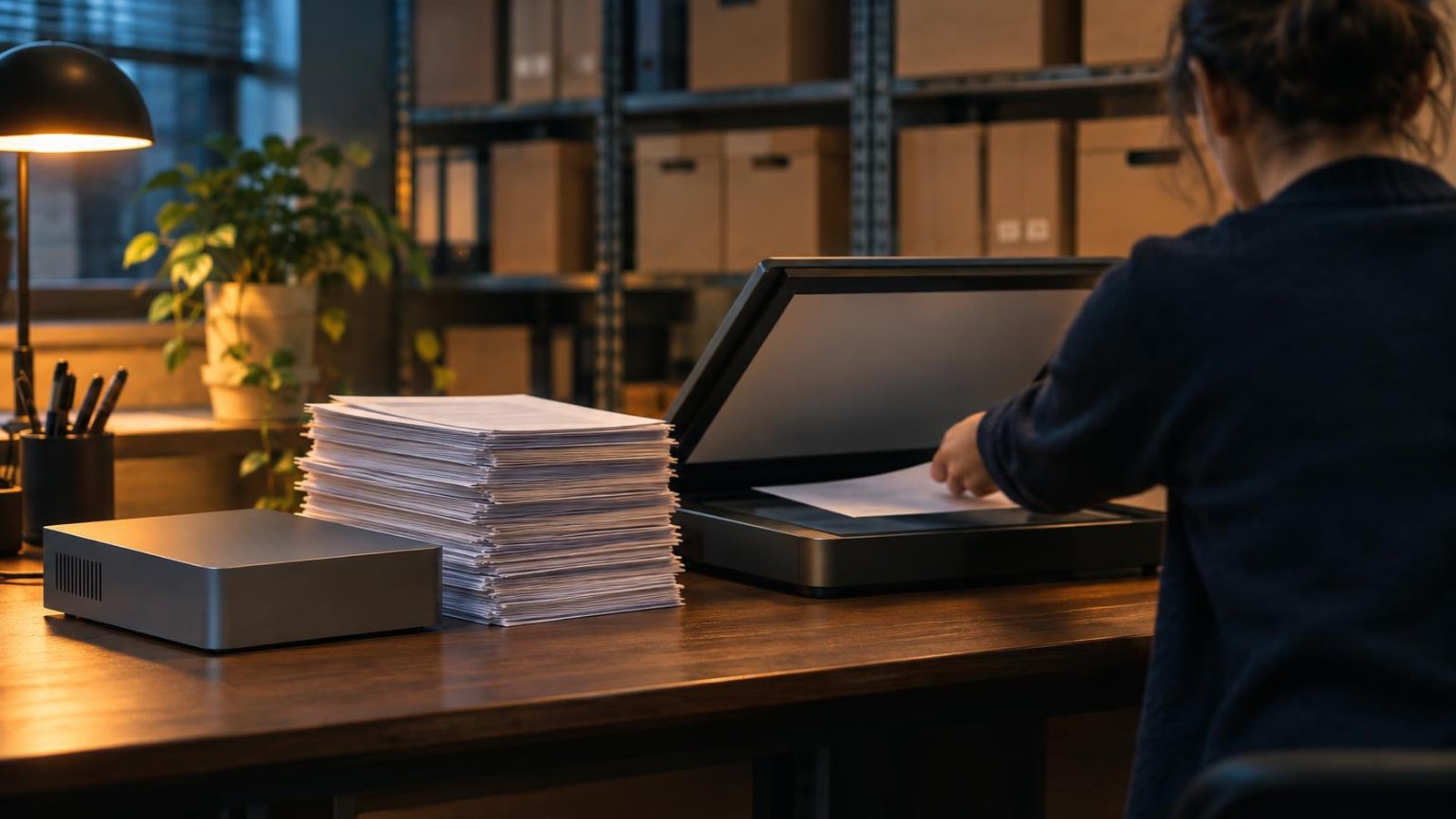

LlamaIndex, the company behind the LlamaParse document-reading service, released OCRia-nano-1 on November 23, 2026. It is a set of small AI models that reads PDFs and scanned documents on an ordinary computer processor, or CPU. It needs no graphics card, the specialized chip that AI models usually run on.
The whole set has 8.1 million parameters, the values a model learns during training. That is about 500 times fewer than the large LlamaIndex model it learned from. Its weights, the files that hold those parameters, can be downloaded from Hugging Face, a platform for sharing AI models. The license limits free commercial use to organizations with less than $2 million in revenue in the previous year and less than $2 million in total funding raised.
The tool performs optical character recognition, or OCR: it turns the image of a page into text that can be copied and searched. It also recovers tables, headings and lists. Everything happens on the user’s own machine, so contracts or invoices can be processed without handing them to an online service.
Seven small models instead of one big one
OCRia-nano-1 combines seven specialized models. A detector first finds the lines of text on the page. A router then identifies the writing system, or script, of each line and sends the line to one of four recognition models.
The first recognition model reads the Latin alphabet, and the second reads Chinese, Japanese and Korean. The third reads Arabic and Hebrew, which are written right to left. The fourth covers about 17 other scripts. With the detector and the router, this text-reading part totals about 3.9 million parameters.
The seventh model, LayoutNet, has 4.27 million parameters on its own. It rebuilds tables and labels each block on the page as a heading, list, caption, header or footer.
LlamaIndex trained these small models through distillation, a method in which a large model teaches a smaller one. The teacher was OCRia-1, LlamaIndex’s own document-reading model, which has 4 billion parameters and runs on a graphics card. OCRia-1 helped produce part of the training data: page transcriptions, table annotations and page-layout labels. Most of the rest came from text already embedded in PDFs, from synthetic pages and from public datasets.
The models run inside LiteParse, LlamaIndex’s document parser, a program that pulls text and structure out of files on the user’s own computer. LiteParse is open-source software under the Apache 2.0 license, which allows commercial use.
LiteParse version 2.21.0, released on November 23, adds OCRia-nano-1 as an optional reading engine. One command downloads the models and ONNX Runtime, the engine that runs them, 60 to 75 megabytes in total. When a PDF already contains text, LiteParse reads that text directly. It runs recognition only on scanned pages or images.
The output comes as plain text, as Markdown or as JSON. Markdown is a text format that keeps headings and lists. JSON is a data format meant for software, and it also gives the position of each word.
LlamaIndex reports 426 milliseconds per page on a single core
LlamaIndex reports an average of 426 milliseconds per page, just under half a second, on a single core. A core is one of the computing units inside a processor. For 90% of pages, the time stays under 862 milliseconds.
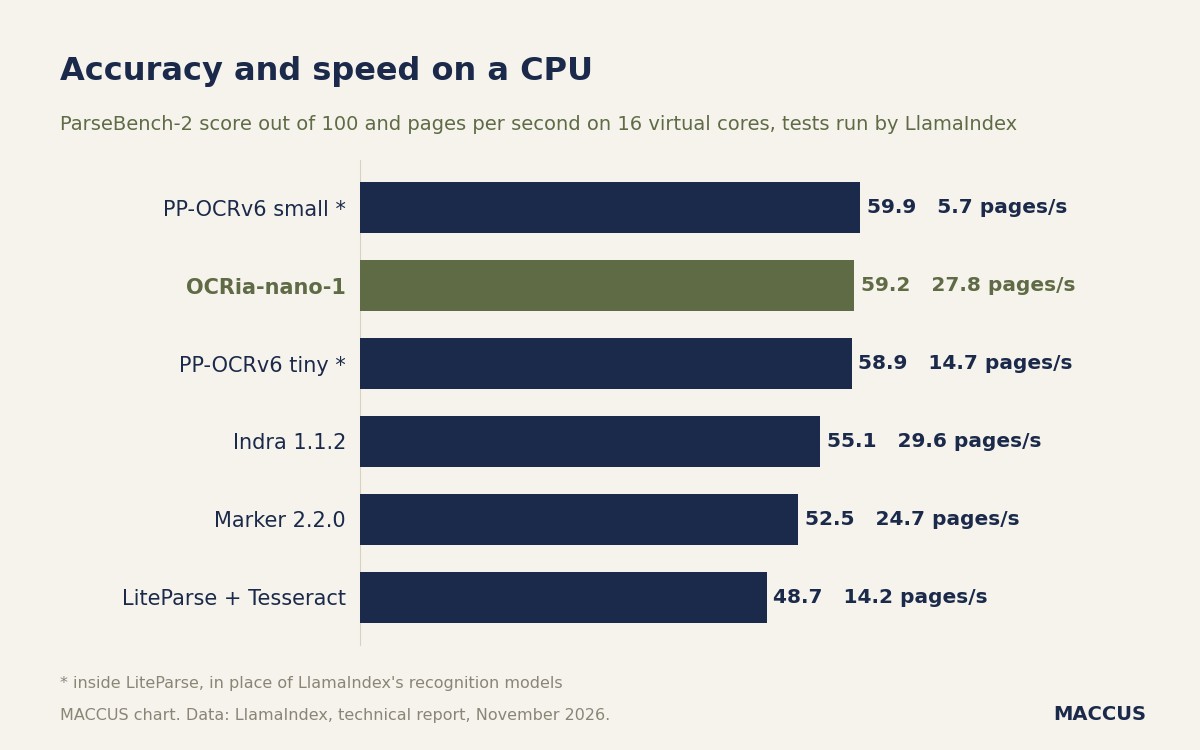
LlamaIndex also ran 16 processes in parallel, one on each virtual core of a rented cloud server. That setup handles 27.8 pages per second, or about 100,000 pages an hour. That is twice as fast as LiteParse’s default setup, which uses Tesseract, a free and open-source text recognition engine.
These figures are averages across five servers rented from Microsoft, Amazon and Google, each with 16 virtual cores. In a web browser on a laptop, LlamaIndex puts the time at 1 to 4 seconds per scanned page.
For comparison, the Chinese AI company DeepSeek charges $0.225 per 1,000 pages for text recognition in its online service, where the documents go to its servers. For an organization under the license thresholds, the only cost of OCRia-nano-1 is the computing time of the machine that processes the pages.
Scores come mostly from LlamaIndex’s own test
ParseBench-2, the main test in LlamaIndex’s technical report, rates document-reading quality out of 100. OCRia-nano-1 scores 59.2, ahead of the three CPU tools the report compares it with directly. Indra and Marker, two parsers from the company Datalab, score 55.1 and 52.5. LiteParse with Tesseract scores 48.7.
The clearest gap is on tables, where OCRia-nano-1 scores 59.5, compared with 47.6 for Indra.
LlamaIndex researchers built that test, though. The paper that introduced it was posted on November 12, 2026, to arXiv, a site where researchers share papers before peer review. Simon Suo, one of its co-authors, is also one of the two authors of the OCRia-nano-1 report.
The report also puts OCRia-nano-1 ahead of Datalab’s tools on OmniParseBench, a test Datalab built itself. There, OCRia-nano-1 scores 74.8, compared with 70.9 for Indra and 69.8 for Marker.
The model is not the most accurate in every case. In one test setup, PP-OCRv6 small, a recognition model from the open-source PaddleOCR project, replaces LlamaIndex’s recognition models. That version scores 59.9 on ParseBench-2, slightly above OCRia-nano-1’s 59.2. But it handles only 5.7 pages per second, compared with 27.8 for OCRia-nano-1.
The models in the report that run on graphics cards or as online services still score higher. On ParseBench-2, LlamaIndex’s own large model, OCRia-1, scores 87.0. Mistral OCR 4.1, the document-reading service of French company Mistral AI, scores 69.3. LlamaIndex rescored these results from outputs that had already been published.
The limits the report acknowledges
According to the report, OCRia-nano-1 has no model for charts. It keeps them as images and scores 3.1 out of 100 in the chart category of ParseBench-2. Its weakest points remain handwriting and scripts for which it had little training data. It does not recognize equations on scanned pages at all.
The documentation does not mention French. The Latin-alphabet recognition model handles 791 characters, but no score for individual languages has been published.
LlamaIndex presents OCRia-nano-1 as a first pass for everyday documents, such as computer-generated reports, simple contracts and invoices with simple tables. For complex tables, handwriting and badly degraded scans, the company recommends its large OCRia-1 model, which it offers in its LlamaParse service.
A free license with two thresholds
The weights are released under the OCRia-nano-1 license, a modified version of the Open RAIL-M license. Open RAIL-M is a license written for AI models. It allows reuse but bans certain uses. LlamaIndex’s version makes the models free for research, for personal use and for commercial work at organizations under two thresholds.
The first threshold is revenue of less than $2 million in the previous year. That is about €1.83 million at the European Central Bank’s exchange rate on November 23, 2026. The second is less than $2 million raised in total, in equity or debt, from any source.
Above those thresholds, an organization needs a commercial license, and LlamaIndex does not publish its price. Companies of any size also need that license for any OCR or document-extraction service that competes with a LlamaIndex product. Those products include LlamaParse and the company’s online platform, LlamaCloud.
The results the models produce belong to the user. Outside research, those outputs cannot be used to train another model that imitates OCRia-nano-1, through distillation for example.
The code and configuration files shipped with the weights fall under the same license. That license states that this “Licensed Code is not open-source software.” LiteParse, the software that runs the models, remains under Apache 2.0. Tesseract stays its default engine until the user downloads the LlamaIndex models.
Other recent releases set different license terms. On November 18, Cloudflare released its Clairic models, which extract data from invoices and receipts, under Apache 2.0, with no size threshold. Mistral AI requires a commercial license only from companies that sell access to its Mistral Large 4 model as a service.
What it means
What is new is the accuracy OCRia-nano-1 reaches at such a small size. The report names Datalab’s Indra, a CPU tool with about 12 million parameters, as the closest comparable tool. OCRia-nano-1 is smaller, at 8.1 million parameters, and still beats it on tables, 59.5 to 47.6. In practice, contracts, invoices or scanned archives can be read on an ordinary computer, with no graphics card and no files sent to a third party.
The speed and accuracy figures come from LlamaIndex, and most were measured on a test its own team designed. As of November 24, no independent test and no score on French documents had been published.
The license also draws a clear line. Above $2 million in revenue or in funding raised, commercial use requires a contract whose price is not public.
The next things to watch are independent measurements, especially on French documents. Since November 23, OCRia-nano-1 has been listed on the public ParseBench leaderboard, a ranking that LlamaIndex runs itself. LiteParse version 2.21.1 came out overnight between November 23 and November 24. It already fixes one flaw: the line detector was missing short, faint words.
Sources
- Introducing OCRia-nano-1, LlamaIndex, November 23, 2026
- llamaindex/OCRia-nano-1 (model card), Hugging Face, November 23, 2026
- OCRia-nano-1 Model License, LlamaIndex, November 23, 2026
- OCRia-nano-1: Fast, Accurate CPU Parsing with 8.1M Parameters, LlamaIndex, November 2026
- LiteParse Python v2.21.0, GitHub, November 23, 2026
- LiteParse Python v2.21.1, GitHub, November 24, 2026
- ParseBench-2: Severity-Aware Evaluation of Document Parsing, arXiv, November 12, 2026
- Models & Pricing, DeepSeek, accessed November 24, 2026