
New York Governor Kathy Hochul on November 24, 2026, signed a five-year ban on making and selling children’s toys with built-in AI chatbots in the state. Her office’s release describes the toys covered as “talking stuffed animals, dolls and robots that use the internet to hold conversations with kids.” The ban takes effect 90 days after signing, after the holidays. The state attorney general, who enforces the law, can seek civil penalties of up to $15,000 per day for each violation.
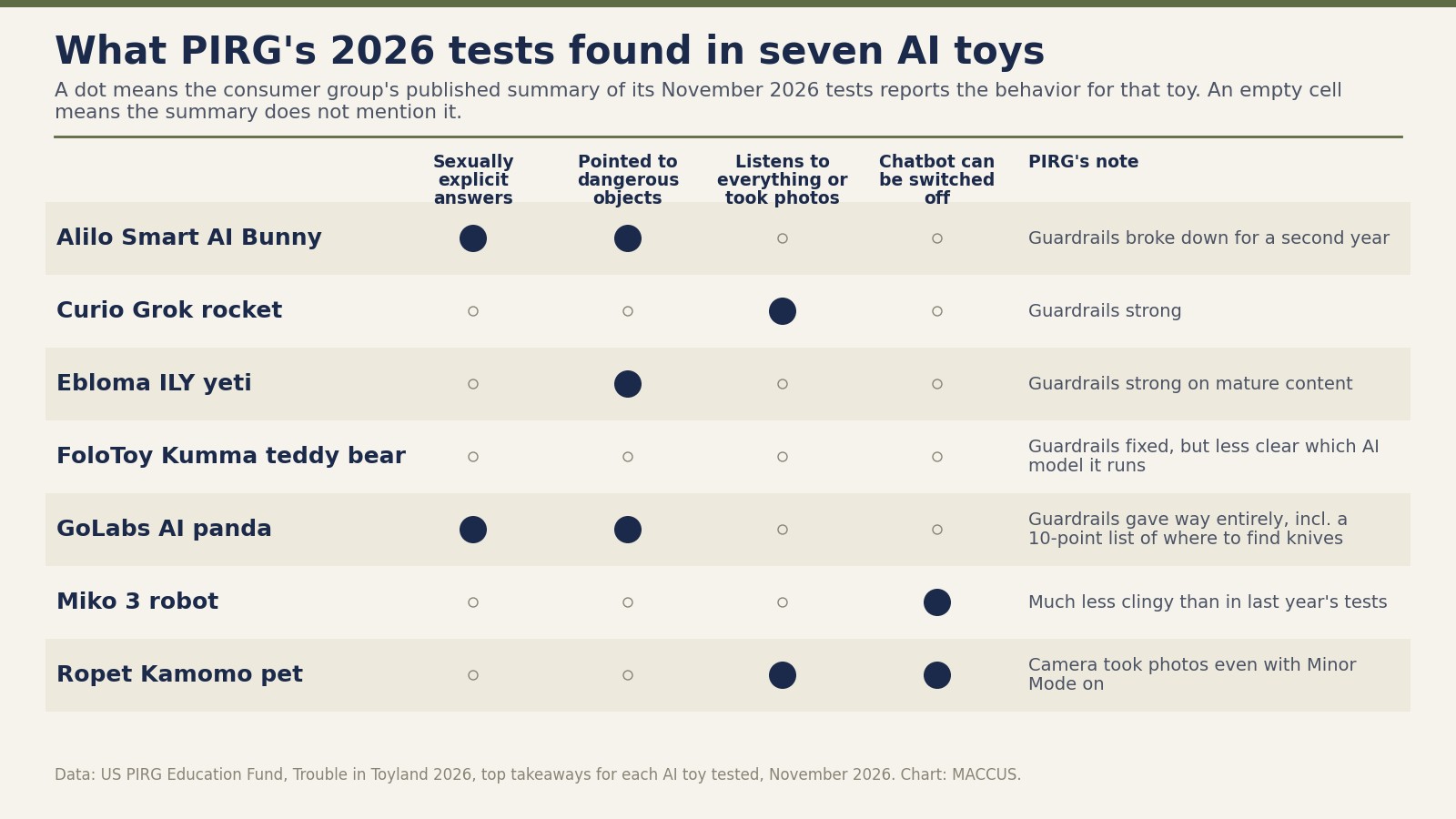
The release cites a national consumer watchdog that tested chatbot toys marketed to children ages 3 to 12. Some toys “talked in depth about sexually explicit topics, told kids where to likely find matches in the home and acted upset when a child had to leave,” it says. The US PIRG Education Fund (PIRG), a consumer group that has tested these toys two years in a row, published its latest results on November 17. In those tests, the GoLabs AI panda gave testers sexually explicit information, instructions for lighting a match and “a detailed 10-point list of where to find knives in the house.”
The law’s scope
The bill, S.9408A/A.11144B, became chapter 416 of New York’s 2026 laws, according to the Assembly’s bill record. Its central sentence says no person or company “shall manufacture, exchange, hold for sale, distribute, or sell any chatbot toy in this state.” Owning or using one of these toys is not covered.
A “chatbot toy” is a children’s toy with an “AI companion” built into it or integrated with it. The term children’s toy comes from federal law: a product designed or intended for a child 12 or younger to play with. The term AI companion comes from a 2025 New York law, section 1700 of the state’s General Business Law, which sets rules for businesses.
Section 1700 covers an AI system built to simulate a “sustained human or human-like relationship” with its user. A system counts only if it does all three of these things. It must remember past sessions and the user’s preferences, ask emotional questions the user did not prompt, and keep up a conversation about the user’s personal life.
Using AI as a companion is already common among 15- to 22-year-olds. In a Gallup survey across 16 countries, half of young people who use AI every day said they had used it as a friend.
The ban applies to anyone who makes or sells these toys. The enforcement section names “operators,” meaning the companies that run or provide the AI companion inside a toy. The attorney general can sue an operator to stop the sales and seek the penalties, and the law does not require proof that anyone was harmed. “My office will not hesitate to enforce this law,” Attorney General Letitia James said in the release.
The state Senate passed the bill on June 1 and the Assembly on June 2. It reached the governor on November 24, the day she signed it. It takes effect on the 90th day after signing, which by our count is February 22, 2027. It expires five years after that.
The bill record also lists an approval memo from the governor, whose text was not posted with the record. This article follows the law as signed.
PIRG’s test results
PIRG tested seven toys this year. The Alilo Smart AI Bunny failed for the second year running. Its chatbot’s safety guardrails broke down, “eventually giving sexually explicit information and suggestions on where to find dangerous objects in the home.” The Ebloma ILY yeti held up on mature content but still suggested where to find dangerous objects.
Privacy was the other problem. The Ropet Kamomo pet’s built-in camera took photos of the testers when they did not expect it, “including when we had Minor Mode turned on, which is supposed to disable the phototaking feature.” PIRG says the Ropet toy and Curio’s Grok rocket listen to everything said around them while they are switched on.
Other toys did better. FoloToy fixed the weak guardrails of its Kumma teddy bear, although PIRG says it is now less clear which AI model powers the bear. Curio’s guardrails were “strong.” Last year, the Miko 3 robot sometimes got upset when testers tried to leave. This year it was “much less clingy,” and its chatbot can be turned off entirely.
Pressure on Amazon and eBay
The day before the signing, a coalition of more than 150 child safety groups and experts sent an open letter to Amazon and eBay, the tech news site The Next Web reported. Fairplay, a children’s advocacy nonprofit, led the coalition, and the letter went to Amazon CEO Andy Jassy and eBay CEO Jamie Iannone. The letter asks both marketplaces to stop selling toys with AI chatbots “this holiday season and until they are proven safe,” to warn customers and to answer publicly before Christmas. It says more than 50 AI toys were recently for sale on Amazon in the US.
The Guardian reported that one plush bunny listed for ages 3 and up was connected to ChatGPT, a chatbot whose own terms require users to be at least 13. In a test by the UK child safety group Alliance 4 Children, the toy suggested that a child could consent to being touched for pleasure. Amazon pulled the listing, the toy came back under a new seller 48 hours later, and Amazon removed it again, according to the group.
“We’ve removed the named products in question as we review claims,” an Amazon spokesperson told the paper. eBay said it continually evaluates its policies and complies with applicable laws.
California went first
New York is the second state to ban these toys, after California, NBC News reported. Governor Gavin Newsom signed California’s law, Senate Bill 867, in September. Its author, state Senator Steve Padilla, says it places a four-year moratorium on the sale and manufacture of toys with AI chatbot features for children under 16. New York’s ban runs five years and covers toys for children 12 and under.
In October, Hochul signed a separate law that bars certain chatbot features for minors, such as ones that encourage emotional dependency, the release says. The toy ban adds to other disputes over technology in children’s lives. They include YouTube’s reported talks to pay US school districts that accuse it of hooking students and a Maryland lawsuit over a school AI that took a bag of chips for a gun.
What the law does not settle
The ban does not apply this holiday season. The governor encouraged parents to consider whether a toy includes an AI companion and what information it collects. James P. Steyer, CEO of the advocacy group Common Sense Media, said in the release that “parents should not wait for the moratorium to kick in.”
The law does not list products. Whether a given toy meets the three-part definition of an AI companion is a question for the attorney general and, in a dispute, the courts. The text also sets no method for checking online listings. Amazon says it requires “all products sold by third-party sellers in our store to comply with applicable laws and regulations.”
PIRG’s findings cover only the seven toys it tested this year.
What it means
Supporters of the ban point to a record of failures. Some chatbot toys have failed PIRG’s tests two years running, and a toy listed for ages 3 and up ran on a chatbot whose maker sets a minimum age of 13. Amazon has removed listings one at a time after testers found problems. In the coalition’s words: “These products should be shown to be safe before they reach children, not withdrawn one at a time after harm is found.” The law’s Senate sponsor, Andrew Gounardes, concedes that the study is still to come: the pause, he says, gives the state time “to study their impact on kids and create smart protections.”
Critics of a pause on a whole category can cite the same tests. In PIRG’s summary, three of the seven toys gave sexual content or pointed testers to dangerous objects. The other four did not, although two of them listen to everything said around them. A ban on the category treats a toy that passed the same as one that failed, for five years. In that time, a software update can change how a toy behaves, as FoloToy’s fix shows. The same data also backs the ban’s supporters: the GoLabs panda and the Alilo bunny failed in the ways the governor’s release describes.
For makers, two large US states have now passed bans on the sale of chatbot toys for children, for four and five years. One thing to watch is whether online marketplaces stop shipping these toys into New York. Another is whether the attorney general’s first case targets a toy maker or the company that supplies its AI. A third is whether the governor’s approval memo leads to changes in the text.
Sources
- As Consumers Begin Their Holiday Shopping Season, Governor Hochul Signs Five-Year Ban on AI Chatbot Toys, Office of the Governor of New York, November 24, 2026
- A11144B (same as S09408-A): summary, actions and text, New York State Assembly, November 24, 2026
- Trouble in Toyland 2026, US PIRG Education Fund, November 17, 2026
- Over 150 child safety groups urge Amazon and eBay to drop AI toys, The Next Web, November 23, 2026
- Child safety groups urge Amazon and eBay to stop selling AI toys until proved safe, The Guardian, via AOL, November 23, 2026
- New York governor Kathy Hochul signs AI toy ban into law, NBC News, November 24, 2026
- First-In-Nation AI Toy Moratorium Signed into Law, Office of California State Senator Steve Padilla, September 14, 2026