

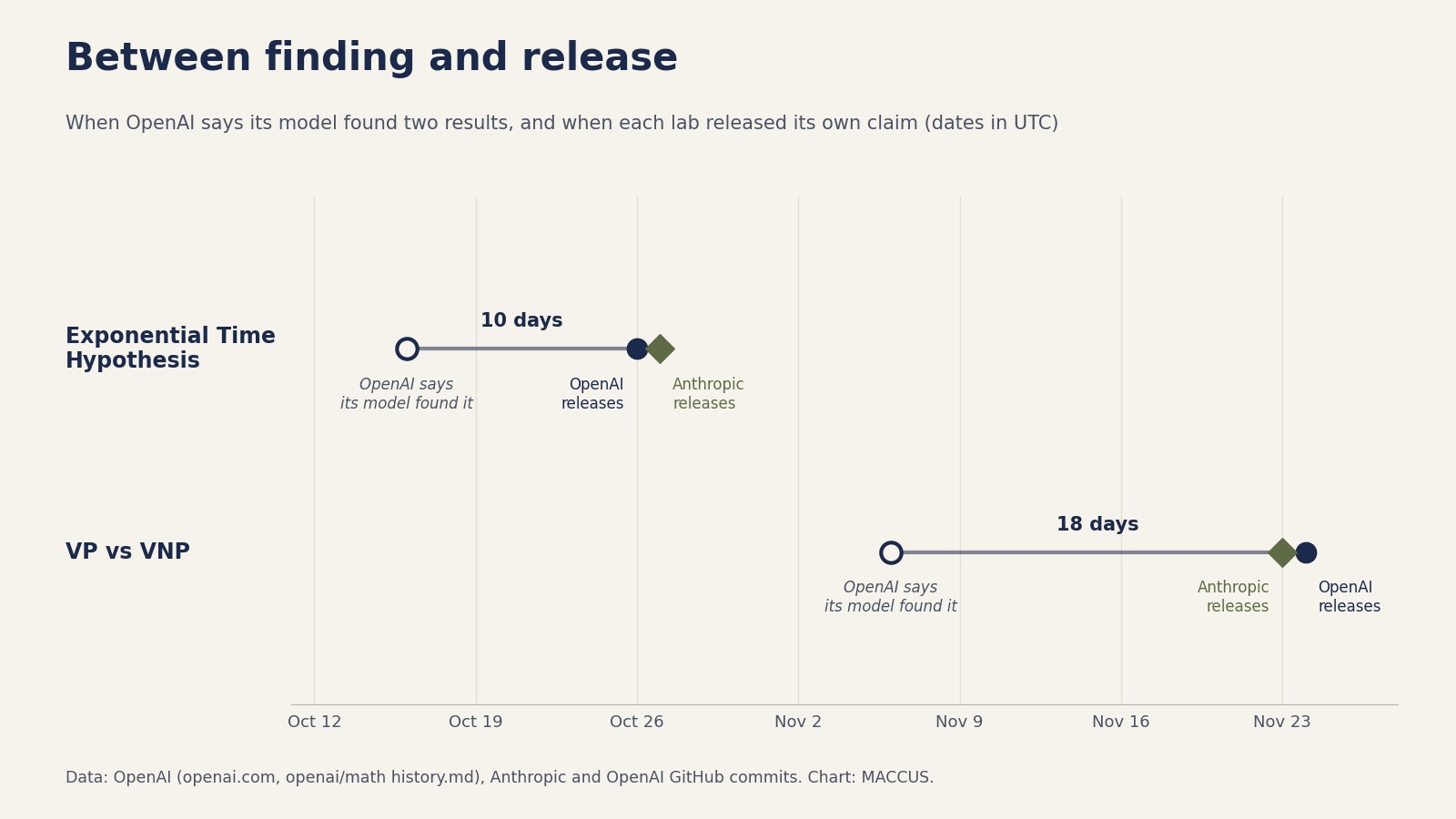
On November 23, 2026, Anthropic posted a claimed proof that two classes of polynomials, called VP and VNP, are different. The computer scientist Leslie Valiant made this conjecture in 1979. OpenAI posted its own claimed proof about four hours later. A note in OpenAI’s GitHub repository says its result was obtained on November 6, 17 days before Anthropic’s release.
Anthropic says no human mathematician has checked its proof, and OpenAI calls its manuscripts raw research data. Each proof comes with code in Lean, a programming language in which a computer checks every step of a proof. A day later, OpenAI posted nine more manuscripts, two of which, it says, include and extend its VP vs VNP results.
The 1979 conjecture behind both proofs
VP vs VNP is the algebraic version of P vs NP, which asks whether every problem whose answer is easy to check is also easy to solve. A proof that VP differs from VNP would not settle P vs NP.
VP vs VNP asks whether a formula called the permanent can be computed by a small circuit, a network of additions and multiplications called gates. The permanent turns a square grid of numbers into one number by adding up products of its entries. It looks like the determinant, a standard formula of linear algebra, without the minus signs.
Two folders on GitHub, four hours apart
Anthropic’s folder is in its public anthropics/formal-math repository on GitHub. The commit, or timestamped change, that added it is dated 8:04 p.m. UTC on November 23. It was merged into the main version at 9:43 p.m. The folder’s README says the result “was discovered by an internal research Claude model” and that “no human mathematician has checked the proof.” We covered Anthropic’s claim when it appeared.
OpenAI’s folder, VP and VNP are different, went into its openai/math repository with a commit dated 1:14 a.m. UTC on November 24, merged at 1:30 a.m. In Pacific time, both folders were merged on November 23, Anthropic’s at 1:43 p.m. and OpenAI’s at 5:30 p.m. The paper lists “OpenAI” as its only author.
The November 6 date comes from the repository’s history file, in an entry dated November 23: “VP and VNP are different. This result was obtained on November 6, 2026.” Anthropic has not said when its model found its proof. Neither lab has announced its result: as of early November 25, OpenAI’s news feed and Anthropic’s newsroom had not mentioned it.
Different bounds, similar methods
Each paper claims a lower bound, a minimum size for any circuit that computes the permanent of a square grid with n rows. Both hold in every number system except those where 1 + 1 equals 0, known as characteristic two. Anthropic’s bound grows like 2 raised to the power (log n)^(4/3). OpenAI’s November 23 paper gives 2 raised to the power (log n)^(5/4), which grows more slowly, so Anthropic’s was the stronger result that day.
A circuit counts as small if its size grows no faster than a fixed power of n, such as n squared. Both bounds outgrow every such power, so if either one holds, the permanent has no small circuit. Both stay far below the exponential 2^n, the size of the best known circuits.
Scott Aaronson, a computer scientist at the University of Texas at Austin, wrote on his blog, Shtetl-Optimized, that “from what little I understand so far, the proof techniques in the Anthropic and OpenAI papers look similar.” Both, he wrote, do some sort of compression of the problem and finish with a diagonalization, “the oldest trick in the book.” Diagonalization builds an object that differs from everything on a list.
OpenAI’s paper does not cite Anthropic’s VP vs VNP paper. It twice cites Anthropic’s earlier claimed algorithm for 3-SAT, a classic true-or-false logic puzzle, and adapts its “grid method” and “square scheme.” OpenAI’s README adds: “We defer to the math community completely on matters of credit, precedence, and concurrent work.”
Nine more manuscripts a day later
At 12:04 a.m. UTC on November 25, the afternoon of November 24 in Pacific time, OpenAI added nine more manuscripts to the same repository. Its history file says two of them “subsume the results of VP and VNP are different.” The file gives no discovery date for any of the nine.
One claims a bound of e raised to the power c(log n)^2/(log log n)^2 gates, which grows faster than either bound of November 23. It covers the permanent outside characteristic two, and the Hamiltonian cycle polynomial, a close relative of the permanent, in every number system. The other claims to prove that four classes in Valiant’s hierarchy, a ladder of classes running from small formulas up to VNP, are all different.
The same batch claims that the exponent of matrix multiplication is exactly 9/4. That number measures how fast large grids of numbers can be multiplied. Another manuscript claims to disprove the polynomial Hirsch conjecture, about the length of paths along the edges of polytopes, flat-sided shapes such as cubes.
The batch also gives what OpenAI calls an answer to Smale’s ninth problem, from the list of open questions the mathematician Stephen Smale drew up in 1998. It is a claimed algorithm that solves linear programs, a standard type of optimization problem, in strongly polynomial time: its number of steps is bounded by a polynomial in the number of variables and constraints, whatever the size of the numbers involved.
The second race in a month
On October 26, OpenAI released a claimed refutation of the Exponential Time Hypothesis, a 1999 assumption about how hard it is to solve 3-SAT. Its announcement said its model had found the disproof on October 16. OpenAI says an independent working group led by the computer scientists Russell Impagliazzo, Ramamohan Paturi and Ryan Williams will examine and explain the proof. Anthropic added its own, separate claimed refutation to its repository the next day, October 27 in UTC.
That month, three teams also posted proofs of the KLS conjecture in geometry, each crediting AI tools.
Andrew Curran wrote on X on November 24 that both labs “chose to simply dump it online with no comment.” He argued they are “sitting on a dragon’s hoard of scientific results they are not releasing to the public.” He quoted Jakub Pachocki, OpenAI’s chief scientist, from a November 22 post in which Pachocki proposed shared limits on AI development. Pachocki wrote that “seeing the resolutions to questions we’ve long thought about coming out of the model one after another in a single Slack thread felt deeply surreal.”
Two complexity theorists react
Lance Fortnow, a computer scientist at the Illinois Institute of Technology, wrote about Anthropic’s paper on November 24 on the blog Computational Complexity. “This is, for now, the most important computational complexity result of the year, which says a lot for 2026,” he wrote. He also wrote that “for now settling the P v NP question remains far out of reach for man or machine.” His post does not mention OpenAI’s proof.
Aaronson wrote that the Lean proofs certify the results “to a level considerably beyond what we’d normally demand for a math paper published in a journal.” After the two claimed refutations of the Exponential Time Hypothesis in October, he had lowered his confidence that P differs from NP from 97% to 95%. Asked by Daniel Harlow whether VP vs VNP changes that, he said he is “now back up to 96%.”
What has not been checked
No expert has published a line-by-line check of either VP vs VNP paper. Lean confirms that each proof establishes its statements as written in Lean, but not whether those statements say what the paper claims. Anthropic’s README warns: “Lean checks the proofs, but no machine checks that this file says what is claimed.”
OpenAI calls its manuscripts “raw research data, rather than polished academic papers” and writes that some results without Lean code “could have issues.” On October 7, it withdrew three manuscripts from the same repository after a sign error was found in one of them.
The November 6 date is OpenAI’s own statement, and the repository publishes no record that shows it. GitHub timestamps record uploads only. They cannot show when a proof was found. Neither lab names the specific model it used.
What it means
Valiant’s conjecture stood for 47 years. Then two labs posted claimed proofs about four hours apart, and one of them says it had its proof 17 days earlier. Historians of science call this multiple discovery. It has now happened twice in a month, which suggests that both labs’ most advanced models reach the same open problems at about the same time.
OpenAI’s discovery dates, set against the release dates in UTC, show a gap between finding a result and releasing it: 10 days for the Exponential Time Hypothesis and 18 days for VP vs VNP. Each lab decides when to publish, so the order of release says little about the order of discovery.
The slow step is now human review. Fortnow and Aaronson wrote about the proofs on November 24, but neither published a line-by-line check. The nine manuscripts of November 24, including the matrix multiplication and linear programming claims, have no public expert reading yet. The next signs to watch are specialists’ readings of those papers, an account from Anthropic of when its model found its proof, and the findings of the Impagliazzo, Paturi and Williams working group on the Exponential Time Hypothesis.
Sources
- VP and VNP are different, OpenAI, GitHub, November 23, 2026
- History, OpenAI, GitHub, November 24, 2026
- Circuit lower bounds for Hamiltonian cycle and the permanent, OpenAI, GitHub, November 24, 2026
- VP ≠ VNP over every field (README), Anthropic, GitHub, November 23, 2026
- Working with academic communities to build scientific understanding, OpenAI, October 26, 2026
- VP ≠ VNP, Computational Complexity (Lance Fortnow), November 24, 2026
- I’ve been drinking wine in my kitchen, Shtetl-Optimized (Scott Aaronson), November 24, 2026
- Perplexity and Intelligence, OpenAI (Jakub Pachocki), November 22, 2026