

On November 25, 2026, Scott Aaronson, a leading computer scientist at the University of Texas at Austin, reacted to OpenAI’s latest AI math papers. His blog post was titled “HOLY SHIT HOLY SHIT HOLY SHIT HOLY SHIT.” “I now feel in my bones, for the first time ever, that a proof of P ≠ NP is not far,” he wrote. P vs NP, the best-known open question in computer science, asks whether every problem whose answer is easy to check is also easy to solve.
The post followed two batches of AI math papers, 15 in two days by the labs’ own dates. OpenAI posted nine manuscripts dated November 24, from what its repository calls “an unnamed internal OpenAI model.” Google Research posted six papers dated November 25 that it says an AI system produced. They claim results on open problems, some decades old.
We mentioned OpenAI’s batch in passing in our piece on OpenAI’s claimed VP vs VNP proof. VP vs VNP is the algebraic version of P vs NP.
What Aaronson wrote
Aaronson opened the post on his blog, Shtetl-Optimized, by saying his earlier posts, podcasts and talks had “failed to do full justice to the magnitude of what’s now happening.” The night before, he and his dinner guests were still absorbing the rival claimed proofs of VP vs VNP from OpenAI and Anthropic. He also mentioned “the Alpöge/Anthropic proof of the Riemann Hypothesis.” He wrote that this claim we covered on November 21, about a famous prime-number problem, “already feels like last week’s news.”
“My working assumption by this point is that any proof that comes directly from OpenAI or Anthropic is correct barring information to the contrary,” he wrote. He pointed to the labs’ Lean certificates: proofs written in Lean, a programming language in which a computer checks every step.
The labs, he noted, “don’t even bother to issue press releases anymore, they just upload papers.” The past week, he wrote, is “very much like I would’ve always imagined the beginning of an AI singularity to look and feel like.”
The matrix claim and OpenAI’s other papers
The claim that set off the post concerns ω (omega), the exponent of matrix multiplication. It measures how the work of multiplying two square grids of numbers, called matrices, grows with their size. The school method needs about n³ multiplications for grids with n rows, an exponent of 3.
Aaronson traces the question to “the late 1960s, when Volker Strassen first showed that ω<3.” Each faster method, like his, sets an upper bound. A lower bound proves that no method can do better, and nobody had proven the exponent must be above 2.
OpenAI’s manuscript claims the exponent is exactly 9/4, or 2.25. According to Aaronson, the matching upper bound came from OpenAI’s release of October 6. No one claims a practical speed-up.
The paper’s README file says it “proves the matching lower bound for formal arithmetic circuits.” In that model, multiplying two grids takes at least half of n to the power 9/4 multiplications or divisions between computed values, with additions not counted.
“The even bigger shock is that the AI was able to prove any lower bound of the form ω>2,” Aaronson wrote. “I never expected this challenge to be all that much easier than P ≠ NP.”
A second manuscript makes the same kind of claim about the Fourier transform, a basic tool of signal processing. The Fast Fourier Transform, in use “since the 1960s” in Aaronson’s words, takes on the order of N log N steps for N numbers.
OpenAI’s paper claims the minimum number of binary linear gates, the basic steps of such a computation, is N(log N)^(1/2+o(1)). It gives upper and lower bounds, both checked in Lean, and Aaronson notes that the upper bound improves on the Fast Fourier Transform. “All these questions from the ancient days are now just getting … straight-up answered,” Aaronson wrote.
The batch also includes what OpenAI calls an answer to Smale’s ninth problem, from the mathematician Stephen Smale’s 1998 list of open problems. It is a claimed algorithm for linear programming, a standard optimization problem. Other manuscripts claim to prove the fixed-petal sunflower conjecture in combinatorics and to disprove the polynomial Hirsch conjecture. The Hirsch conjecture concerns path lengths along the edges of a polytope, a flat-sided shape.
Google’s AI system posts six papers in one day
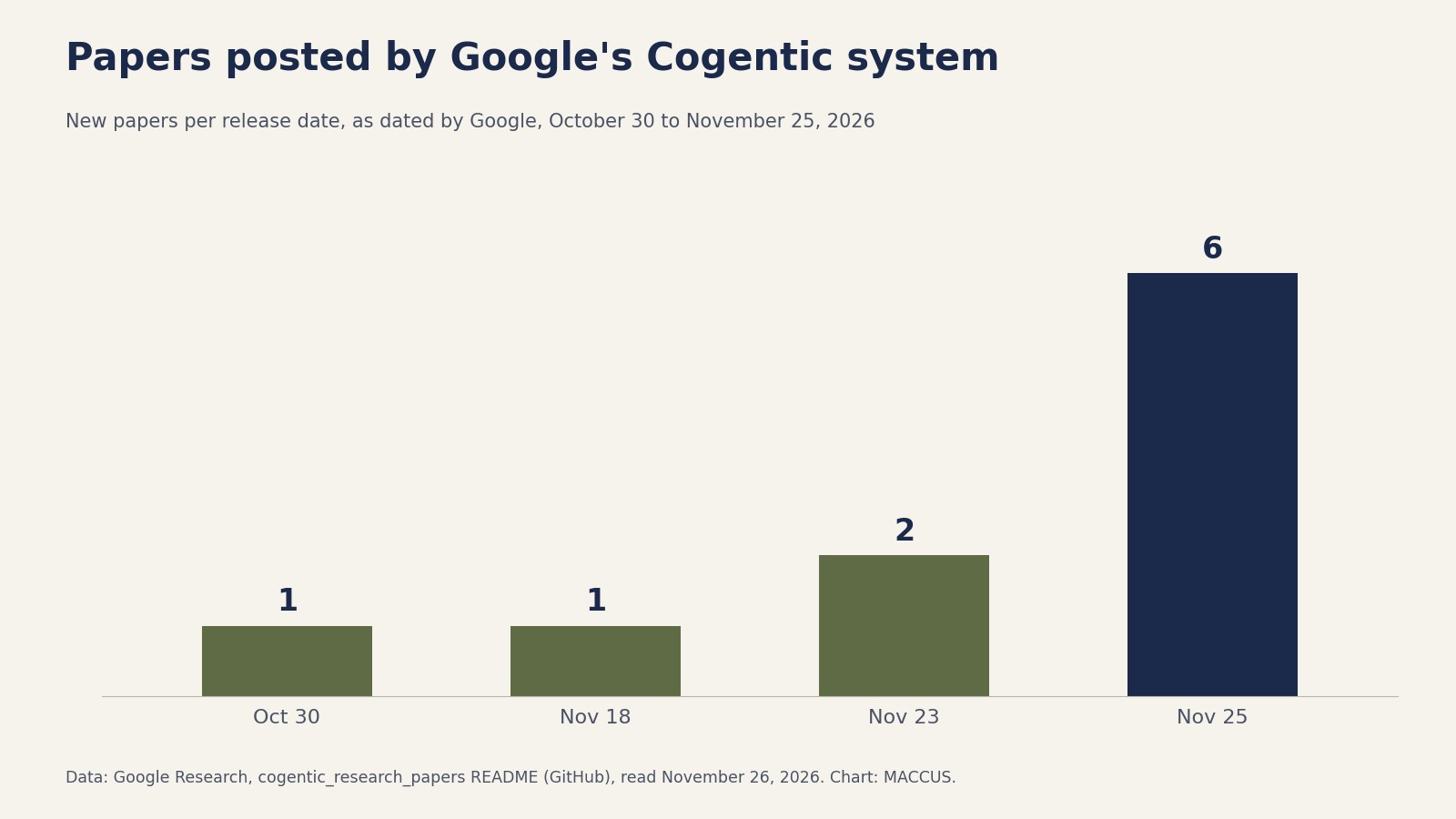
Google Research posted its batch on GitHub at 10:21 a.m. UTC on November 25, about ten hours after OpenAI’s. The six papers come from Cogentic, a system built by seven Google Research and Google DeepMind researchers. It splits a problem among many AI proof-writers and checks their work, as described in a September 30 paper.
Each README says the paper and its Lean proof “were entirely obtained by Cogentic,” using Google’s Gemini 4 model. It adds that “there was no human interaction other than the initial prompt.”
The papers cover integer factoring, discrete logarithms, Nash equilibria in two-player games, the log-rank conjecture and a 1964 graph conjecture by Frank Harary.
In a Nash equilibrium, no player gains by switching strategy alone. The game paper claims an algorithm that finds a 1/5-approximate equilibrium, against earlier bounds of 1/3 (2023) and about 0.31 (2026). Smaller is better.
The graph paper claims to settle Harary’s conjecture for every graph, or network of points and lines, with at least 1,000 times as many lines as points.
The Cogentic folder lists ten papers since October 30.
The factoring paper claims a proof that every integer can be factored, or split into primes, in the same speed class as the number field sieve. The sieve is the fastest practical method, but its speed rests on unproven assumptions. The paper says it improves on an older proven guarantee, “the rigorous L_N[1/2,1] bound of Lenstra and Pomerance (1992).”
Aaronson’s post names only OpenAI and Anthropic, but in the comments that afternoon a reader asked him about Google’s factoring papers. He replied that he saw “some big theoretical results on factoring algorithms like number field sieve,” but “nothing of practical relevance for cryptography.”
In the post, he wrote he is “virtually certain, from multiple reliable sources, that the AI labs are now sitting on one or more bombshells” in cryptography. He added he is “much, much less confident about the specific nature of those bombshells” and does not “wish to be responsible for spreading unverified rumors.” No lab has confirmed anything of the kind.
Earlier this month, in a separate project, Google DeepMind AI agents reran a published 1024-bit RSA attack. RSA is a common encryption method. The project’s authors say the work does not threaten 2048-bit keys.
What has not been checked
We found no published expert check of any of the 15 papers. Google’s September paper says each of the system’s first results “was independently verified by domain experts.” The six November 25 READMEs make no such statement. Aaronson wrote in a comment that the newest papers “did have quite readable introductions, but I haven’t yet made it far into any of them.”
OpenAI calls its manuscripts “a form of raw research data, rather than polished academic papers.” On October 7 it pulled three manuscripts after “a sign error” invalidated an argument.
OpenAI’s history file says it added “Lean formalizations of selected results from each manuscript,” and the company writes that “some of the unformalized results could have issues.” Some Lean proofs cover less than the paper claims: the matrix result is checked only for circuits without division, and the linear programming result only for rational inputs (fractions).
Google says complete Lean proofs of all six papers exist and “will be released in a companion submission,” but they were not public on November 26. Lean also checks only statements as written in Lean and would miss a mismatch with the paper’s claim.
Google’s proven factoring guarantee has a constant of 105, against about 1.92 for the sieve’s expected speed. The guarantee is far weaker than the sieve’s real-world speed, so nothing changes in practice, which matches Aaronson’s comment.
What it means
OpenAI and Google now release AI math papers in bulk. OpenAI opened its math repository on October 6 with 722 manuscripts, the “great Mathocalypse drop” Aaronson mentions, and it now lists 730. Google’s Cogentic went from one paper on October 30 to six on November 25.
This week’s batches differ in what they claim and in how Aaronson reads them. He had never expected the matrix lower bound to be “all that much easier than P ≠ NP.” He says Yupan Liu’s QIP(2) = PSPACE preprint would have ranked among the top complexity results of 2025, yet its use of AI “didn’t even raise an eyebrow.”
Human reading is now the bottleneck, and Aaronson says he has not read far into the newest papers. Lean proofs cover only part of OpenAI’s claims, and Google’s have not been released.
What to watch next: the release of Google’s Lean proofs, the first expert readings of the 9/4 lower bound, any lab statement on the cryptography rumors Aaronson reports, and whether either repository withdraws a paper, as OpenAI did in October.
Sources
- HOLY SHIT HOLY SHIT HOLY SHIT HOLY SHIT, Shtetl-Optimized (Scott Aaronson), November 25, 2026
- Readme, OpenAI, GitHub, November 24, 2026
- History, OpenAI, GitHub, November 24, 2026
- The matrix multiplication exponent is nine fourths, OpenAI, GitHub, November 24, 2026
- The logarithmic exponent of finite Fourier transforms, OpenAI, GitHub, November 24, 2026
- Cogentic Research Papers, Google Research, GitHub, November 25, 2026
- Unconditional Integer Factorization in Time L_N[1/3, O(1)], Google Research, GitHub, November 25, 2026
- Cogentic: Multi-Agent Orchestration for Automated Proof Discovery, arXiv (Yang Cai et al.), September 30, 2026