
Tenants in New York City’s roughly 1 million rent-stabilized apartments will keep paying the same rent when they renew a lease that starts between October 1, 2026, and September 30, 2027. On November 25, 2026, a judge in Manhattan upheld the Rent Guidelines Board’s order that set a 0% increase for one-year and two-year renewals. The board is the city panel that decides each year how much rents in these apartments may rise. The judge, Justice Brendan Lantry, sits on the New York State Supreme Court, the state’s trial-level court.
The ruling ends, for now, a lawsuit that seven landlords filed in July, arguing that the board ignored rising building costs. They also said the outcome was decided in advance by Mayor Zohran Mamdani, who had promised a rent freeze during his campaign. The judge found that the board had a rational basis, meaning a reasonable justification, for the freeze, according to amNY, which read the 20-page ruling. He also called the mayor’s campaign guarantee “reckless and irresponsible,” because the power to set stabilized rents belongs to the board alone.
What the freeze covers
On June 25, 2026, the nine-member board voted 7 to 1 for a 0% increase on both one-year and two-year leases. It was the first time the board had ever frozen two-year leases, amNY reported that night.
A tenant whose two-year renewal starts in the 12-month window keeps the same rent for both years. That lease ends between September 2028 and September 2029. The freeze took effect on October 1, while the case was still pending, HousingWire reported. If a tenant paid more than the new levels allow, the order says the extra “shall be fully credited against the next month’s rent.”
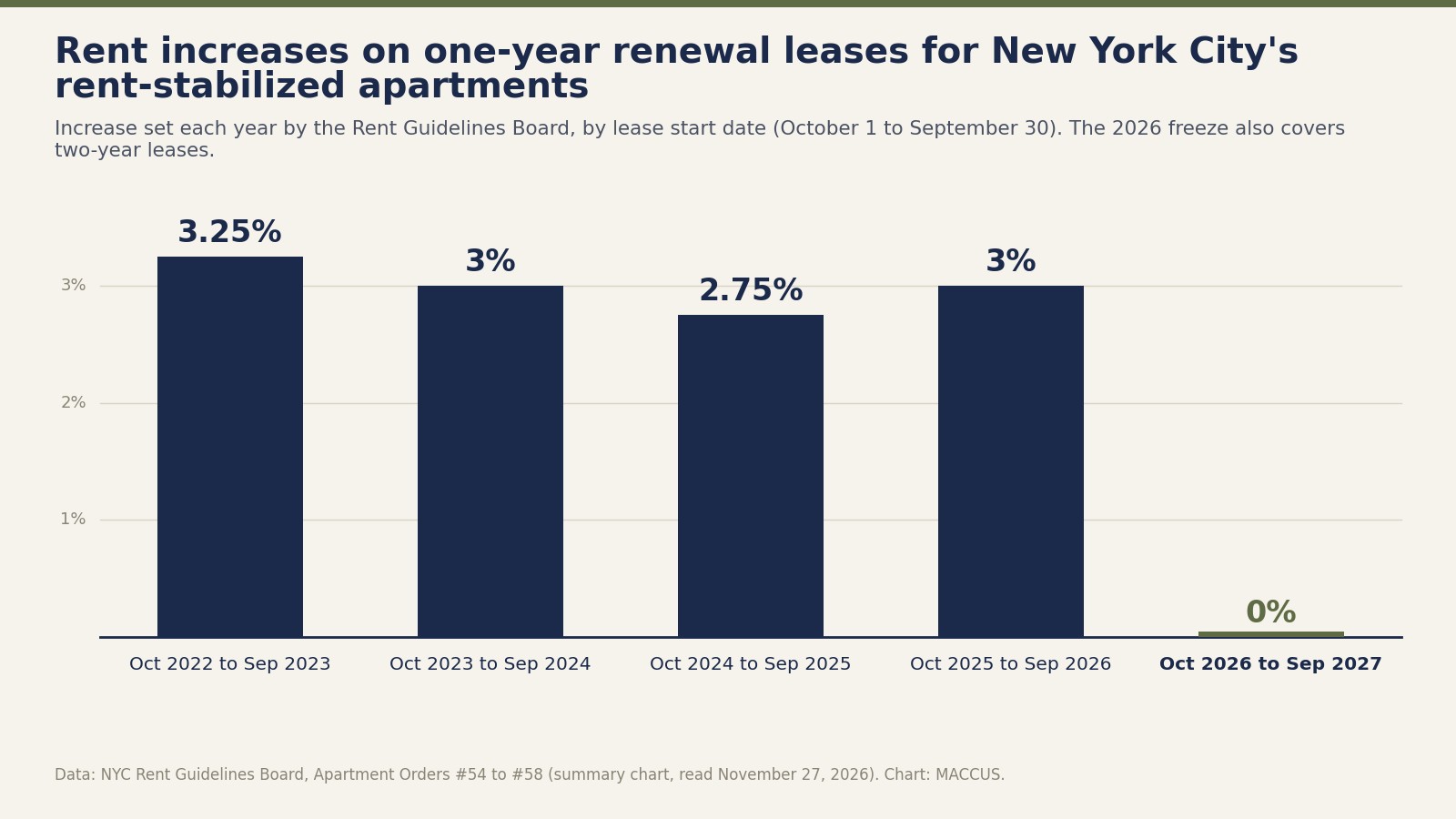
The freeze follows four years of increases. The board’s own summary shows one-year increases of 3.25% for leases starting in October 2022, then 3% in 2023, 2.75% in 2024 and 3% in 2025. The two-year increase for leases starting in 2025 was 4.5%. The board had frozen one-year leases before, for leases starting in 2015, 2016 and 2020.
The mayor’s office puts the number of people living in rent-stabilized apartments at “more than two million New Yorkers.” Apartments rented at market rates are outside the board’s orders and get no cap from this ruling.
Why seven landlords went to court
The seven landlords are companies that own or operate rent-stabilized buildings in Staten Island, Queens, the Bronx and Brooklyn, according to amNY. They sued on July 22, 2026. Their lawyer, Randy Mastro, was first deputy mayor under former Mayor Eric Adams.
The lawsuit said the board’s vote “was the result of a corrupted and compromised process,” with “an outcome wired and predetermined from inception.” It pointed to the mayor’s campaign promises and to his appointments.
In February, Mamdani named five new board members and reappointed a tenant representative. That gave his picks six of the nine seats, and all six voted for the freeze. A board member who represented owners resigned hours before the June vote, saying the result had been decided in advance.
The landlords also challenged how the board read its own numbers. Its index of operating costs found that building expenses rose 5.3%, with fuel up 11% and insurance up 10.5%. They asked the court to cancel the vote and keep the previous year’s increases, 3% for one-year leases and 4.5% for two-year leases, until a new vote. The judge denied that request.
The judge’s decision
Because the board acts much like a legislature, its orders stand if they have a rational basis, HousingWire reported. A judge may not replace the board’s judgment with his own.
Justice Lantry found that the board’s 42-page statement explaining its vote covered each factor the city’s code requires. Those include the condition of the real estate industry and the cost of living. He wrote that the freeze “has a rational basis and must therefore be upheld as valid,” 6sqft reported.
He also wrote that the freeze could have “detrimental impacts on the New York City residential real estate industry.” But the legal test, he said, is not whether a policy is wise.
On the board’s independence, the judge looked at about 1,000 documents the board handed over in late September, mostly screenshots of texts and emails. One email troubled him. Before the vote, the board’s chair had shared a draft of its statement with an aide to the deputy mayor for housing and planning.
“Such communication puts a dark shadow over the purported ‘independence’ of the Board,” he wrote. But without more evidence of a decision dictated by City Hall, “it does not rise to the level of an Article 78 violation,” he added. Article 78 is the New York procedure for challenging a government agency’s decision. He noted that the landlords never asked to question witnesses under oath, known as depositions, and agreed to end the exchange of documents.
On the appointments, he wrote that members sharing the mayor’s views did not prove collusion: “elections have consequences, a premise that is the backbone of our democracy.”
Lantry then turned to the mayor. The court “would be remiss not to state that such comments, promises, and guarantees to freeze the rent were reckless and irresponsible,” he wrote. He added that the mayor “has no authority to unilaterally raise, ‘freeze’ or otherwise adjust the rent of stabilized units in this City.” He called the mayor’s calls for a freeze “inconsequential to this proceeding.”
Landlords and tenants react
Mastro, the landlords’ lawyer, said the judge “deferred to the RGB’s ultimate decision,” meaning the board’s. He said the judge did so despite an “uncontroverted factual record” that the freeze “will have devastating consequences for small landlords.” He added: “Therefore, we are continuing to review the ruling and considering next steps,” The Real Deal reported.
The president of Small Property Owners of New York, a landlord group whose members include some of the plaintiffs, called the ruling “terribly disappointing.” In a statement, she added: “Property taxes, water and sewer rates, and insurance, energy, heating, repair and other costs and expenses aren’t frozen. Rents should not be frozen, either.”
Two legal aid groups, the Legal Aid Society and Legal Services NYC, represented two tenant groups in the case. They said the court “affirmed that the Board’s decision to pass a rent freeze earlier this year was lawful, rational, and well within its discretion.”
The mayor’s statement welcomed the ruling and said “more than two million New Yorkers can breathe a little easier.” It did not address the judge’s criticism.
The limits of the ruling
The landlords can still appeal the decision, The Real Deal noted. No appeal had been reported by the morning of November 27.
The freeze is also limited in time. It covers leases that start by September 30, 2027, and the board votes again every year. A tenant whose lease began before October 1, 2026, pays the rent set by that lease until it comes up for renewal.
The 0% is the board’s yearly guideline, and the order applies it “together with such further adjustments as may be authorized by law.” That means the 0% does not cancel increases that other rules allow.
The ruling only concerns New York City’s rent-stabilized stock, the apartments the city board regulates. State laws such as Vermont’s limits on how apps use children’s data or New York’s five-year ban on talking AI toys cover a whole state once they take effect.
Outside rent stabilization, tenants deal with their landlords under other rules. That was the case for a Raleigh, North Carolina, tenant who was evicted on November 19 even though an email had accepted a later payment date. She says the email came from her landlord’s AI tool.
What it means
For tenants, the practical result is 12 months of renewals with no increase, now backed by a court ruling. Supporters of the freeze point to the board’s finding that net operating income, the income left after operating costs, rose 6.2% in buildings with at least one rent-stabilized apartment, amNY reported.
The landlords say that figure is skewed by buildings with market-rate units and other income, amNY reported in July. In buildings where every apartment is rent-stabilized, the board found net operating income rose 2.4%, while the board’s cost index rose 5.3%. Their argument is that a freeze leaves older buildings less money for maintenance and repairs, as the Real Estate Board of New York, an industry group, said after the June vote. The judge himself acknowledged the possible harm to the industry.
In our reading, the freeze survived on narrow ground: the board explained its numbers in a 42-page statement, and the court only had to find that explanation rational. The judge also wrote that the mayor has no authority to set stabilized rents on his own. Next year’s vote, on leases starting from October 1, 2027, is therefore again the board’s alone. The landlords have not said whether they will appeal.
Sources
- Statement From Mayor Mamdani on Manhattan Judge Ruling to Uphold RGB’s Decision, NYC Office of the Mayor, November 25, 2026
- 2026-27 Apartment/Loft Order #58, NYC Rent Guidelines Board, June 25, 2026
- Mamdani’s rent freeze survives landlord lawsuit, but judge rebukes mayor over ‘reckless and irresponsible’ campaign promise, amNY, November 25, 2026
- Court upholds NYC rent freeze backed by Mayor Mamdani, HousingWire, November 25, 2026
- Judge upholds two-year rent freeze for NYC stabilized apartments, 6sqft, November 25, 2026
- Mamdani wins rent freeze suit, The Real Deal, November 25, 2026
- Landlords sue to put Mamdani’s rent freeze on ice, amNY, July 22, 2026
- Rent Guidelines Board votes to freeze the rent, fulfilling Mamdani campaign promise, amNY, June 25, 2026