
Employees of SK hynix, the South Korean memory chipmaker, accrued profit-sharing bonuses averaging about 230 million won (about $172,000) in the third quarter of 2026 alone, before tax. Two Korean newspapers, Chosunbiz and Maeil Shinmun, published that estimate on November 27, 2026, working from the company’s quarterly report and its bonus rule. None of it has been paid.
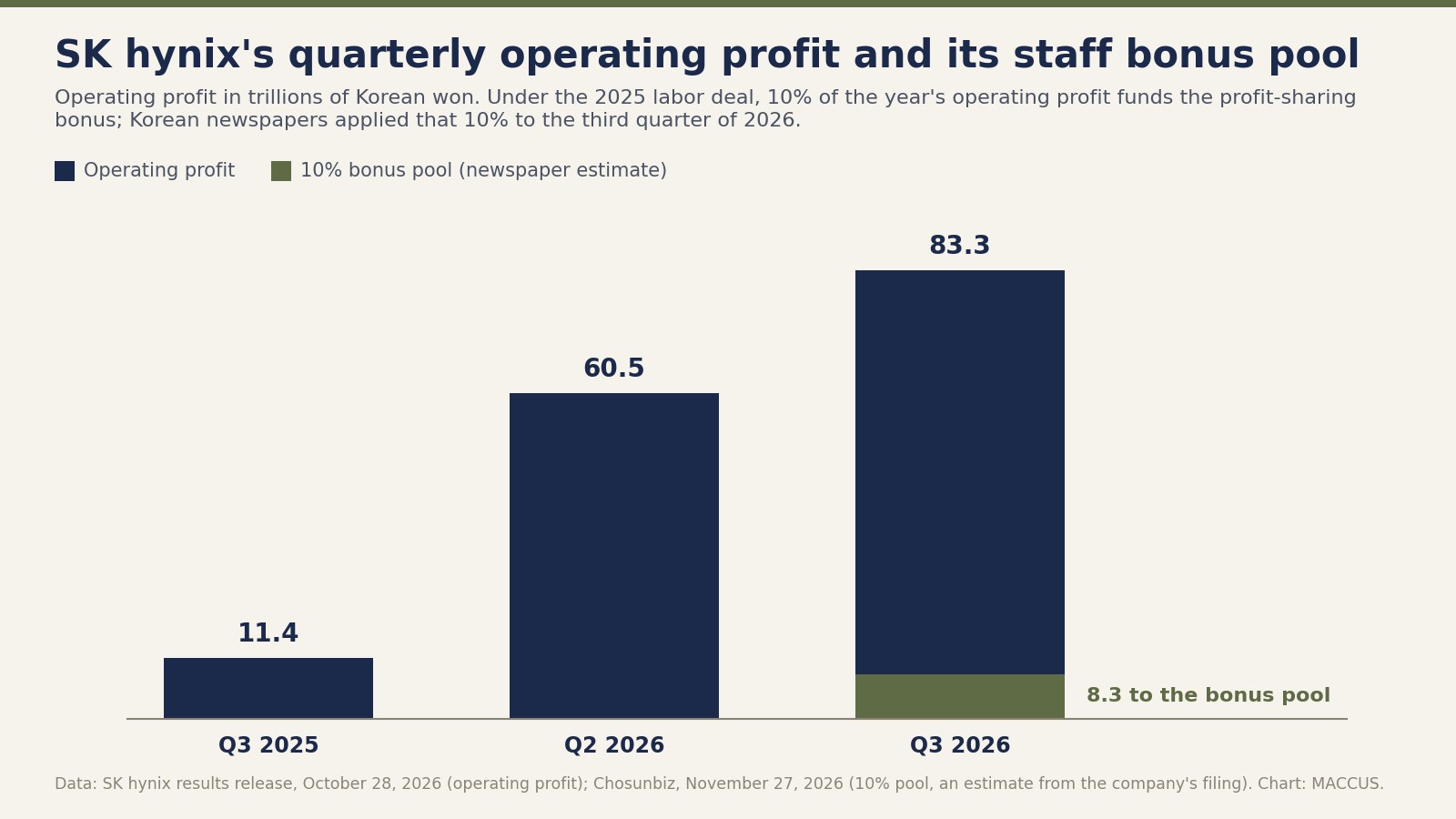
The rule sends 10% of SK hynix’s annual operating profit to a staff bonus pool. On October 28, the company reported 83.3 trillion won (about $62 billion) of operating profit for July to September, equal to 80% of its revenue. It said prices of key products had risen with demand for AI memory.
Under a labor agreement reached in September 2026, 80% of the 2026 pool will be paid in early 2027: 50% of the total in cash and 30% in shares. The last 20% comes in shares, 10% one year later and 10% two years later.
Through September, the bonus accrued per employee averaged about 502 million won (about $376,000). If full-year profit matches analysts’ forecasts, the average would reach about 785 million won (about $588,000), Chosunbiz calculated.
SK hynix makes DRAM, the working memory in servers, PCs and phones, and NAND flash chips for storage. Its HBM4 chips are high-bandwidth memory: stacked DRAM layers that sit beside the processors used to train and run AI models.
A 10% rule with no cap
Profit sharing gives SK hynix staff part of the year’s operating profit. In September 2025, management and the union set that part at 10% and dropped the old cap of 1,000% of base pay, both newspapers report. For the third quarter, 10% of 83.3 trillion won comes to about 8.3 trillion won (about $6.2 billion).
The quarterly report gives no headcount, and the papers divided the pool by the 36,150 people SK hynix employed at the end of June. That gives the 230 million won average. The third-quarter pool alone is 1.9 times the whole 2025 pool of about 4.5 trillion won, according to Maeil Shinmun.
Part of the bonus will be paid in shares. On October 28, SK hynix’s board approved a 20 trillion won buyback of its own shares. Half of those shares will be canceled, and the other half, about 10 trillion won, “will be used for employee compensation,” the company said. Neither the release nor the newspapers say whether any of it goes to the profit-sharing bonus.
Record results from AI memory
Third-quarter revenue reached 104.6 trillion won, up 328% from a year earlier. Revenue had never before passed 100 trillion won in a quarter. Operating profit was 83.3 trillion won, up from 11.4 trillion won a year earlier and 60.5 trillion won in the second quarter of 2026. The operating margin rose from 47% a year earlier to 76% in the second quarter and 80% in the third.
The results release places the jump in a market where “prices of key products have risen on the back of growing demand for AI memory,” and credits “the competitiveness of its high-value-added products.” Sales of DDR5 server memory rose sharply, and HBM4 shipments “began in earnest.” Sales of eSSD, the solid-state drives built for data centers, also grew.
SK hynix says long-term agreements with 14 major customers, including leading global cloud providers, cover more than half of its production capacity for 2027 and 2028. It expects demand for memory to exceed supply through 2030.
A forecast of falling prices from 2028
On November 27, TrendForce, a Taiwanese market research firm, published its forecast for conventional DRAM contract prices, the prices chipmakers negotiate with device and server makers. In its base case, price increases shrink through 2027 and prices may level off in the second half, then fall in 2028. Among the base-case factors, “consumer electronics manufacturers are facing mounting sales pressure and have limited capacity to absorb further price increases,” the firm wrote. In its pessimistic case, prices start falling in the fourth quarter of 2027.
TrendForce’s reasons include the US midterm elections, after which market participants expect a more cautious US policy on data center building. On November 3, US voters sided against data centers in 40 of 41 local ballot measures, by Ballotpedia’s unofficial count. The firm also cites power supply constraints, a problem visible in the Netherlands, where data centers used 5% of the country’s electricity in 2025.
Its list includes new US rules that restrict advanced AI chips for data centers that supply large amounts of computing to Chinese companies. The United States already bars exports of Nvidia’s Blackwell chips to China without a license.
On November 25, TrendForce had said that supplies of low-cost memory for PCs and smartphones had run out and that “device prices face upward pressure in 2027.”
Rival chipmakers and their staff
Samsung Electronics runs a separate bonus scheme. In May 2026, its management and union created a special bonus worth 10.5% of its chip division’s results, on top of an existing performance incentive. That division earned 106.5 trillion won of operating profit in the third quarter.
Chosunbiz puts that quarter’s pool at about 11.2 trillion won. It estimates about 200 million won (about $150,000) per employee in the memory business, and less in the division’s other units. Samsung plans to pay the whole special bonus in its own shares, after tax, once its shareholders’ meeting in March 2027 approves it.
At Micron, the US memory maker, the union in Taiwan had argued that the Samsung and SK hynix bonus systems widened the pay gap with Korean rivals. It had asked for a one-time cash bonus of about seven years of base pay, about $170,000 per employee on average by Bloomberg’s estimate. The Korean daily JoongAng Ilbo reported the union’s demands on September 11. That day, Micron said it would pay its Taiwan staff a cash bonus of 1 million Taiwan dollars each, plus stock.
What the estimate does not show
SK hynix did not publish the per-employee figures, and neither newspaper quotes the company about them. They are averages: the pool divided by the June headcount, before Korean income tax. Individual amounts vary.
The newspapers applied the 10% to group-wide operating profit, but the 2025 pool left out the profit of Solidigm, a storage subsidiary. The full-year projection assumes 2026 operating profit of 283.8 trillion won, the average of brokers’ forecasts compiled by FnGuide. The October 28 release called its figures preliminary and subject to audit.
SK hynix books each quarter’s share of the bonus in that year’s accounts, the papers explain. The part recorded as a liability stays on the books as unpaid wages until it is paid. Both newspapers estimate that line at about 15.8 trillion won (about $11.8 billion) at the end of September. The line also holds other pay owed, so it does not measure the pool alone.
The quarterly report, filed on November 16, leaves unpaid wages out of its tables of financial liabilities, and both papers call their figure an estimate. By our arithmetic, the nine-month average of 502 million won, multiplied by 36,150 employees, comes to about 18.1 trillion won. That is more than the 15.8 trillion won on that line, and neither paper says how the two fit.
What it means
The workers’ case rests on the rule their union negotiated in 2025 and on a comparison with shareholders. SK hynix plans about 100 trillion won of shareholder returns for 2026, with 30 trillion won or more in dividends and 60 trillion won or more in buybacks. Its third-quarter dividend of 14 trillion won is bigger than the quarter’s estimated pool of 8.3 trillion won, though half is a special payout from gains on its stake in Kioxia, a Japanese memory maker. The release credits the record to “the competitiveness of its high-value-added products” and also places it in a market where prices of key products rose with demand for AI memory.
Read from the buyers’ side, the bonus comes out of the quarter’s 80% operating margin, earned in a market where, the company says, prices of key products rose. TrendForce says device makers have little room left to absorb further increases, and sees upward pressure on phone and PC prices in 2027. No source links the bonus to any memory or device price, and the pool is a share of profit. The company credits server and data center memory, and its long-term contracts include leading global cloud providers.
Because the pool is a fixed 10% of operating profit, it moves with that profit. If TrendForce’s base case holds and contract prices fall in 2028, the pool could shrink without any change to the rule, on our reading. Samsung’s chip staff receive their shares after March 2027, and Micron’s Taiwan union cited the Korean gap in September.
Sources
- SK hynix Announces 3Q26 Financial Results, SK hynix, October 28, 2026
- SK하이닉스 직원들, 3분기에만 평균 2억3000만원 성과급 확보, Chosunbiz, November 27, 2026
- “난 마이너스인데…” SK하이닉스, 인당 7억여원 성과급 전망, Maeil Shinmun, November 27, 2026
- SK하이닉스 분기보고서 (2026.09), DART, Financial Supervisory Service, November 16, 2026
- Limited Demand Visibility and Growing Supply Chain Caution Heighten Risk of DRAM Contract Price Declines in 2028, Says TrendForce, TrendForce, November 27, 2026
- Cuts to Chinese CSP Demand Weigh on Price Outlook, Slowing Memory Industry Revenue Growth in 2027, Says TrendForce, TrendForce, November 25, 2026
- 신입급에도 1억4000만원 쏜다…역대급 실적에 돈 푸는 이 회사, JoongAng Ilbo, September 11, 2026