

Two Comet users in California sued Perplexity, the AI company behind the Comet browser, in federal court in San Francisco on November 27, 2026. Their complaint says the browser kept sending Perplexity the full web address, or URL, of every page they opened. This continued after they switched off the setting meant to keep Comet away from their browsing history.
According to the 27-page complaint, those addresses included search terms and other details in the URL. Each was sent with two identifiers, a “device-id” and a “visitor-id,” that let Perplexity tie the activity to a user and a device. The apparent purpose, the complaint says, was to pre-fill suggested prompts for Comet’s AI assistant, a side panel the plaintiffs say they did not open while browsing.
The proposed class action, filed by the law firm Edelson PC and signed by attorney Brandt Silverkorn, accuses Perplexity of violating the federal Wiretap Act and California privacy law. The plaintiffs’ lawyers write that “a reasonable person would find it highly offensive to be handed a labeled switch that was connected to nothing.” None of the claims has been tested in court. Perplexity had not answered the complaint as of November 28, and no public statement from the company could be found on the morning of November 29.
The browser and its “Comet Assistant” switch
Perplexity was founded in 2022 as an AI “answer engine,” a search tool that replies with written answers. The complaint says the company is “reportedly valued at approximately $30 billion.” Comet is built on Chromium, the open-source engine behind Google Chrome and Microsoft Edge. The complaint says Chromium alone sends Perplexity no record of where users go.
Perplexity released Comet in July 2025 to subscribers of its most expensive plan, then $200 a month, according to the news site PPC Land. It made the browser free for everyone on October 2, 2025. Its main feature is an AI assistant that opens in a side panel and can answer questions about a page, draft an email or shop for the user.
At the center of the case is a toggle named “Comet Assistant” in Comet’s Privacy and Security settings. Its description reads “Allow Comet to access your browser history, navigate the web, and interact with sites.” It is on by default. The complaint calls it the “Browsing History Access Setting,” or BHAS, and says it is “the only control Perplexity offers over Comet’s access to a user’s browsing history.”
Under the toggle, Perplexity prints three promises, the first two about where data goes. The first reads “Your data stays on your device by default.” The second reads “Comet sends data to Perplexity only when necessary to complete your request.” It adds that Comet “shares only the minimum data needed: the context of the current page for tasks like booking a restaurant.”
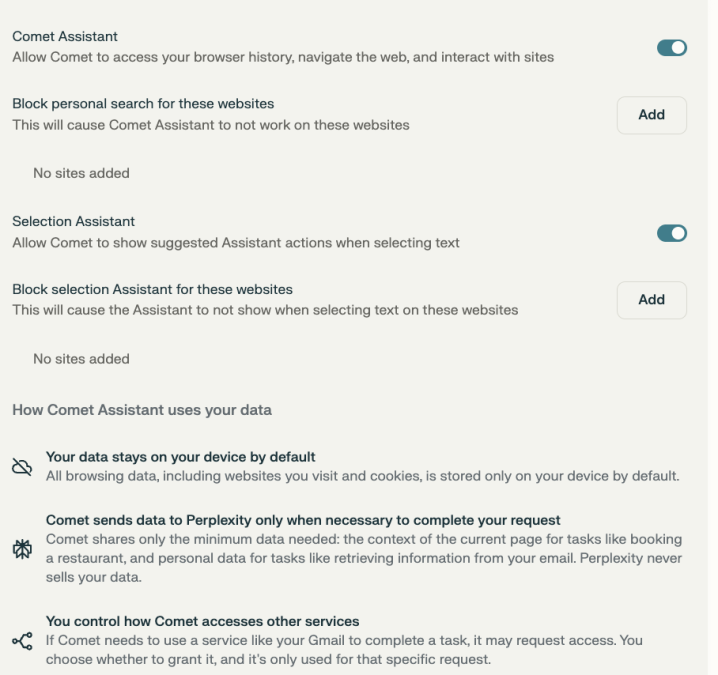
This toggle governs the assistant’s access to browsing history. AI training opt-outs are separate, and our opt-out guide lists them tool by tool, Perplexity included.
The browser extensions the complaint describes
The complaint describes at least three browser extensions, small add-on programs, that install automatically with Comet. One, which it calls the Orchestrator, starts when the browser opens and watches the active tab. When the user loads a new page in a tab where no assistant conversation has started, it passes the URL to a second extension, the Sidecar.
According to the complaint, the Sidecar sends that address to perplexity.ai/rest/autosuggest/list-autosuggest in a POST request, a standard way of sending data to a server. The request goes out alongside the user’s own request to the website, “before the requested page has finished loading.” Once the user opens the assistant in a tab and starts a conversation, the sending stops for that tab.
The suit’s central claim is that the off switch does not break this chain. “Even with the BHAS switched off and the AI Assistant never opened,” the complaint says, Comet “continues to transmit the full-string URL and embedded data of every page the user visits to Perplexity’s servers.”
The complaint argues that full addresses “routinely reveal the medical conditions a person is researching, the financial products a person is shopping for, the political and religious content a person reads, and the legal problems a person is trying to solve.” The plaintiffs say they kept using Comet with the setting off for online banking and for medical and legal research, often reaching pages through searches.
Wiretap claims and a $5,000-per-violation demand
The suit seeks to represent everyone in the United States who turned the setting off and then browsed with Comet without opening the assistant, plus a California subclass. It gives no count, saying only that “Defendant has many thousands of Comet users who fall within the definitions of the Classes.” Its only total is more than $5 million at stake, a threshold for class actions in federal court.
The federal claim rests on the Electronic Communications Privacy Act, which extended the Wiretap Act to electronic communications. The lawyers argue that a full URL is the content of a user’s exchange with a website rather than a simple address. They add that Perplexity was not a party to that exchange.
Four more claims rest on California law. Two invoke the California Invasion of Privacy Act, a state eavesdropping law, under which the plaintiffs seek $5,000 per violation for the California subclass.
The plaintiffs ask the court to order Perplexity to stop sending browsing data from users who turned the setting off and “to delete the data unlawfully collected.” They also seek damages, any profits Perplexity made from the conduct, punitive damages and a jury trial. A consumer case filed in Germany the same week took another route: the German suit over canceling ChatGPT asks only for an injunction, a court order to stop a practice, and claims no damages.
Magistrate Judge Joseph C. Spero is assigned to the case, according to PPC Land, which reported the suit on November 28.
What the complaint does not show
As PPC Land pointed out, the filing does not explain how the plaintiffs’ lawyers observed the transmissions, or name the Comet versions and operating systems they examined. It does not say what Perplexity does with the addresses or how long it keeps them. It says the data “can be used to build profiles, to train and tune models,” but does not allege that Perplexity did either.
The complaint itself links the transmissions to a product feature: ready-made prompts such as “Summarize this article.” In an October 31, 2025, blog post on Comet’s privacy controls, Perplexity wrote that “When the Comet Assistant takes actions on your behalf, it needs context from your browsing history to be helpful.” It added that when a user asks the assistant a question, “some data, such as your currently open tab and relevant browsing history, will be transferred to Perplexity.”
The complaint also cites Perplexity’s chief business officer, unnamed in the filing, as saying Comet users can browse normally with the assistant disabled. It calls that picture “misleading at best” but gives no date or place for the remark.
Comet has been in court before: Amazon sued Perplexity in November 2025 over Comet’s shopping agent. On August 4, 2026, the U.S. Court of Appeals for the Ninth Circuit vacated a preliminary injunction, the pretrial order Amazon had won against the agent. The court concluded that “the user (not Perplexity) accesses Amazon using the Assistant as an AI tool.” Perplexity itself is also named, though not sued, in the New York Times case against Brave, which says the search company sold scraped articles to AI firms.
What it means
The plaintiffs argue that an address sent while the assistant panel is closed completes no request and so breaks the promise under the toggle. Their complaint calls a switch that does not stop the sending “worse than offering no privacy control at all.” It names a fix Perplexity could have used: sending page information “only when a user opens the AI Assistant side panel.” The complaint itself concedes that the requests appear meant to prepare suggestions for the assistant.
On the other side of the argument, Comet is an AI browser whose assistant reads pages by design. The suit alleges no use of the data beyond its collection, counts no affected users beyond “many thousands” and does not say how the requests were captured. Perplexity’s own 2025 post said the assistant needs browsing context, and in the Amazon case an appeals court treated Comet’s agent as the user’s tool at the preliminary-injunction stage. That reading still has to deal with Perplexity’s settings panel, which says data leaves the device only to complete a request.
The next filing to watch is Perplexity’s first response in court, an answer or a motion to dismiss asking the judge to throw out the case. Perplexity may dispute that the requests are sent at all or say the toggle was never meant to cover them. It may also argue that a web address is not the content of a communication under the Wiretap Act. Any change to Comet’s autosuggest requests or to the wording under the toggle is the other thing to watch.
Sources
- Class Action Complaint, Case No. 3:26-cv-14933 (Document 1), U.S. District Court for the Northern District of California, November 27, 2026
- Perplexity faces lawsuit claiming its browser tracked users who opted out, PPC Land, November 28, 2026
- Introducing Privacy Snapshot, Perplexity, October 31, 2025
- Amazon.com Services, LLC v. Perplexity AI, Inc., No. 26-1444, opinion, U.S. Court of Appeals for the Ninth Circuit, August 4, 2026