
Since October 21, 2026, users of Claude Opus 5.5 have reported that Anthropic’s model cuts off their reverse-engineering requests partway through: analyzing a TV’s firmware, decompiling a game, working out how a program behaves without its source code. On October 23, Decrypt published a case one of its own reporters ran into, warning message included. The next day, Kotaku rounded up the complaints posted on Reddit.
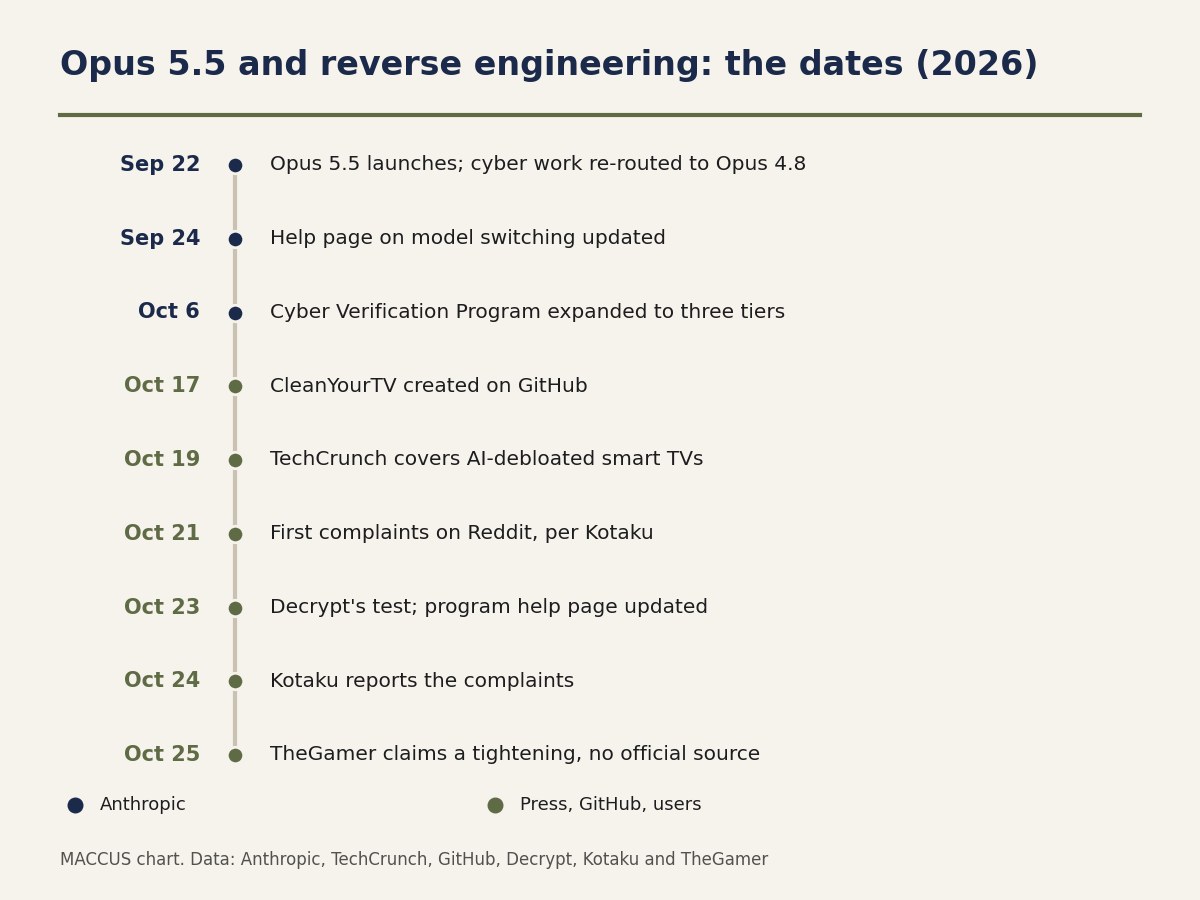
Anthropic has made no statement about the blocks. Since Opus 5.5 launched on September 22, though, the company’s own pages have described a cybersecurity filter that sends “most cybersecurity tasks” to an older model, Claude Opus 4.8. On October 6, Anthropic called its cyber safeguards “conservative.”
From smart TVs to video games, a tinkering craze
On October 19, TechCrunch described smart TV owners handing their sets to Claude Code, Anthropic’s coding agent, to strip out ads and preinstalled apps. The open-source project CleanYourTV grew out of exactly that. In a post quoted by TechCrunch, its author describes giving Claude Code their parents’ TV: the agent removed 25 Xiaomi software packages and wrote a new launcher. The project, which works without rooting the TV, was created on GitHub on October 17 and had more than 35,000 stars by October 26.
Several complaints target a tool called REA, short for “Reverse Engineer Anything.” The MIT-licensed open-source project hooks an AI agent up to binary analysis tools such as Ghidra and IDA, and it had about 385,000 GitHub stars on October 26. The trend has reached video games too: decompilation, which used to keep teams of enthusiasts busy for years, now moves so fast that the community site decomp.dev announced on October 15 that it is winding down.
The case Decrypt documented
Jose Antonio Lanz, a reporter at Decrypt, wanted to install Free My TV, an open-source home screen for LG TVs running webOS. Claude reviewed the install script and judged it clean, then had him switch on LG’s Developer Mode. That wiped the partition holding the tools from the root access he had gained in 2023, including an unofficial app store and an ad-free version of YouTube.
The agent had spotted signs of that root access in its very first network scan. “This was my fault,” it admitted, before reinstalling both apps.
Restoring root meant exploiting a different flaw, since LG had patched the 2023 one in April 2024. When Claude researched the one remaining method, a warning appeared: “Opus 5.5’s safeguards flagged this message. Switch to Opus 4.8 and keep going whenever this happens?” According to Decrypt, Opus 4.8 got further before it, too, was stopped when it went to download a package named “root.” The new home screen did install, but without root it has to be launched by hand.
Kotaku and TheGamer pick up the complaints
Kotaku traces the complaints to a Reddit thread posted on October 21 whose title accuses Anthropic of secretly killing off REA. Several people in the thread describe a safeguard that kicks in mid-sentence. In one example Kotaku cites, Claude says a safety check stopped its response partway through and that it cannot produce that write-up again, “even reworded.”
According to Kotaku, a minority of commenters counter that these requests have always been hit or miss because the classifier is “really twitchy.” Kotaku notes that Anthropic has not announced or shipped a new version of Opus 5.5, but that the company did unveil a batch of updates to several Claude-related products on October 21, the same day the first complaints appeared.
On October 25, TheGamer went further, writing that Anthropic had updated its cybersecurity classifiers to block decompilation through REA, with a Reddit post as its only cited source. The same day, a Reddit user reported that Opus 5.5 had refused to analyze a smart light switch its manufacturer had abandoned, while Opus 4.8 went ahead.
The filter Anthropic describes
In its September 22 announcement, Anthropic wrote that Opus 5.5 users “will be able to identify and fix bugs in their code,” but that “most cybersecurity tasks will be re-routed to Opus 4.8,” its previous-generation Opus model.
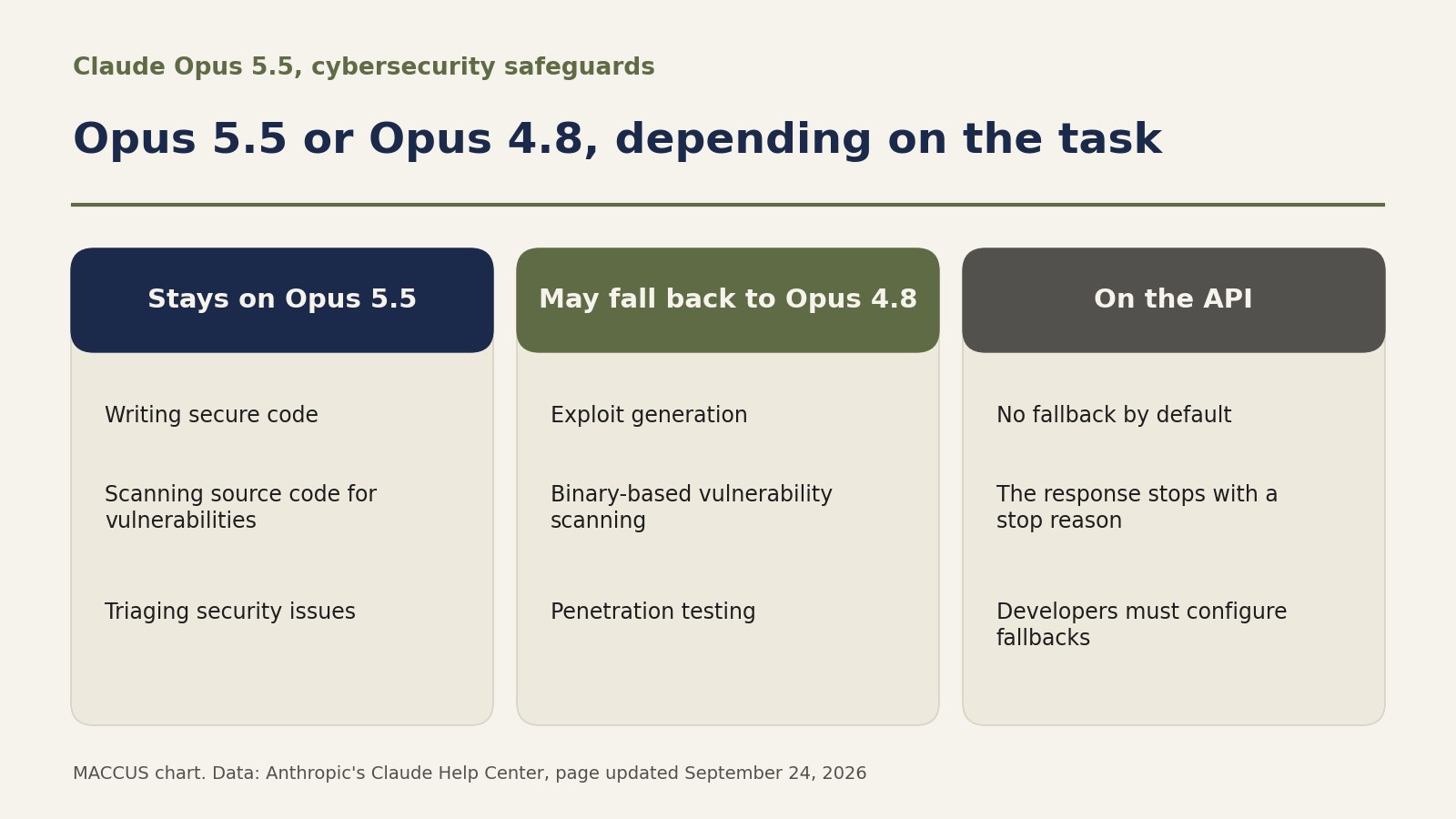
Anthropic’s help page on model switching, last updated September 24, says automated classifiers check every request, along with everything the model reads: memory, content from connectors, web search results and files. A block can therefore come from content the user never typed. Among the requests that may fall back to Opus 4.8, the page lists exploit generation, binary-based vulnerability scanning and penetration testing. Writing secure code and scanning source code for vulnerabilities still work on Opus 5.5.
According to the same page, switching to Opus 4.8 is on by default in the Claude apps and in Claude Code, with an on-screen notice. On the API, it is off: until a developer configures fallbacks, the model returns an HTTP 200 response with a stop reason. A request blocked midstream is still billed, with the input tokens and the tokens already generated charged at the rates of the model that produced them.
On October 6, when it expanded its Cyber Verification Program, Anthropic wrote that its generally available models, Opus 5.5 among them, “have conservative cyber safeguards that block most cyber work.” The program has three tiers. The first, Defense Access, covers “reverse-engineering malware,” among other things; it is the only tier open to individual applicants, such as researchers with a track record of reported vulnerabilities, and it requires a paid plan. Red Team Access, which covers penetration testing, is limited to organizations.
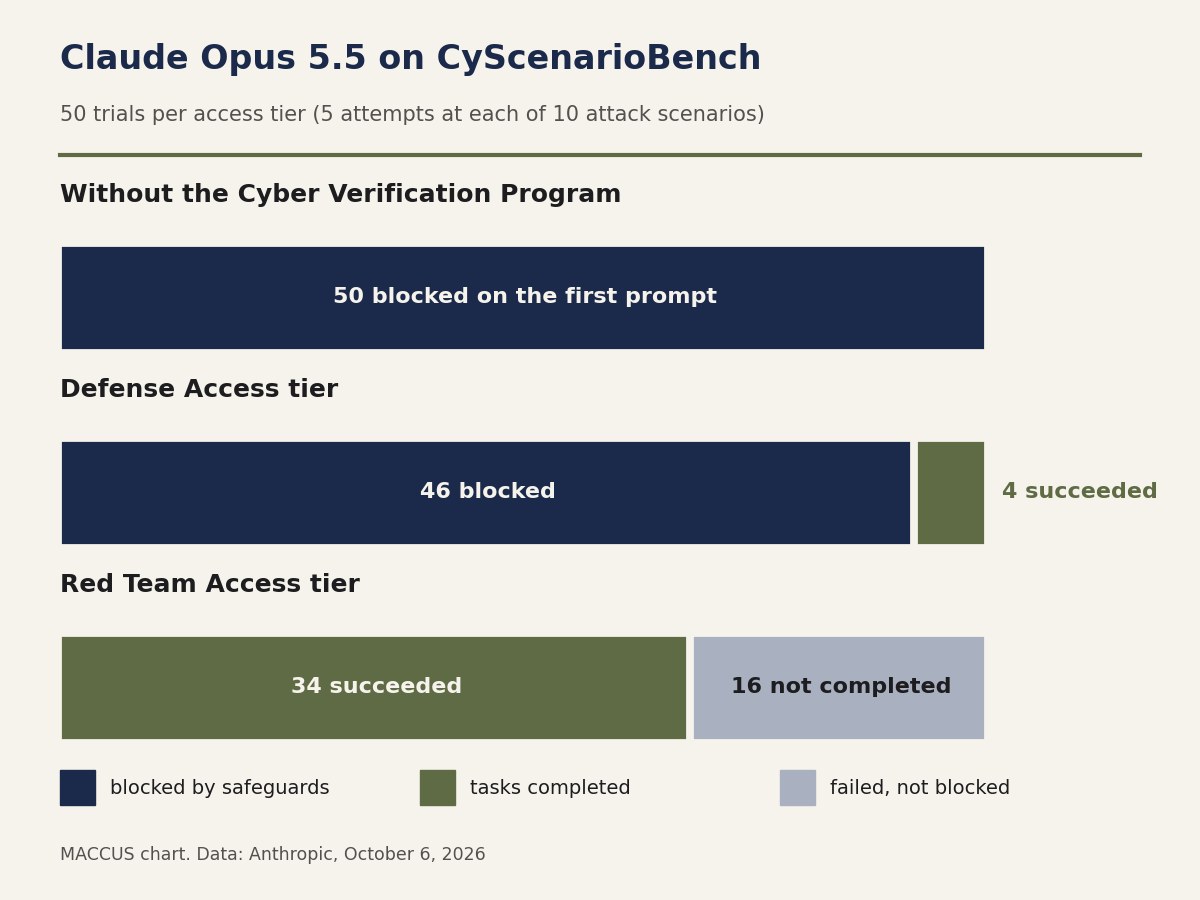
Anthropic ran Opus 5.5 through CyScenarioBench, a benchmark from the security firm Irregular, with five attempts at each of 10 multi-stage attack scenarios. Without the program, the company says, every task was blocked on the first prompt. In the Defense Access tier, 46 of 50 trials were blocked at some point; in the Red Team Access tier, none were, and Opus 5.5 completed 34 of the 50 tasks.
The limits of the evidence
Users describe a quiet tightening around October 21. Public sources can neither confirm nor rule it out. The help page on model switching has not changed since September 24, before the first complaints. The Cyber Verification Program page, updated on October 23, mentions no change to the filters.
Refusals also predate October 21. On October 19, TechCrunch noted that some users had to rephrase their requests because Claude “wouldn’t respond” to a simple “hack my TV.”
Anthropic also says it keeps fine-tuning its classifiers to reduce false positives, factoring in “a range of account trust signals.” The filter’s behavior can therefore shift without a new model version and vary from one account to another, which makes it hard to compare one user’s results with another’s.
Decrypt’s case, the best documented, involves exploiting a flaw, which is close to the “exploit generation” category in Anthropic’s documentation. Restoring root on the TV meant using a known vulnerability, whereas CleanYourTV works without root.
What it means
Within a few months, agent-assisted reverse engineering has gone from specialist work to a mainstream hobby, driven by projects that together have hundreds of thousands of GitHub stars. That crowd is running into a rule that has not changed on paper since September 22, enforced by a filter the company itself presents as deliberately broad. Anthropic says these safeguards are similar to Fable 5.1’s; on October 23, it estimated that Fable 5’s safeguards would have blocked the actions of Claude Mythos 5 during a cybersecurity test in real-world conditions.
The documented line runs between source code and binaries. Scanning available source code for flaws stays within Opus 5.5’s scope; hunting for them in a compiled program or in firmware is among the requests that may fall back. Common professional tasks sit close to that line: maintaining business software whose vendor is gone, getting two systems to talk to each other, reusing hardware its manufacturer has abandoned.
In the EU, Article 6 of Directive 2009/24/EC on the legal protection of computer programs allows decompilation without the rights holder’s authorization, under certain conditions, when it is indispensable to make an independently created program interoperable with other programs. Anthropic’s documentation does not frame the question that way. It sorts requests by type of task, and beyond a feedback button, the only recourse it offers for blocked work with a legitimate defensive purpose is its verification program, which is built for security professionals. The fallback model is no guarantee either: Opus 4.8 has its own safeguards, as Decrypt’s test showed.
Two questions remain open: whether thresholds were adjusted around October 21, and how much weight account trust signals carry. An update to Anthropic’s help page, or a statement from the company, will show whether the filter was tightened or simply found a much larger audience.
Sources
- Why Claude switched models in your conversation with Opus 5 or Opus 5.5, Anthropic (Claude Help Center), updated September 24, 2026
- Introducing Claude Opus 5.5, Anthropic, September 22, 2026
- Expanding the Cyber Verification Program, Anthropic, October 6, 2026
- How I Vibe Coded My Smart TV, And Claude Killed It, Decrypt, October 23, 2026
- Claude’s Reverse Engineering Capabilities Used To Recompile Games May Have Been Quietly Nerfed, Kotaku, October 24, 2026
- People are using AI to make their smart TVs dumb again, TechCrunch, October 19, 2026
- New Update Makes It Way Harder To Churn Out Browser Ports And Recomps, TheGamer, October 25, 2026
- Directive 2009/24/EC on the legal protection of computer programs, European Parliament and Council of the European Union, April 23, 2009
Header image: MACCUS chart, data from Anthropic’s Claude Help Center (September 24, 2026)