

On November 26, 2026, Ahrefs, a search-marketing software company, published a three-month update on what Google’s AI Overviews have done to clicks in France. AI Overviews are the AI-written answers Google places above the usual list of links (how AI Overviews and AI Mode work). Across 31,612 French keywords, or search terms, Ahrefs estimated that searches showing an AI Overview lost 24.4% of their click-through rate (CTR), measured against the trend of searches without one. CTR is the share of people who see a result and click on it.
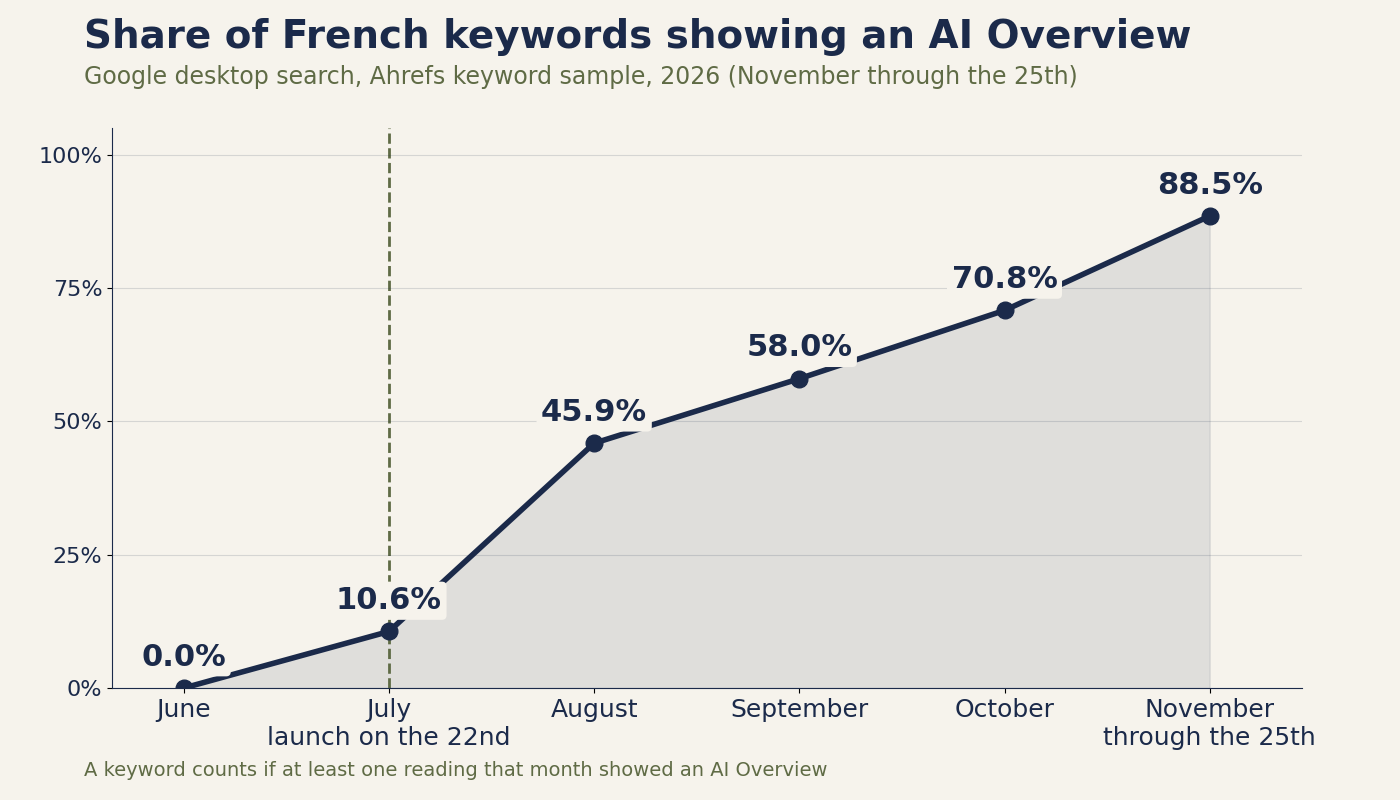
Google launched AI Overviews in France on July 22, 2026, after a global rollout that began in May 2024. AI Mode, its chat-style search mode, launched in France the same day. From November 1 to 25, 88.5% of the French keywords Ahrefs tracks in desktop search showed an AI Overview at least once.
A second study points elsewhere. On November 26, the French tech news site Siècle Digital reported a study by Wysistat, a French audience-measurement firm, covering 168 French news outlets. By its count, AI Overviews explain only 11% of the traffic lost by the outlets in decline.
A 22.4% drop that Ahrefs counts as 24.4%
Juliette Begue, Ahrefs’ marketing manager for France, wrote the study, with data scientist Xibeijia Guan as a contributor. It compares CTR in June 2026, before the launch, with October 2026.
Ahrefs split the keywords into two groups: those that showed an AI Overview and those that did not. The second group was the control, standing in for what would have happened without the AI answers. Its average CTR rose 2.6% between June and October.
For keywords that went on to show an AI Overview, average CTR fell from 2.53% in June to 1.964% in October, a relative drop of 22.4%. Ahrefs calculates that if they had followed the control group’s trend, their CTR would have reached about 2.596%. The actual 1.964% is about 24.4% below that expected level, the study’s headline figure.
Ahrefs argues that this 25-point gap, a 2.6% rise against a 22.4% fall, rules out a seasonal effect, since both groups covered the same market over the same months.
Nearly nine in ten tracked keywords showed an AI Overview in November
In Google’s desktop search, the share of Ahrefs’ French keywords with an AI Overview rose from 0% in June to 10.6% in July and 45.9% in August. It then reached 58.0% in September, 70.8% in October and 88.5% through November 25. August brought the largest jump, 35.4 percentage points.
A keyword counts for a month if one check that month found an AI Overview.
Even the top result and purchase searches lose a fifth of their CTR
Ahrefs also broke down the June-to-September loss by ranking position, meaning a link’s place in the list of results. On searches with an AI Overview, each of the first seven positions lost more than 20% of its CTR. The top result went from 11.06% to 8.69%, an observed drop of 21.4%.
From the gain of keywords without an AI Overview, Ahrefs estimates that the top result would otherwise have reached a CTR of 11.78% in September, which puts its net loss at 26.2%.
Position 5 stands out, with an observed drop of 48.9%, against 21.4% to 29.1% for the other six. Blog du Modérateur, a French news site on digital marketing, noted that Ahrefs does not comment on the gap.
Ahrefs also sorted searches by intent, meaning what the searcher is after. Without an AI Overview, CTR rose by 1% to 3%, from commercial searches, where people compare products, to transactional ones, where they are ready to buy. With an AI Overview, searches for an answer (informational) and for a specific site (navigational) lost about 25% net. Commercial and transactional searches lost about 20%.
In August, Ahrefs had written that intent mattered more than a site’s industry. It now says intent softens the loss by 4 to 5 percentage points but does not prevent it. “A transactional query that triggers an AI Overview still loses a fifth of its CTR,” the study says.
Ahrefs’ first study, in August
Ahrefs’ first look, published August 18, 2026, tracked 963 websites through Google Search Console, a free Google tool that shows site owners their own search clicks, comparing 28 days before the launch with 9 days after.
In those nine days, the sites studied lost 3.4% of their CTR. The most exposed sites, those with an AI Overview on more than 20% of their searches, saw their median CTR fall 23.1%. In November, Ahrefs wrote that the scope had changed but the size of the loss had held, at about a quarter.
A study of news sites points to Google Discover
Wysistat looked at where declining news outlets lost their traffic. Siècle Digital says AI Overviews account for only 11% of that loss. About a third came from lost visibility on Google Discover, the personalized feed of articles Google shows mainly on phones. About a fifth came from changes in regular search outside AI Overviews.
Blog du Modérateur, citing the same study, puts the Discover share at 34% and the search share at 21%, for January to November 2026. Neither Siècle Digital nor Blog du Modérateur says what accounts for the rest of the decline. Of the 168 outlets, 53.6% lost more than 10% of their traffic in 2026, 27.4% grew by more than 10% and 19% held roughly stable.
Siècle Digital says Discover traffic fell in two steps: first in the spring, then in what it calls a “purge” on November 4. In Wysistat’s figures, the median drop in Discover traffic was 27.1% on May 25 and 40.1% after that purge.
On October 29, five French publishing trade groups (CPA, FNPS, GESTE, SEPM and Spiil) filed a complaint against Google with the European Commission over AI Overviews and AI Mode.
A modeled figure and an unnamed data source
Blog du Modérateur’s Matthieu Eugène pointed out that the 24.4% net figure comes from a model rather than a direct measurement. It assumes that both groups of keywords would have moved in step without the AI answers, which he notes the study does not document.
Ahrefs does not say where its CTR figures come from. They could be Search Console data from its customers’ sites, a clickstream panel (a group of users whose browsing is tracked) or another source. Only the coverage chart is labeled desktop, so it is unclear whether CTR covers desktop, mobile or both. The study gives neither the number of sites behind the 31,612 keywords nor their sectors.
The position breakdown stops in September, while the headline figure runs to October. Blog du Modérateur noted that counting a keyword once a month shows how many searches are affected rather than how often an AI answer appears. Ahrefs flags one weak spot itself. Its navigational figure, a 25.3% loss, rests on a small number of compared keywords, and Ahrefs draws no conclusion from it.
The study also promotes Ahrefs’ own product, a filter in its Site Explorer tool that lists the searches showing an AI Overview. Its rule of thumb applies a 25% CTR loss to the share of a site’s unpaid search traffic that comes from those searches. A site that gets 40% of that traffic from them would lose about 10% of it, if it appears in results as often as before. Ahrefs calls the estimate rough, and its English version adds: “An average isn’t a prediction.”
Wysistat’s full report could not be found online on November 27, and its method is not public.
What it means
Ahrefs measures the click rate of searches that show an AI Overview. Wysistat measures where declining news outlets lost their traffic, and news sites rely heavily on Discover, a feed that works without any search. AI Overviews can cut the click rate sharply where they appear and still explain a small share of what declining French news outlets lost in 2026.
In Ahrefs’ data, the risk varies with the type of search. Sites that rely on informational searches face the largest net loss in click rate, about 25%. Online stores are exposed too, since transactional searches lost about 20% net. From June to September, even the top result lost 26.2% net.
The 24.4% net figure and the 22.4% observed drop are averages across Ahrefs’ keyword sample. Neither is a number any single site will find in its own analytics, and neither is a traffic forecast. The effect on visits depends on how often a site appears in results and on how much of its traffic comes from searches with an AI Overview.
Google gives site owners no click figure for AI Overviews or AI Mode. Search Console counts those clicks together with other web clicks and has no filter to separate them, and Google’s November 12 page on spotting search traffic in analytics tools does not mention either feature.
A randomized experiment in the United States points the same way. Researchers Saharsh Agarwal of the Indian School of Business and Ananya Sen of Carnegie Mellon University found clicks to outside sites fell 39.8% when an AI Overview was shown.
Awareness in France lags behind: a November 18 poll by the French polling firm Ifop found that 55% of French adults have seen AI Overviews and 18% know exactly what they are.
According to Blog du Modérateur, Wysistat is due to present its detailed findings on December 2 at Presse & Médias au Futur, a news media trade show. The share of Ahrefs’ keywords showing an AI Overview was still rising in November. The publishers’ complaint is now before the European Commission. As of November 27, Google had not commented on either study.
Sources
- AI Overviews Cut CTR by −24.4% in France (3 Month Update), Ahrefs, November 26, 2026
- Etude : -24,4 % de taux de clics après 3 mois d’Aperçus IA en France, Ahrefs, November 26, 2026
- 1 mois d’AI Overviews en France et déjà -23,1% de taux de clics : qui est concerné ?, Ahrefs, August 18, 2026
- Google AI Overviews ne serait pas le principal responsable de la chute du trafic des médias, Siècle Digital, November 26, 2026
- Depuis l’arrivée des AI Overviews, le taux de clics a reculé de 22 % en France, Blog du Modérateur, November 26, 2026
- Lancement des Aperçus IA et du Mode IA dans la Recherche Google en France, Google, July 22, 2026