

On October 6, 2026, at Advertising Week New York, Meta unveiled a set of AI tools for Meta Ads. For a small business, the most practical news is about the AI assistant built into Ads Manager. It now remembers the context of your business, and Meta is testing its ability to create a campaign, change targeting or adjust a budget when you ask. The announcements land seven weeks before Black Friday, on November 27, 2026, just as many retailers are planning their holiday campaigns.
According to Metricool’s 2026 Social Ads Report, published in September, Meta sales campaigns returned an average of 4.57 times their cost in the first half of 2026, down from 5.48 times a year earlier. Metricool analyzed 44,355 advertisers running ads on Meta or TikTok: 91% of them use Meta only.
October 6 announcements: the status of each tool
Meta lays out the details on its business site. The table below shows the status Meta gave each tool on that date. The announcement names no countries and gives no country-by-country timeline.
| Tool | Status announced on October 6, 2026 | What it does |
|---|---|---|
| AI assistant memory | Launched | The assistant picks up where your last conversation left off: what you tested last quarter, your seasonality, your goals |
| Assistant actions | In testing, “soon” | Create a campaign, generate images and copy, change targeting or adjust a budget through conversation |
| Scheduled tasks and alerts | In testing | Performance monitoring, weekly summaries, reminders to review your budgets |
| Video from static images (Advantage+ creative) | Generally available | Turn your existing images into video |
| Customer Lifecycle Strategy | Open to all advertisers | Recommendations for excluding existing customers from an acquisition campaign |
| AI audience discovery | By the end of the year | Describe your ideal customer in plain language in Detailed Targeting |
| In-chat checkout | In testing on Messenger, tests planned this fall in Meta AI | Pay without leaving the conversation: with Shopify on Messenger, then with Adyen, PayPal, Shopify and Stripe in Meta AI |
Meta cites one figure: advertisers who follow its assistant’s recommendations typically see 5% more conversions at the same cost per conversion than those who don’t. The announcement does not explain how this was measured.
The assistant itself is not new: Meta launched it in October 2025 with small businesses in the U.S. It lives in Ads Manager, Meta Business Suite and Business Support Home. On April 22, 2026, according to Meta’s announcement, the beta was extended to advertisers and agencies of all sizes across major global markets, with local language support in the U.S. and across EMEA, APAC and Latin America. The announcement does not list the countries.
What changes if you run your own ads
Memory is the most useful change right now. A retailer whose year hinges on the fourth quarter can explain its seasonality and goals once, instead of repeating them in every new conversation.
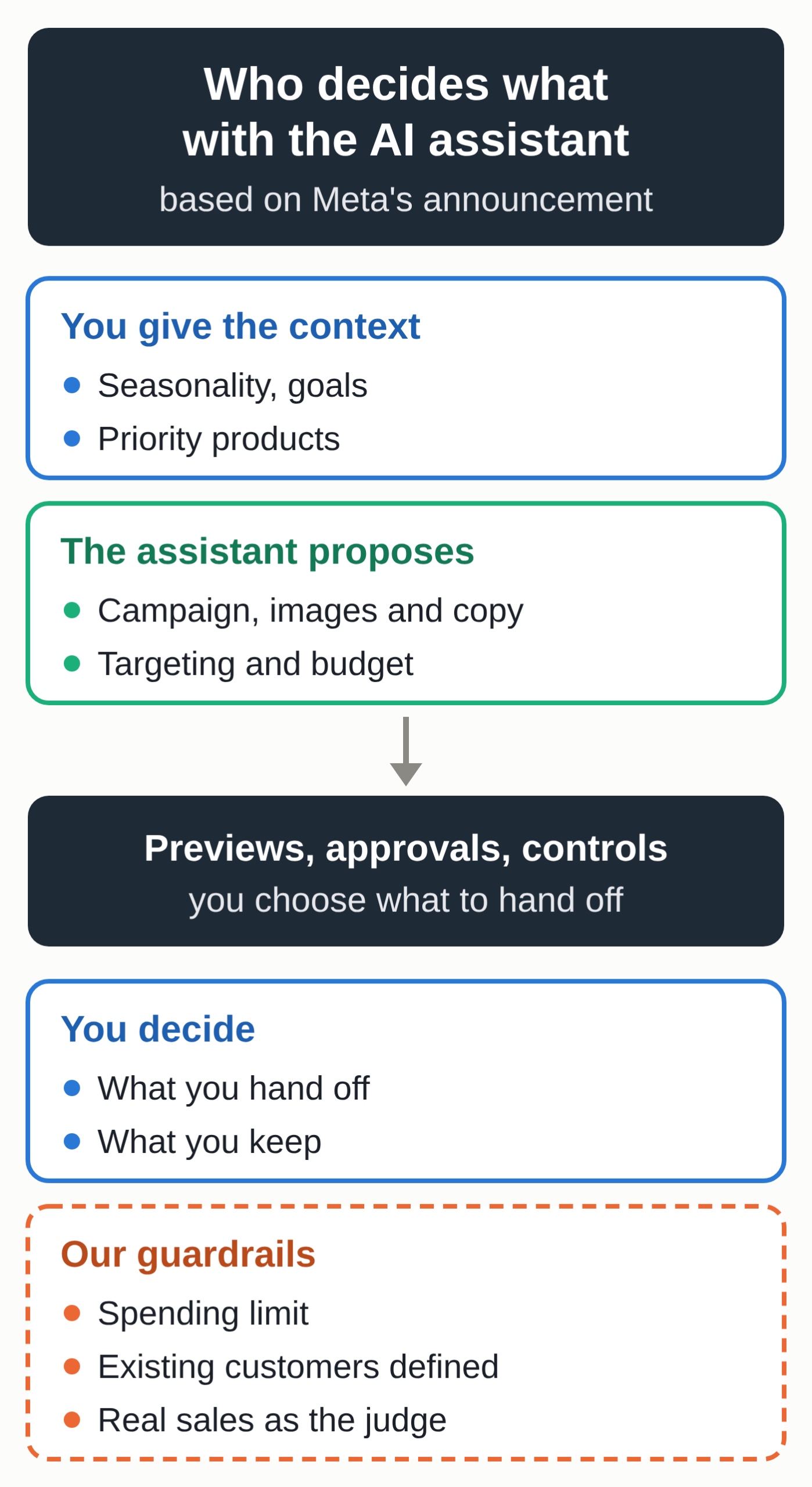
The assistant’s actions raise a different question: who decides on the budget? Meta says previews, approvals and controls will let you decide what to hand off and what to keep. In our view, a small business should let the assistant make suggestions and approve every budget change itself: November is when a misunderstood setting costs the most. The same caution applies to any AI agent you let act on your accounts.
Video generated from static images matters most to stores that only have product photos. According to Meta, people spend more than 60% of their time on Facebook and Instagram watching video. Turning catalog product images into video, on the other hand, is still in beta for eligible advertisers.
Customer Lifecycle Strategy is built for acquisition campaigns, where part of the budget can end up reaching people who have already bought from you. On April 2, 2026, Jon Loomer, a U.S. consultant, described the feature based on screenshots: the text Meta displayed warned that the “Acquire new customers” option could increase your cost per result. He also noted that the exclusion only works if you have defined your existing customers as an audience segment in your advertising settings.
Before Black Friday: seven things to set up now
- Open the assistant in Ads Manager and give it your context: your peak season, your priority products, your goal for the season. The memory feature launched on October 6 should let it recall this later.
- Cap spending on your fourth-quarter campaigns with Meta’s campaign spending limit. Once the assistant’s actions reach your account, check that limit after every change: in its announcement of April 22, 2026, Meta said the assistant can already update spend limits.
- Before you turn on the acquisition option, define your existing customers in your audience segments, using your pixel or your customer list. A customer list contains personal data: make sure your privacy policy covers this use.
- Test video generated from your static images on a campaign that is already running, side by side with your current creative, well before Black Friday week.
- Add a second admin to your business portfolio. An advertiser on Reddit says their Facebook profile, the only admin on their ad account, was disabled, and the account keeps charging the company card with no way to pause the campaigns. Our advice: two trusted people with full control, each with two-factor authentication turned on.
- Judge your campaigns on actual sales, at the register or in your online store: Ads Manager numbers are not enough. Metricool found that average spend per Meta campaign rose 47% in a year, while returns on sales campaigns fell.
- Don’t bet everything on one channel. In Metricool’s sample, a click on TikTok cost less than half as much as a click on Meta. Small businesses can also advertise elsewhere, for example with ads in ChatGPT or Reddit Ads, and organic marketing keeps working after the budget runs out. Also check how much of your budget runs on Threads, which Meta adds to your campaigns automatically (see our guide to Threads for businesses). On the Google side, also check Google Ads automated promotions, on by default since October 12, 2026.
What to watch through the end of the year
First on the list: the assistant’s actions reaching accounts in Europe. Meta says “soon,” with no date and no countries. You should also watch for scheduled tasks and alerts, which are in testing too, especially the reminders to review your budgets.
AI audience discovery is due in Detailed Targeting by the end of the year. Meta pitches it as a tool for brand advertisers and agencies: they will be able to describe their ideal customer in plain language, and Ads Manager will suggest audiences they can keep or drop.
Meta is also testing direct checkout with Shopify in Meta Business Agent on Messenger, so customers can pay without leaving the conversation. Tests in Meta AI, with Adyen, PayPal, Shopify and Stripe, are planned for this fall.
Large advertisers and agencies can now upload creative, preview ads and track performance from third-party AI tools through the Meta ads MCP server. According to Meta, every action stays gated behind advertiser-set permissions and explicit approval before anything goes live.
The limits of these announcements
The October 6 announcement names no countries, and Meta gives no account-by-account timeline: a feature announced as available may not show up in your account right away, and features in testing may not be offered to you before Black Friday.
The 5% gain in conversions is measured by Meta, on its own advertisers, and the announcement gives no method. Metricool’s figures cover 44,355 advertisers worldwide: sales campaigns for the average U.S. brand, for example, returned 2.42 times their cost, compared with a study average of 4.57. They show a broad trend that you should check against your own sales.
The more the assistant does on its own, the more your starting settings matter. A poorly defined customer segment or a campaign with no spending cap produces the same mistakes as before, only faster.
If rising Meta ad costs make you want to rely less on advertising, our organic marketing services help you build an audience on social media without paying for every view.