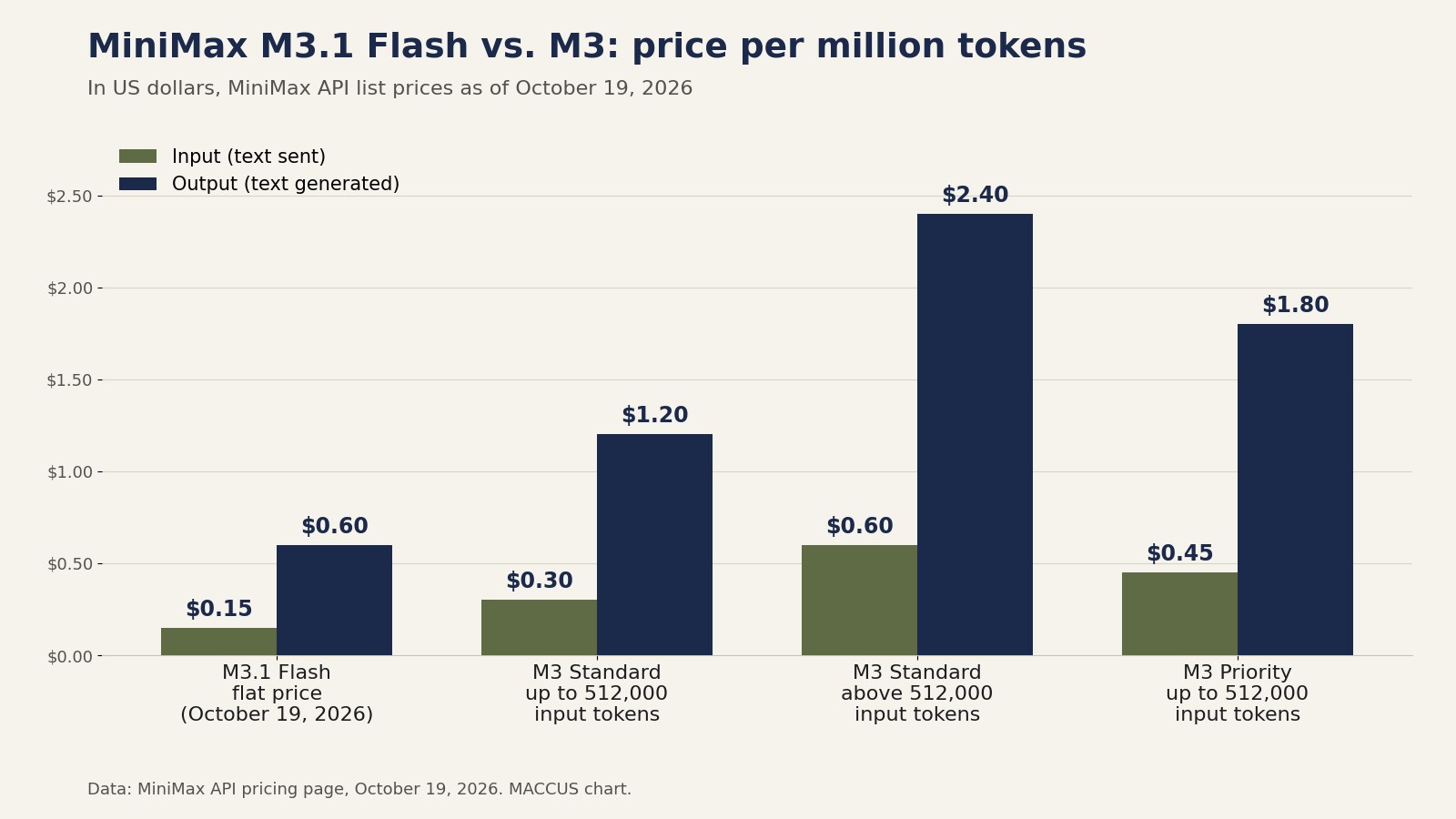

On October 19, 2026, Chinese AI company MiniMax launched MiniMax M3.1 Flash, a language model built for AI agents, coding and computer use. It lists at $0.15 per million tokens sent and $0.60 per million tokens generated. That is half the base price of MiniMax M3, the company’s previous language model, which remains available.
M3.1 Flash is available now through the MiniMax API, the company’s M Plan subscription and MiniMax Code, its coding app. The model weights, which would let anyone run it on their own servers, “will be released later,” MiniMax says, without giving a date. The company also confirmed that Space Bunny, an anonymous model that by MiniMax’s count “processed more than 200 trillion tokens,” was an early version of M3.1 Flash.
The launch comes two days after fellow Chinese lab DeepSeek updated its fast model, V4.1-Flash-1017, and rolled out web search APIs priced at $0.75 per 1,000 calls on October 17. MiniMax’s launch post compares the two models.
The published prices
MiniMax charges one flat rate regardless of request length: $0.15 per million input tokens, $0.60 per million output tokens and $0.015 per million tokens read from the cache (text already sent, which the API keeps in memory). By its pricing page’s estimate, a million tokens is about 750,000 English words.
MiniMax M3 costs $0.30 for input and $1.20 for output as long as the input stays at or under 512,000 tokens, then $0.60 and $2.40 above that. Cache reads cost $0.06, four times the M3.1 Flash rate. A Priority tier, which moves requests to the front of the queue for faster responses, costs 1.5 times the standard rate; the pricing page offers it for M3 only.
The launch post adds another figure: “For agentic tasks, the model’s overall usage cost is 70% lower than its predecessor.” MiniMax does not name that predecessor or show the math. The 70% figure covers the total cost of a task, which also depends on how many tokens the model uses. The public price list shows a 50% per-token cut from M3’s base rate.
A million tokens of context and adjustable reasoning
M3.1 Flash takes up to 1 million tokens in a single request, the same as M3, according to MiniMax’s documentation. It accepts text, images and video as input.
The model reasons before it answers, and that step cannot be turned off. A parameter called “effort” sets how deeply it thinks, on five levels from low to max. By default, the API uses max, the setting that generates the most output tokens, which are the costlier kind. To cut response time and token use, the documentation recommends lowering the effort level.
The API accepts two request formats: Anthropic’s, which MiniMax recommends, and OpenAI’s. On speed, MiniMax says output in everyday use can exceed 200 tokens per second, with a median consistently above 170 tokens per second. The company credits “more aggressive sparsity” in the model. The post also claims online inference is “nearly three times faster,” without saying compared with what.
The scores MiniMax published
The text of the post cites five results. A table published as an image in the same post lists fifteen and puts M3.1 Flash up against six models: DeepSeek V4.1-Flash-1017 and V4.1-Flash, Kimi-K3, GLM-5.3, GPT-5.6 Sol and Anthropic’s Opus 5.
M3.1 Flash has the top score on three rows. It leads on Automation-Bench (62.2), a business-workflow benchmark published by Zapier, and on LOCA-Bench 256K (60.3), which tests agents on very long contexts. On BankerToolBench, it ties Opus 5 at 76.2.
On the other four tests cited in the text, a rival scores higher in that same table:
| Test | M3.1 Flash score | Top score in the table |
|---|---|---|
| DeepSWE v1.1 (software development) | 73.7 | 77.0 (DeepSeek V4.1-Flash-1017) |
| OSWorld 2.0 (computer use) | 61.7 | 70.6 (Opus 5) |
| Agents’ Last Exam (professional tasks) | 29.6 | 32.2 (Opus 5) |
| CyberGym (vulnerability discovery) | 82.2 | 84.5 (GLM-5.3) |
The post ranks M3.1 Flash first among Chinese models on OSWorld and Agents’ Last Exam. MiniMax also says the model can run business workflows end to end across several SaaS tools, in sales, marketing, operations, customer service, finance and HR.
The table’s footnotes describe conditions set by MiniMax: most tests run through coding agents such as Claude Code or Codex, with context windows chosen by the company. On BankerToolBench, another MiniMax model, M2.7, graded the answers. The Agents’ Last Exam score comes from the test’s official leaderboard, at max effort according to a chart in the post.
Another chart plots scores against cost. On Automation-Bench, M3.1 Flash reaches 62.8% at max effort (the table listed 62.2) for an average of under 5 cents per task, compared with nearly $1 for Opus 5.5, Opus 5’s successor, at the same setting. A note under the chart says DeepSeek V4.1-Flash-1017 is priced at its peak-hour rate, $0.30 input and $1.20 output. At off-peak hours, DeepSeek’s price list puts it at $0.15 and $0.60, the same as M3.1 Flash.
Space Bunny, tested under a fake name
MiniMax says Space Bunny processed its 200 trillion tokens “while operating anonymously,” without saying where. According to Startup Fortune, a free model called Space Bunny Alpha appeared on September 23, 2026, on OpenRouter, a platform that offers many models through a single API. It was listed under the provider tag “Stealth,” with a 1-million-token context window, and the listing expired on October 5. By then, MiniMax was developers’ consensus pick, the site reports.
In the meantime, on September 27, MiniMax gave MiniMax Code users a preview, M3.1-Flash-Preview, according to IT Home.
Undated promises and outside measurements
The documentation calls M3.1 Flash “an ultra-efficient open-weight model for everyday work,” but the post says the weights “will be released later,” with no date or license. As of October 19, nobody can download the model or host it themselves. A Pro model, described as the one that “pushes the boundaries of intelligence,” will also “arrive later.”
Benchmarking firm Artificial Analysis posted its page on the model on October 19. M3.1 Flash scores 42 on its Intelligence Index, against a median of 13 for comparable models. Running the index’s tests, it generated 180 million tokens versus a median of 99 million, which Artificial Analysis calls “very verbose.” The site lists it as a proprietary model for now.
What it means
MiniMax now sells an agent and coding model at $0.15 input and $0.60 output per million tokens, with the same rate all the way up to a million tokens per request. That is not the lowest price on the market. DeepSeek charges the same for V4.1-Flash-1017 during off-peak hours. According to Anthropic’s pricing page, Claude Haiku 5.5 costs $0.10 input and $0.50 output as long as the prompt stays at or under 100,000 tokens, then $0.50 and $2.50 above that.
Against Haiku, M3.1 Flash comes out cheaper per token only on long requests, above 100,000 input tokens: large codebases, documents hundreds of pages long, agent sessions that pile up context. Because the API accepts Anthropic’s request format, a tool written for the Claude API can call this model by changing the base URL, the key and the model name. That makes switching providers easier.
October has already brought several open or low-cost models. On October 15, Meta released the weights of Muse Spark Open, and NVIDIA put two models from its Nemotron 3.5 family up for download on Hugging Face. At MiniMax, “open-weight” is still a promise.
The per-token price is only part of the bill. The model reasons on every request, at the highest level by default, and Artificial Analysis measured token output well above the median. The post’s cost comparisons rest on MiniMax’s own choices, including the peak-hour rate it used for DeepSeek. The company has not published the breakdown behind its 70% savings figure either.
Three things will show how the launch holds up: the release of the weights and their license, more independent evaluations (especially on coding and cybersecurity), and the date and price of the Pro model.
Sources
- MiniMax M3.1 Flash: Redefining Agent Performance and Cost, MiniMax, October 19, 2026
- Pricing Overview, MiniMax API documentation, accessed October 19, 2026
- Model Invocation, MiniMax API documentation, accessed October 19, 2026
- MiniMax-M3.1-Flash Intelligence, Performance & Price Analysis, Artificial Analysis, accessed October 19, 2026
- Models & Pricing, DeepSeek API documentation, accessed October 19, 2026
- Pricing, Anthropic Claude documentation, accessed October 19, 2026
- MiniMax quietly launches M3.1-Flash after weeks as a mystery Space Bunny model, Startup Fortune, October 19, 2026
- MiniMax 最新文本模型 M3.1-Flash-Preview 上线 MiniMax Code 平台,额度重置卡同步发出, IT Home, September 27, 2026
Header image: MACCUS chart, data from the MiniMax API pricing page (October 19, 2026)